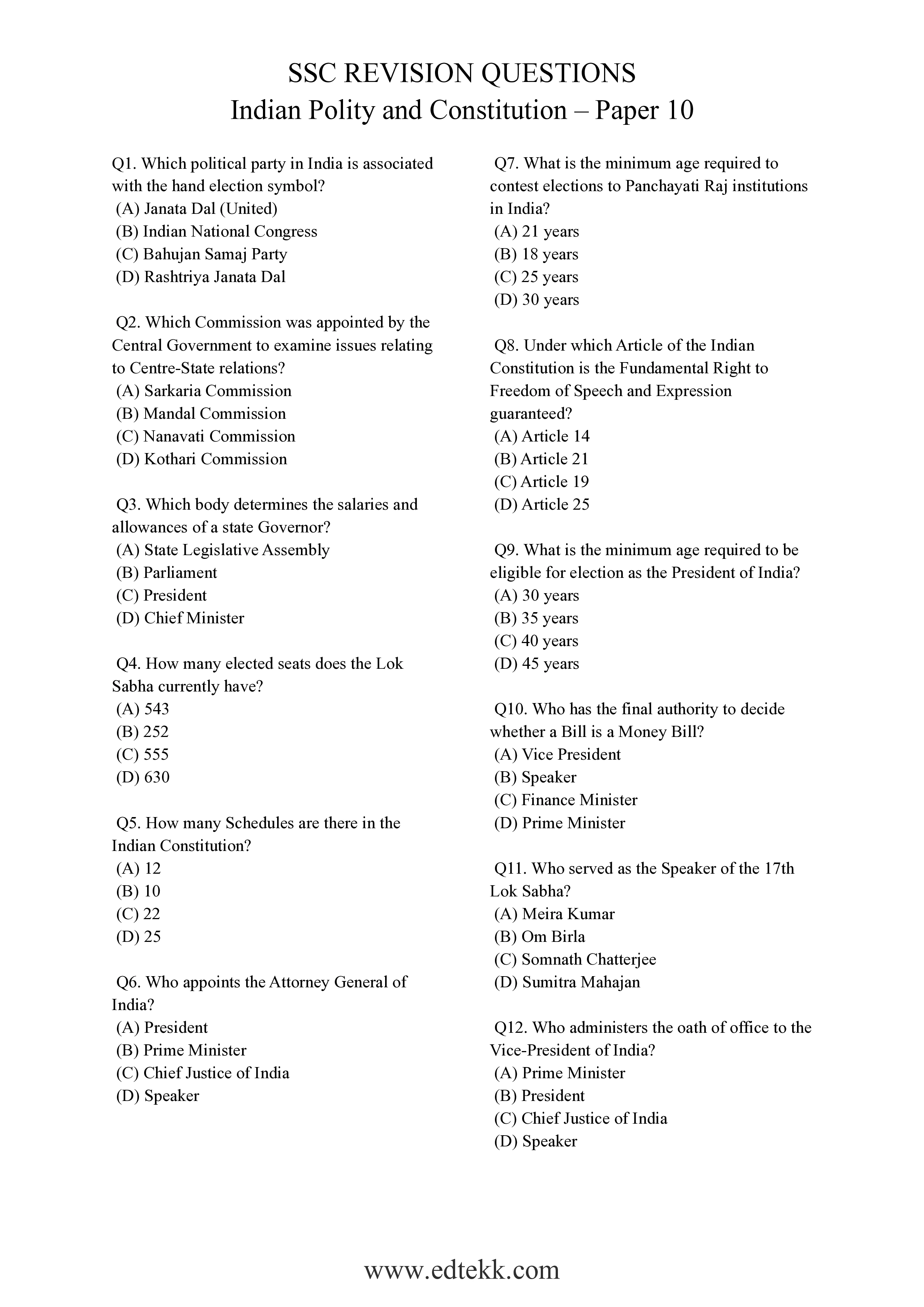
Complete another round of Indian Polity and Constitution revision with SSC Revision Questions Paper 10. This practice set covers important polity and constitutional concepts through objective MCQs, supported by answers and explanations. It helps candidates consolidate their subject knowledge, practise exam-oriented questions and prepare for SSC CGL, CHSL, CPO, MTS, GD and Selection Post examinations.
Test Details
Topic: Indian Polity and Constitution
Total Questions: 20
Question Format: MCQs – Single Correct Answer
Suitable for: SSC CGL, CHSL, CPO, MTS, GD, Selection Post
Download All Papers in This Series (PDF)
Questions and Answers
Q1. Which political party in India is associated with the hand election symbol?
(A) Janata Dal (United)
(B) Indian National Congress
(C) Bahujan Samaj Party
(D) Rashtriya Janata Dal
Explanation: The hand symbol is the reserved election symbol of the Indian National Congress (INC). It is one of the most recognisable political symbols in India and has been associated with the party for several decades.
Q2. Which Commission was appointed by the Central Government to examine issues relating to Centre-State relations?
(A) Sarkaria Commission
(B) Mandal Commission
(C) Nanavati Commission
(D) Kothari Commission
Explanation: The Sarkaria Commission was appointed by the Central Government in 1983 to examine Centre-State relations and recommend improvements. It was chaired by Justice R.S. Sarkaria. Its recommendations covered legislative, administrative and financial relations between the Union and the States, emphasising cooperative federalism.
Q3. Which body determines the salaries and allowances of a state Governor?
(A) State Legislative Assembly
(B) Parliament
(C) President
(D) Chief Minister
Explanation: Parliament determines the Governor’s salaries, allowances and privileges by law. These financial entitlements are governed at the Union level, while the expenses relating to the Governor’s emoluments and allowances are charged on the Consolidated Fund of the State. Article 158(3) protects these entitlements against diminution during the Governor’s term.
Q4. How many elected seats does the Lok Sabha currently have?
(A) 543
(B) 252
(C) 555
(D) 630
Explanation: The Lok Sabha currently has 543 elected seats representing territorial constituencies across India’s states and Union Territories. Members are directly elected by eligible voters through general elections. This figure represents the sanctioned elected strength of the House, not the constitutional maximum of 550 members. Actual membership may temporarily be lower because of vacancies.
Q5. How many Schedules are there in the Indian Constitution?
(A) 12
(B) 10
(C) 22
(D) 25
Explanation: The Indian Constitution originally contained eight Schedules. Following subsequent constitutional amendments, their number increased to 12. The Schedules deal with various subjects, including the allocation of Rajya Sabha seats, administration of tribal areas, official languages, anti-defection provisions and distribution of legislative powers.
Q6. Who appoints the Attorney General of India?
(A) President
(B) Prime Minister
(C) Chief Justice of India
(D) Speaker
Explanation: Under Article 76, the President appoints the Attorney General of India, who must be qualified for appointment as a Supreme Court judge. The Attorney General is the highest law officer of the Union Government and advises the Government of India on legal matters.
Q7. What is the minimum age required to contest elections to Panchayati Raj institutions in India?
(A) 21 years
(B) 18 years
(C) 25 years
(D) 30 years
Explanation: Under Article 243F of the Constitution, a person cannot be disqualified from Panchayat membership on the ground of being under 25 if they have attained 21 years of age. Other eligibility and disqualification conditions under applicable law also apply.
Q8. Under which Article of the Indian Constitution is the Fundamental Right to Freedom of Speech and Expression guaranteed?
(A) Article 14
(B) Article 21
(C) Article 19
(D) Article 25
Explanation: Article 19(1)(a) guarantees freedom of speech and expression to Indian citizens. It includes the freedom to express opinions through speech, writing, publication and other means. However, this right is subject to reasonable restrictions under Article 19(2) on specified grounds, including public order, security of the State, defamation and incitement to an offence.
Q9. What is the minimum age required to be eligible for election as the President of India?
(A) 30 years
(B) 35 years
(C) 40 years
(D) 45 years
Explanation: A person must be at least 35 years old to be eligible for election as President of India under Article 58(1) of the Constitution. The candidate must also be an Indian citizen, be qualified for election as a member of the Lok Sabha and fulfil the other constitutional requirements for presidential eligibility.
Q10. Who has the final authority to decide whether a Bill is a Money Bill?
(A) Vice President
(B) Speaker
(C) Finance Minister
(D) Prime Minister
Explanation: The Speaker of the Lok Sabha has the final authority to decide whether a bill is a Money Bill under Article 110(3) of the Constitution. The Speaker’s decision is constitutionally treated as final, and the Speaker’s certificate is required when a Money Bill is transmitted to the Rajya Sabha.
Q11. Who served as the Speaker of the 17th Lok Sabha?
(A) Meira Kumar
(B) Om Birla
(C) Somnath Chatterjee
(D) Sumitra Mahajan
Explanation: Om Birla was the Speaker of the 17th Lok Sabha. He was elected on 19 June 2019 and served until the conclusion of the 17th Lok Sabha in 2024. He was subsequently re-elected as Speaker of the 18th Lok Sabha in June 2024.
Q12. Who administers the oath of office to the Vice-President of India?
(A) Prime Minister
(B) President
(C) Chief Justice of India
(D) Speaker
Explanation: Under Article 69, the Vice President takes the oath or affirmation before the President of India or a person appointed by the President for that purpose. The oath requires the Vice President to bear true faith and allegiance to the Constitution and faithfully discharge the duties of office. The Vice President also serves as the ex officio Chairman of the Rajya Sabha.
Q13. Which body determines the emoluments and allowances of a state Governor?
(A) President
(B) Prime Minister
(C) Parliament
(D) Finance Minister
Explanation: Parliament determines the Governor’s emoluments, allowances and privileges by law. Under Article 158(3), these cannot be diminished during the Governor’s term of office. The expenses relating to the Governor’s emoluments and allowances are charged on the Consolidated Fund of the State.
Q14. Which Article of the Indian Constitution provides for the appointment of the Governor?
(A) Article 153
(B) Article 155
(C) Article 360
(D) Article 356
Explanation: Article 155 of the Indian Constitution deals with the appointment of the Governor. It provides that the Governor of a state shall be appointed by the President by warrant under the President’s hand and seal.
Q15. What is the normal term of office of elected representatives of a Gram Panchayat?
(A) 3 years
(B) 5 years
(C) 2 years
(D) 4 years
Explanation: The normal term of an elected Gram Panchayat is five years from the date appointed for its first meeting, as provided under Article 243E of the Constitution. Elections must generally be completed before the expiry of this term. If a Panchayat is dissolved prematurely, elections must ordinarily be held within six months, subject to the constitutional exception.
Q16. Who is the ex officio Chairman of the Rajya Sabha?
(A) President
(B) Prime Minister
(C) Vice President
(D) Speaker of Lok Sabha
Explanation: Under Article 64 of the Constitution, the Vice-President of India is the ex-officio Chairman of the Rajya Sabha. The Vice-President presides over its proceedings and maintains order but is not a member of the Rajya Sabha. The Chairman ordinarily does not vote, except when exercising a casting vote in the event of a tie.
Q17. Which Part of the Indian Constitution deals with the Directive Principles of State Policy?
(A) Part III
(B) Part V
(C) Part IV
(D) Part VI
Explanation: Part IV (Articles 36–51) of the Indian Constitution deals with the Directive Principles of State Policy. These principles guide the State in promoting social and economic justice and public welfare. Although they are not directly enforceable by courts, Article 37 declares them fundamental to the governance of the country.
Q18. Which Part of the Indian Constitution deals with Fundamental Rights?
(A) Part II
(B) Part V
(C) Part III
(D) Part IV
Explanation: Part III (Articles 12–35) of the Indian Constitution deals with Fundamental Rights. These include the Right to Equality, Right to Freedom, Right against Exploitation, Right to Freedom of Religion, Cultural and Educational Rights, and Right to Constitutional Remedies. These rights are enforceable through courts.
Q19. Which Article of the Indian Constitution prescribes the procedure for the impeachment of the President?
(A) Article 80
(B) Article 76
(C) Article 61
(D) Article 72
Explanation: Article 61 of the Indian Constitution prescribes the procedure for the impeachment of the President on the ground of violation of the Constitution. Either House of Parliament may initiate the process by giving at least 14 days’ notice, signed by one-fourth of its total membership. The other House investigates the charge, and both Houses must pass it by a two-thirds majority of their total membership.
Q20. How are seats reserved for Scheduled Castes and Scheduled Tribes in Panchayati Raj institutions determined?
(A) 0.33
(B) 0.15
(C) 0.25
(D) Proportional to population
Explanation: Article 243D of the Constitution provides for reservation of seats for Scheduled Castes and Scheduled Tribes in Panchayati Raj institutions in proportion, as nearly as practicable, to their population in the Panchayat area. This reservation promotes representation of these communities in rural local governance.
Question Paper Images