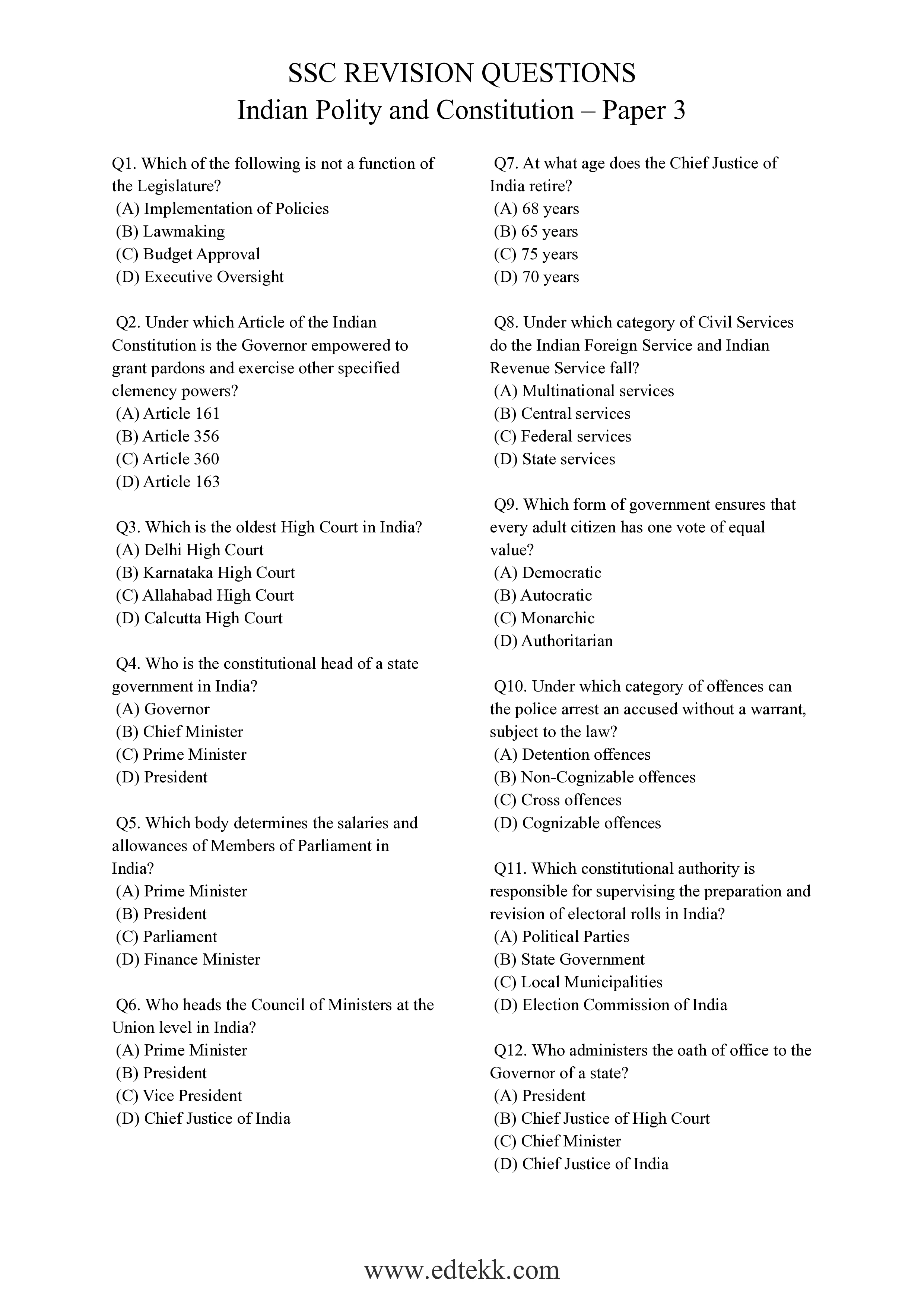
Strengthen your preparation for SSC examinations through Indian Polity and Constitution Revision Questions Paper 3. The question set provides objective practice on important polity and constitutional topics, supported by answers and explanations. It helps candidates assess their knowledge, improve accuracy and revise key concepts for SSC CGL, CHSL, CPO, MTS, GD and Selection Post exams.
Test Details
Topic: Indian Polity and Constitution
Total Questions: 20
Question Format: MCQs – Single Correct Answer
Suitable for: SSC CGL, CHSL, CPO, MTS, GD, Selection Post
Download All Papers in This Series (PDF)
Questions and Answers
Q1. Which of the following is not a function of the Legislature?
(A) Implementation of Policies
(B) Lawmaking
(C) Budget Approval
(D) Executive Oversight
Explanation: Implementation of government policies is primarily an executive function rather than a legislative function. The legislature is responsible for making laws, approving budgets and exercising oversight over the executive. The executive implements government policies, administers public programmes and ensures the enforcement of laws.
Q2. Under which Article of the Indian Constitution is the Governor empowered to grant pardons and exercise other specified clemency powers?
(A) Article 161
(B) Article 356
(C) Article 360
(D) Article 163
Explanation: Article 161 empowers the Governor to grant pardons, reprieves, respites and remissions of punishment, and to suspend, remit or commute sentences for offences within the State’s executive power. This authority is subject to constitutional limitations and differs from the President’s clemency powers under Article 72.
Q3. Which is the oldest High Court in India?
(A) Delhi High Court
(B) Karnataka High Court
(C) Allahabad High Court
(D) Calcutta High Court
Explanation: The Calcutta High Court is the oldest High Court in India. It was established on 1 July 1862 under the Indian High Courts Act, 1861, and was originally known as the High Court of Judicature at Fort William. The Bombay and Madras High Courts were also established in 1862, but commenced operations later.
Q4. Who is the constitutional head of a state government in India?
(A) Governor
(B) Chief Minister
(C) Prime Minister
(D) President
Explanation: The Governor is the constitutional head of a state under Article 154 of the Indian Constitution. The Chief Minister is the real executive head and leads the elected state government. The Governor generally exercises executive functions on the aid and advice of the Council of Ministers headed by the Chief Minister, except in constitutionally recognised discretionary matters.
Q5. Which body determines the salaries and allowances of Members of Parliament in India?
(A) Prime Minister
(B) President
(C) Parliament
(D) Finance Minister
Explanation: Parliament determines the salaries and allowances of its members through legislation under Article 106 of the Constitution. These payments are regulated by the Salary, Allowances and Pension of Members of Parliament Act, 1954, and subsequent amendments. Neither the Prime Minister nor the President independently determines MPs’ remuneration.
Q6. Who heads the Council of Ministers at the Union level in India?
(A) Prime Minister
(B) President
(C) Vice President
(D) Chief Justice of India
Explanation: The Prime Minister is the head of the Council of Ministers at the Union level. The Prime Minister leads the government, coordinates the functioning of various ministries and advises the President on ministerial appointments. Under Article 75(3) of the Constitution, the Council of Ministers is collectively responsible to the Lok Sabha.
Q7. At what age does the Chief Justice of India retire?
(A) 68 years
(B) 65 years
(C) 75 years
(D) 70 years
Explanation: The Chief Justice of India retires at the age of 65 years, the same retirement age applicable to all other Supreme Court judges. This is prescribed under Article 124(2) of the Indian Constitution. In contrast, High Court judges retire at 62 years under Article 217(1).
Q8. Under which category of Civil Services do the Indian Foreign Service and Indian Revenue Service fall?
(A) Multinational services
(B) Central services
(C) Federal services
(D) State services
Explanation: The Indian Foreign Service (IFS) and Indian Revenue Service (IRS) are Central Civil Services functioning under the Union Government. They are distinct from the All India Services, which include the IAS, IPS and Indian Forest Service. Recruitment to these services is primarily conducted through the UPSC Civil Services Examination.
Q9. Which form of government ensures that every adult citizen has one vote of equal value?
(A) Democratic
(B) Autocratic
(C) Monarchic
(D) Authoritarian
Explanation: Democracy is based on political equality and universal adult franchise. Every eligible adult citizen has an equal right to vote, and each vote carries equal value, irrespective of religion, caste, gender, economic status or social background. This principle ensures equal political participation in the democratic process.
Q10. Under which category of offences can the police arrest an accused without a warrant, subject to the law?
(A) Detention offences
(B) Non-Cognizable offences
(C) Cross offences
(D) Cognizable offences
Explanation: Cognizable offences are those in which the police may register a case and arrest an accused without a warrant, subject to the conditions prescribed by law. In non-cognizable offences, the police generally require a Magistrate’s order to investigate and cannot ordinarily make an arrest without a warrant.
Q11. Which constitutional authority is responsible for supervising the preparation and revision of electoral rolls in India?
(A) Political Parties
(B) State Government
(C) Local Municipalities
(D) Election Commission of India
Explanation: Article 324 vests the Election Commission of India with the superintendence, direction and control of the preparation and revision of electoral rolls and the conduct of elections to Parliament, State Legislatures, and the offices of the President and Vice-President. It is an independent constitutional authority responsible for administering these elections.
Q12. Who administers the oath of office to the Governor of a state?
(A) President
(B) Chief Justice of High Court
(C) Chief Minister
(D) Chief Justice of India
Explanation: The Chief Justice of the concerned High Court administers the oath of office to the Governor under Article 159 of the Constitution. In the Chief Justice’s absence, the senior-most available judge of that High Court administers the oath. The Governor swears to faithfully discharge the duties of the office and preserve, protect and defend the Constitution and the law.
Q13. How many Fundamental Duties are currently enshrined in the Indian Constitution?
(A) 10
(B) 11
(C) 12
(D) 15
Explanation: The Indian Constitution contains 11 Fundamental Duties under Article 51A in Part IVA. Initially, ten duties were introduced through the 42nd Constitutional Amendment Act, 1976. The 86th Constitutional Amendment Act, 2002, added the eleventh duty concerning educational opportunities for children aged six to fourteen years.
Q14. Which Constitutional Amendment Act introduced the anti-defection law in India?
(A) 44th Amendment
(B) 52nd Amendment
(C) 73rd Amendment
(D) 91st Amendment
Explanation: The 52nd Constitutional Amendment Act, 1985, introduced the anti-defection law by adding the Tenth Schedule to the Constitution. It provides for the disqualification of legislators on specified grounds, including voluntarily giving up membership of a political party and voting or abstaining contrary to party directions without the prescribed permission.
Q15. Which Article did Dr. B. R. Ambedkar describe as the ‘heart and soul’ of the Indian Constitution?
(A) Article 21
(B) Article 24
(C) Article 32
(D) Article 256
Explanation: Dr. B. R. Ambedkar described Article 32 as the “heart and soul” of the Indian Constitution. It guarantees the right to approach the Supreme Court for the enforcement of Fundamental Rights. The Supreme Court can issue five constitutional writs: habeas corpus, mandamus, prohibition, certiorari and quo warranto.
Q16. How many Fundamental Duties are currently provided for under the Indian Constitution?
(A) 20
(B) 5
(C) 10
(D) 11
Explanation: The Indian Constitution provides for 11 Fundamental Duties under Article 51A. Initially, ten duties were introduced through the 42nd Constitutional Amendment Act, 1976. The 86th Constitutional Amendment Act, 2002, added the eleventh duty, requiring parents or guardians to provide educational opportunities to children or wards aged 6–14 years.
Q17. Which Constitutional Amendment Act introduced the constitutional framework for the Goods and Services Tax (GST) in India?
(A) 100th Amendment
(B) 122nd Amendment
(C) 101st Amendment
(D) 125th Amendment
Explanation: The 101st Constitutional Amendment Act, 2016, introduced the constitutional framework for the Goods and Services Tax (GST) in India. It enabled the implementation of a unified indirect tax system by subsuming several central and state indirect taxes and introduced provisions for cooperative fiscal federalism, including the GST Council under Article 279A.
Q18. Who formally appoints the Chief Election Commissioner of India?
(A) Prime Minister of India
(B) President of India
(C) Chief Justice of India
(D) Parliament of India
Explanation: The President of India formally appoints the Chief Election Commissioner under Article 324(2). Under the 2023 legislation, the selection committee comprises the Prime Minister, a Union Cabinet Minister nominated by the Prime Minister, and the Leader of Opposition in the Lok Sabha or, where applicable, the leader of the largest opposition party.
Q19. On whose written recommendation can the President of India proclaim a National Emergency?
(A) Prime Minister
(B) Lok Sabha
(C) Union Cabinet
(D) Rajya Sabha
Explanation: Under Article 352(3), the President can proclaim a National Emergency only when the decision of the Union Cabinet has been communicated to the President in writing. The Union Cabinet comprises the Prime Minister and other ministers of Cabinet rank. This requirement, introduced by the 44th Constitutional Amendment, ensures collective Cabinet responsibility rather than reliance solely on the Prime Minister’s advice.
Q20. Who appoints the Advocate General of a state?
(A) Chief Minister
(B) Governor
(C) Prime Minister
(D) President
Explanation: Under Article 165, the Governor appoints the Advocate General for the State, the State Government’s highest law officer. The appointee must be qualified to be appointed a High Court judge. The Advocate General advises the State Government on legal matters and performs other legal duties assigned by the Governor.
Question Paper Images