Test and strengthen your knowledge of Computer and IT with Practice Paper 3 for Police Constable and Police SI examinations. The 20-question practice set focuses on important computer concepts and information technology awareness, providing answers and explanations to help candidates assess their preparation and improve accuracy in competitive examinations.
Test Details
Topic: Computer and IT
Total Questions: 20
Question Format: MCQs – Single Correct Answer
Suitable for: Police Constable, Police SI
Download All Papers in This Series (PDF)
Questions and Answers
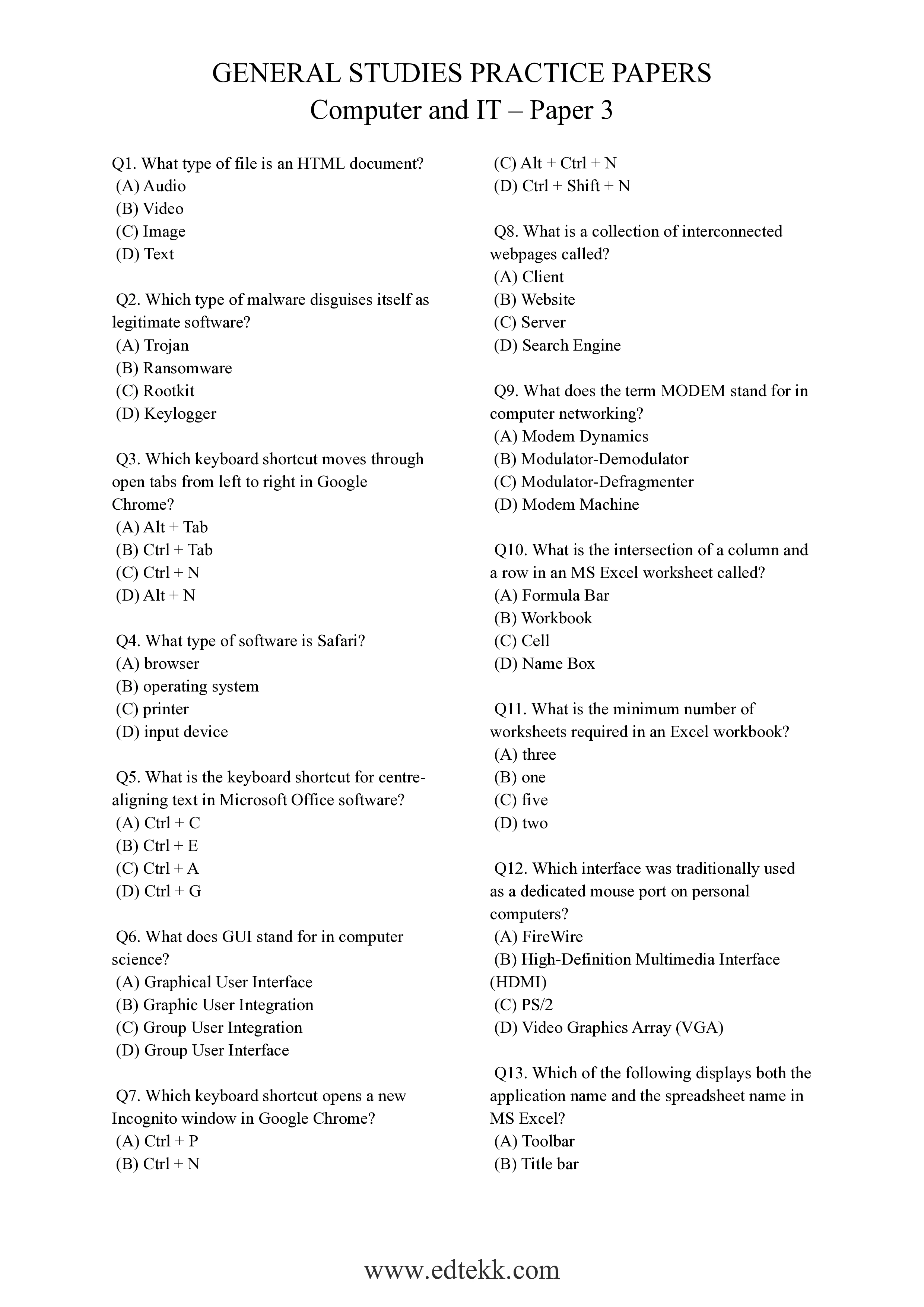
Q1. What type of file is an HTML document?
(A) Audio
(B) Video
(C) Image
(D) Text
Explanation: An HTML file is a text file containing HyperText Markup Language code. It uses tags and attributes to define the structure and content of a webpage. Although an HTML document can reference images, audio and video files, its source code is stored as text.
Q2. Which type of malware disguises itself as legitimate software?
(A) Trojan
(B) Ransomware
(C) Rootkit
(D) Keylogger
Explanation: A Trojan (Trojan horse) is a type of malware disguised as legitimate or useful software to deceive users into installing or executing it. Once activated, it may steal sensitive information, provide unauthorized access, or install additional malware. Unlike viruses and worms, Trojans do not inherently replicate themselves. They commonly spread through deceptive downloads and malicious email attachments.
Q3. Which keyboard shortcut moves through open tabs from left to right in Google Chrome?
(A) Alt + Tab
(B) Ctrl + Tab
(C) Ctrl + N
(D) Alt + N
Explanation: In Google Chrome on Windows and Linux, Ctrl + Tab switches to the next open tab, moving from left to right through the tab sequence. When the final tab is reached, the shortcut cycles back to the first tab. Ctrl + Shift + Tab moves in the opposite direction. These shortcuts improve navigation when multiple browser tabs are open.
Q4. What type of software is Safari?
(A) browser
(B) operating system
(C) printer
(D) input device
Explanation: Safari is a web browser developed by Apple. It is used to access, retrieve and display webpages and other internet content. Safari is available on Apple devices, including iPhones, iPads and Macs. It is browser software, not an operating system, printer or input device.
Q5. What is the keyboard shortcut for centre-aligning text in Microsoft Office software?
(A) Ctrl + C
(B) Ctrl + E
(C) Ctrl + A
(D) Ctrl + G
Explanation: Ctrl + E is the keyboard shortcut for centre alignment in Microsoft Word. It centres the selected paragraph or the paragraph containing the cursor between the left and right margins. Other alignment shortcuts include Ctrl + L for left, Ctrl + R for right and Ctrl + J for justified alignment.
Q6. What does GUI stand for in computer science?
(A) Graphical User Interface
(B) Graphic User Integration
(C) Group User Integration
(D) Group User Interface
Explanation: GUI stands for Graphical User Interface. It enables users to interact with computers through graphical elements such as windows, icons, menus and buttons rather than relying exclusively on text-based commands. GUIs provide a visual and user-friendly means of interacting with computer systems and applications.
Q7. Which keyboard shortcut opens a new Incognito window in Google Chrome?
(A) Ctrl + P
(B) Ctrl + N
(C) Alt + Ctrl + N
(D) Ctrl + Shift + N
Explanation: Google Chrome uses Ctrl + Shift + N on Windows and Linux to open a new Incognito window. Incognito mode does not save browsing history, cookies, or site data after all Incognito windows are closed. However, downloaded files and bookmarks are retained. It does not make users anonymous to websites, internet service providers, or network administrators.
Q8. What is a collection of interconnected webpages called?
(A) Client
(B) Website
(C) Server
(D) Search Engine
Explanation: A website is a collection of related and interconnected web pages hosted on web servers and accessible through the Internet. These pages are generally organised under a common domain name and connected through hyperlinks. They may contain text, images, videos and other multimedia resources.
Q9. What does the term MODEM stand for in computer networking?
(A) Modem Dynamics
(B) Modulator-Demodulator
(C) Modulator-Defragmenter
(D) Modem Machine
Explanation: MODEM stands for Modulator-Demodulator. It converts digital data into signals suitable for transmission over a communication medium and converts received signals back into data. Cable modems enable internet connectivity through cable networks by transmitting and receiving data over the cable infrastructure.
Q10. What is the intersection of a column and a row in an MS Excel worksheet called?
(A) Formula Bar
(B) Workbook
(C) Cell
(D) Name Box
Explanation: A cell is the intersection of a row and a column in an Excel worksheet. Each cell has a unique address, such as A1, B5, or C10, consisting of a column letter and row number.
Q11. What is the minimum number of worksheets required in an Excel workbook?
(A) three
(B) one
(C) five
(D) two
Explanation: An Excel workbook must contain at least one worksheet. A worksheet is an individual spreadsheet containing rows and columns in which data is entered and processed. Users can create additional worksheets within the same workbook whenever required.
Q12. Which interface was traditionally used as a dedicated mouse port on personal computers?
(A) FireWire
(B) High-Definition Multimedia Interface (HDMI)
(C) PS/2
(D) Video Graphics Array (VGA)
Explanation: PS/2 was a traditional interface for connecting keyboards and mice to personal computers. It uses a six-pin mini-DIN connector and was common on desktop computers before USB became widespread. VGA and HDMI are display interfaces, while FireWire was used for high-speed data transfer.
Q13. Which of the following displays both the application name and the spreadsheet name in MS Excel?
(A) Toolbar
(B) Title bar
(C) Task bar
(D) Menu bar
Explanation: The title bar displays the name of the application and the name of the currently open spreadsheet or workbook. In Microsoft Excel, it appears at the top of the application window and helps users identify the active application and file.
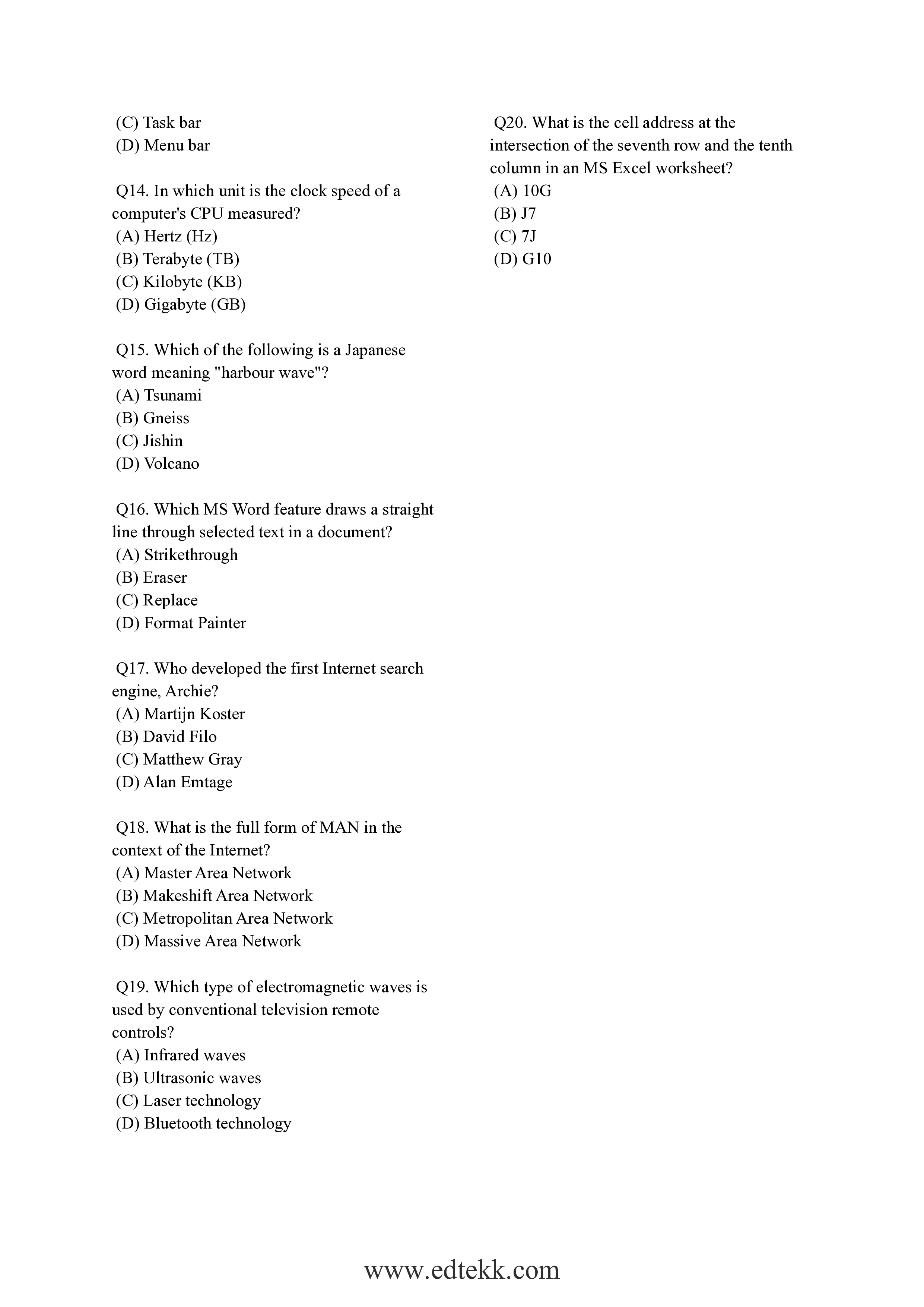
Q14. In which unit is the clock speed of a computer’s CPU measured?
(A) Hertz (Hz)
(B) Terabyte (TB)
(C) Kilobyte (KB)
(D) Gigabyte (GB)
Explanation: CPU clock speed is measured in hertz (Hz), which represents the number of clock cycles per second. Modern processors commonly operate at frequencies measured in gigahertz (GHz). However, clock speed alone does not determine overall performance, which also depends on processor architecture, core count and other factors.
Q15. Which of the following is a Japanese word meaning “harbour wave”?
(A) Tsunami
(B) Gneiss
(C) Jishin
(D) Volcano
Explanation: Tsunami is derived from the Japanese words tsu, meaning harbour, and nami, meaning wave. It refers to a series of large sea waves generally generated by underwater earthquakes, volcanic eruptions or submarine landslides. Tsunamis can travel across entire ocean basins and cause severe destruction in coastal areas.
Q16. Which MS Word feature draws a straight line through selected text in a document?
(A) Strikethrough
(B) Eraser
(C) Replace
(D) Format Painter
Explanation: Strikethrough is a character-formatting feature that draws a horizontal line through selected text. It is commonly used to indicate deleted or superseded content without removing the original words. Eraser, Replace and Format Painter perform different editing or formatting functions.
Q17. Who developed the first Internet search engine, Archie?
(A) Martijn Koster
(B) David Filo
(C) Matthew Gray
(D) Alan Emtage
Explanation: Alan Emtage, a student at McGill University in Canada, developed Archie in 1990. It is widely regarded as the first Internet search engine. Archie indexed file listings available on anonymous FTP servers, enabling users to locate specific files across the Internet.
Q18. What is the full form of MAN in the context of the Internet?
(A) Master Area Network
(B) Makeshift Area Network
(C) Metropolitan Area Network
(D) Massive Area Network
Explanation: MAN stands for Metropolitan Area Network. It connects multiple Local Area Networks (LANs) across a geographical area larger than a LAN but generally smaller than a Wide Area Network (WAN). MANs typically cover cities, large campuses or metropolitan regions.
Q19. Which type of electromagnetic waves is used by conventional television remote controls?
(A) Infrared waves
(B) Ultrasonic waves
(C) Laser technology
(D) Bluetooth technology
Explanation: Most conventional television remote controls operate using infrared (IR) waves. When a button is pressed, the remote transmits coded infrared pulses that are received and interpreted by the television. Some modern remote controls also use Bluetooth or radio-frequency communication.
Q20. What is the cell address at the intersection of the seventh row and the tenth column in an MS Excel worksheet?
(A) 10G
(B) J7
(C) 7J
(D) G10
Explanation: Excel cell references consist of the column letter followed by the row number. The tenth column is J, and the seventh row is 7. Therefore, their intersection is J7.
Question Paper Images