Prepare effectively for Police Constable and Police SI recruitment examinations through this fourth Computer and IT revision paper. It features 20 practice MCQs covering essential computer knowledge and information technology, along with answers and explanations to support focused revision and conceptual clarity.
Test Details
Topic: Computer and IT
Total Questions: 20
Question Format: MCQs – Single Correct Answer
Suitable for: Police Constable, Police SI
Download All Papers in This Series (PDF)
Questions and Answers
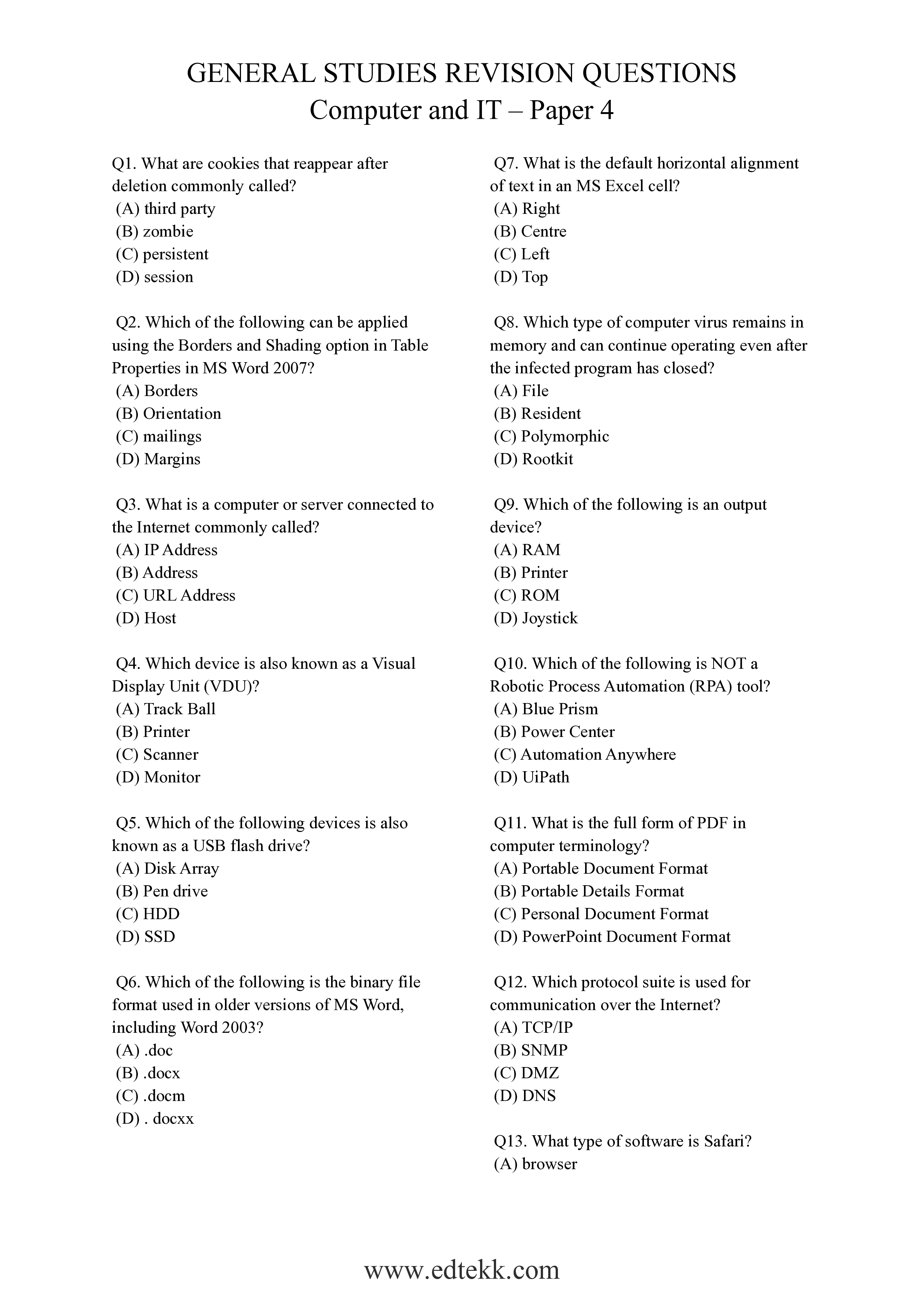
Q1. What are cookies that reappear after deletion commonly called?
(A) third party
(B) zombie
(C) persistent
(D) session
Explanation: Zombie cookies are tracking cookies that can reappear after users delete them. They may be recreated using information stored through alternative browser storage mechanisms or other persistent identifiers. This behaviour can undermine users’ attempts to remove tracking information and protect their privacy. Zombie cookies are also commonly known as evercookies because of their ability to persist or regenerate.
Q2. Which of the following can be applied using the Borders and Shading option in Table Properties in MS Word 2007?
(A) Borders
(B) Orientation
(C) mailings
(D) Margins
Explanation: The Borders and Shading option in Microsoft Word 2007 allows users to apply borders and shading to table cells, rows, columns or entire tables. It controls the appearance of table boundaries and cell backgrounds. Orientation, Mailings and Margins are unrelated to this function.
Q3. What is a computer or server connected to the Internet commonly called?
(A) IP Address
(B) Address
(C) URL Address
(D) Host
Explanation: A host is a computer or other network-connected device that communicates over the Internet. It is identified through an IP address and can access or provide network services. The term host is broader than server because not every Internet-connected host provides services to other devices.
Q4. Which device is also known as a Visual Display Unit (VDU)?
(A) Track Ball
(B) Printer
(C) Scanner
(D) Monitor
Explanation: A monitor is also known as a Visual Display Unit (VDU) because it displays information processed by a computer. It presents text, images, videos and graphical interfaces. A printer produces hard-copy output, a scanner captures input, and a trackball controls the pointer.
Q5. Which of the following devices is also known as a USB flash drive?
(A) Disk Array
(B) Pen drive
(C) HDD
(D) SSD
Explanation: A pen drive, also called a USB flash drive, is a portable storage device that uses flash memory and connects through a USB interface. It is commonly used to store and transfer digital files. Unlike a conventional hard disk drive, it has no moving mechanical parts.
Q6. Which of the following is the binary file format used in older versions of MS Word, including Word 2003?
(A) .doc
(B) .docx
(C) .docm
(D) . docxx
Explanation: The .doc extension represents the older binary Microsoft Word document format, particularly associated with Word 97–2003. Microsoft Word 2007 introduced the Office Open XML-based .docx format as its default document format. The .docm extension is used for macro-enabled Word documents.
Q7. What is the default horizontal alignment of text in an MS Excel cell?
(A) Right
(B) Centre
(C) Left
(D) Top
Explanation: By default, text entered in an Excel cell is left-aligned, whereas numerical values are generally right-aligned. Alignment can be changed using the Alignment options on the Home tab.
Q8. Which type of computer virus remains in memory and can continue operating even after the infected program has closed?
(A) File
(B) Resident
(C) Polymorphic
(D) Rootkit
Explanation: Resident viruses load themselves into a computer’s memory (RAM) and remain active while the system is running. They can infect files or interfere with system operations even after the originally infected program has stopped executing. Removing the infected file alone may not eliminate an active memory-resident virus. Effective removal may require antivirus tools and a clean system restart.
Q9. Which of the following is an output device?
(A) RAM
(B) Printer
(C) ROM
(D) Joystick
Explanation: A printer is an output device that produces a physical representation of computer-generated information on paper. RAM and ROM are memory components, whereas a joystick is an input device commonly used to control movement in games and other applications.
Q10. Which of the following is NOT a Robotic Process Automation (RPA) tool?
(A) Blue Prism
(B) Power Center
(C) Automation Anywhere
(D) UiPath
Explanation: PowerCenter is an enterprise data integration and ETL (Extract, Transform, Load) tool developed by Informatica, rather than a dedicated Robotic Process Automation (RPA) platform. Blue Prism, UiPath and Automation Anywhere are established RPA tools used to automate repetitive, rule-based business processes.
Q11. What is the full form of PDF in computer terminology?
(A) Portable Document Format
(B) Portable Details Format
(C) Personal Document Format
(D) PowerPoint Document Format
Explanation: PDF stands for Portable Document Format. Developed by Adobe, it is a file format designed to present documents consistently across different operating systems, devices and software applications. It preserves document layouts, fonts, images and formatting, making it suitable for sharing, printing and archiving.
Q12. Which protocol suite is used for communication over the Internet?
(A) TCP/IP
(B) SNMP
(C) DMZ
(D) DNS
Explanation: TCP/IP stands for Transmission Control Protocol/Internet Protocol. It is the fundamental suite of communication protocols used by the Internet. IP handles addressing and packet routing between networks, while TCP provides reliable, ordered data transmission between communicating endpoints. Other protocols, including UDP, also operate within the TCP/IP suite.
Q13. What type of software is Safari?
(A) browser
(B) operating system
(C) printer
(D) input device
Explanation: Safari is a web browser developed by Apple. It is used to access, retrieve and display webpages and other internet content. Safari is available on Apple devices, including iPhones, iPads and Macs. It is browser software, not an operating system, printer or input device.
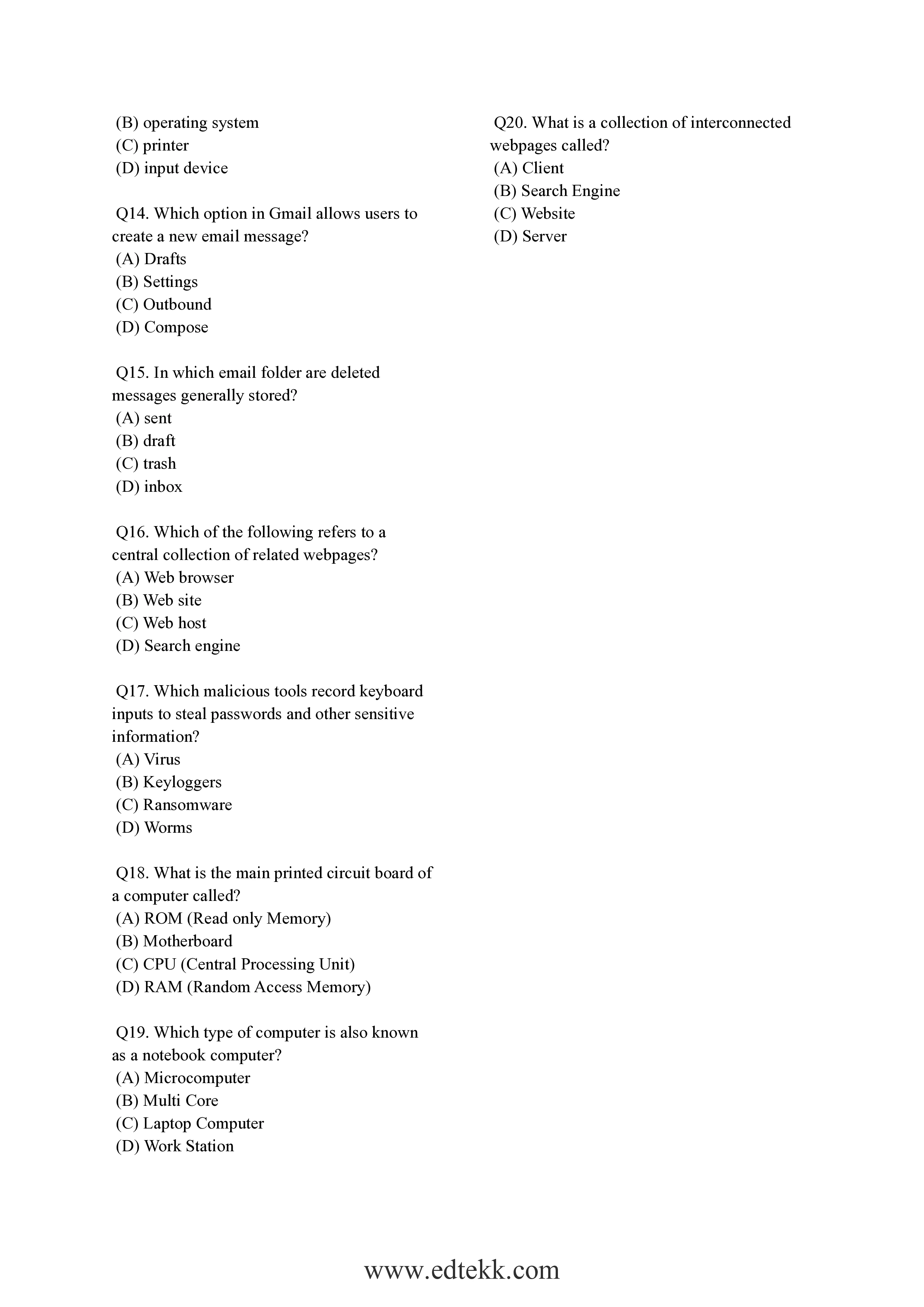
Q14. Which option in Gmail allows users to create a new email message?
(A) Drafts
(B) Settings
(C) Outbound
(D) Compose
Explanation: The Compose option in Gmail allows users to create a new email message. Selecting Compose opens a message window where users can enter the recipient’s email address, subject and message body. Attachments can also be added, and unsent messages are generally saved automatically in Drafts.
Q15. In which email folder are deleted messages generally stored?
(A) sent
(B) draft
(C) trash
(D) inbox
Explanation: Deleted emails are generally moved to the Trash or Bin folder, where they remain temporarily before permanent deletion. Most email services allow users to restore messages from this folder within a specified retention period. The folder name may vary between email applications.
Q16. Which of the following refers to a central collection of related webpages?
(A) Web browser
(B) Web site
(C) Web host
(D) Search engine
Explanation: A website is a collection of related web pages generally organised under a common domain name. These pages are interconnected through hyperlinks and hosted on web servers. Users access websites through web browsers using a domain name or a specific URL.
Q17. Which malicious tools record keyboard inputs to steal passwords and other sensitive information?
(A) Virus
(B) Keyloggers
(C) Ransomware
(D) Worms
Explanation: Keyloggers are software programs or hardware devices that record keystrokes entered through a keyboard. Malicious keyloggers can capture usernames, passwords, financial information, and private communications without the user’s knowledge. Although some keylogging tools have legitimate administrative or diagnostic applications, unauthorized keylogging poses a significant cybersecurity threat by compromising confidential information.
Q18. What is the main printed circuit board of a computer called?
(A) ROM (Read only Memory)
(B) Motherboard
(C) CPU (Central Processing Unit)
(D) RAM (Random Access Memory)
Explanation: The motherboard is the main printed circuit board (PCB) of a computer. It provides physical and electrical connections for essential components, including the CPU, RAM, storage devices and expansion cards, and enables communication among connected components.
Q19. Which type of computer is also known as a notebook computer?
(A) Microcomputer
(B) Multi Core
(C) Laptop Computer
(D) Work Station
Explanation: A notebook computer is another name for a laptop computer. It is a portable microcomputer with integrated components such as a display, keyboard, battery and processor. Its compact design allows users to perform computing tasks in different locations.
Q20. What is a collection of interconnected webpages called?
(A) Client
(B) Search Engine
(C) Website
(D) Server
Explanation: A website is a collection of related and interconnected web pages hosted on web servers and accessible through the Internet. These pages are generally organised under a common domain name and connected through hyperlinks. They may contain text, images, videos and other multimedia resources.
Question Paper Images