Strengthen your General Studies preparation with Computer and IT Practice Paper 6, designed for Police Constable and Police SI aspirants. The set covers 20 objective questions on relevant computer and information technology concepts, with answers and explanations. Use this practice paper to assess subject knowledge and improve examination readiness.
Test Details
Topic: Computer and IT
Total Questions: 20
Question Format: MCQs – Single Correct Answer
Suitable for: Police Constable, Police SI
Download All Papers in This Series (PDF)
Questions and Answers
Q1. Which high-level, interpreted, general-purpose programming language is widely used in software development?
(A) Python
(B) Spider
(C) Penguin
(D) Cookie
Explanation: Python is a high-level, general-purpose programming language commonly executed through an interpreter. It is widely used in web development, artificial intelligence, data science, automation, and software development. Python supports multiple programming paradigms, including object-oriented, procedural, and functional programming. Its readable syntax and extensive libraries make it suitable for beginners and experienced developers.
Q2. What is the full form of MAN in computer networking?
(A) Megabyte Area Network
(B) Margin Area Network
(C) Maximize Area Network
(D) Metropolitan Area Network
Explanation: MAN stands for Metropolitan Area Network. It covers a geographical area larger than that of a Local Area Network (LAN) but generally smaller than that of a Wide Area Network (WAN). A MAN commonly connects multiple LANs across a city or metropolitan region.
Q3. Which CPU unit controls and directs the operations of the processor?
(A) Data Unit
(B) Memory Unit
(C) Arithmetic Logic Unit
(D) Control Unit
Explanation: The Control Unit (CU) directs and coordinates the operations of the CPU. It fetches instructions from memory, decodes them and generates control signals to coordinate the activities of other components, including the ALU, registers and memory. Unlike the ALU, the Control Unit does not directly perform arithmetic or logical calculations.
Q4. Which keyboard shortcut is used to copy selected content in most Windows applications?
(A) Ctrl + X
(B) Ctrl + C
(C) Ctrl + Z
(D) Ctrl + V
Explanation: Ctrl + C is the standard keyboard shortcut for copying selected text, files or other supported content in most Windows applications. Ctrl + X cuts selected content, Ctrl + Z typically undoes the most recent action, and Ctrl + V pastes copied or cut content.
Q5. Which computer device performs a function opposite to that of a keyboard?
(A) Trackball
(B) Printer
(C) Mouse
(D) Joystick
Explanation: A printer is an output device, functionally contrasting with a keyboard, which is an input device. A keyboard sends text and commands to a computer, whereas a printer produces hard-copy output on paper. A mouse, trackball and joystick are also input devices.
Q6. Which number system is used by digital computers to represent and process data?
(A) Hexadecimal
(B) Octal
(C) Ternary
(D) Binary
Explanation: Binary is the number system used internally by digital computers to represent and process information. It uses only two digits, 0 and 1, corresponding to two distinct electronic states. Text, images, instructions and numerical values are represented through combinations of binary digits, each of which is called a bit.
Q7. Which of the following devices is also known as a USB flash drive?
(A) Pen drive
(B) Disk Array
(C) HDD
(D) SSD
Explanation: A pen drive, also called a USB flash drive, is a portable storage device that uses flash memory and connects through a USB interface. It is commonly used to store and transfer digital files. Unlike a conventional hard disk drive, it has no moving mechanical parts.
Q8. Which of the following is NOT a Robotic Process Automation (RPA) tool?
(A) Power Center
(B) Blue Prism
(C) UiPath
(D) Automation Anywhere
Explanation: PowerCenter is an enterprise data integration and ETL (Extract, Transform, Load) tool developed by Informatica, rather than a dedicated Robotic Process Automation (RPA) platform. Blue Prism, UiPath and Automation Anywhere are established RPA tools used to automate repetitive, rule-based business processes.
Q9. AIX is the operating system developed by which company?
(A) Apple
(B) IBM
(C) Microsoft
(D) Unisys
Explanation: AIX (Advanced Interactive eXecutive) is IBM’s proprietary Unix-based operating system. First introduced in 1986, it is primarily associated with IBM’s enterprise computing platforms. AIX is designed for reliability, scalability, security, and performance. It is commonly used in enterprise environments requiring stable operating systems for mission-critical applications and database workloads.
Q10. What is real-time online communication through instant message exchanges called?
(A) BLOG
(B) VLOG
(C) E-MAIL
(D) CHAT
Explanation: Chat refers to online communication in which two or more participants exchange messages interactively, often in real time. Unlike traditional email, which may involve delays between responses, chat typically enables rapid exchanges and may also support voice calls, video calls, and file sharing.
Q11. What is Ubuntu in computer terminology?
(A) Open source Linux operating system
(B) A firewall developed by Microsoft
(C) An ERP system from SAP
(D) Latest financial software package by Infosys
Explanation: Ubuntu is an open-source, Linux-based operating system distribution developed and maintained by Canonical. It is widely used on desktop computers, servers and cloud platforms. Ubuntu is known for its user-friendly interface, regular updates and extensive software support.
Q12. What are the small symbols placed before items in an unordered list in Microsoft Word called?
(A) Tabs
(B) Indentation
(C) Numbering
(D) Bullets
Explanation: Bullets are small symbols, such as dots, squares, dashes or other graphics, placed before items in a list. They are used to organise information when the sequence or numerical order of the items is not important.
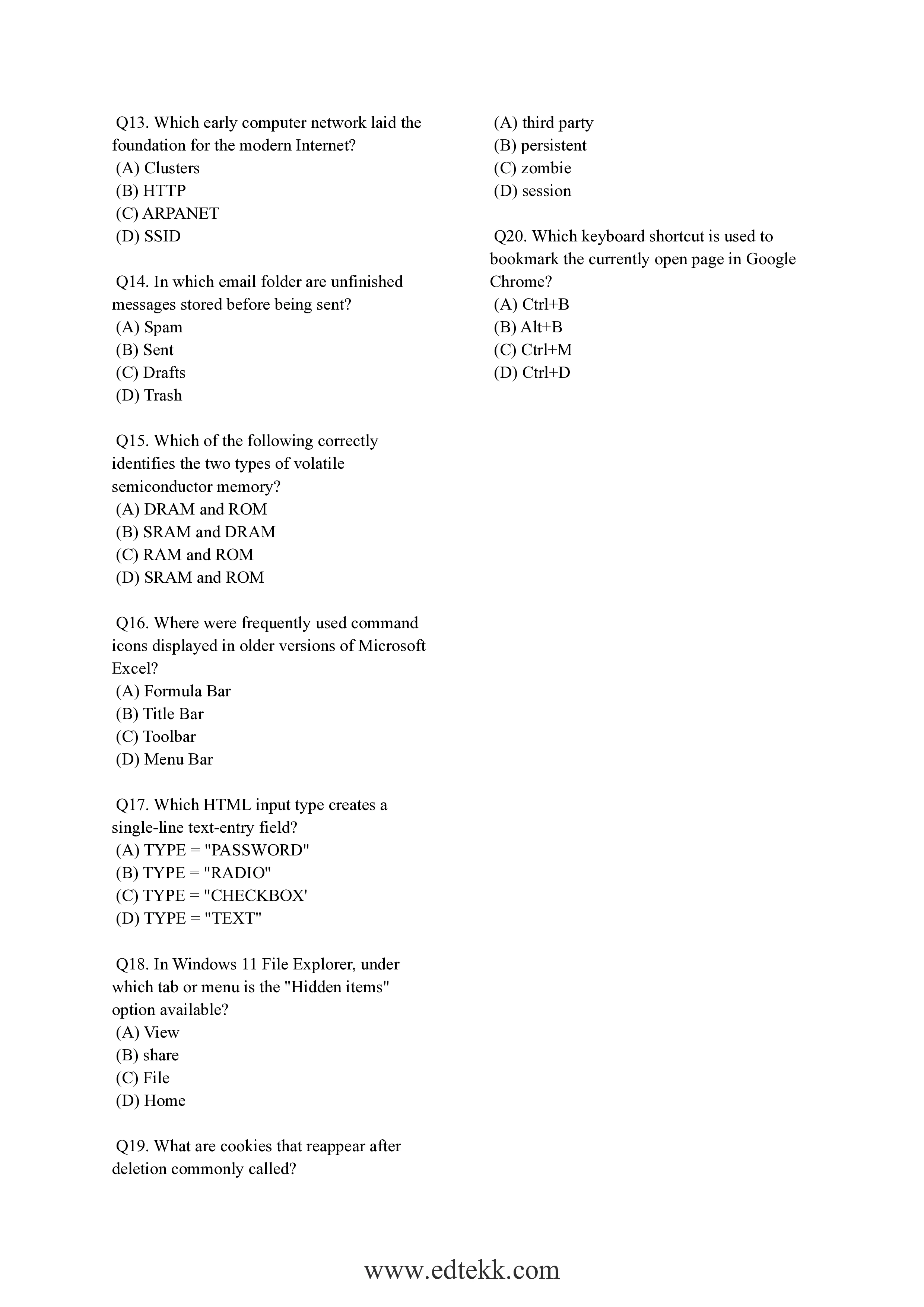
Q13. Which early computer network laid the foundation for the modern Internet?
(A) Clusters
(B) HTTP
(C) ARPANET
(D) SSID
Explanation: ARPANET was an early packet-switching network that laid the foundation for the modern Internet. It facilitated communication between geographically separated computers and contributed to the development of networking technologies and protocols that enabled interconnected computer networks to evolve into the global Internet.
Q14. In which email folder are unfinished messages stored before being sent?
(A) Spam
(B) Sent
(C) Drafts
(D) Trash
Explanation: The Drafts folder stores unfinished email messages that have been saved but not yet sent. Users can reopen, edit, and complete these messages later. The Sent folder stores sent messages, Trash stores deleted messages, and Spam generally contains messages identified as unwanted or suspicious.
Q15. Which of the following correctly identifies the two types of volatile semiconductor memory?
(A) DRAM and ROM
(B) SRAM and DRAM
(C) RAM and ROM
(D) SRAM and ROM
Explanation: Semiconductor memory is classified as volatile or non-volatile according to its ability to retain data without electrical power. SRAM (Static Random Access Memory) and DRAM (Dynamic Random Access Memory) are both volatile memory types because they require power to retain stored information. ROM is an example of non-volatile memory.
Q16. Where were frequently used command icons displayed in older versions of Microsoft Excel?
(A) Formula Bar
(B) Title Bar
(C) Toolbar
(D) Menu Bar
Explanation: In older versions of Excel that used menus and toolbars, frequently used commands were represented by icons on the Toolbar. These provided quick access to operations such as saving, printing, copying, pasting, and formatting.
Q17. Which HTML input type creates a single-line text-entry field?
(A) TYPE = “PASSWORD”
(B) TYPE = “RADIO”
(C) TYPE = “CHECKBOX’
(D) TYPE = “TEXT”
Explanation: The HTML element creates a single-line text field that allows users to enter information. Password fields conceal entered characters, while radio buttons and checkboxes are used to select predefined options.
Q18. In Windows 11 File Explorer, under which tab or menu is the “Hidden items” option available?
(A) View
(B) share
(C) File
(D) Home
Explanation: In Windows 11 File Explorer, the Hidden items option is available under View > Show > Hidden items in supported versions of the interface. Enabling this option displays files and folders marked as hidden. The precise menu layout may vary with Windows 11 updates.
Q19. What are cookies that reappear after deletion commonly called?
(A) third party
(B) persistent
(C) zombie
(D) session
Explanation: Zombie cookies are tracking cookies that can reappear after users delete them. They may be recreated using information stored through alternative browser storage mechanisms or other persistent identifiers. This behaviour can undermine users’ attempts to remove tracking information and protect their privacy. Zombie cookies are also commonly known as evercookies because of their ability to persist or regenerate.
Q20. Which keyboard shortcut is used to bookmark the currently open page in Google Chrome?
(A) Ctrl+B
(B) Alt+B
(C) Ctrl+M
(D) Ctrl+D
Explanation: In Google Chrome on Windows and Linux, Ctrl + D opens the bookmark dialog for the currently displayed webpage. Users can save the page, modify its bookmark name, and choose a folder for storing it. Bookmarks provide convenient access to frequently visited websites. On macOS, the equivalent shortcut is Command + D.
Question Paper Images