Enhance your competitive-exam preparation with Police Recruitment Computer and IT Practice Paper 5. Specially intended for Police Constable and Police SI aspirants, this set provides objective questions on computer and IT fundamentals, complete with correct answers and explanations for better understanding, practice and revision.
Test Details
Topic: Computer and IT
Total Questions: 20
Question Format: MCQs – Single Correct Answer
Suitable for: Police Constable, Police SI
Download All Papers in This Series (PDF)
Questions and Answers
Q1. What is a computer or server connected to the Internet commonly called?
(A) Address
(B) Host
(C) URL Address
(D) IP Address
Explanation: A host is a computer or other network-connected device that communicates over the Internet. It is identified through an IP address and can access or provide network services. The term host is broader than server because not every Internet-connected host provides services to other devices.
Q2. Who developed the Linux kernel while studying at a university in Finland?
(A) Barbara Liskov
(B) Linus Torvalds
(C) Leonard M. Adleman
(D) Leslie Lamport
Explanation: Linus Torvalds began developing the Linux kernel in 1991 while studying at the University of Helsinki in Finland. He initially created it as a personal project inspired by Unix-like operating systems. The Linux kernel subsequently became a central component of numerous open-source operating systems. Linux-based systems are now widely used in servers, smartphones, supercomputers, and embedded devices.
Q3. Which light-sensitive device is used to convert images into digital form?
(A) Scanner
(B) Printer
(C) Monitor
(D) RAM
Explanation: A scanner is an input device that uses light-sensitive sensors to capture printed text, photographs and other images and convert them into digital form. The resulting digital data can be stored, edited and processed by a computer.
Q4. What is the keyboard shortcut for cutting selected text in MS Word?
(A) Alt + Ctrl + C
(B) Ctrl + X
(C) Ctrl + C
(D) Alt + X
Explanation: Ctrl + X is the keyboard shortcut used to cut selected text in Microsoft Word. The cut content is removed from its original location and temporarily stored on the Clipboard. It can subsequently be inserted elsewhere using Ctrl + V.
Q5. Which CPU unit controls and directs the operations of the processor?
(A) Memory Unit
(B) Arithmetic Logic Unit
(C) Control Unit
(D) Data Unit
Explanation: The Control Unit (CU) directs and coordinates the operations of the CPU. It fetches instructions from memory, decodes them and generates control signals to coordinate the activities of other components, including the ALU, registers and memory. Unlike the ALU, the Control Unit does not directly perform arithmetic or logical calculations.
Q6. What is the area of computer memory that stores frequently accessed data for rapid retrieval called?
(A) Cache
(B) Cookie
(C) Plug-in
(D) Token
Explanation: A cache is a high-speed storage area that temporarily stores frequently accessed data or instructions for faster retrieval. Processors use cache memory to reduce access time compared with main memory. Cookies store website-related information, plug-ins extend application functionality, and tokens serve identification or authentication purposes.
Q7. Which type of formatting controls paragraph alignment, indentation and spacing in Microsoft Word?
(A) Font formatting
(B) Sentence formatting
(C) Word formatting
(D) Paragraph formatting
Explanation: Microsoft Word primarily uses two types of formatting: character formatting and paragraph formatting. Character formatting affects individual characters or selected text, whereas paragraph formatting controls the appearance and layout of entire paragraphs, including alignment, indentation and spacing.
Q8. Which malicious tools record keyboard inputs to steal passwords and other sensitive information?
(A) Keyloggers
(B) Virus
(C) Worms
(D) Ransomware
Explanation: Keyloggers are software programs or hardware devices that record keystrokes entered through a keyboard. Malicious keyloggers can capture usernames, passwords, financial information, and private communications without the user’s knowledge. Although some keylogging tools have legitimate administrative or diagnostic applications, unauthorized keylogging poses a significant cybersecurity threat by compromising confidential information.
Q9. What is the full form of POP, the email retrieval protocol?
(A) Post Office Progress
(B) Partial Order Program
(C) Post Office Protocol
(D) Partial Order Protocol
Explanation: POP stands for Post Office Protocol. It is an email retrieval protocol that allows an email client to download messages from a mail server. POP3 is the commonly used version. Unlike IMAP, POP traditionally focuses on downloading emails for local access rather than synchronising mailbox contents across multiple devices.
Q10. In which corner of the Excel application window is the Zoom slider generally located?
(A) bottom-left
(B) top-right
(C) top-left
(D) bottom-right
Explanation: The Excel Zoom slider is generally located at the bottom-right of the application window on the Status Bar. It allows users to increase or decrease the worksheet’s viewing magnification.
Q11. Who among the following was one of the co-founders of Twitter?
(A) Tim Berners-Lee
(B) Jack Dorsey
(C) Narayana Murthy
(D) Bill Gates
Explanation: Jack Dorsey was one of the co-founders of Twitter, which was launched in 2006. The other co-founders were Biz Stone, Evan Williams and Noah Glass. Twitter became a major social media platform known for short-form public messaging and was rebranded as X in July 2023.
Q12. Which of the following is NOT a search engine?
(A) Ask
(B) Yahoo
(C) Safari
(D) Bing
Explanation: Safari is a web browser developed by Apple, not a search engine. Ask, Yahoo and Bing are search engine services that help users find information on the Internet. Safari enables users to access websites and supports different search engines for processing search queries.
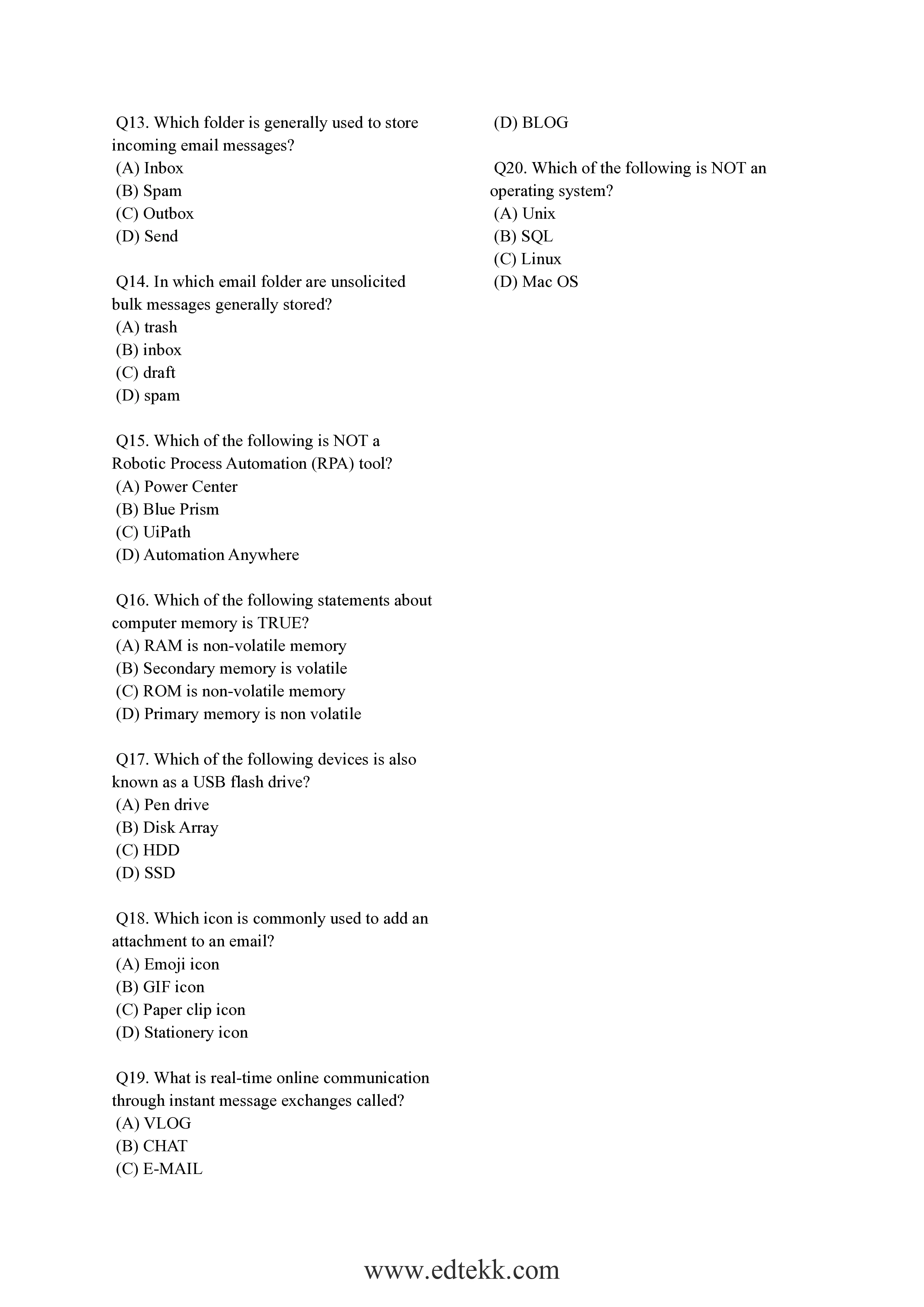
Q13. Which folder is generally used to store incoming email messages?
(A) Inbox
(B) Spam
(C) Outbox
(D) Send
Explanation: The Inbox folder generally stores incoming email messages received by an email account. Spam stores messages identified as unwanted or suspicious, while Outbox typically holds outgoing messages awaiting transmission and Sent stores messages that have been sent.
Q14. In which email folder are unsolicited bulk messages generally stored?
(A) trash
(B) inbox
(C) draft
(D) spam
Explanation: Spam refers to unsolicited or unwanted bulk email messages. Email services use automated filters to identify such messages and generally store them in the Spam or Junk folder rather than the main Inbox. The folder name may vary depending on the email service.
Q15. Which of the following is NOT a Robotic Process Automation (RPA) tool?
(A) Power Center
(B) Blue Prism
(C) UiPath
(D) Automation Anywhere
Explanation: PowerCenter is an enterprise data integration and ETL (Extract, Transform, Load) tool developed by Informatica, rather than a dedicated Robotic Process Automation (RPA) platform. Blue Prism, UiPath and Automation Anywhere are established RPA tools used to automate repetitive, rule-based business processes.
Q16. Which of the following statements about computer memory is TRUE?
(A) RAM is non-volatile memory
(B) Secondary memory is volatile
(C) ROM is non-volatile memory
(D) Primary memory is non volatile
Explanation: Read-only memory (ROM) is non-volatile memory, meaning it retains stored information when power is switched off. RAM is generally volatile and loses its contents when power is removed. Primary memory can include both volatile and non-volatile memory, so it is incorrect to classify all primary memory as non-volatile.
Q17. Which of the following devices is also known as a USB flash drive?
(A) Pen drive
(B) Disk Array
(C) HDD
(D) SSD
Explanation: A pen drive, also called a USB flash drive, is a portable storage device that uses flash memory and connects through a USB interface. It is commonly used to store and transfer digital files. Unlike a conventional hard disk drive, it has no moving mechanical parts.
Q18. Which icon is commonly used to add an attachment to an email?
(A) Emoji icon
(B) GIF icon
(C) Paper clip icon
(D) Stationery icon
Explanation: The paper clip icon is commonly used in email applications to indicate the attachment function. Selecting it allows users to choose files, such as documents and photographs, to attach to an outgoing email. The icon’s appearance may vary slightly across applications.
Q19. What is real-time online communication through instant message exchanges called?
(A) VLOG
(B) CHAT
(C) E-MAIL
(D) BLOG
Explanation: Chat refers to online communication in which two or more participants exchange messages interactively, often in real time. Unlike traditional email, which may involve delays between responses, chat typically enables rapid exchanges and may also support voice calls, video calls, and file sharing.
Q20. Which of the following is NOT an operating system?
(A) Unix
(B) SQL
(C) Linux
(D) Mac OS
Explanation: SQL (Structured Query Language) is a language used to create, retrieve, update, and manage data in relational database systems. It supports operations such as querying records, defining database structures, and controlling access to data. Unix, Linux, and Mac OS are operating systems, whereas SQL is a database language and cannot independently perform operating system functions.
Question Paper Images