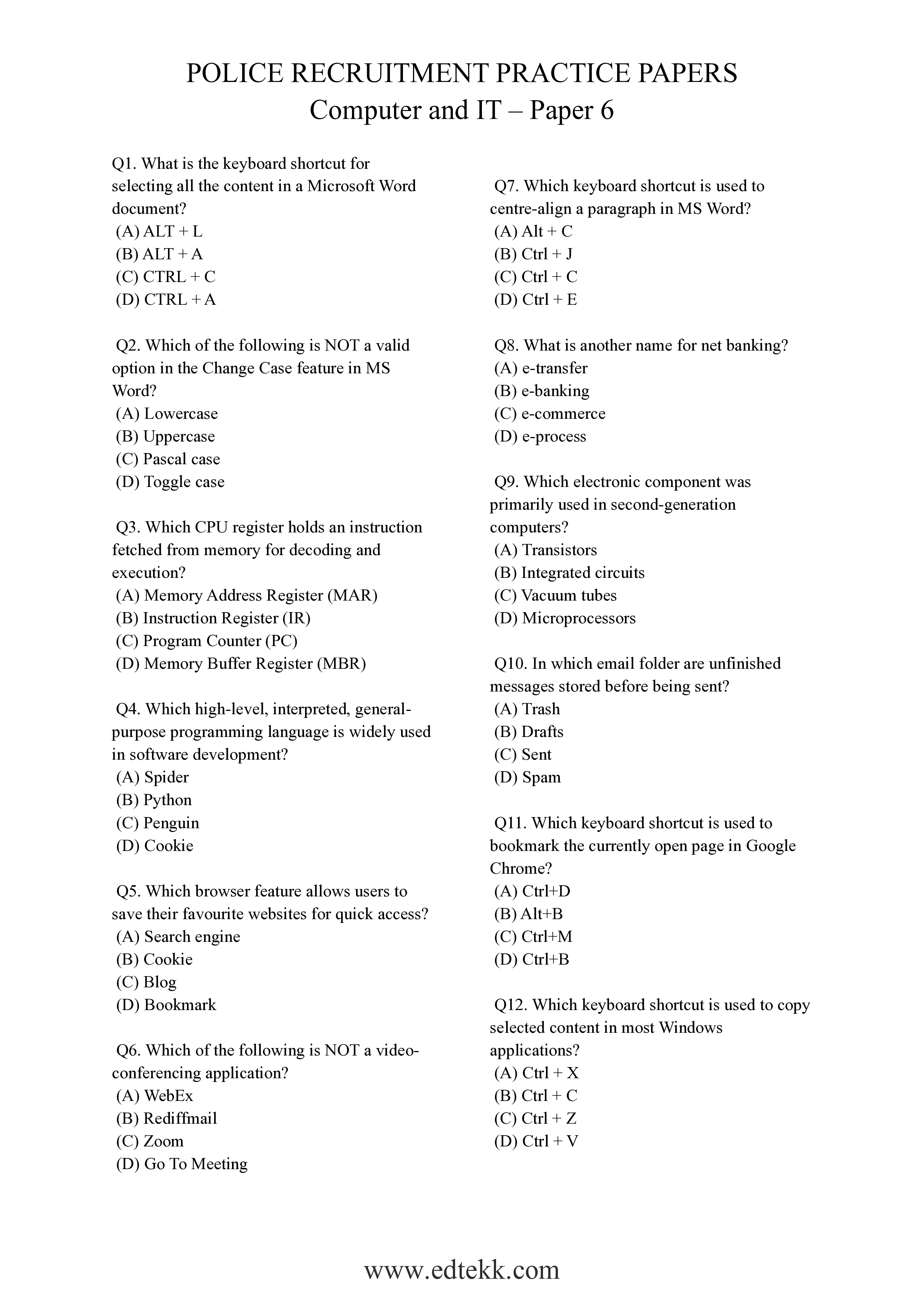
Test and improve your computer awareness with Police Recruitment Computer and IT Practice Paper 6. Designed for candidates preparing for Police Constable and Police SI examinations, this question set covers essential computer and IT concepts through MCQs, providing correct answers and explanations for focused practice and revision.
Test Details
Topic: Computer and IT
Total Questions: 20
Question Format: MCQs – Single Correct Answer
Suitable for: Police Constable, Police SI
Download All Papers in This Series (PDF)
Questions and Answers
Q1. What is the keyboard shortcut for selecting all the content in a Microsoft Word document?
(A) ALT + L
(B) ALT + A
(C) CTRL + C
(D) CTRL + A
Explanation: Ctrl + A is the standard keyboard shortcut for selecting all content in a Microsoft Word document. Depending on the editing context, it may initially select content within the current text container; pressing it again can expand the selection to a larger area, including the document.
Q2. Which of the following is NOT a valid option in the Change Case feature in MS Word?
(A) Lowercase
(B) Uppercase
(C) Pascal case
(D) Toggle case
Explanation: Pascal case is not one of the standard Change Case options in Microsoft Word. The standard options include Sentence case, lowercase, UPPERCASE, Capitalize Each Word and tOGGLE cASE. Pascal case is a programming-related naming convention in which each word begins with a capital letter and spaces are omitted.
Q3. Which CPU register holds an instruction fetched from memory for decoding and execution?
(A) Memory Address Register (MAR)
(B) Instruction Register (IR)
(C) Program Counter (PC)
(D) Memory Buffer Register (MBR)
Explanation: The Instruction Register (IR) holds the current instruction fetched from memory while the CPU decodes and executes it. The Control Unit interprets the instruction and coordinates its execution. The Memory Address Register (MAR) stores a memory address, whereas the Program Counter (PC) holds the address of the next instruction to be fetched.
Q4. Which high-level, interpreted, general-purpose programming language is widely used in software development?
(A) Spider
(B) Python
(C) Penguin
(D) Cookie
Explanation: Python is a high-level, general-purpose programming language commonly executed through an interpreter. It is widely used in web development, artificial intelligence, data science, automation, and software development. Python supports multiple programming paradigms, including object-oriented, procedural, and functional programming. Its readable syntax and extensive libraries make it suitable for beginners and experienced developers.
Q5. Which browser feature allows users to save their favourite websites for quick access?
(A) Search engine
(B) Cookie
(C) Blog
(D) Bookmark
Explanation: A bookmark is a browser feature that allows users to save website addresses for quick access later. Users can organise bookmarks into folders and revisit saved webpages without manually entering their web addresses or searching for them again.
Q6. Which of the following is NOT a video-conferencing application?
(A) WebEx
(B) Rediffmail
(C) Zoom
(D) Go To Meeting
Explanation: Rediffmail is an email service used for sending and receiving electronic messages. Webex, Zoom and GoTo Meeting are platforms that provide video-conferencing facilities. Therefore, Rediffmail is not a video-conferencing application.
Q7. Which keyboard shortcut is used to centre-align a paragraph in MS Word?
(A) Alt + C
(B) Ctrl + J
(C) Ctrl + C
(D) Ctrl + E
Explanation: Ctrl + E is the keyboard shortcut for centre-aligning a paragraph in Microsoft Word. It positions the paragraph centrally between the left and right margins. Other alignment shortcuts include Ctrl + L for left alignment, Ctrl + R for right alignment and Ctrl + J for justified alignment.
Q8. What is another name for net banking?
(A) e-transfer
(B) e-banking
(C) e-commerce
(D) e-process
Explanation: Net banking, also known as internet banking or online banking, is a form of e-banking that enables customers to access banking services through the internet. Common services include checking account balances, transferring funds, paying bills and viewing transaction histories.
Q9. Which electronic component was primarily used in second-generation computers?
(A) Transistors
(B) Integrated circuits
(C) Vacuum tubes
(D) Microprocessors
Explanation: Second-generation computers (approximately 1956–1963) primarily used transistors instead of vacuum tubes. Transistors made computers smaller, faster, more reliable and energy-efficient. Integrated circuits became the defining technology of third-generation computers, while microprocessors characterised fourth-generation computers.
Q10. In which email folder are unfinished messages stored before being sent?
(A) Trash
(B) Drafts
(C) Sent
(D) Spam
Explanation: The Drafts folder stores unfinished email messages that have been saved but not yet sent. Users can reopen, edit, and complete these messages later. The Sent folder stores sent messages, Trash stores deleted messages, and Spam generally contains messages identified as unwanted or suspicious.
Q11. Which keyboard shortcut is used to bookmark the currently open page in Google Chrome?
(A) Ctrl+D
(B) Alt+B
(C) Ctrl+M
(D) Ctrl+B
Explanation: In Google Chrome on Windows and Linux, Ctrl + D opens the bookmark dialog for the currently displayed webpage. Users can save the page, modify its bookmark name, and choose a folder for storing it. Bookmarks provide convenient access to frequently visited websites. On macOS, the equivalent shortcut is Command + D.
Q12. Which keyboard shortcut is used to copy selected content in most Windows applications?
(A) Ctrl + X
(B) Ctrl + C
(C) Ctrl + Z
(D) Ctrl + V
Explanation: Ctrl + C is the standard keyboard shortcut for copying selected text, files or other supported content in most Windows applications. Ctrl + X cuts selected content, Ctrl + Z typically undoes the most recent action, and Ctrl + V pastes copied or cut content.
Q13. What is the database used by Microsoft Windows to store configuration information called?
(A) Registry
(B) Record
(C) Cookie
(D) Cache
Explanation: The Windows Registry is a hierarchical database that stores configuration settings for the Windows operating system, installed applications, hardware devices, and user preferences. It contains keys and values that help Windows and compatible applications function correctly. Users and administrators can inspect or modify registry entries using Registry Editor, although incorrect modifications may cause system instability.
Q14. What are the small symbols placed before items in an unordered list in Microsoft Word called?
(A) Bullets
(B) Numbering
(C) Tabs
(D) Indentation
Explanation: Bullets are small symbols, such as dots, squares, dashes or other graphics, placed before items in a list. They are used to organise information when the sequence or numerical order of the items is not important.
Q15. Which of the following can be used to change the width of columns in a table in MS Word?
(A) Translate
(B) Define
(C) Insert
(D) Table properties
Explanation: Table Properties provides options for adjusting the width of columns in a Microsoft Word table. Users can select a specific column and specify its preferred width. Column widths can also be adjusted by dragging the column boundaries directly within the table or using the ruler.
Q16. What is the process of transferring files from a computer to the Internet called?
(A) Deleting
(B) Uploading
(C) Accessing
(D) Downloading
Explanation: Uploading means transferring data or files from a local computer or device to a remote computer, server or Internet-based platform. Downloading refers to the opposite process, in which data is transferred from the Internet or another remote system to the user’s device.
Q17. What type of file is an HTML document?
(A) Text
(B) Audio
(C) Video
(D) Image
Explanation: An HTML file is a text file containing HyperText Markup Language code. It uses tags and attributes to define the structure and content of a webpage. Although an HTML document can reference images, audio and video files, its source code is stored as text.
Q18. Which early computer network laid the foundation for the modern Internet?
(A) Clusters
(B) HTTP
(C) ARPANET
(D) SSID
Explanation: ARPANET was an early packet-switching network that laid the foundation for the modern Internet. It facilitated communication between geographically separated computers and contributed to the development of networking technologies and protocols that enabled interconnected computer networks to evolve into the global Internet.
Q19. Which component of an MS Excel worksheet displays the contents of the selected cell?
(A) Status bar”
(B) Formula bar
(C) Name box
(D) Title bar
Explanation: The Formula Bar displays the contents of the active cell, including text, numbers, and formulas. When a formula is selected, the Formula Bar displays the formula, while the cell normally displays its calculated result.
Q20. Which of the following is NOT an open-source operating system?
(A) Windows
(B) Ubuntu
(C) Debian
(D) Fedora
Explanation: Windows is a proprietary operating system developed by Microsoft, unlike Ubuntu, Debian, and Fedora, which are Linux distributions built primarily from open-source software. Their source code is available under applicable open-source licences, permitting modification and redistribution subject to licence conditions. Windows is distributed under Microsoft’s proprietary licensing terms and is therefore the correct answer.
Question Paper Images