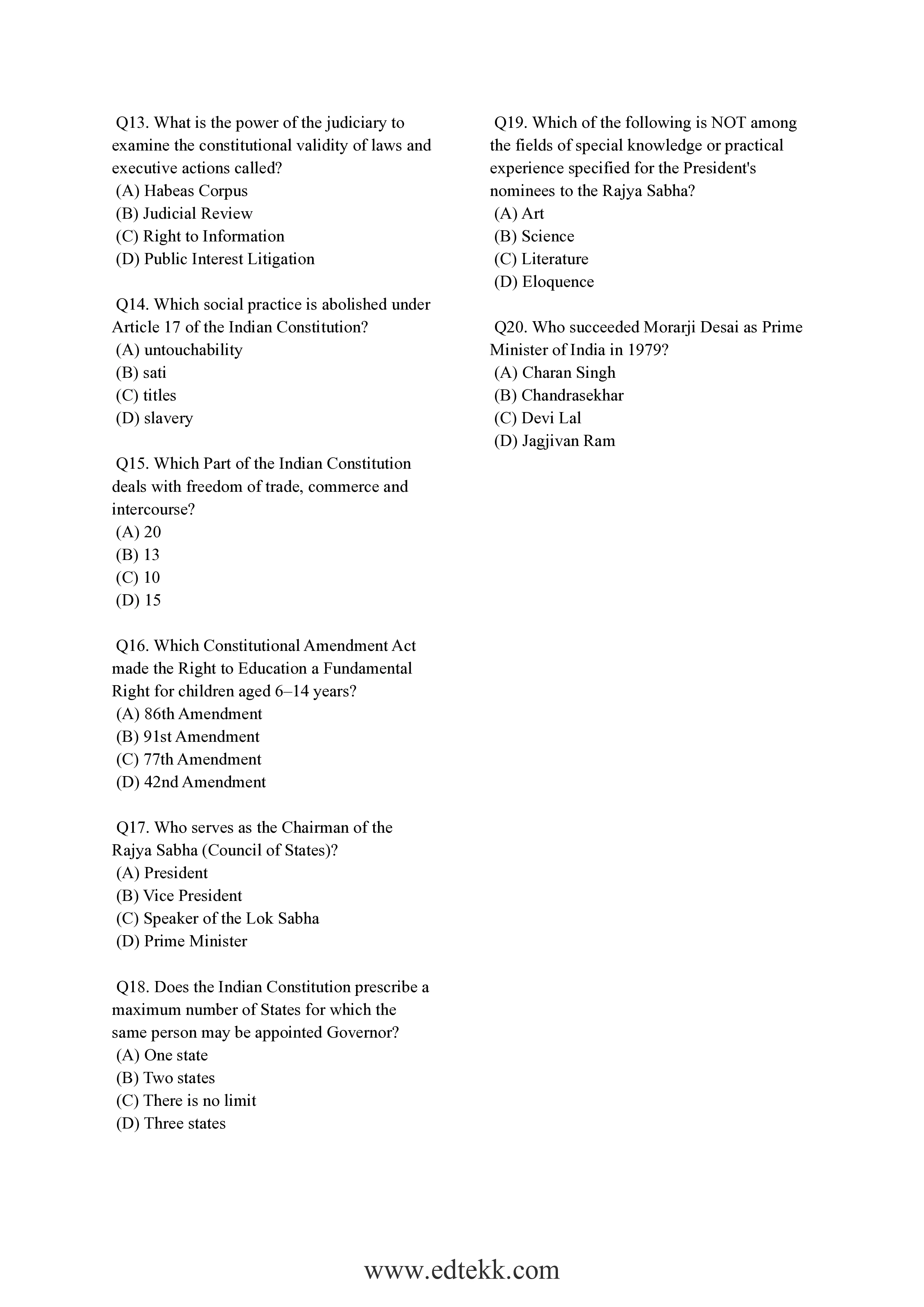
Complete another round of Indian Polity and Constitution revision with SSC Practice Paper 10. This question set provides an opportunity to assess knowledge of constitutional provisions, government institutions, political processes and important governance concepts. Practise objective questions with answers and explanations for SSC CGL, CHSL, CPO, MTS, GD and Selection Post examinations.
Test Details
Topic: Indian Polity and Constitution
Total Questions: 20
Question Format: MCQs – Single Correct Answer
Suitable for: SSC CGL, CHSL, CPO, MTS, GD, Selection Post
Download All Papers in This Series (PDF)
Questions and Answers
Q1. What is the minimum age required to become a member of the Rajya Sabha?
(A) 30 years
(B) 35 years
(C) 25 years
(D) 18 years
Explanation: Under Article 84(b) of the Constitution, the minimum age for membership of the Rajya Sabha is thirty years. Candidates must also be Indian citizens and satisfy other qualifications prescribed by law. In comparison, the minimum age for membership of the Lok Sabha is twenty-five years.
Q2. Where is the Prime Minister’s Office (PMO) located?
(A) South Block, New Delhi
(B) Rashtrapati Bhavan
(C) Parliament House
(D) North Block, New Delhi
Explanation: The Prime Minister’s Office (PMO) is located in South Block, New Delhi, on Raisina Hill. South Block houses key offices of the Union Government, including the Prime Minister’s Office and the Ministry of External Affairs.
Q3. What is the normal constitutional term of office of the Governor of an Indian state?
(A) Five
(B) Four
(C) Six
(D) Seven
Explanation: Under Article 156, the Governor is appointed by the President and ordinarily holds office for five years from the date of entering office. However, the Governor holds office during the pleasure of the President and may resign by writing to the President. The five-year term does not guarantee tenure for the entire period.
Q4. Who has the constitutional authority to prorogue either House of Parliament?
(A) Prime Minister of India
(B) Speaker of Lok Sabha
(C) Chairman of Rajya Sabha
(D) President of India
Explanation: The President of India has the constitutional power under Article 85 to prorogue either House of Parliament. Prorogation formally terminates a parliamentary session, whereas adjournment suspends a sitting. The Speaker and Chairman may adjourn their respective Houses but cannot prorogue them.
Q5. Who presides over a joint sitting of the Lok Sabha and the Rajya Sabha?
(A) Deputy Speaker of Lok Sabha
(B) Speaker of Lok Sabha
(C) Vice President
(D) Prime Minister
Explanation: The Speaker of the Lok Sabha presides over a joint sitting of both Houses of Parliament under Article 118(4). In the Speaker’s absence, the Deputy Speaker presides. If both are unavailable, the Deputy Chairman of the Rajya Sabha or another person determined under the applicable rules may preside.
Q6. What is the maximum term of office of the Chief Election Commissioner of India under the applicable law, subject to the prescribed age limit?
(A) Six years
(B) Three years
(C) Five years
(D) Seven years
Explanation: Under the Chief Election Commissioner and Other Election Commissioners (Appointment, Conditions of Service and Term of Office) Act, 2023, the Chief Election Commissioner holds office for six years or until attaining 65 years of age, whichever is earlier. Where an Election Commissioner is appointed as CEC, the combined tenure in both offices cannot exceed six years.
Q7. To which House or Houses of Parliament can the President of India address messages?
(A) Both Houses of Parliament
(B) Only Lok Sabha
(C) Only Rajya Sabha
(D) State Legislatures
Explanation: Under Article 86, the President may address either House of Parliament or both Houses assembled together and may send messages to either House concerning pending legislation or other matters. This power relates to Parliament, not state legislatures.
Q8. Which Part of the Indian Constitution provides for the Union Public Service Commission?
(A) Part X
(B) Part VIII
(C) Part XIV
(D) Part XVI
Explanation: Part XIV of the Constitution deals with services under the Union and the States and contains provisions relating to Public Service Commissions. Articles 315–323 provide for the Union Public Service Commission and State Public Service Commissions.
Q9. What is the term of office of a member of the Rajya Sabha (Council of States)?
(A) 6 years
(B) 4 years
(C) 5 years
(D) 3 years
Explanation: A member of the Rajya Sabha serves a six-year term. Under Article 83(1), the Rajya Sabha is a permanent House and is not subject to dissolution. Approximately one-third of its members retire every two years, ensuring continuity in parliamentary functioning.
Q10. Who was the third Vice-President of India?
(A) Gopal Swarup Pathak
(B) B D Jatti
(C) Zakir Hussain
(D) V V Giri
Explanation: V. V. Giri was the third Vice-President of India, serving from 13 May 1967 to 3 May 1969. He was succeeded by Gopal Swarup Pathak, who served from 31 August 1969 to 30 August 1974. The Vice-President of India also serves as the ex-officio Chairman of the Rajya Sabha.
Q11. How are seats reserved for Scheduled Castes and Scheduled Tribes in Panchayati Raj institutions determined?
(A) 0.15
(B) 0.25
(C) Proportional to population
(D) 0.33
Explanation: Article 243D of the Constitution provides for reservation of seats for Scheduled Castes and Scheduled Tribes in Panchayati Raj institutions in proportion, as nearly as practicable, to their population in the Panchayat area. This reservation promotes representation of these communities in rural local governance.
Q12. Under which Article of the Indian Constitution can the President proclaim a National Emergency?
(A) Article 370
(B) Article 356
(C) Article 360
(D) Article 352
Explanation: Article 352 empowers the President to proclaim a national emergency when the security of India or any part of its territory is threatened by war, external aggression or armed rebellion. Article 356 concerns President’s Rule in a state, while Article 360 deals with a financial emergency.
Q13. What is the power of the judiciary to examine the constitutional validity of laws and executive actions called?
(A) Habeas Corpus
(B) Judicial Review
(C) Right to Information
(D) Public Interest Litigation
Explanation: Judicial review refers to the power of courts to examine the constitutional validity of legislative enactments and executive actions. If any law or government action violates the Constitution, the competent court can declare it unconstitutional to the extent of the violation. This power safeguards fundamental rights and upholds constitutional supremacy.
Q14. Which social practice is abolished under Article 17 of the Indian Constitution?
(A) untouchability
(B) sati
(C) titles
(D) slavery
Explanation: Article 17 of the Indian Constitution abolishes untouchability and prohibits its practice in any form. Enforcement of any disability arising from untouchability is an offence punishable according to law. This provision is a significant constitutional safeguard against caste-based discrimination and promotes equality and human dignity.
Q15. Which Part of the Indian Constitution deals with freedom of trade, commerce and intercourse?
(A) 20
(B) 13
(C) 10
(D) 15
Explanation: Part XIII of the Indian Constitution, comprising Articles 301–307, deals with trade, commerce and intercourse within the territory of India. Article 301 establishes the general principle of freedom of trade, commerce and intercourse throughout India, subject to the constitutional restrictions and exceptions provided in subsequent articles.
Q16. Which Constitutional Amendment Act made the Right to Education a Fundamental Right for children aged 6–14 years?
(A) 86th Amendment
(B) 91st Amendment
(C) 77th Amendment
(D) 42nd Amendment
Explanation: The 86th Constitutional Amendment Act, 2002, made free and compulsory education a Fundamental Right for children aged 6 to 14 years by inserting Article 21A. It also modified Article 45 and introduced Article 51A(k), establishing a corresponding fundamental duty of parents or guardians.
Q17. Who serves as the Chairman of the Rajya Sabha (Council of States)?
(A) President
(B) Vice President
(C) Speaker of the Lok Sabha
(D) Prime Minister
Explanation: The Vice-President of India is the ex-officio Chairman of the Rajya Sabha under Article 89(1) of the Constitution. The Chairman presides over its proceedings, maintains order and ensures that parliamentary business is conducted according to established rules. The Vice-President is not a member of the Rajya Sabha.
Q18. Does the Indian Constitution prescribe a maximum number of States for which the same person may be appointed Governor?
(A) One state
(B) Two states
(C) There is no limit
(D) Three states
Explanation: The Constitution does not prescribe a maximum number of States for which the same person may be appointed Governor. Under Article 153, the same person may serve as Governor of two or more States.
Q19. Which of the following is NOT among the fields of special knowledge or practical experience specified for the President’s nominees to the Rajya Sabha?
(A) Art
(B) Science
(C) Literature
(D) Eloquence
Explanation: Under Article 80(3) of the Constitution, the President nominates 12 members to the Rajya Sabha having special knowledge or practical experience in literature, science, art or social service. Eloquence is not among the four specified fields. These nominated members contribute their specialised knowledge and experience to parliamentary deliberations.
Q20. Who succeeded Morarji Desai as Prime Minister of India in 1979?
(A) Charan Singh
(B) Chandrasekhar
(C) Devi Lal
(D) Jagjivan Ram
Explanation: Charan Singh replaced Morarji Desai as Prime Minister on 28 July 1979. He became India’s fifth Prime Minister and remained in office until January 1980. His government could not face a confidence vote in the Lok Sabha because the Congress withdrew its support before the vote.
Question Paper Images