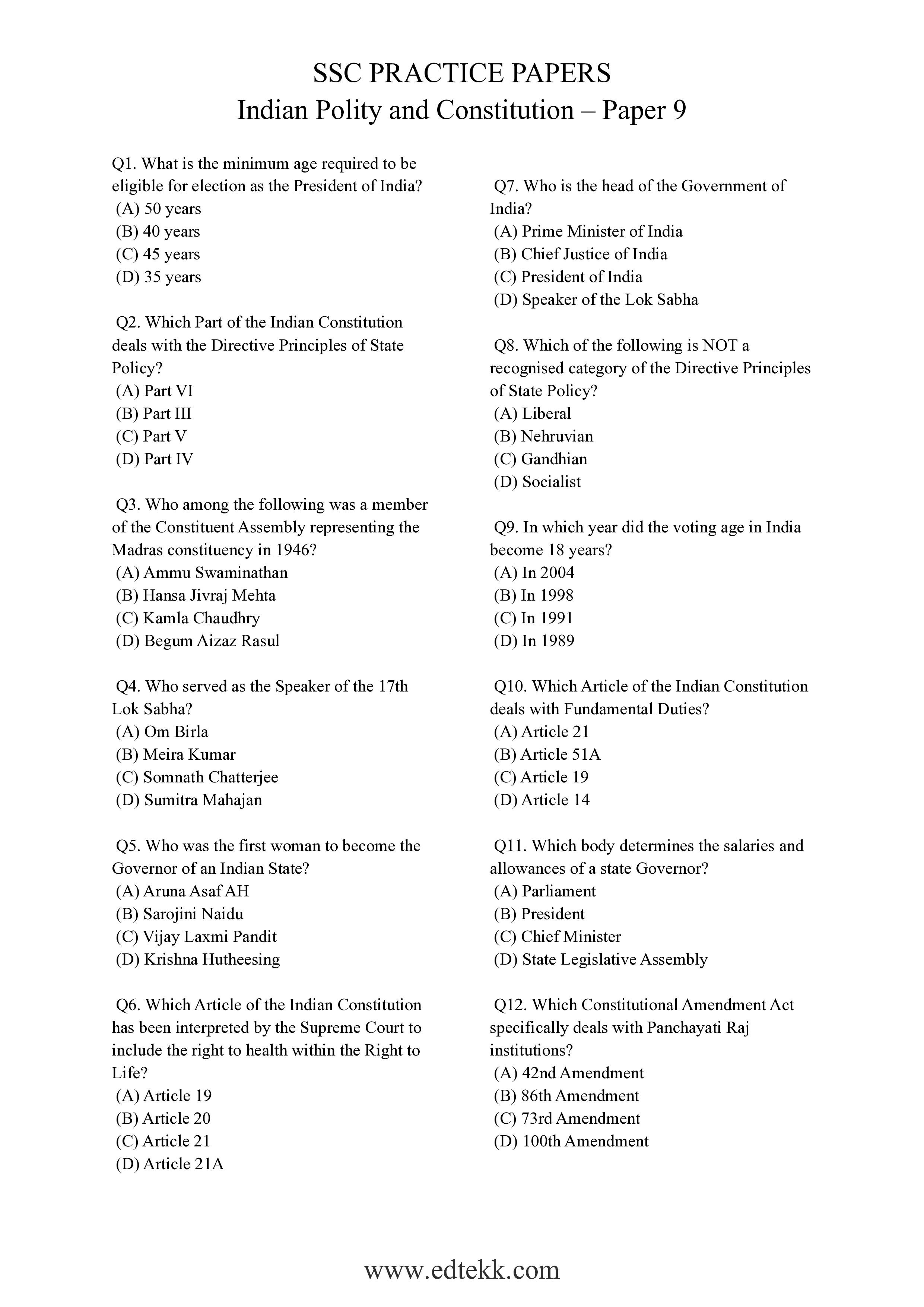
Revise important Indian Polity concepts with SSC Practice Paper 9. This question set covers constitutional history, the Constituent Assembly, sources of the Constitution, citizenship and significant constitutional provisions. Solve multiple-choice questions with answers and explanations to prepare systematically for SSC CGL, CHSL, CPO, MTS, GD and Selection Post examinations.
Test Details
Topic: Indian Polity and Constitution
Total Questions: 20
Question Format: MCQs – Single Correct Answer
Suitable for: SSC CGL, CHSL, CPO, MTS, GD, Selection Post
Download All Papers in This Series (PDF)
Questions and Answers
Q1. What is the minimum age required to be eligible for election as the President of India?
(A) 50 years
(B) 40 years
(C) 45 years
(D) 35 years
Explanation: Under Article 58 of the Constitution, a candidate for President of India must be an Indian citizen, have completed 35 years of age and be qualified for election as a member of the Lok Sabha. The candidate must also satisfy the constitutional conditions concerning office of profit.
Q2. Which Part of the Indian Constitution deals with the Directive Principles of State Policy?
(A) Part VI
(B) Part III
(C) Part V
(D) Part IV
Explanation: Part IV (Articles 36–51) of the Indian Constitution deals with the Directive Principles of State Policy (DPSP). These principles guide the State in establishing social and economic justice and promoting public welfare. They are not directly enforceable by courts under Article 37 but are fundamental to the governance of the country.
Q3. Who among the following was a member of the Constituent Assembly representing the Madras constituency in 1946?
(A) Ammu Swaminathan
(B) Hansa Jivraj Mehta
(C) Kamla Chaudhry
(D) Begum Aizaz Rasul
Explanation: Ammu Swaminathan was a member of the Constituent Assembly representing Madras. She participated in constitution-making as one of the Assembly’s women members and subsequently served in the provisional Parliament and the Lok Sabha. Her contribution formed part of the broader participation of women in India’s constitutional development.
Q4. Who served as the Speaker of the 17th Lok Sabha?
(A) Om Birla
(B) Meira Kumar
(C) Somnath Chatterjee
(D) Sumitra Mahajan
Explanation: Om Birla was the Speaker of the 17th Lok Sabha. He was elected on 19 June 2019 and served until the conclusion of the 17th Lok Sabha in 2024. He was subsequently re-elected as Speaker of the 18th Lok Sabha in June 2024.
Q5. Who was the first woman to become the Governor of an Indian State?
(A) Aruna Asaf AH
(B) Sarojini Naidu
(C) Vijay Laxmi Pandit
(D) Krishna Hutheesing
Explanation: Sarojini Naidu became the first woman Governor of an Indian State when she was appointed Governor of the United Provinces in 1947. She was a prominent freedom fighter, poet and political leader, popularly known as the “Nightingale of India.”
Q6. Which Article of the Indian Constitution has been interpreted by the Supreme Court to include the right to health within the Right to Life?
(A) Article 19
(B) Article 20
(C) Article 21
(D) Article 21A
Explanation: Article 21 guarantees the Right to Life and Personal Liberty. The Supreme Court has interpreted this right to include the right to health and access to medical care. This interpretation recognises that the right to life extends beyond mere physical existence and includes conditions necessary for living with human dignity.
Q7. Who is the head of the Government of India?
(A) Prime Minister of India
(B) Chief Justice of India
(C) President of India
(D) Speaker of the Lok Sabha
Explanation: The Prime Minister is the head of the Union Government and leads the Council of Ministers. The President is the constitutional head of the Indian state, while executive functions are exercised in accordance with the Constitution, generally on the aid and advice of the Council of Ministers headed by the Prime Minister.
Q8. Which of the following is NOT a recognised category of the Directive Principles of State Policy?
(A) Liberal
(B) Nehruvian
(C) Gandhian
(D) Socialist
Explanation: Directive Principles of State Policy are conventionally classified into three categories: Socialist, Gandhian and Liberal-Intellectual principles. Nehruvian is not recognised as a standard category in this classification. These are academic classifications rather than constitutional headings.
Q9. In which year did the voting age in India become 18 years?
(A) In 2004
(B) In 1998
(C) In 1991
(D) In 1989
Explanation: The voting age was reduced from 21 to 18 years through the 61st Constitutional Amendment Act, 1988. The amendment came into force in 1989, enabling citizens aged 18 years and above to vote in elections to the Lok Sabha and State Legislative Assemblies.
Q10. Which Article of the Indian Constitution deals with Fundamental Duties?
(A) Article 21
(B) Article 51A
(C) Article 19
(D) Article 14
Explanation: Fundamental Duties are mentioned in Article 51A of the Indian Constitution. They outline citizens’ responsibilities, including respecting the Constitution, national flag and national anthem, protecting the environment and promoting harmony. They were introduced by the 42nd Constitutional Amendment Act, 1976, and one additional duty was incorporated by the 86th Amendment Act, 2002.
Q11. Which body determines the salaries and allowances of a state Governor?
(A) Parliament
(B) President
(C) Chief Minister
(D) State Legislative Assembly
Explanation: Parliament determines the Governor’s salaries, allowances and privileges by law. These financial entitlements are governed at the Union level, while the expenses relating to the Governor’s emoluments and allowances are charged on the Consolidated Fund of the State. Article 158(3) protects these entitlements against diminution during the Governor’s term.
Q12. Which Constitutional Amendment Act specifically deals with Panchayati Raj institutions?
(A) 42nd Amendment
(B) 86th Amendment
(C) 73rd Amendment
(D) 100th Amendment
Explanation: The 73rd Constitutional Amendment Act, 1992, is specifically associated with Panchayati Raj institutions. It granted constitutional status to rural local self-government and introduced provisions relating to regular elections, reservation of seats, a five-year tenure and the institutional framework for democratic decentralisation.
Q13. Which list in the Seventh Schedule of the Indian Constitution includes subjects such as police, public health and sanitation, and agriculture?
(A) Union List
(B) State List
(C) Concurrent List
(D) Residual Powers
Explanation: The State List, contained in the Seventh Schedule of the Indian Constitution, includes subjects such as police, public health, sanitation and agriculture. State Legislatures generally have exclusive authority to legislate on these subjects, subject to constitutional provisions that permit Parliament to legislate on State List matters in specified circumstances.
Q14. Who is the constitutional head of a state government in India?
(A) Chief Minister
(B) Prime Minister
(C) Governor
(D) President
Explanation: The Governor is the constitutional head of a state under Article 154 of the Indian Constitution. The Chief Minister is the real executive head and leads the elected state government. The Governor generally exercises executive functions on the aid and advice of the Council of Ministers headed by the Chief Minister, except in constitutionally recognised discretionary matters.
Q15. Which State proposed to establish India’s first ‘Blockchain District’?
(A) Tamil Nadu
(B) Gujarat
(C) Maharashtra
(D) Telangana
Explanation: Telangana proposed India’s first Blockchain District as an initiative to promote blockchain technology, innovation and investment. Associated with Hyderabad, the initiative aimed to establish an ecosystem involving technology companies, startups, academic institutions and government agencies. It formed part of Telangana’s efforts to develop emerging technology sectors.
Q16. How many Schedules are there in the Indian Constitution?
(A) 25
(B) 10
(C) 22
(D) 12
Explanation: The Indian Constitution originally contained eight Schedules. Following subsequent constitutional amendments, their number increased to 12. The Schedules deal with various subjects, including the allocation of Rajya Sabha seats, administration of tribal areas, official languages, anti-defection provisions and distribution of legislative powers.
Q17. Who is the presiding officer of the Lok Sabha?
(A) Speaker
(B) Prime Minister
(C) President
(D) Chief Justice of India
Explanation: The Speaker is the presiding officer of the Lok Sabha and is elected by its members under Article 93. The Speaker maintains order, regulates debates and ensures compliance with parliamentary procedures. In the Speaker’s absence, the Deputy Speaker or another authorised member may preside. The Speaker also certifies Money Bills under Article 110.
Q18. Which Fundamental Right guarantees free and compulsory education to children aged 6–14 years?
(A) Right to Education
(B) Right to Equality
(C) Right to Freedom
(D) Right against Exploitation
Explanation: Article 21A guarantees free and compulsory education to all children aged 6–14 years. It was introduced through the 86th Constitutional Amendment Act, 2002, and came into force on 1 April 2010. The State is constitutionally obligated to provide elementary education to children within this age group in accordance with the law.
Q19. Which Article of the Indian Constitution guarantees the Right to Freedom of Speech and Expression?
(A) Article 19
(B) Article 14
(C) Article 21
(D) Article 25
Explanation: Article 19(1)(a) guarantees citizens the Fundamental Right to freedom of speech and expression. It includes expressing opinions through speech, writing, publication and other forms of communication. However, this right is not absolute. Reasonable restrictions may be imposed under Article 19(2) on specified grounds, including public order, security of the State, defamation and incitement to an offence.
Q20. Who was the Prime Minister of India during the Emergency from 1975 to 1977?
(A) Indira Gandhi
(B) Rajiv Gandhi
(C) Morarji Desai
(D) Charan Singh
Explanation: Indira Gandhi was the Prime Minister of India throughout the National Emergency from 25 June 1975 to 21 March 1977. The Emergency was proclaimed under Article 352, and Morarji Desai became Prime Minister following the 1977 general election.
Question Paper Images