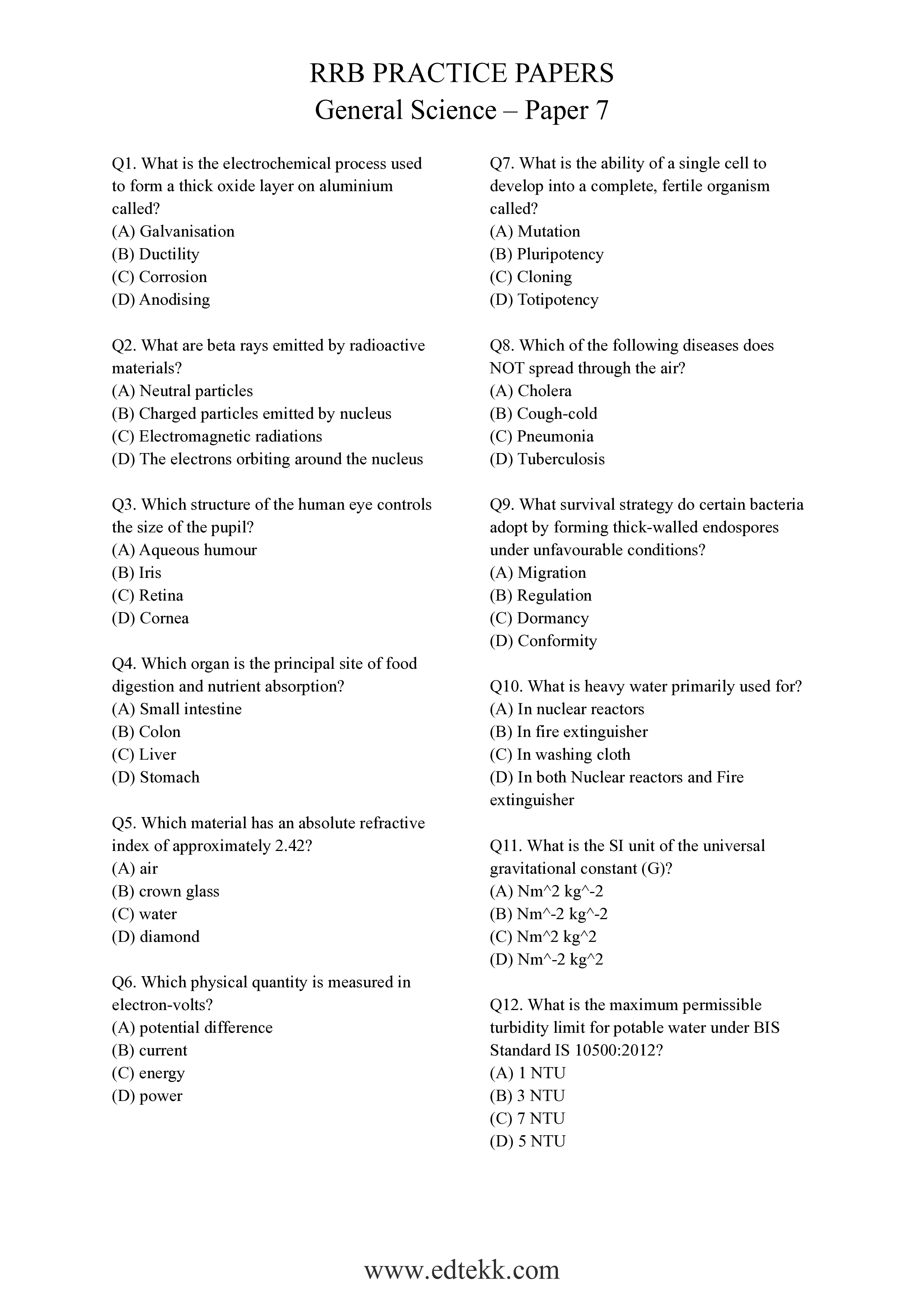
Test your General Science knowledge with Railway Practice Paper 7, designed for candidates preparing for RRB recruitment examinations. The set includes 20 MCQs with answers and explanations to support effective revision, identify knowledge gaps and improve subject preparation for NTPC, Group D, ALP and Technician exams.
Test Details
Topic: General Science
Total Questions: 20
Question Format: MCQs – Single Correct Answer
Suitable for: RRB NTPC, Group D, ALP, Technician
Download All Papers in This Series (PDF)
Questions and Answers
Q1. What is the electrochemical process used to form a thick oxide layer on aluminium called?
(A) Galvanisation
(B) Ductility
(C) Corrosion
(D) Anodising
Explanation: Anodising is an electrochemical process used to form a thick, protective aluminium oxide layer on the surface of aluminium. It improves corrosion resistance, increases surface hardness and provides a suitable surface for colouring.
Q2. What are beta rays emitted by radioactive materials?
(A) Neutral particles
(B) Charged particles emitted by nucleus
(C) Electromagnetic radiations
(D) The electrons orbiting around the nucleus
Explanation: Beta rays consist of high-speed charged particles emitted during radioactive decay. Beta-minus (β⁻) particles are electrons, while beta-plus (β⁺) particles are positrons. These particles are produced during nuclear transformations and are not ordinary orbital electrons. Unlike gamma rays, beta rays are particulate radiation rather than electromagnetic radiation.
Q3. Which structure of the human eye controls the size of the pupil?
(A) Aqueous humour
(B) Iris
(C) Retina
(D) Cornea
Explanation: The iris controls the size of the pupil and regulates the amount of light entering the eye. In bright light, its circular muscles contract and its radial muscles relax, constricting the pupil. In dim light, the radial muscles contract and the circular muscles relax, dilating the pupil.
Q4. Which organ is the principal site of food digestion and nutrient absorption?
(A) Small intestine
(B) Colon
(C) Liver
(D) Stomach
Explanation: The small intestine is the principal site of chemical digestion and nutrient absorption in humans. It receives digestive enzymes from the pancreas and bile from the liver, facilitating the digestion of carbohydrates, proteins and fats. Its numerous villi and microvilli provide a large surface area for efficient nutrient absorption.
Q5. Which material has an absolute refractive index of approximately 2.42?
(A) air
(B) crown glass
(C) water
(D) diamond
Explanation: Diamond has an absolute refractive index of approximately 2.42. The absolute refractive index of a medium is the ratio of the speed of light in vacuum to its speed in that medium. Diamond has a high refractive index because light travels considerably slower through it than through air or water.
Q6. Which physical quantity is measured in electron-volts?
(A) potential difference
(B) current
(C) energy
(D) power
Explanation: An electron-volt (eV) is a unit of energy. It is defined as the energy gained by an elementary charge when it moves through a potential difference of one volt. One electron-volt is approximately 1.602 × 10⁻¹⁹ joules. It is commonly used in atomic, nuclear and particle physics.
Q7. What is the ability of a single cell to develop into a complete, fertile organism called?
(A) Mutation
(B) Pluripotency
(C) Cloning
(D) Totipotency
Explanation: Totipotency is the ability of a single cell to develop into a complete organism under suitable conditions. A totipotent cell can give rise to all cell types, including embryonic and extraembryonic tissues. The zygote is a classic example of a totipotent cell.
Q8. Which of the following diseases does NOT spread through the air?
(A) Cholera
(B) Cough-cold
(C) Pneumonia
(D) Tuberculosis
Explanation: Cholera is primarily transmitted through food or water contaminated with Vibrio cholerae, commonly due to inadequate sanitation. In contrast, tuberculosis spreads through airborne particles, while respiratory infections causing colds and some forms of pneumonia may spread through respiratory particles, depending on the causative pathogen.
Q9. What survival strategy do certain bacteria adopt by forming thick-walled endospores under unfavourable conditions?
(A) Migration
(B) Regulation
(C) Dormancy
(D) Conformity
Explanation: Certain bacteria, including species of Bacillus and Clostridium, survive unfavourable environmental conditions by forming thick-walled endospores. These structures are highly resistant to heat, radiation, drying and chemicals. Endospore formation is a survival mechanism involving a dormant state, not a method of reproduction. The bacteria become active again when favourable conditions return.
Q10. What is heavy water primarily used for?
(A) In nuclear reactors
(B) In fire extinguisher
(C) In washing cloth
(D) In both Nuclear reactors and Fire extinguisher
Explanation: Heavy water (D₂O) is primarily used as a neutron moderator in nuclear reactors. It slows down fast neutrons without absorbing many of them, thereby helping sustain the nuclear fission chain reaction. It is also used as a coolant in certain types of nuclear reactors.
Q11. What is the SI unit of the universal gravitational constant (G)?
(A) Nm^2 kg^-2
(B) Nm^-2 kg^-2
(C) Nm^2 kg^2
(D) Nm^-2 kg^2
Explanation: The SI unit of the universal gravitational constant ((G)) is N m² kg⁻². According to Newton’s law of universal gravitation, it relates the gravitational force between two masses to their masses and the square of the distance between them. Its approximate value is (6.674 times 10^{-11}) N m² kg⁻².
Q12. What is the maximum permissible turbidity limit for potable water under BIS Standard IS 10500:2012?
(A) 1 NTU
(B) 3 NTU
(C) 7 NTU
(D) 5 NTU
Explanation: Turbidity measures the cloudiness of water caused by suspended particles. Under BIS IS 10500:2012, the acceptable limit for drinking water is 1 NTU, while the permissible limit in the absence of an alternative source is 5 NTU. Therefore, 5 NTU is the correct answer because the question asks for the maximum permissible limit.
Q13. Which process is the major driving force behind the movement of water through the xylem during the day?
(A) Transpiration pull
(B) Evaporation
(C) Suction
(D) Translocation
Explanation: Transpiration pull is the major driving force responsible for the upward movement of water through xylem during the day. Evaporation of water from leaf surfaces generates negative pressure, which pulls the continuous column of water upward from the roots.
Q14. Which of the following electromagnetic waves has the highest frequency?
(A) Gamma Rays
(B) Radio Waves
(C) Ultraviolet Rays
(D) Microwaves
Explanation: Gamma rays have the highest frequency and shortest wavelength among the given electromagnetic waves. Their photon energies are higher than those of ultraviolet rays, microwaves and radio waves. According to the relationship c = νλ, frequency and wavelength are inversely proportional in a vacuum.
Q15. Which part of the brain controls posture, balance and equilibrium?
(A) Brainstem
(B) Cerebellum
(C) Cerebrum
(D) Diencephalon
Explanation: The cerebellum coordinates voluntary movements and plays a central role in maintaining posture, balance and equilibrium. It integrates information from the vestibular system, sensory receptors and other parts of the nervous system to produce smooth, coordinated movements. Damage to the cerebellum can cause impaired balance, uncoordinated movements and an unsteady gait.
Q16. What is the general formula of alkenes?
(A) CnH3n
(B) CnH2n
(C) CnH6n
(D) CnH4n
Explanation: The general molecular formula of open-chain alkenes containing one carbon–carbon double bond is CₙH₂ₙ, where n is at least 2. Alkenes are unsaturated hydrocarbons. For example, ethene (C₂H₄) and propene (C₃H₆) follow this formula. Cyclic alkenes and compounds with multiple double bonds have different general formulas.
Q17. What are members of the class Phaeophyceae commonly known as?
(A) red algae
(B) white algae
(C) brown algae
(D) green algae
Explanation: Phaeophyceae is the class of algae commonly known as brown algae. Their characteristic brown colour results primarily from the pigment fucoxanthin, which masks the green colour of chlorophyll. Most members are marine and include genera such as Sargassum, Laminaria and Fucus.
Q18. What is the SI unit of temperature?
(A) Degree Fahrenheit
(B) Degree Celsius
(C) Kelvin
(D) Candela
Explanation: The kelvin (K) is the SI base unit of thermodynamic temperature. Although degrees Celsius are widely used in everyday life and scientific applications, kelvin is the standard SI unit. Both scales have equal-sized increments, but their zero points differ by 273.15 degrees.
Q19. Which of the following equations represents Ohm’s law?
(A) R = V × I
(B) V = I + R
(C) I = V × R
(D) V = IR
Explanation: Ohm’s law states that the potential difference across a conductor is directly proportional to the electric current flowing through it, provided its temperature and other physical conditions remain constant. Mathematically, it is expressed as V = IR, where V represents voltage, I represents current and R represents resistance.
Q20. Which of the following statements is correct?
(A) Joule is a unit of power.
(B) Newton is a unit of power.
(C) Joule is a unit of force.
(D) Newton is a unit of force.
Explanation: Newton (N) is the SI unit of force. One newton is the force required to accelerate a mass of one kilogram at one metre per second squared. Joule is the SI unit of work and energy, whereas watt is the SI unit of power.
Question Paper Images