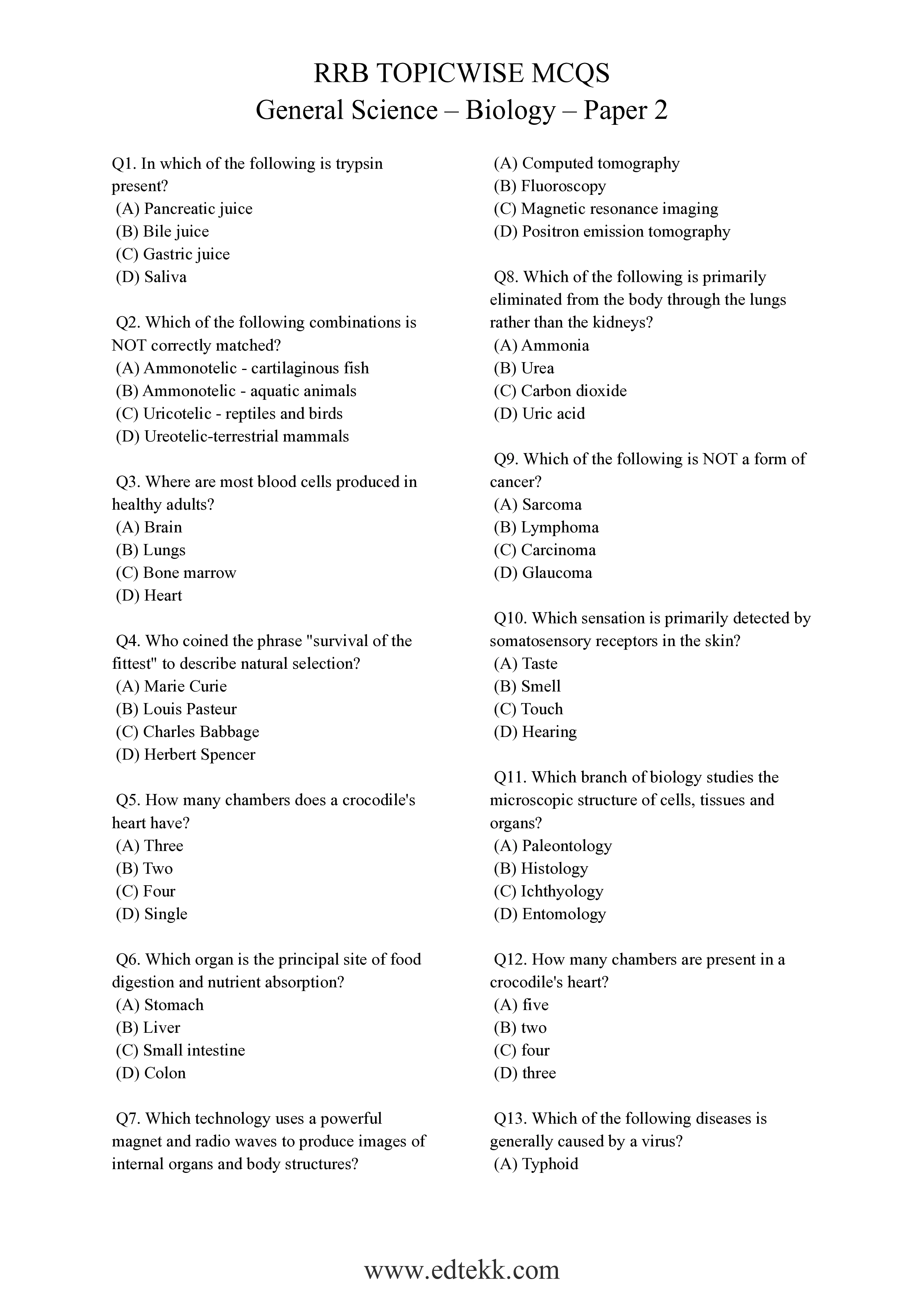
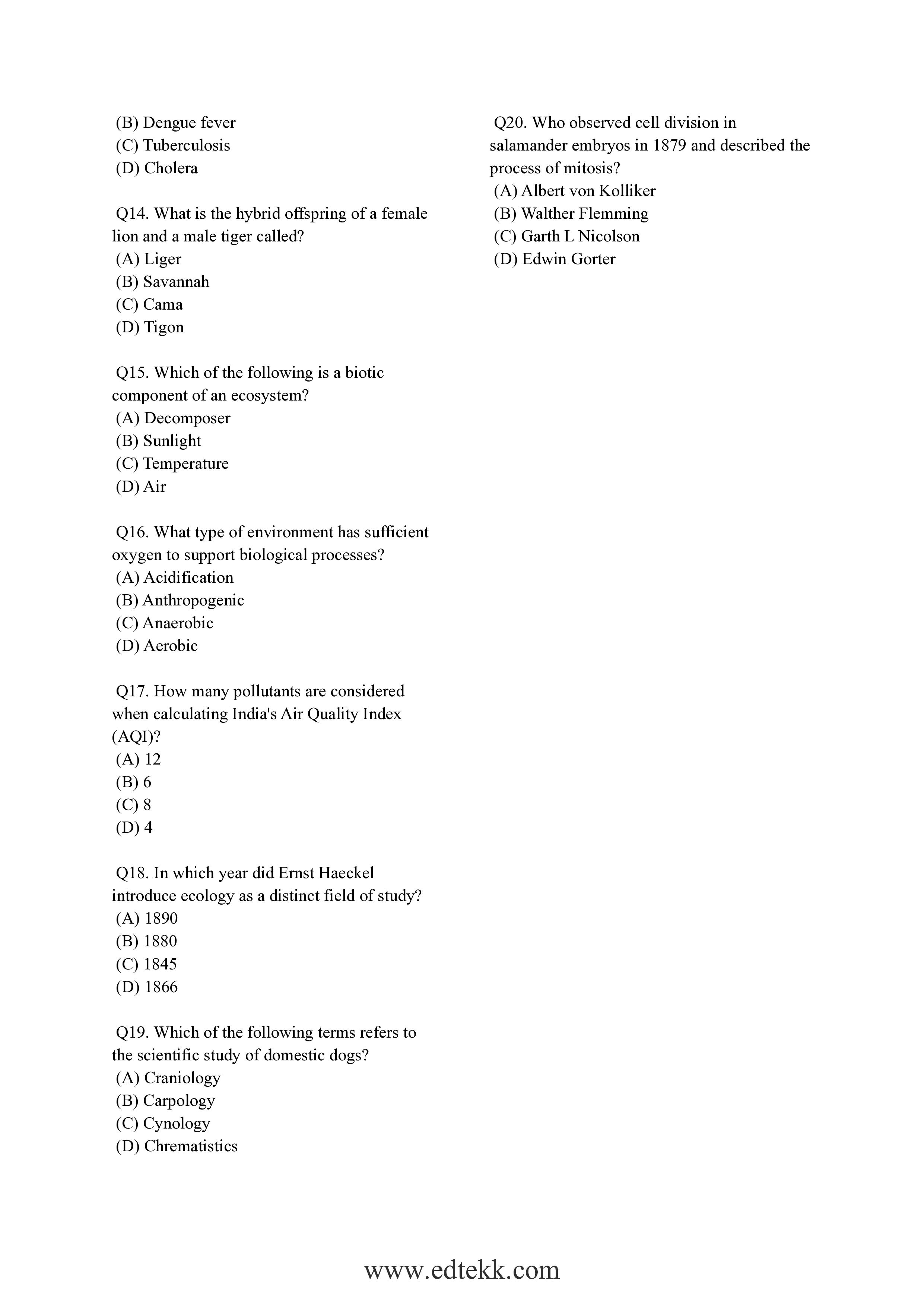
Enhance your General Science preparation through Railway Biology MCQs – Paper 2. This question set provides topicwise objective questions, answers and explanations to support concept-based revision. Suitable for RRB NTPC, Group D, ALP and Technician exams, it helps aspirants improve accuracy and exam readiness.
Test Details
Topic: Biology
Total Questions: 20
Question Format: MCQs – Single Correct Answer
Suitable for: RRB NTPC, Group D, ALP, Technician
Download All Papers in This Series (PDF)
Questions and Answers
Q1. In which of the following is trypsin present?
(A) Pancreatic juice
(B) Bile juice
(C) Gastric juice
(D) Saliva
Explanation: Trypsin is a protein-digesting enzyme produced by the pancreas and released into pancreatic juice in its inactive form, trypsinogen. In the small intestine, trypsinogen is activated by enteropeptidase, and active trypsin helps digest proteins into smaller peptides. Trypsin functions optimally in the alkaline environment of the small intestine.
Q2. Which of the following combinations is NOT correctly matched?
(A) Ammonotelic – cartilaginous fish
(B) Ammonotelic – aquatic animals
(C) Uricotelic – reptiles and birds
(D) Ureotelic-terrestrial mammals
Explanation: Cartilaginous fishes, including sharks and rays, are predominantly ureotelic because they excrete nitrogenous waste mainly as urea. Many aquatic animals, especially freshwater bony fishes, are ammonotelic. Birds and most reptiles are uricotelic, while terrestrial mammals are generally ureotelic. Therefore, the incorrectly matched pair is Ammonotelic – cartilaginous fish.
Q3. Where are most blood cells produced in healthy adults?
(A) Brain
(B) Lungs
(C) Bone marrow
(D) Heart
Explanation: Bone marrow is the primary site of blood cell production in healthy adults. This process is called haematopoiesis. Red bone marrow produces red blood cells, white blood cells and platelets from haematopoietic stem cells. In adults, active red bone marrow is mainly found in the pelvis, sternum, ribs and vertebrae.
Q4. Who coined the phrase “survival of the fittest” to describe natural selection?
(A) Marie Curie
(B) Louis Pasteur
(C) Charles Babbage
(D) Herbert Spencer
Explanation: The phrase “survival of the fittest” was coined by Herbert Spencer in his work on evolutionary theory. Charles Darwin subsequently adopted the expression in the fifth edition of On the Origin of Species (1869). It describes the differential survival and reproductive success of organisms better adapted to their environments.
Q5. How many chambers does a crocodile’s heart have?
(A) Three
(B) Two
(C) Four
(D) Single
Explanation: Crocodiles possess a four-chambered heart consisting of two atria and two ventricles. Unlike most reptiles, which generally have a three-chambered heart, crocodilians have complete separation between the right and left ventricles. However, specialised blood vessels permit controlled blood shunting under certain physiological conditions.
Q6. Which organ is the principal site of food digestion and nutrient absorption?
(A) Stomach
(B) Liver
(C) Small intestine
(D) Colon
Explanation: The small intestine is the principal site of chemical digestion and nutrient absorption in humans. It receives digestive enzymes from the pancreas and bile from the liver, facilitating the digestion of carbohydrates, proteins and fats. Its numerous villi and microvilli provide a large surface area for efficient nutrient absorption.
Q7. Which technology uses a powerful magnet and radio waves to produce images of internal organs and body structures?
(A) Computed tomography
(B) Fluoroscopy
(C) Magnetic resonance imaging
(D) Positron emission tomography
Explanation: Magnetic resonance imaging (MRI) uses a strong magnetic field and radiofrequency waves to produce detailed images of internal organs, tissues and other body structures. Unlike computed tomography (CT), MRI does not use ionising X-ray radiation. It is particularly useful for examining soft tissues, the brain and spinal cord.
Q8. Which of the following is primarily eliminated from the body through the lungs rather than the kidneys?
(A) Ammonia
(B) Urea
(C) Carbon dioxide
(D) Uric acid
Explanation: Carbon dioxide is primarily eliminated through the lungs during exhalation. It is produced during cellular respiration and transported in the blood mainly as bicarbonate ions. In the lungs, bicarbonate is converted back into carbon dioxide, which diffuses into the alveoli and is exhaled. Urea and uric acid are eliminated mainly through the kidneys.
Q9. Which of the following is NOT a form of cancer?
(A) Sarcoma
(B) Lymphoma
(C) Carcinoma
(D) Glaucoma
Explanation: Glaucoma is an eye disease that damages the optic nerve, often associated with increased intraocular pressure. It is not a form of cancer. In contrast, lymphoma, carcinoma and sarcoma are major categories of cancer. Lymphoma affects lymphatic tissues, carcinoma arises from epithelial cells, and sarcoma develops from connective or supporting tissues.
Q10. Which sensation is primarily detected by somatosensory receptors in the skin?
(A) Taste
(B) Smell
(C) Touch
(D) Hearing
Explanation: Touch is detected by somatosensory receptors in the skin, including mechanoreceptors that respond to pressure, vibration and skin deformation. Other sensory receptors detect temperature and potentially damaging stimuli. Taste, smell and hearing depend on specialised receptors located primarily in the tongue, nasal cavity and inner ear, respectively.
Q11. Which branch of biology studies the microscopic structure of cells, tissues and organs?
(A) Paleontology
(B) Histology
(C) Ichthyology
(D) Entomology
Explanation: Histology is the branch of biology concerned primarily with the microscopic study of tissues and their organisation. It examines tissue structure and the relationship between structure and function using microscopes. It is particularly important in anatomy, pathology and medical diagnosis.
Q12. How many chambers are present in a crocodile’s heart?
(A) five
(B) two
(C) four
(D) three
Explanation: Crocodiles possess a four-chambered heart consisting of two atria and two ventricles. This distinguishes them from most other reptiles, which generally have a three-chambered heart. Crocodiles also possess specialised circulatory adaptations, including the ability to redirect blood through alternative pathways under particular physiological conditions.
Q13. Which of the following diseases is generally caused by a virus?
(A) Typhoid
(B) Dengue fever
(C) Tuberculosis
(D) Cholera
Explanation: Dengue fever is caused by the dengue virus and is transmitted primarily through the bite of infected female Aedes mosquitoes. Typhoid and tuberculosis are bacterial diseases caused by Salmonella Typhi and Mycobacterium tuberculosis, respectively. Cholera is caused by the bacterium Vibrio cholerae.
Q14. What is the hybrid offspring of a female lion and a male tiger called?
(A) Liger
(B) Savannah
(C) Cama
(D) Tigon
Explanation: A tigon is the hybrid offspring of a female lion and a male tiger. It may exhibit physical characteristics of both parent species. A tigon is different from a liger, which results from the mating of a male lion and a female tiger.
Q15. Which of the following is a biotic component of an ecosystem?
(A) Decomposer
(B) Sunlight
(C) Temperature
(D) Air
Explanation: Decomposers are biotic components of an ecosystem because they are living organisms. They include bacteria and fungi, which break down dead plants, animals and organic waste, thereby recycling nutrients. Sunlight, temperature and air are abiotic components because they are non-living environmental factors.
Q16. What type of environment has sufficient oxygen to support biological processes?
(A) Acidification
(B) Anthropogenic
(C) Anaerobic
(D) Aerobic
Explanation: An aerobic environment is one in which oxygen is readily available. Aerobic organisms and processes require oxygen for their functioning, whereas anaerobic conditions refer to environments where oxygen is absent or present in insufficient quantities for aerobic processes.
Q17. How many pollutants are considered when calculating India’s Air Quality Index (AQI)?
(A) 12
(B) 6
(C) 8
(D) 4
Explanation: India’s National Air Quality Index (NAQI) considers eight pollutants: particulate matter (PM10 and PM2.5), nitrogen dioxide (NO2), sulphur dioxide (SO2), carbon monoxide (CO), ozone (O3), ammonia (NH3) and lead (Pb). Their concentrations are monitored to assess ambient air quality and communicate associated health risks.
Q18. In which year did Ernst Haeckel introduce ecology as a distinct field of study?
(A) 1890
(B) 1880
(C) 1845
(D) 1866
Explanation: Ernst Haeckel, a German zoologist, introduced the term ecology in 1866. He used it to describe the study of relationships between organisms and their surrounding environment. The term originates from the Greek words oikos (house or dwelling) and logos (study).
Q19. Which of the following terms refers to the scientific study of domestic dogs?
(A) Craniology
(B) Carpology
(C) Cynology
(D) Chrematistics
Explanation: Cynology refers to the scientific study of domestic dogs, including their behaviour, genetics, anatomy, breeding and development. Craniology deals with the study of skulls, carpology concerns fruits and seeds, while chrematistics relates to the study of wealth and economic transactions.
Q20. Who observed cell division in salamander embryos in 1879 and described the process of mitosis?
(A) Albert von Kolliker
(B) Walther Flemming
(C) Garth L Nicolson
(D) Edwin Gorter
Explanation: Walther Flemming systematically studied cell division in animal cells, particularly in salamander tissues, and described mitosis. His research, published in 1879, documented the behaviour of chromosomes during cell division. He is recognised as a pioneer in cytology and the study of chromosome dynamics.
Question Paper Images