Improve your Railway exam preparation with General Science Biology MCQs – Paper 1. This topicwise practice set contains objective Biology questions, answers and explanations for effective learning and revision. Designed for RRB NTPC, Group D, ALP and Technician examinations, it helps candidates strengthen their Biology knowledge.
Test Details
Topic: Biology
Total Questions: 20
Question Format: MCQs – Single Correct Answer
Suitable for: RRB NTPC, Group D, ALP, Technician
Download All Papers in This Series (PDF)
Questions and Answers
Q1. Which vitamin is naturally produced by the human body through exposure to sunlight?
(A) Vitamin C
(B) Vitamin D
(C) Vitamin A
(D) Vitamin B
Explanation: Sunlight is the primary natural source that enables the human body to produce vitamin D. When ultraviolet B (UVB) radiation reaches the skin, it converts 7-dehydrocholesterol into previtamin D3, which subsequently forms vitamin D3. Vitamin D is essential for calcium absorption and maintaining healthy bones.
Q2. Which process is the major driving force behind the movement of water through the xylem during the day?
(A) Transpiration pull
(B) Evaporation
(C) Suction
(D) Translocation
Explanation: Transpiration pull is the major driving force responsible for the upward movement of water through xylem during the day. Evaporation of water from leaf surfaces generates negative pressure, which pulls the continuous column of water upward from the roots.
Q3. What is the common name of ascorbic acid?
(A) Vitamin K
(B) Vitamin B12
(C) Vitamin C
(D) Vitamin A
Explanation: Ascorbic acid is the chemical name of vitamin C, a water-soluble vitamin essential for collagen synthesis, wound healing and normal immune function. Severe vitamin C deficiency causes scurvy, which may result in bleeding gums, easy bruising, poor wound healing and fatigue.
Q4. What type of seaweeds are Hypnea indica and Hypnea bullata?
(A) yellow seaweeds
(B) green seaweeds
(C) black seaweeds
(D) red seaweeds
Explanation: Hypnea indica and Hypnea bullata are species of red seaweeds belonging to the genus Hypnea and the class Rhodophyceae. Members of this genus are marine macroalgae and are commercially important sources of carrageenan, a polysaccharide widely used as a thickening and gelling agent in food and other industries.
Q5. Which of the following is the third stage in the life cycle of a butterfly?
(A) Pupa
(B) Egg
(C) Adult
(D) Larva
Explanation: The typical life cycle of a butterfly consists of four stages: egg, larva (caterpillar), pupa (chrysalis) and adult. The pupa is the third stage, during which extensive transformation occurs and the adult butterfly develops. This type of development is known as complete metamorphosis.
Q6. Which of the following is NOT a recognised type of biological adaptation?
(A) Physiological
(B) Emotional
(C) Behavioural
(D) Morphological
Explanation: Biological adaptations are generally classified into three principal categories: morphological (structural), physiological (functional) and behavioural adaptations. These adaptations involve changes in body structure, internal functioning and behaviour, respectively, that improve an organism’s survival and reproductive success. Emotional adaptation is not recognised as a principal category of biological adaptation.
Q7. Phytoplankton, which are small aquatic organisms, belong to which trophic level of the food web?
(A) Primary producers
(B) Primary consumers
(C) Secondary consumers
(D) Decomposers
Explanation: Phytoplankton are microscopic, photosynthetic organisms found in aquatic ecosystems. They prepare their own food through photosynthesis and form the foundation of most aquatic food webs. Therefore, they occupy the first trophic level as primary producers and provide energy to higher-level consumers.
Q8. Which of the following diseases is caused by bacteria?
(A) Dengue fever
(B) Common cold
(C) AIDS
(D) Tuberculosis
Explanation: Tuberculosis (TB) is caused by bacteria belonging to the Mycobacterium tuberculosis complex. It most commonly affects the lungs and spreads through the air when a person with infectious TB releases airborne particles. The common cold and dengue are generally caused by viruses, while AIDS results from infection with HIV.
Q9. What is the primary source of energy for most ecosystems?
(A) Oxidation in plants
(B) Moonlight
(C) Sunlight
(D) Heat released during respiration
Explanation: Sunlight is the primary energy source for most ecosystems. Green plants and other photosynthetic organisms capture solar energy and convert it into chemical energy stored in organic compounds. This energy is transferred through different trophic levels via food chains and food webs. However, some ecosystems, such as deep-sea hydrothermal vent ecosystems, depend on chemical energy rather than sunlight.
Q10. Which gland regulates the functioning of several other endocrine glands?
(A) Pancreas
(B) Pituitary gland
(C) Pineal gland
(D) Adrenal gland
Explanation: The pituitary gland is commonly called the master gland because it secretes hormones that regulate several other endocrine glands, including the thyroid, adrenal glands and gonads. However, the hypothalamus plays a major role in controlling pituitary function by regulating its hormone secretion.
Q11. What are the rhythmic muscle contractions of the alimentary canal that propel food forward called?
(A) Segmentation
(B) Guttation
(C) Peristalsis
(D) Diffusion
Explanation: Peristalsis refers to coordinated, wave-like contractions and relaxations of the smooth muscles lining the alimentary canal. These movements propel food through the digestive tract, moving it along the oesophagus and through the stomach and intestines. Peristalsis is essential for the onward transport of food during digestion.
Q12. A bacterial flagellum consists of three major structural components. Which of the following is NOT one of them?
(A) Hook
(B) Torso
(C) Filament
(D) Basal body
Explanation: A typical bacterial flagellum consists of three major structural components: the filament, hook and basal body. The filament acts as a propeller, the hook connects it to the basal body, and the basal body anchors the structure in the bacterial cell envelope and functions as its motor. Torso is not a component of the bacterial flagellum.
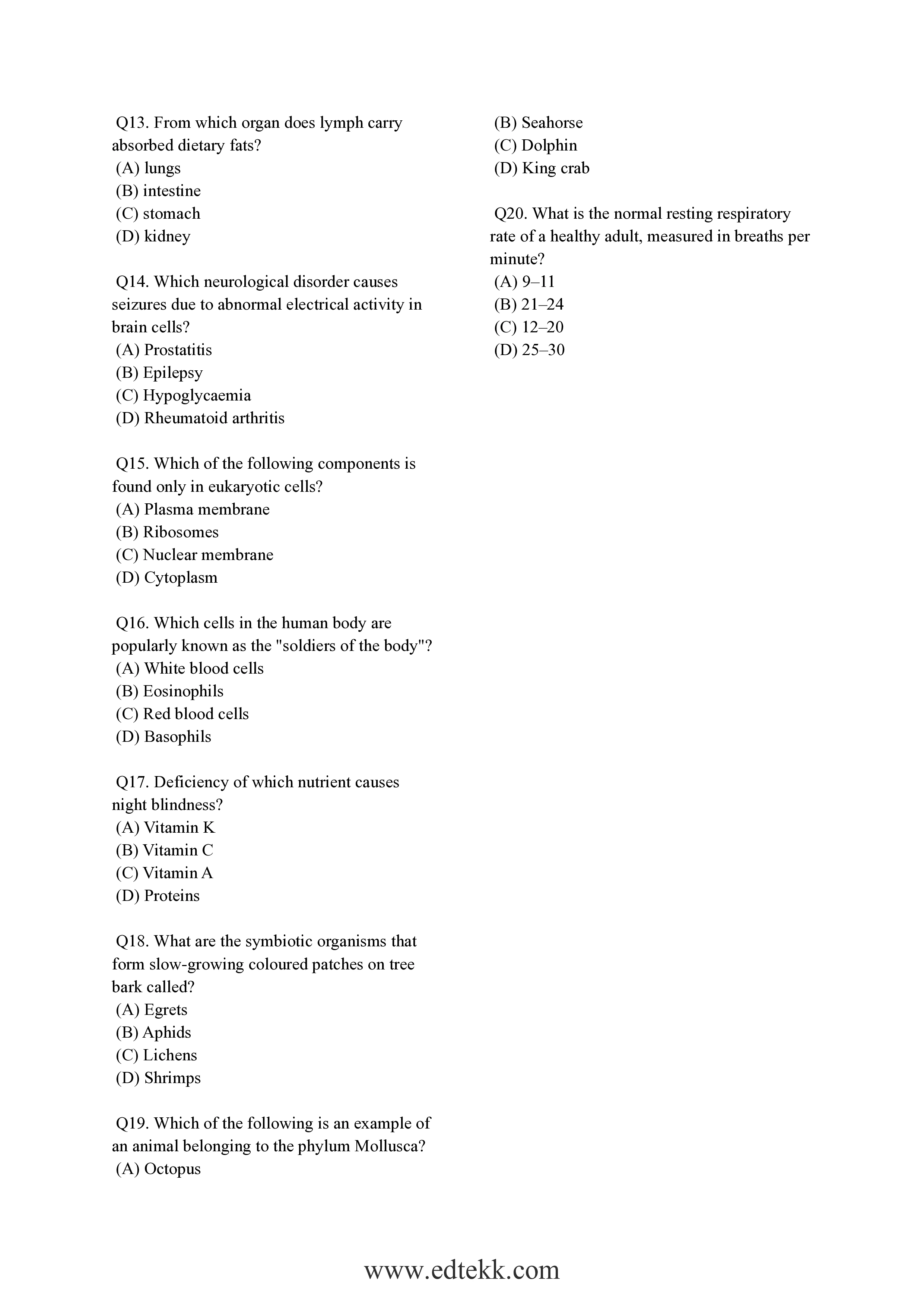
Q13. From which organ does lymph carry absorbed dietary fats?
(A) lungs
(B) intestine
(C) stomach
(D) kidney
Explanation: Lymph carries absorbed dietary fats from the small intestine through specialised lymphatic capillaries called lacteals. These vessels absorb fats packaged into chylomicrons. The resulting fat-rich lymph, known as chyle, travels through the lymphatic vessels and eventually enters the bloodstream, mainly through the thoracic duct.
Q14. Which neurological disorder causes seizures due to abnormal electrical activity in brain cells?
(A) Prostatitis
(B) Epilepsy
(C) Hypoglycaemia
(D) Rheumatoid arthritis
Explanation: Epilepsy is a neurological disorder characterised by an enduring predisposition to recurrent, unprovoked seizures. Seizures result from abnormal, excessive or synchronous electrical activity in the brain. Their manifestations vary depending on the brain regions involved and may include involuntary movements, altered awareness and temporary loss of consciousness.
Q15. Which of the following components is found only in eukaryotic cells?
(A) Plasma membrane
(B) Ribosomes
(C) Nuclear membrane
(D) Cytoplasm
Explanation: The nuclear membrane, also called the nuclear envelope, is a characteristic component of eukaryotic cells. It surrounds the nucleus and separates the genetic material from the cytoplasm. Ribosomes, plasma membranes and cytoplasm are present in both prokaryotic and eukaryotic cells, whereas prokaryotes lack a membrane-bound nucleus.
Q16. Which cells in the human body are popularly known as the “soldiers of the body”?
(A) White blood cells
(B) Eosinophils
(C) Red blood cells
(D) Basophils
Explanation: White blood cells, also known as leukocytes, are popularly called the soldiers of the human body because they protect the body against infections and foreign substances. Different types of white blood cells perform specialised immune functions, including engulfing pathogens, producing antibodies and coordinating immune responses.
Q17. Deficiency of which nutrient causes night blindness?
(A) Vitamin K
(B) Vitamin C
(C) Vitamin A
(D) Proteins
Explanation: Vitamin A deficiency can cause night blindness, a condition characterised by difficulty seeing in dim light or darkness. Vitamin A is required for the formation of retinal, a component of rhodopsin, the light-sensitive pigment present in the rod cells of the retina. Prolonged deficiency can cause corneal damage and permanent blindness.
Q18. What are the symbiotic organisms that form slow-growing coloured patches on tree bark called?
(A) Egrets
(B) Aphids
(C) Lichens
(D) Shrimps
Explanation: Lichens are associations between a fungus and a photosynthetic partner, usually a green alga or cyanobacterium. They commonly grow slowly on tree bark, rocks and other surfaces, forming coloured patches. The fungal partner provides structural support and helps retain moisture, while the photosynthetic partner produces organic nutrients.
Q19. Which of the following is an example of an animal belonging to the phylum Mollusca?
(A) Octopus
(B) Seahorse
(C) Dolphin
(D) King crab
Explanation: Octopuses belong to the phylum Mollusca and the class Cephalopoda. They have soft bodies, arms bearing suckers and typically lack an external shell in their adult stage. Seahorses and dolphins belong to Chordata, while king crabs belong to Arthropoda.
Q20. What is the normal resting respiratory rate of a healthy adult, measured in breaths per minute?
(A) 9–11
(B) 21–24
(C) 12–20
(D) 25–30
Explanation: The normal resting respiratory rate of a healthy adult is approximately 12–20 breaths per minute. Breathing is regulated primarily by respiratory centres in the brainstem. Exercise, fever, anxiety and certain illnesses can increase the respiratory rate. Persistent abnormalities may warrant medical evaluation.
Question Paper Images