Build a strong foundation in General Science with Railway Chemistry MCQs – Paper 1. This topicwise practice set includes objective questions, answers and explanations covering Chemistry concepts relevant to competitive examinations. It is designed for RRB NTPC, Group D, ALP and Technician aspirants preparing for Railway recruitment exams.
Test Details
Topic: Chemistry
Total Questions: 20
Question Format: MCQs – Single Correct Answer
Suitable for: RRB NTPC, Group D, ALP, Technician
Download All Papers in This Series (PDF)
Questions and Answers
Q1. Which of the following substances has a strong fruity fragrance?
(A) Methyl chloride
(B) Methanoic acid
(C) Ethyl acetate
(D) Methanol
Explanation: Ethyl acetate is an ester with a characteristic pleasant, fruity odour. Esters are commonly responsible for the fruity fragrances of many fruits and are widely used in perfumes, artificial flavourings and as organic solvents in paints, adhesives and nail polish removers.
Q2. Which of the following particles is not positively charged?
(A) Alpha particle
(B) Electron
(C) Helium nucleus
(D) Proton
Explanation: An electron carries a negative electric charge (−1e), whereas a proton carries a positive charge (+1e). An alpha particle is the nucleus of a helium-4 atom, containing two protons and two neutrons, and has a charge of +2e. Therefore, the electron is the only negatively charged particle among the options.
Q3. How are positively charged ions, known as cations, formed?
(A) Addition of electron
(B) Addition of proton
(C) Removal of electron
(D) Removal of proton
Explanation: Cations are positively charged ions commonly formed when neutral atoms lose one or more electrons. Electron loss leaves the species with more protons than electrons, producing a net positive charge. For example, sodium forms Na⁺ by losing one electron: Na → Na⁺ + e⁻. Electron gain generally produces anions.
Q4. What type of chemical reaction produces a single product from two or more reactants?
(A) Decomposition reaction
(B) Displacement reaction
(C) Combination reaction
(D) Double displacement reaction
Explanation: A combination reaction is a chemical reaction in which two or more reactants combine to form a single product. It is generally represented as A + B → AB. Decomposition reactions involve the opposite process, in which a single compound breaks down into two or more simpler substances.
Q5. Which class of compounds is formed by the reaction of an oxoacid with a hydroxyl compound, such as an alcohol or phenol?
(A) Carbonyls
(B) Amines
(C) Esters
(D) Carboxylic acids
Explanation: Esters are formed through esterification, a reaction between an oxoacid, commonly a carboxylic acid, and a hydroxyl-containing compound such as an alcohol or phenol. The reaction generally involves the elimination of water. Esters commonly have fruity odours and are widely used in perfumes, flavourings and solvents.
Q6. What does the Greek-origin word ‘Elektron’ mean?
(A) Amber
(B) Negative
(C) Ebonite
(D) Charge
Explanation: The Greek word ‘Elektron’ means amber. In ancient times, it was observed that amber attracts lightweight objects when rubbed, owing to static electricity. The English word ‘electricity’ ultimately derives from this Greek term through the Latin word electricus.
Q7. What is the common name of the compound with the chemical formula C₆H₆?
(A) Methanol
(B) Acetic acid
(C) Benzene
(D) Acetone
Explanation: Benzene (C₆H₆) is an aromatic hydrocarbon consisting of a six-carbon ring with delocalised pi electrons. It is a colourless, volatile liquid widely used as an industrial chemical feedstock. Its molecular formula is C₆H₆, distinguishing it from methanol, acetic acid and acetone.
Q8. What is the chemical name of saltpetre?
(A) sodium chloride
(B) potassium nitrate
(C) potassium chloride
(D) sodium hydroxide
Explanation: Saltpetre, also spelled saltpeter, is the common name for potassium nitrate (KNO₃). It is used in fertilisers and in the manufacture of explosives. Sodium chloride, in contrast, is commonly known as common salt.
Q9. Which of the following ions is a cation?
(A) Ammonium
(B) Fluoride
(C) Chloride
(D) Iodide
Explanation: Ammonium (NH₄⁺) is a positively charged polyatomic ion and is therefore classified as a cation. Iodide (I⁻), fluoride (F⁻) and chloride (Cl⁻) are negatively charged ions and are classified as anions.
Q10. What is the name of the compound with the chemical formula CH₃CH₂OH?
(A) Acetic Acid
(B) Methane
(C) Ethanol
(D) Chloroform
Explanation: CH₃CH₂OH is the chemical formula of ethanol, a two-carbon alcohol containing a hydroxyl group (-OH). It is also known as ethyl alcohol and is the characteristic alcohol present in alcoholic beverages.
Q11. How many carbon atoms and hydrogen atoms, respectively, are present in a propane molecule?
(A) 2, 6
(B) 2, 4
(C) 3, 8
(D) 4, 7
Explanation: Propane has the molecular formula C₃H₈. Each molecule contains three carbon atoms and eight hydrogen atoms. It is the third member of the alkane series, which follows the general formula CₙH₂ₙ₊₂. Propane is widely used as a fuel and is a component of liquefied petroleum gas (LPG).
Q12. Which of the following methods is NOT used to purify organic compounds?
(A) Sublimation
(B) Sedimentation
(C) Distillation
(D) Crystallisation
Explanation: Sedimentation is not a standard method for purifying organic compounds. It is primarily used to separate suspended solid particles from liquids based on differences in density. Common methods for purifying organic compounds include crystallisation, sublimation, distillation and chromatography.
Q13. What are hydrocarbons containing exactly two carbon–carbon double bonds called?
(A) Terpenes
(B) Trialkyne
(C) Dienes
(D) Dialkyne
Explanation: Dienes are hydrocarbons containing two carbon–carbon double bonds (C=C). Depending on the arrangement of these bonds, they are classified as conjugated, isolated or cumulated dienes. Dialkynes, in contrast, contain two carbon–carbon triple bonds.
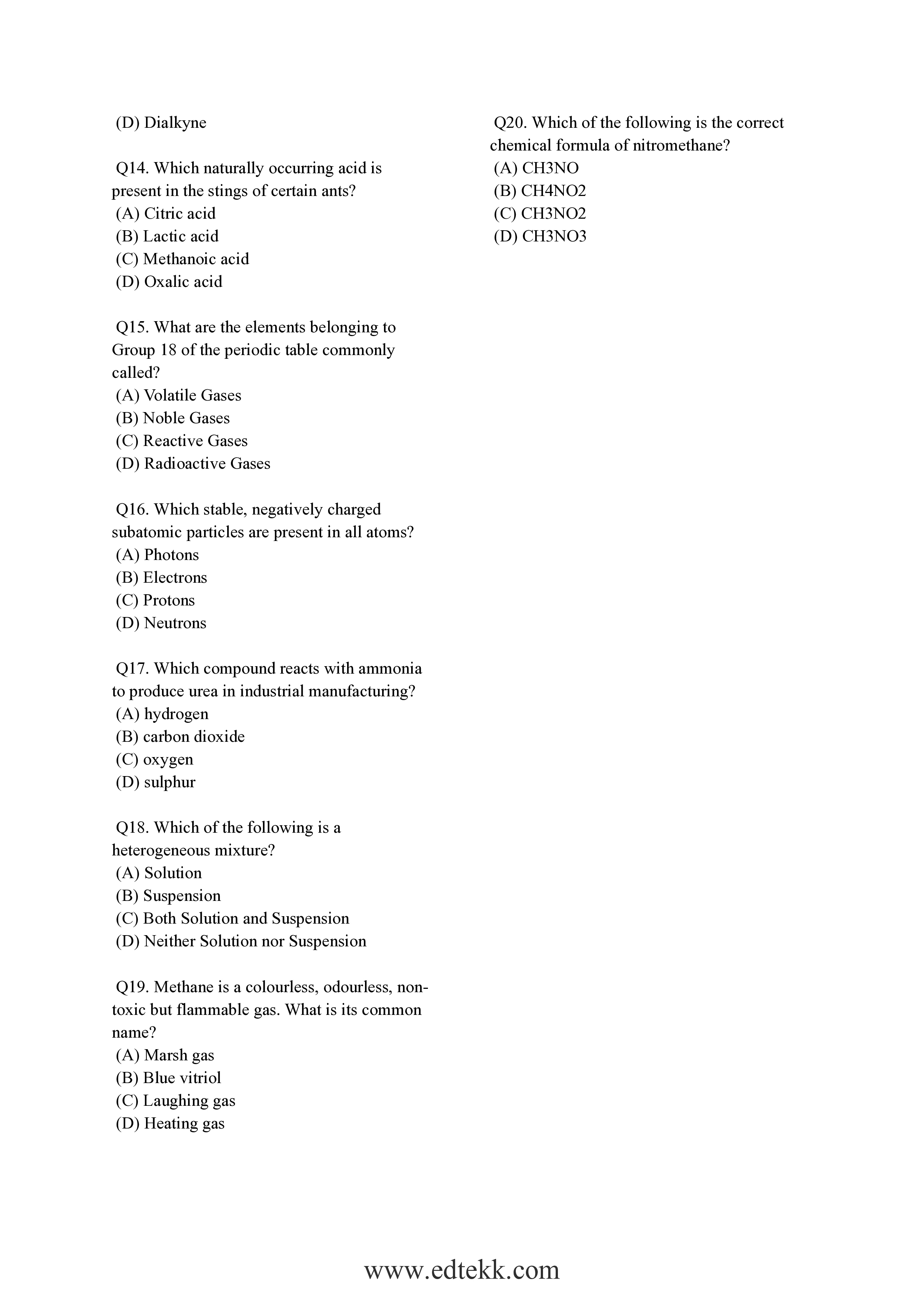
Q14. Which naturally occurring acid is present in the stings of certain ants?
(A) Citric acid
(B) Lactic acid
(C) Methanoic acid
(D) Oxalic acid
Explanation: Methanoic acid, commonly known as formic acid, is naturally present in the venom of many ant species. It is responsible for the characteristic irritating sensation associated with certain ant stings. Its chemical formula is HCOOH. However, not all ant species use formic acid as their primary defensive chemical.
Q15. What are the elements belonging to Group 18 of the periodic table commonly called?
(A) Volatile Gases
(B) Noble Gases
(C) Reactive Gases
(D) Radioactive Gases
Explanation: Group 18 elements of the periodic table are commonly known as noble gases. They include helium, neon, argon, krypton, xenon, radon and oganesson. They generally possess completely filled outermost electron shells, making them relatively unreactive. However, some heavier noble gases can form compounds under specific conditions.
Q16. Which stable, negatively charged subatomic particles are present in all atoms?
(A) Photons
(B) Electrons
(C) Protons
(D) Neutrons
Explanation: Electrons are stable, negatively charged subatomic particles present in all atoms. They occupy regions surrounding the nucleus and carry a charge of approximately −1.602 × 10⁻¹⁹ coulomb. Protons carry a positive charge, whereas neutrons have no electric charge. Photons are particles of electromagnetic radiation.
Q17. Which compound reacts with ammonia to produce urea in industrial manufacturing?
(A) hydrogen
(B) carbon dioxide
(C) oxygen
(D) sulphur
Explanation: Urea, with the chemical formula CO(NH₂)₂, is manufactured industrially by reacting ammonia (NH₃) with carbon dioxide (CO₂) under elevated pressure and temperature. The process initially produces ammonium carbamate, which subsequently dehydrates to form urea and water. Urea is widely used as a nitrogen-rich fertiliser.
Q18. Which of the following is a heterogeneous mixture?
(A) Solution
(B) Suspension
(C) Both Solution and Suspension
(D) Neither Solution nor Suspension
Explanation: A suspension is a heterogeneous mixture in which relatively large particles are dispersed throughout a medium without dissolving. These particles may settle on standing and can generally be separated by filtration. In contrast, a true solution is a homogeneous mixture in which the solute is uniformly distributed at the molecular or ionic level.
Q19. Methane is a colourless, odourless, non-toxic but flammable gas. What is its common name?
(A) Marsh gas
(B) Blue vitriol
(C) Laughing gas
(D) Heating gas
Explanation: Methane (CH₄) is commonly known as marsh gas because it is naturally produced in marshes, swamps and other oxygen-deficient environments through the anaerobic decomposition of organic matter by microorganisms. It is colourless, odourless in its pure form and highly flammable.
Q20. Which of the following is the correct chemical formula of nitromethane?
(A) CH3NO
(B) CH4NO2
(C) CH3NO2
(D) CH3NO3
Explanation: Nitromethane has the molecular formula CH₃NO₂. It consists of a methyl group (CH₃) attached to a nitro group (NO₂). It is the simplest organic nitro compound and is used as an industrial solvent and in specialised fuel applications.
Question Paper Images