Prepare for Railway examinations with General Science Physics MCQs – Paper 1. This practice set covers important Physics concepts through topicwise questions, answers and explanations. Designed for RRB NTPC, Group D, ALP and Technician exams, it helps candidates strengthen fundamentals and improve accuracy.
Test Details
Topic: Physics
Total Questions: 20
Question Format: MCQs – Single Correct Answer
Suitable for: RRB NTPC, Group D, ALP, Technician
Download All Papers in This Series (PDF)
Questions and Answers
Q1. What is the SI unit of magnetic flux density?
(A) Cobalt
(B) Ohm
(C) Tesla
(D) Ampere
Explanation: Tesla (T) is the SI unit of magnetic flux density, commonly called the magnetic field in elementary physics. One tesla is equivalent to one weber per square metre (Wb/m²). It is named after the scientist and inventor Nikola Tesla.
Q2. Which subatomic particles constitute cathode rays?
(A) electrons
(B) positrons
(C) neutrons
(D) protons
Explanation: Cathode rays are streams of negatively charged electrons emitted from the cathode in a discharge tube under suitable conditions. They travel towards the anode and can be deflected by electric and magnetic fields. J. J. Thomson’s experiments with cathode rays in 1897 established the existence of electrons.
Q3. Which scientist developed the theory of relativity?
(A) Niels Bohr
(B) Albert Einstein
(C) Ernest Rutherford
(D) JJ Thomson
Explanation: Albert Einstein developed the special theory of relativity in 1905 and the general theory of relativity, published in its final form in 1915. These theories revolutionised the understanding of space, time, gravity and motion. Niels Bohr, Ernest Rutherford and J. J. Thomson contributed significantly to atomic physics.
Q4. Which scientist demonstrated through prism experiments that white light can be separated into its constituent colours?
(A) Galileo Galilei
(B) Niels Bohr
(C) Albert Einstein
(D) Isaac Newton
Explanation: Isaac Newton demonstrated the dispersion of white light through prism experiments. He showed that white light separates into its constituent colours when passed through a glass prism and that these colours can be recombined to produce white light. This established that white light contains light of different visible wavelengths.
Q5. Approximately how many joules of heat energy are equivalent to one calorie?
(A) 0.48
(B) 0.24
(C) 2.4
(D) 4.2
Explanation: One calorie is approximately the amount of heat required to raise the temperature of 1 gram of water by 1°C. Its mechanical equivalent is approximately 4.184 joules. Therefore, one calorie is conventionally rounded to 4.2 joules.
Q6. Which physical quantity is represented by the slope of a distance–time graph?
(A) acceleration
(B) speed
(C) momentum
(D) mass
Explanation: The slope of a distance–time graph represents speed. It is calculated as the change in distance divided by the corresponding time interval. A steeper slope indicates greater speed, while a horizontal line indicates that the object is at rest.
Q7. How many times stronger is the magnetic field produced by an n-turn coil than that produced by an otherwise identical single-turn coil?
(A) (n^2/2)
(B) (n^2)
(C) (n/2)
(D) (n)
Explanation: The magnetic field at the centre of a circular coil is directly proportional to its number of turns, provided the current and radius remain constant. Therefore, an n-turn circular coil produces a magnetic field n times that of an otherwise identical single-turn coil carrying the same current.
Q8. Which of the following is the SI unit of temperature?
(A) Reaumur scale
(B) Candela
(C) Kelvin
(D) Ampere
Explanation: The kelvin (K) is the SI base unit of thermodynamic temperature. It is used in scientific measurements and is distinct from the Celsius and Fahrenheit scales commonly used for everyday temperature measurements.
Q9. Which type of mirror always forms a virtual, erect and diminished image of a real object placed in front of it?
(A) Plane mirror
(B) Concave mirror
(C) Convex mirror
(D) Cylindrical mirror
Explanation: A convex mirror always forms a virtual, erect and diminished image of a real object placed in front of it. The image appears behind the mirror, irrespective of the object’s position. Convex mirrors provide a wide field of view and are commonly used as rear-view and side-view mirrors in vehicles.
Q10. What is the SI unit of speed?
(A) m/s
(B) km/s
(C) km/hr
(D) m/hr
Explanation: The SI unit of speed is metre per second (m/s). Speed is defined as the distance travelled per unit time. Although kilometres per hour (km/h) is commonly used in everyday life, it is not the SI unit of speed.
Q11. Which physical quantity is calculated by dividing the total energy consumed by the total time taken?
(A) force
(B) power
(C) torque
(D) momentum
Explanation: Average power is calculated by dividing the total energy consumed by the total time taken. Mathematically, (P_{text{average}}=E_{text{total}}/t_{text{total}}). Its SI unit is the watt (W), equivalent to one joule per second.
Q12. What is the size of the image formed by a concave mirror when an object is placed between its pole and principal focus?
(A) Same Size
(B) Enlarged
(C) Diminished
(D) Point Size
Explanation: When an object is placed between the pole and principal focus of a concave mirror, the reflected rays diverge and their extensions meet behind the mirror. The resulting image is virtual, erect and enlarged. This property makes concave mirrors useful in shaving and makeup mirrors.
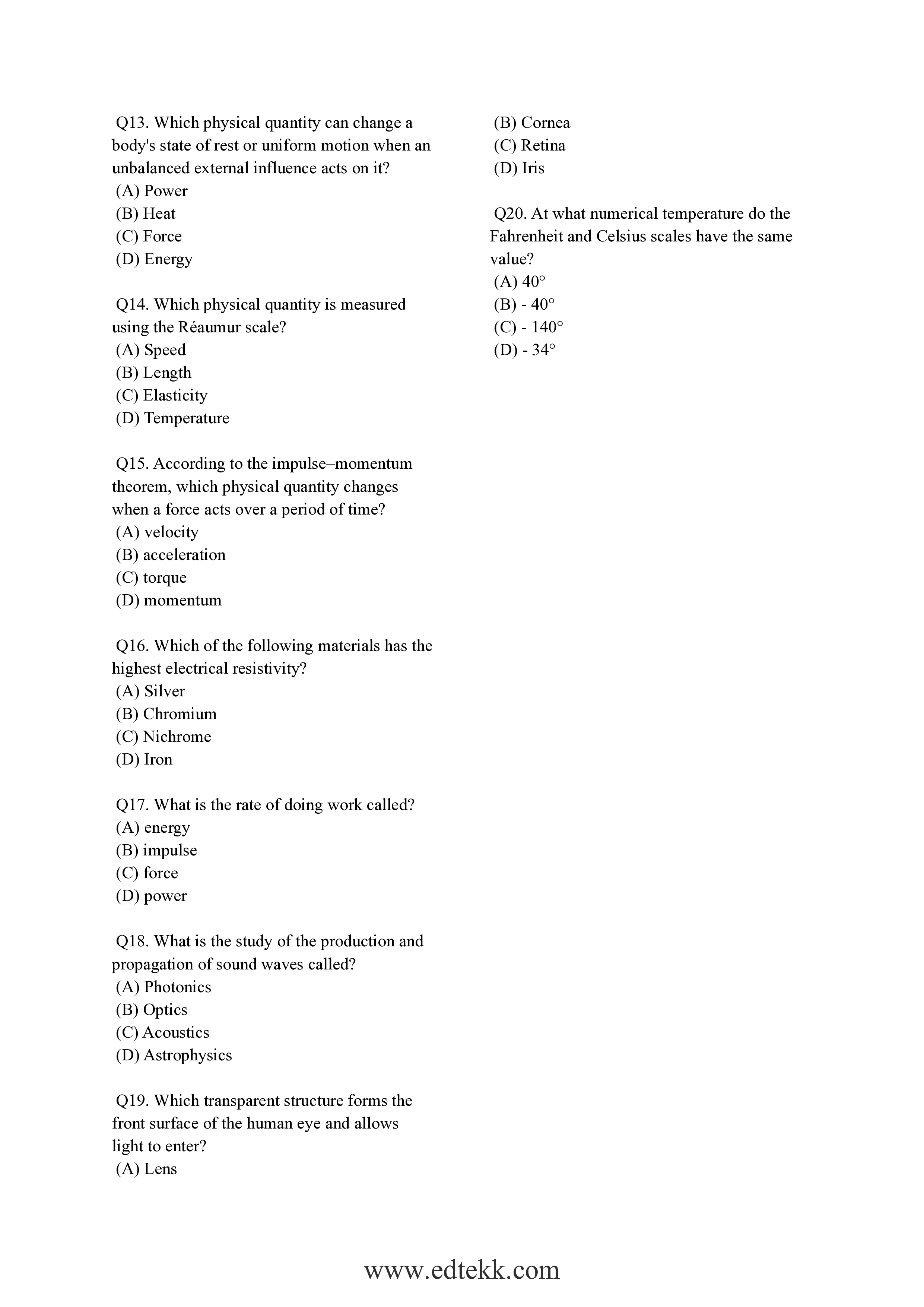
Q13. Which physical quantity can change a body’s state of rest or uniform motion when an unbalanced external influence acts on it?
(A) Power
(B) Heat
(C) Force
(D) Energy
Explanation: Force is an external influence that can change an object’s state of rest or uniform motion. An unbalanced net force produces acceleration, resulting in a change in speed, direction or both. According to Newton’s second law, acceleration is directly proportional to the net force and inversely proportional to the object’s mass.
Q14. Which physical quantity is measured using the Réaumur scale?
(A) Speed
(B) Length
(C) Elasticity
(D) Temperature
Explanation: The Réaumur scale is a historical temperature scale in which the freezing point of water is 0°Ré and its boiling point is 80°Ré at standard atmospheric pressure. It was formerly used in some European countries but has largely been replaced by the Celsius scale.
Q15. According to the impulse–momentum theorem, which physical quantity changes when a force acts over a period of time?
(A) velocity
(B) acceleration
(C) torque
(D) momentum
Explanation: According to the impulse-momentum theorem, the impulse of the net force acting on a body equals the change in its momentum. Mathematically, (J=Delta p). For a constant net force, (FDelta t=Delta p), where (F) is the net force and (Delta t) is the time interval.
Q16. Which of the following materials has the highest electrical resistivity?
(A) Silver
(B) Chromium
(C) Nichrome
(D) Iron
Explanation: Among silver, chromium, iron and nichrome, nichrome has the highest electrical resistivity. Nichrome is an alloy primarily composed of nickel and chromium. Its high resistivity, oxidation resistance and ability to withstand elevated temperatures make it suitable for heating elements in electric heaters, toasters and other electrical appliances.
Q17. What is the rate of doing work called?
(A) energy
(B) impulse
(C) force
(D) power
Explanation: Power is defined as the rate of doing work or transferring energy per unit time. Mathematically, average power is expressed as (P=W/t), where (W) represents the work done and (t) represents the time taken. Its SI unit is the watt (W), equivalent to one joule per second.
Q18. What is the study of the production and propagation of sound waves called?
(A) Photonics
(B) Optics
(C) Acoustics
(D) Astrophysics
Explanation: Acoustics is the branch of physics concerned with the production, transmission, propagation and effects of sound waves. It includes phenomena such as reflection, absorption, resonance and interference of sound. Optics deals with light, while astrophysics studies physical processes in celestial objects.
Q19. Which transparent structure forms the front surface of the human eye and allows light to enter?
(A) Lens
(B) Cornea
(C) Retina
(D) Iris
Explanation: The cornea is the transparent, dome-shaped front surface of the human eye. It allows light to enter and provides much of the eye’s refractive power by bending incoming light. It also helps protect the eye from dust and microorganisms. The iris regulates pupil size, while the retina detects light and converts it into nerve signals.
Q20. At what numerical temperature do the Fahrenheit and Celsius scales have the same value?
(A) 40°
(B) – 40°
(C) – 140°
(D) – 34°
Explanation: The Fahrenheit and Celsius scales have the same numerical value at −40 degrees. This can be verified using the conversion formula (F=frac{9}{5}C+32). Substituting −40°C gives −40°F. Thus, −40 is the common numerical value on both scales.
Question Paper Images