Prepare for SSC examinations with this fourth topicwise Biology MCQ paper under General Science. The set contains 20 multiple-choice practice questions covering important Biology concepts, with correct answers and explanations to support thorough revision and improve accuracy. It is suitable for candidates preparing for SSC CGL, CHSL, CPO, MTS, GD and Selection Post examinations.
Test Details
Topic: Biology
Total Questions: 20
Question Format: MCQs – Single Correct Answer
Suitable for: SSC CGL, CHSL, CPO, MTS, GD, Selection Post
Download All Papers in This Series (PDF)
Questions and Answers
Q1. Which type of reproduction commonly occurs in Hydra?
(A) Fragmentation
(B) Budding
(C) Binary Fission
(D) Spore Formation
Explanation: Hydra commonly reproduces asexually through budding. A small outgrowth develops on the parent’s body through repeated cell division, gradually forming a mouth and tentacles. Once fully developed, the bud separates from the parent and becomes an independent individual. Hydra can also reproduce sexually under certain environmental conditions.
Q2. Which of the following belongs to the family Hominidae?
(A) Man
(B) Mango
(C) Housefly
(D) Wheat
Explanation: Humans belong to the family Hominidae, which includes the great apes, namely chimpanzees, gorillas, orangutans and humans. Mango and wheat are plants, while houseflies belong to the phylum Arthropoda.
Q3. Which of the following animals is oviparous?
(A) Squirrel
(B) Rabbit
(C) Mouse
(D) Frog
Explanation: Frogs are oviparous animals, meaning they reproduce by laying eggs. Most frogs lay their eggs in water, where fertilisation generally occurs externally. Rabbits, mice and squirrels are mammals that give birth to live young. Therefore, frog is the correct answer.
Q4. Which of the following animals is commonly known as the ‘white ant’?
(A) Mosquito
(B) Wasp
(C) Termite
(D) Housefly
Explanation: A termite is commonly called a white ant because of its pale appearance and social behaviour. However, termites are not true ants; they belong to a separate insect group and are evolutionarily more closely related to cockroaches. They live in organised colonies consisting of reproductive individuals, workers and soldiers.
Q5. How many canine teeth does an adult human normally have?
(A) 8
(B) 4
(C) 3
(D) 2
Explanation: An adult human normally has four canine teeth: two in the upper jaw and two in the lower jaw. Canines are pointed teeth located between the incisors and premolars. They help tear food and contribute to the alignment and guidance of teeth during jaw movements.
Q6. Which of the following substances has the greatest affinity for haemoglobin?
(A) Oxygen
(B) Carbon monoxide
(C) Carbon dioxide
(D) Nitrogen
Explanation: Haemoglobin has a much greater affinity for carbon monoxide than for oxygen, approximately 200–250 times greater under commonly cited physiological conditions. Carbon monoxide forms carboxyhaemoglobin, reducing the blood’s oxygen-carrying capacity and impairing oxygen release to tissues. Exposure can cause severe, potentially fatal poisoning.
Q7. Where does glucose break down into pyruvate?
(A) Golgi bodies
(B) Chloroplast
(C) Cytoplasm
(D) Protoplasm
Explanation: Glycolysis is the metabolic pathway in which one molecule of glucose is converted into two molecules of pyruvate. It occurs in the cytoplasm of cells and does not directly require oxygen. The process produces a net gain of two ATP molecules and two NADH molecules per glucose molecule and constitutes the first stage of cellular respiration.
Q8. What is the vertical distribution of different species across the levels of an ecosystem called?
(A) biomagnification
(B) stratification
(C) revolution
(D) decomposition
Explanation: Stratification refers to the vertical distribution of different species or communities at different levels in an ecosystem. For example, forest vegetation may be arranged into distinct layers, including the canopy, understory, shrub layer and forest floor.
Q9. What survival strategy do certain bacteria adopt by forming thick-walled endospores under unfavourable conditions?
(A) Migration
(B) Conformity
(C) Dormancy
(D) Regulation
Explanation: Certain bacteria, including species of Bacillus and Clostridium, survive unfavourable environmental conditions by forming thick-walled endospores. These structures are highly resistant to heat, radiation, drying and chemicals. Endospore formation is a survival mechanism involving a dormant state, not a method of reproduction. The bacteria become active again when favourable conditions return.
Q10. Yeast and mushrooms belong to which kingdom?
(A) Monera
(B) Fungi
(C) Plantae
(D) Protista
Explanation: Yeast and mushrooms belong to kingdom Fungi. Fungi are eukaryotic, heterotrophic organisms that obtain nutrients through absorption. Yeast is generally unicellular and reproduces mainly by budding, whereas mushrooms are multicellular fungi with specialised reproductive structures.
Q11. What are the male reproductive structures that produce and contain sperm cells in bryophytes and ferns called?
(A) megasporangia
(B) antheridium
(C) archegonium
(D) protonema
Explanation: Antheridia are the male reproductive structures found in bryophytes and ferns. They produce and contain male gametes called antherozoids, which are generally flagellated and require water for fertilisation. Archegonia are the corresponding female reproductive structures that contain the egg cell.
Q12. Which cells in the retina respond to light and generate electrical signals?
(A) Photoreceptor cells (rods and cones)
(B) Optic nerve cells
(C) Ciliary muscles
(D) Vitreous humour
Explanation: Photoreceptor cells, consisting of rods and cones, are specialised light-sensitive cells in the retina. Rods enable vision in dim light, whereas cones are responsible for colour vision and sharp visual detail under brighter conditions. They convert light into electrical signals that are processed by retinal neurons and transmitted to the brain through the optic nerve.
Q13. What is the distinctive characteristic of marsupials?
(A) They lay eggs
(B) They carry young ones in pouches
(C) They hibernate in winter
(D) They migrate from one place to another
Explanation: Marsupials are mammals that generally give birth to relatively underdeveloped young. Their offspring continue developing after birth, usually attached to a teat and often protected inside a pouch called the marsupium. Kangaroos, koalas and wombats are well-known examples of marsupials.
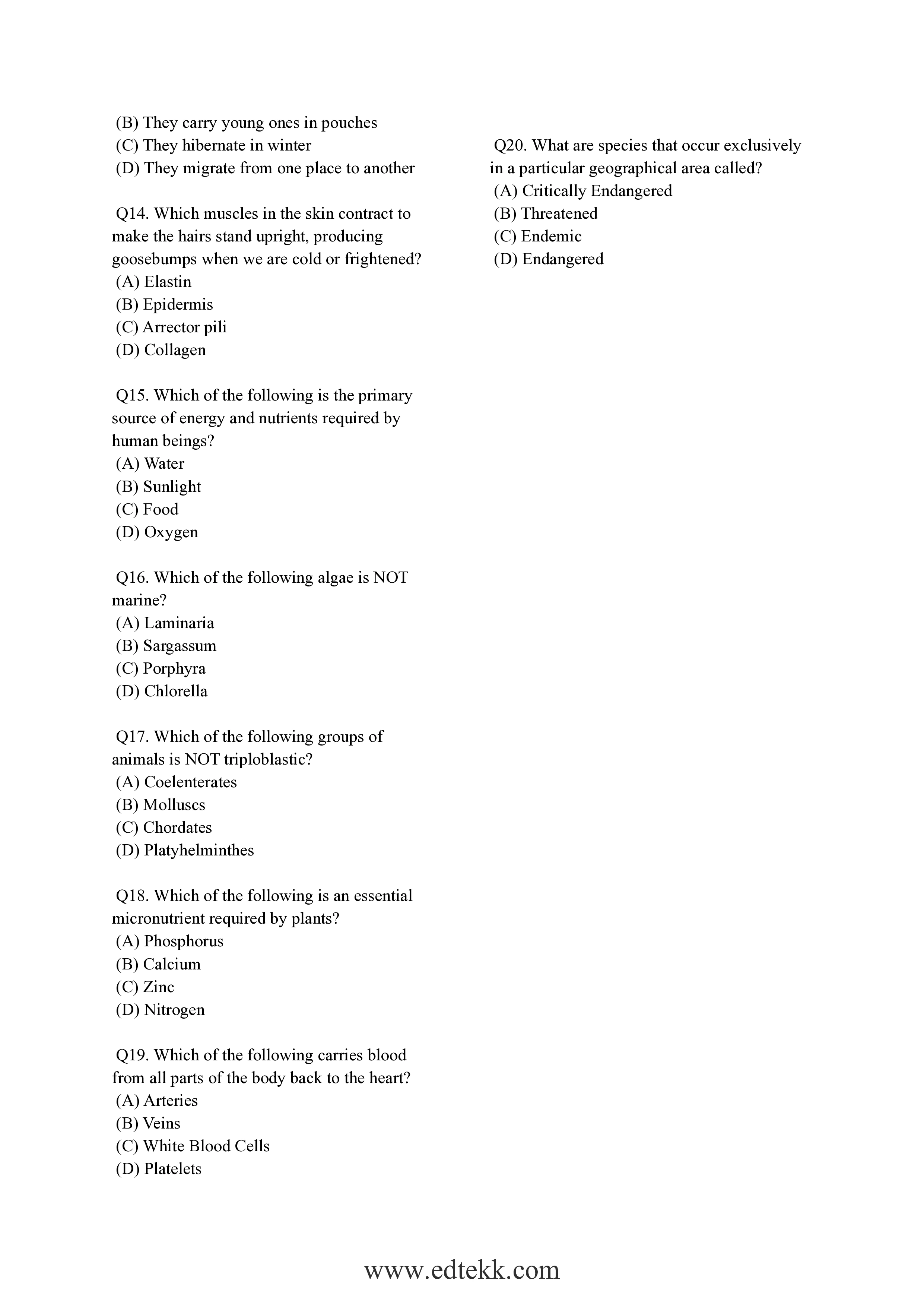
Q14. Which muscles in the skin contract to make the hairs stand upright, producing goosebumps when we are cold or frightened?
(A) Elastin
(B) Epidermis
(C) Arrector pili
(D) Collagen
Explanation: Arrector pili are small, involuntary smooth muscles attached to hair follicles. When these muscles contract, they pull the hairs upright and produce small elevations on the skin, commonly known as goosebumps. This response occurs during exposure to cold or in response to emotional stimuli such as fear.
Q15. Which of the following is the primary source of energy and nutrients required by human beings?
(A) Water
(B) Sunlight
(C) Food
(D) Oxygen
Explanation: Food is the primary source of energy and essential nutrients for human beings. It supplies carbohydrates, fats and proteins needed for energy production, growth and tissue repair, as well as vitamins and minerals required for normal physiological functioning. Water and oxygen are essential for survival but do not provide dietary energy.
Q16. Which of the following algae is NOT marine?
(A) Laminaria
(B) Sargassum
(C) Porphyra
(D) Chlorella
Explanation: Chlorella is a unicellular green alga commonly found in freshwater and other non-marine environments. In contrast, Sargassum, Porphyra and Laminaria are predominantly marine algae. Chlorella is also studied for its nutritional value, high protein content and potential applications in biotechnology and biofuel production.
Q17. Which of the following groups of animals is NOT triploblastic?
(A) Coelenterates
(B) Molluscs
(C) Chordates
(D) Platyhelminthes
Explanation: Coelenterates, traditionally called cnidarians, are diploblastic animals. They develop from two primary germ layers, the ectoderm and endoderm, with mesoglea between them. Molluscs, chordates and platyhelminthes are triploblastic animals possessing three primary germ layers.
Q18. Which of the following is an essential micronutrient required by plants?
(A) Phosphorus
(B) Calcium
(C) Zinc
(D) Nitrogen
Explanation: Zinc is an essential plant micronutrient required in small quantities for normal growth and development. It contributes to enzyme activity, protein synthesis, and the regulation of growth-related processes. Although phosphorus, calcium, and nitrogen are also essential plant nutrients, they are classified as macronutrients because plants generally require them in substantially larger quantities than zinc.
Q19. Which of the following carries blood from all parts of the body back to the heart?
(A) Arteries
(B) Veins
(C) White Blood Cells
(D) Platelets
Explanation: Veins generally carry blood from body tissues towards the heart. Most veins transport deoxygenated blood, although pulmonary veins carry oxygenated blood from the lungs to the heart. In contrast, arteries carry blood away from the heart, while white blood cells and platelets are components of blood.
Q20. What are species that occur exclusively in a particular geographical area called?
(A) Critically Endangered
(B) Threatened
(C) Endemic
(D) Endangered
Explanation: Endemic species are plants or animals naturally restricted to a particular geographical region and not found naturally elsewhere. Their distribution may be limited to an island, mountain range, country or other specific area. Endemism describes geographical restriction and does not necessarily indicate that a species is endangered.
Question Paper Images