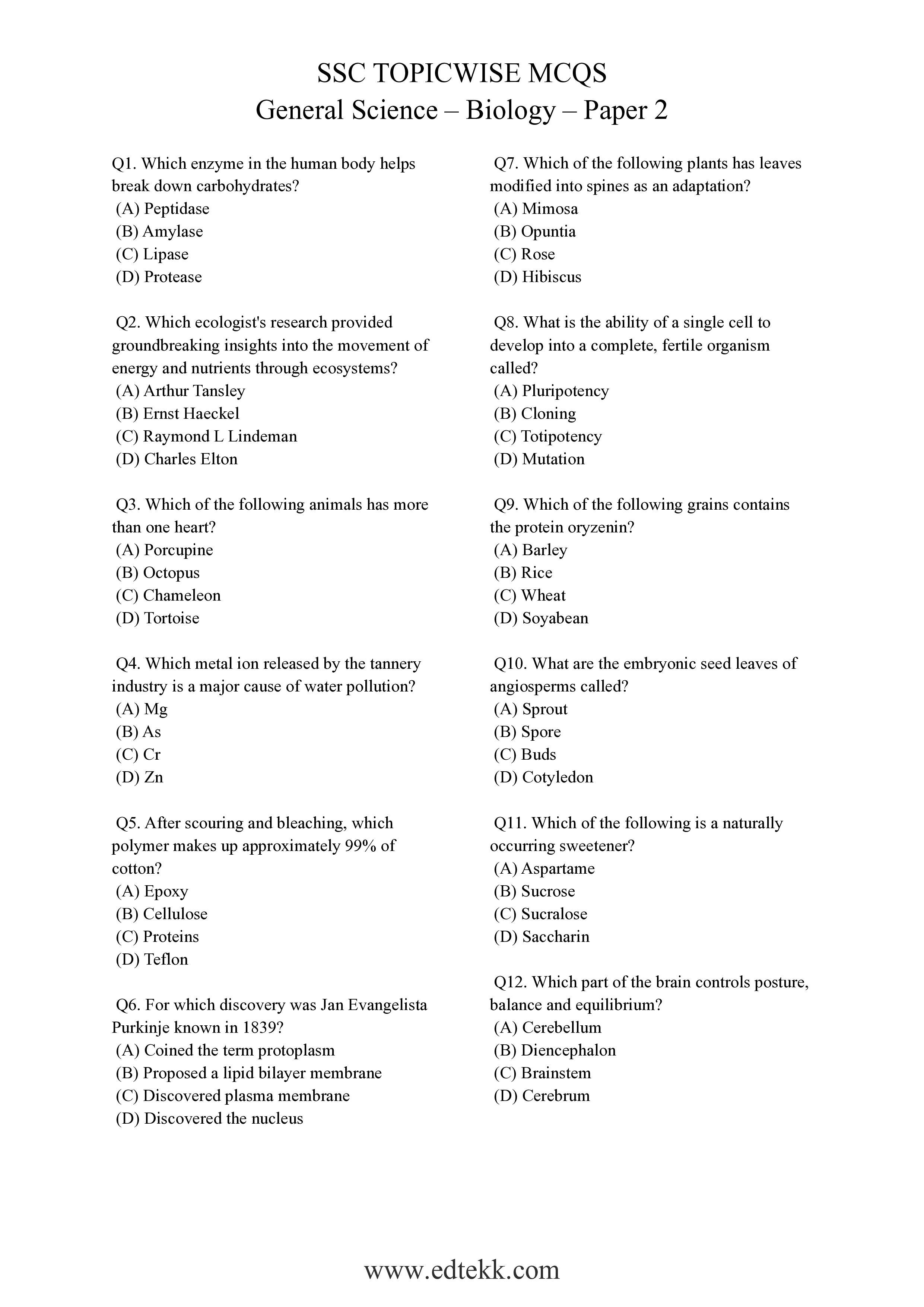
Improve your Biology preparation with this second topicwise General Science MCQ paper for SSC examinations. This set includes 20 objective questions designed to strengthen understanding of important Biology concepts, along with correct answers and explanations for effective practice and revision for SSC CGL, CHSL, CPO, MTS, GD and Selection Post.
Test Details
Topic: Biology
Total Questions: 20
Question Format: MCQs – Single Correct Answer
Suitable for: SSC CGL, CHSL, CPO, MTS, GD, Selection Post
Download All Papers in This Series (PDF)
Questions and Answers
Q1. Which enzyme in the human body helps break down carbohydrates?
(A) Peptidase
(B) Amylase
(C) Lipase
(D) Protease
Explanation: Amylase is an enzyme that breaks down starch into smaller carbohydrates, including maltose and oligosaccharides. It is produced primarily by the salivary glands and pancreas. Peptidases and proteases digest proteins, whereas lipase breaks down fats. Thus, amylase is the correct answer for carbohydrate digestion.
Q2. Which ecologist’s research provided groundbreaking insights into the movement of energy and nutrients through ecosystems?
(A) Arthur Tansley
(B) Ernst Haeckel
(C) Raymond L Lindeman
(D) Charles Elton
Explanation: Raymond L. Lindeman made fundamental contributions to ecosystem ecology through his trophic-dynamic concept. His research explained how energy is transferred through successive trophic levels and how energy availability decreases along food chains. His work significantly advanced the scientific understanding of ecosystem functioning and energy flow.
Q3. Which of the following animals has more than one heart?
(A) Porcupine
(B) Octopus
(C) Chameleon
(D) Tortoise
Explanation: An octopus possesses three hearts: two branchial hearts that pump blood through the gills and one systemic heart that circulates oxygenated blood throughout the body. Porcupines, chameleons and tortoises each possess a single heart. This three-heart arrangement is characteristic of octopuses and other cephalopods.
Q4. Which metal ion released by the tannery industry is a major cause of water pollution?
(A) Mg
(B) As
(C) Cr
(D) Zn
Explanation: Chromium is a major pollutant associated with tannery effluents because chromium salts, particularly chromium(III) compounds, are widely used in leather tanning. Improper discharge contaminates water bodies. Hexavalent chromium (Cr(VI)) is particularly toxic, carcinogenic and harmful to aquatic organisms and human health.
Q5. After scouring and bleaching, which polymer makes up approximately 99% of cotton?
(A) Epoxy
(B) Cellulose
(C) Proteins
(D) Teflon
Explanation: Cellulose is the principal structural polymer of cotton fibres. After thorough scouring and bleaching, highly purified cotton may contain approximately 99% cellulose, depending on processing conditions. Cellulose is a natural polysaccharide composed of β-D-glucose units joined by β-1,4-glycosidic bonds.
Q6. For which discovery was Jan Evangelista Purkinje known in 1839?
(A) Coined the term protoplasm
(B) Proposed a lipid bilayer membrane
(C) Discovered plasma membrane
(D) Discovered the nucleus
Explanation: Jan Evangelista Purkinje introduced the term protoplasm in 1839 to describe the living substance within cells. The term subsequently became important in cell biology for referring to the living contents of a cell. Purkinje also made significant contributions to physiology and the study of nervous tissue.
Q7. Which of the following plants has leaves modified into spines as an adaptation?
(A) Mimosa
(B) Opuntia
(C) Rose
(D) Hibiscus
Explanation: Opuntia, commonly known as prickly pear cactus, is a xerophytic plant adapted to dry environments. Its leaves are modified into spines, reducing water loss through transpiration and providing protection against herbivores. Its flattened, green stems perform photosynthesis and store water.
Q8. What is the ability of a single cell to develop into a complete, fertile organism called?
(A) Pluripotency
(B) Cloning
(C) Totipotency
(D) Mutation
Explanation: Totipotency is the ability of a single cell to develop into a complete organism under suitable conditions. A totipotent cell can give rise to all cell types, including embryonic and extraembryonic tissues. The zygote is a classic example of a totipotent cell.
Q9. Which of the following grains contains the protein oryzenin?
(A) Barley
(B) Rice
(C) Wheat
(D) Soyabean
Explanation: Oryzenin is the principal storage protein of rice and belongs to the glutelin group of proteins. It is found predominantly in the rice endosperm. Other cereals possess characteristic storage proteins, such as gliadins and glutenins in wheat and hordeins in barley.
Q10. What are the embryonic seed leaves of angiosperms called?
(A) Sprout
(B) Spore
(C) Buds
(D) Cotyledon
Explanation: Cotyledons are embryonic seed leaves present in angiosperm embryos. Monocotyledonous plants possess one cotyledon, whereas dicotyledonous plants generally possess two. Cotyledons may store food or absorb and transfer nutrients from stored food reserves to the developing embryo.
Q11. Which of the following is a naturally occurring sweetener?
(A) Aspartame
(B) Sucrose
(C) Sucralose
(D) Saccharin
Explanation: Sucrose is a naturally occurring disaccharide commonly known as table sugar. It is found naturally in sugarcane, sugar beet and several fruits. Aspartame, sucralose and saccharin are artificial sweeteners. Although sucrose is a natural sweetener, excessive consumption can contribute to obesity, dental caries and metabolic disorders.
Q12. Which part of the brain controls posture, balance and equilibrium?
(A) Cerebellum
(B) Diencephalon
(C) Brainstem
(D) Cerebrum
Explanation: The cerebellum coordinates voluntary movements and plays a central role in maintaining posture, balance and equilibrium. It integrates information from the vestibular system, sensory receptors and other parts of the nervous system to produce smooth, coordinated movements. Damage to the cerebellum can cause impaired balance, uncoordinated movements and an unsteady gait.
Q13. Who published an article in 1838 discussing the structure and origin of plant cells?
(A) Robert Brown
(B) Rudolf Virchow
(C) Matthias Schleiden
(D) Albert von Kolliker
Explanation: Matthias Schleiden, a German botanist, published his work on plant cells in 1838. He proposed that plants are composed of cells and that the cell is the basic structural unit of plant life. His work, together with Theodor Schwann’s subsequent studies on animals, contributed to the development of cell theory.
Q14. How is methane classified based on its contribution to global warming?
(A) infectious
(B) poisonous
(C) carcinogenic
(D) greenhouse
Explanation: Methane is classified as a greenhouse gas because it absorbs and re-emits infrared radiation, contributing to heat retention in the atmosphere. This process enhances the greenhouse effect and contributes to global warming. Other important greenhouse gases include carbon dioxide, nitrous oxide and water vapour.
Q15. Which of the following animals is NOT a non-chordate?
(A) Arthropods
(B) Porifera
(C) Reptiles
(D) Arachnids
Explanation: Reptiles are chordates and vertebrates, whereas arthropods, poriferans and arachnids are non-chordates. Chordates possess a notochord at least during some stage of development. Reptiles have a vertebral column and a well-developed internal skeleton.
Q16. Which animal phylum is commonly known as the flatworms?
(A) Platyhelminthes
(B) Ctenophora
(C) Porifera
(D) Cnidaria
Explanation: Platyhelminthes is the phylum commonly known as flatworms because its members have dorsoventrally flattened bodies. They are bilaterally symmetrical, triploblastic and acoelomate animals. Examples include planarians, tapeworms and liver flukes. Many species are parasitic, while others are free-living.
Q17. Which structure serves as a common passage for both sperm and urine in human males?
(A) vas deferens
(B) ureter
(C) seminal vesicle
(D) urethra
Explanation: The urethra is the common passage through which both urine and semen are discharged from the male body, although they do not normally pass simultaneously. Urine enters the urethra from the urinary bladder, while semen enters it through the ejaculatory ducts during ejaculation.
Q18. On which of the following is the numerical taxonomy of plants based?
(A) Chemical constituents
(B) All observable characteristics
(C) Structure
(D) Chromosome number
Explanation: Numerical taxonomy classifies organisms by evaluating a large number of observable characteristics and expressing similarities through numerical methods. In classical numerical taxonomy, characters are generally given equal weight, and organisms are grouped according to overall similarity. These characteristics may include morphological, anatomical, physiological and biochemical features.
Q19. Which of the following does NOT belong to Kingdom Fungi?
(A) Mucor
(B) Aspergillus
(C) Rhizopus
(D) Euglena
Explanation: Euglena does not belong to Kingdom Fungi. It is a unicellular, flagellated eukaryotic organism traditionally classified under Kingdom Protista. Aspergillus, Rhizopus and Mucor belong to Kingdom Fungi. Euglena possesses chloroplasts in photosynthetic species and can also obtain nutrients heterotrophically.
Q20. Which structures constitute the central nervous system in the human body?
(A) Only brain
(B) Only blood
(C) Only spinal cord
(D) Both brain and spinal cord
Explanation: The human central nervous system (CNS) consists of the brain and spinal cord. It receives and processes sensory information, coordinates responses and regulates various bodily functions. The peripheral nervous system comprises nerves and ganglia outside the CNS and connects it with the rest of the body.
Question Paper Images