Strengthen your General Science preparation with this third topicwise Biology MCQ paper for SSC examinations. It features 20 multiple-choice questions covering important Biology concepts, supported by correct answers and explanations. This practice set helps candidates assess their subject knowledge and prepare effectively for SSC CGL, CHSL, CPO, MTS, GD and Selection Post.
Test Details
Topic: Biology
Total Questions: 20
Question Format: MCQs – Single Correct Answer
Suitable for: SSC CGL, CHSL, CPO, MTS, GD, Selection Post
Download All Papers in This Series (PDF)
Questions and Answers
Q1. Which of the following is NOT a vertebrate?
(A) Mammal
(B) Snail
(C) Bird
(D) Fish
Explanation: A snail is an invertebrate because it lacks a vertebral column or backbone. It belongs to the phylum Mollusca and possesses a soft body, usually protected by a shell. Mammals, fish and birds are vertebrates because they possess a backbone and an internal skeletal framework.
Q2. What is the common name of Parthenium hysterophorus?
(A) Carrot grass
(B) Lemongrass
(C) Lawn grass
(D) Horse grass
Explanation: Parthenium hysterophorus is commonly known as carrot grass, congress grass or congress weed. It is an invasive weed that adversely affects agricultural productivity and biodiversity. Its pollen can cause allergic reactions, while contact with the plant may cause dermatitis and other allergic symptoms.
Q3. Which of the following can break down detritus into simpler inorganic substances?
(A) Algae
(B) Phytoplankton
(C) Fungal enzymes
(D) Lichens
Explanation: Decomposers, particularly fungi and bacteria, break down detritus (dead organic matter) into simpler substances through enzymatic activity. Fungal enzymes help decompose complex organic materials, facilitating mineralisation and the recycling of nutrients within ecosystems.
Q4. Which of the following cells is amoeboid in shape?
(A) White blood cell
(B) Nerve cell
(C) Columnar epithelial cell
(D) Red blood cell
Explanation: White blood cells, also called leukocytes, are generally amoeboid in shape. They can change their shape and form temporary projections to move through tissues and reach sites of infection. This movement is called amoeboid movement. Red blood cells, in contrast, have a characteristic biconcave disc shape.
Q5. Which group of plants is known as the amphibians of the plant kingdom?
(A) Bryophytes
(B) Liverworts
(C) Gymnosperms
(D) Pteridophytes
Explanation: Bryophytes are called the amphibians of the plant kingdom because they are primarily terrestrial but require water for sexual reproduction. Their motile male gametes swim through a film of water to reach the female reproductive structure. They include mosses, liverworts and hornworts and generally grow in moist environments.
Q6. Which metal ion is present in vitamin B12?
(A) Iron
(B) Zinc
(C) Cobalt
(D) Nickel
Explanation: Vitamin B12, also known as cobalamin, contains cobalt as its central metal ion. This element forms an essential part of the vitamin’s molecular structure. Vitamin B12 is necessary for normal red blood cell formation, DNA synthesis and proper nervous system functioning.
Q7. Which cell structure regulates the entry and exit of substances into and out of the cell?
(A) Cell wall
(B) Protoplasm
(C) Plasma membrane
(D) Cytoplasm
Explanation: The plasma membrane, also called the cell membrane, is selectively permeable. It regulates the movement of substances into and out of the cell, allowing certain materials to pass while restricting others. This selective permeability helps maintain the internal environment necessary for cellular activities.
Q8. Which type of symmetry is exhibited by arthropods?
(A) Bilateral
(B) Axial
(C) Translational
(D) Radial
Explanation: Arthropods exhibit bilateral symmetry, meaning their bodies can generally be divided into two approximately mirror-image halves along a single longitudinal plane. This characteristic is observed in insects, arachnids, crustaceans and myriapods. Their bodies also commonly exhibit segmentation and jointed appendages.
Q9. Which of the following diseases can be caused by drinking contaminated water?
(A) Cholera
(B) Rickets
(C) Anaemia
(D) Scurvy
Explanation: Cholera is an infectious disease caused by the bacterium Vibrio cholerae. It commonly spreads through drinking water or consuming food contaminated with the bacterium. The disease causes severe watery diarrhoea and vomiting, which can lead to dangerous dehydration and electrolyte loss if left untreated.
Q10. Which of the following diseases is NOT inherited?
(A) Malaria
(B) Down syndrome
(C) Muscular dystrophy
(D) Cystic fibrosis
Explanation: Malaria is an infectious disease caused by Plasmodium parasites and transmitted primarily through the bites of infected female Anopheles mosquitoes. It is acquired through infection rather than inherited genetically. Cystic fibrosis and muscular dystrophy are inherited genetic disorders, while Down syndrome usually results from a chromosomal abnormality.
Q11. Which leaf structure connects the leaf blade to the stem?
(A) Stipules
(B) Midrib
(C) Petiole
(D) Vein
Explanation: The petiole is the stalk-like structure that connects the leaf blade (lamina) to the stem. It supports the leaf and provides a passage for vascular tissues that transport water, minerals and manufactured food. Some leaves are sessile and lack a petiole.
Q12. The Bacille Calmette–Guérin (BCG) vaccine is used to prevent which disease?
(A) Jaundice
(B) Typhoid
(C) Tuberculosis
(D) Polio
Explanation: The Bacille Calmette–Guérin (BCG) vaccine is used to protect against tuberculosis (TB), an infectious disease caused by bacteria belonging to the Mycobacterium tuberculosis complex. It is particularly effective in protecting children against severe forms of tuberculosis, including tuberculous meningitis and disseminated TB. Its effectiveness against pulmonary tuberculosis varies across populations.
Q13. Which of the following is the smallest bird in the world?
(A) Bee Hummingbird
(B) Finch
(C) Diamond Firetail
(D) Robin
Explanation: The bee hummingbird (Mellisuga helenae), native to Cuba, is recognised as the world’s smallest living bird. Adults measure approximately 5–6 cm in length and weigh around 1.6–2 grams. Its exceptionally small body size distinguishes it from all other living bird species.
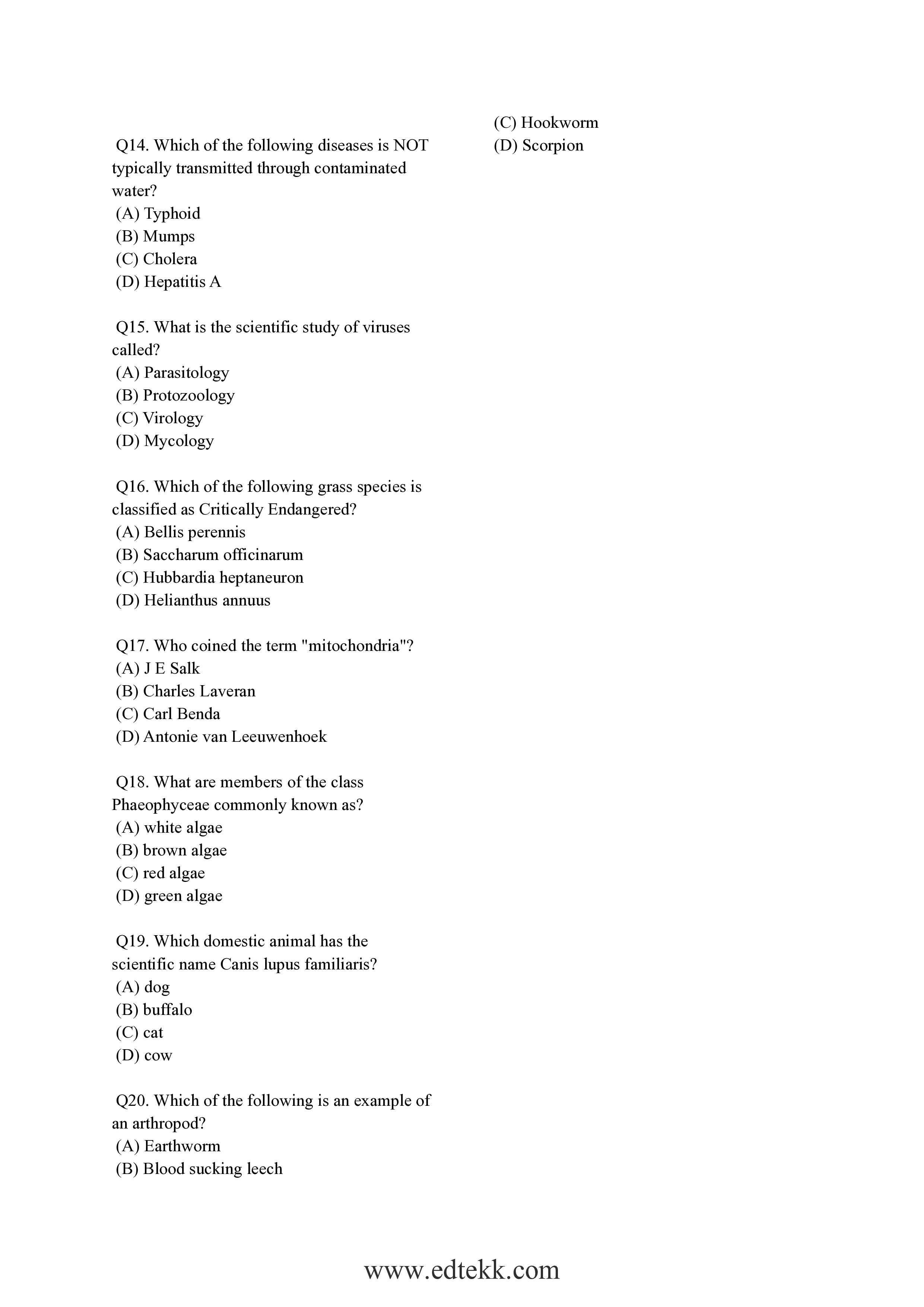
Q14. Which of the following diseases is NOT typically transmitted through contaminated water?
(A) Typhoid
(B) Mumps
(C) Cholera
(D) Hepatitis A
Explanation: Mumps is primarily transmitted through respiratory droplets and direct contact with infected saliva, not through contaminated water. In contrast, typhoid, hepatitis A and cholera can spread through contaminated food and water. Mumps is a viral disease commonly characterised by painful swelling of the salivary glands, particularly the parotid glands.
Q15. What is the scientific study of viruses called?
(A) Parasitology
(B) Protozoology
(C) Virology
(D) Mycology
Explanation: Virology is the branch of science concerned with the study of viruses. It examines their structure, classification, replication, genetics, evolution and interactions with host organisms. Virology also investigates viral diseases and contributes to the development of vaccines and antiviral treatments.
Q16. Which of the following grass species is classified as Critically Endangered?
(A) Bellis perennis
(B) Saccharum officinarum
(C) Hubbardia heptaneuron
(D) Helianthus annuus
Explanation: Hubbardia heptaneuron is a rare grass species endemic to the Western Ghats of India, particularly the Mahabaleshwar region of Maharashtra. It is classified as Critically Endangered because of its restricted distribution and threatened habitat. The other options are common plant species and are not classified as Critically Endangered.
Q17. Who coined the term “mitochondria”?
(A) J E Salk
(B) Charles Laveran
(C) Carl Benda
(D) Antonie van Leeuwenhoek
Explanation: The term mitochondria was coined by German anatomist Carl Benda in 1898. The word is derived from Greek terms meaning thread and granule, reflecting the appearance of these structures under a microscope. Mitochondria are membrane-bound organelles involved in cellular energy production, particularly through aerobic respiration and oxidative phosphorylation.
Q18. What are members of the class Phaeophyceae commonly known as?
(A) white algae
(B) brown algae
(C) red algae
(D) green algae
Explanation: Phaeophyceae is the class of algae commonly known as brown algae. Their characteristic brown colour results primarily from the pigment fucoxanthin, which masks the green colour of chlorophyll. Most members are marine and include genera such as Sargassum, Laminaria and Fucus.
Q19. Which domestic animal has the scientific name Canis lupus familiaris?
(A) dog
(B) buffalo
(C) cat
(D) cow
Explanation: The domestic dog is scientifically classified as Canis lupus familiaris, a subspecies of the grey wolf (Canis lupus) under a widely accepted taxonomic classification. It belongs to the family Canidae and the order Carnivora.
Q20. Which of the following is an example of an arthropod?
(A) Earthworm
(B) Blood sucking leech
(C) Hookworm
(D) Scorpion
Explanation: Scorpions are arthropods belonging to the class Arachnida. They possess jointed appendages, a segmented body and a chitinous exoskeleton. Leeches and earthworms belong to the phylum Annelida, while hookworms are roundworms belonging to the phylum Nematoda.
Question Paper Images