Strengthen your General Science preparation through this third Physics topicwise MCQ paper for SSC competitive examinations. The set contains 20 objective questions to assess Physics fundamentals and knowledge, supported by accurate answers and explanations. It is useful for revision and practice for SSC CGL, CHSL, CPO, MTS, GD and Selection Post.
Test Details
Topic: Physics
Total Questions: 20
Question Format: MCQs – Single Correct Answer
Suitable for: SSC CGL, CHSL, CPO, MTS, GD, Selection Post
Download All Papers in This Series (PDF)
Questions and Answers
Q1. Which of the following is the equivalent SI unit expression for one pascal (Pa)?
(A) N m²
(B) N m⁻²
(C) N m
(D) N m⁻¹
Explanation: One pascal (Pa) is the SI unit of pressure and is defined as one newton of force acting perpendicularly over an area of one square metre. Therefore, (1text{ Pa} = 1text{ N/m}^2 = 1text{ N m}^{-2}).
Q2. How is a voltmeter connected between the two points across which the potential difference is to be measured?
(A) Along the same magnetic field
(B) In concentric circles
(C) In parallel
(D) Perpendicular to each other
Explanation: A voltmeter is connected in parallel across the two points between which the potential difference is to be measured. It has very high resistance, so it draws negligible current from the circuit and minimises disturbance to the potential difference being measured.
Q3. A rectangular copper-wire coil rotates in a magnetic field. After how much rotation does the direction of the induced current reverse?
(A) Half revolution
(B) Two revolutions
(C) One revolution
(D) One fourth revolution
Explanation: The direction of induced current in a rotating rectangular coil reverses after every half revolution (180°). This occurs because the direction of motion of the coil’s sides relative to the magnetic field reverses. This principle is used in an alternating-current (AC) generator.
Q4. Which of the following elements has the highest electrical conductivity?
(A) Silver
(B) Copper
(C) Zinc
(D) Lead
Explanation: Silver has the highest electrical conductivity among the four listed metals under ordinary conditions. Its electrical resistivity is lower than that of copper, zinc and lead. Although copper is more commonly used in electrical wiring because of its lower cost, silver is the better electrical conductor.
Q5. What is the approximate equivalent of 30°C on the Kelvin scale?
(A) -30
(B) -243
(C) 303
(D) 130
Explanation: Celsius temperature is converted into Kelvin using the formula (K=°C+273.15). For 30°C, (K=30+273.15=303.15) K. Rounded to the nearest whole number, the temperature is approximately 303 K. Kelvin is the SI unit of thermodynamic temperature.
Q6. Which laboratory apparatus is used to measure the heat capacity of a substance?
(A) Calorimeter
(B) Hygrometer
(C) Manometer
(D) Colorimeter
Explanation: A calorimeter is an apparatus used to measure the heat absorbed or released during physical and chemical processes. It is also used to determine the specific heat capacity of substances. A hygrometer measures humidity, a manometer measures pressure, and a colorimeter measures light absorption by a solution.
Q7. Which physical quantity is represented by the ratio of arc length to radius?
(A) Plane angle
(B) Surface tension
(C) Velocity
(D) Linear Momentum
Explanation: The ratio of arc length to radius, (s/r), gives the plane angle in radians when both measurements are expressed in the same units. The radian is the SI-derived unit of plane angle. Although this ratio is dimensionless, it represents a specific geometric quantity.
Q8. A bullet of mass 10 g is fired at a velocity of 20 m/s from a gun of mass 2 kg. What is the recoil velocity of the gun, in m/s?
(A) 2
(B) 1
(C) 0.2
(D) 0.1
Explanation: According to the law of conservation of momentum, the initial total momentum of the gun–bullet system is zero. Therefore, (0.01 times 20 + 2v = 0), giving (v = -0.1text{ m/s}). The negative sign indicates that the gun recoils in the direction opposite to the bullet’s motion.
Q9. Which of Newton’s laws provides a quantitative definition of force?
(A) First law of motion
(B) Universal law of gravitation
(C) Second law of motion
(D) Third law of motion
Explanation: Newton’s second law provides a quantitative relationship between net force and the rate of change of momentum. For an object of constant mass, it is expressed as (F=ma). Newton’s first law explains inertia, while the third law describes action–reaction pairs. The law of universal gravitation explains gravitational attraction between masses.
Q10. What is the power of time (second) in the SI unit of acceleration?
(A) 0
(B) 1
(C) -1
(D) -2
Explanation: Acceleration is the rate of change of velocity with respect to time. Its SI unit is metre per second squared (m/s²), which can be expressed as (LT^{-2}). Therefore, the power of the second in the SI unit of acceleration is −2.
Q11. Which of the following electromagnetic waves has the highest frequency?
(A) Gamma Rays
(B) Ultraviolet Rays
(C) Microwaves
(D) Radio Waves
Explanation: Gamma rays have the highest frequency and shortest wavelength among the given electromagnetic waves. Their photon energies are higher than those of ultraviolet rays, microwaves and radio waves. According to the relationship c = νλ, frequency and wavelength are inversely proportional in a vacuum.
Q12. Which physical quantity is represented by the slope of a distance–time graph?
(A) speed
(B) acceleration
(C) momentum
(D) mass
Explanation: The slope of a distance–time graph represents speed. It is calculated as the change in distance divided by the corresponding time interval. A steeper slope indicates greater speed, while a horizontal line indicates that the object is at rest.
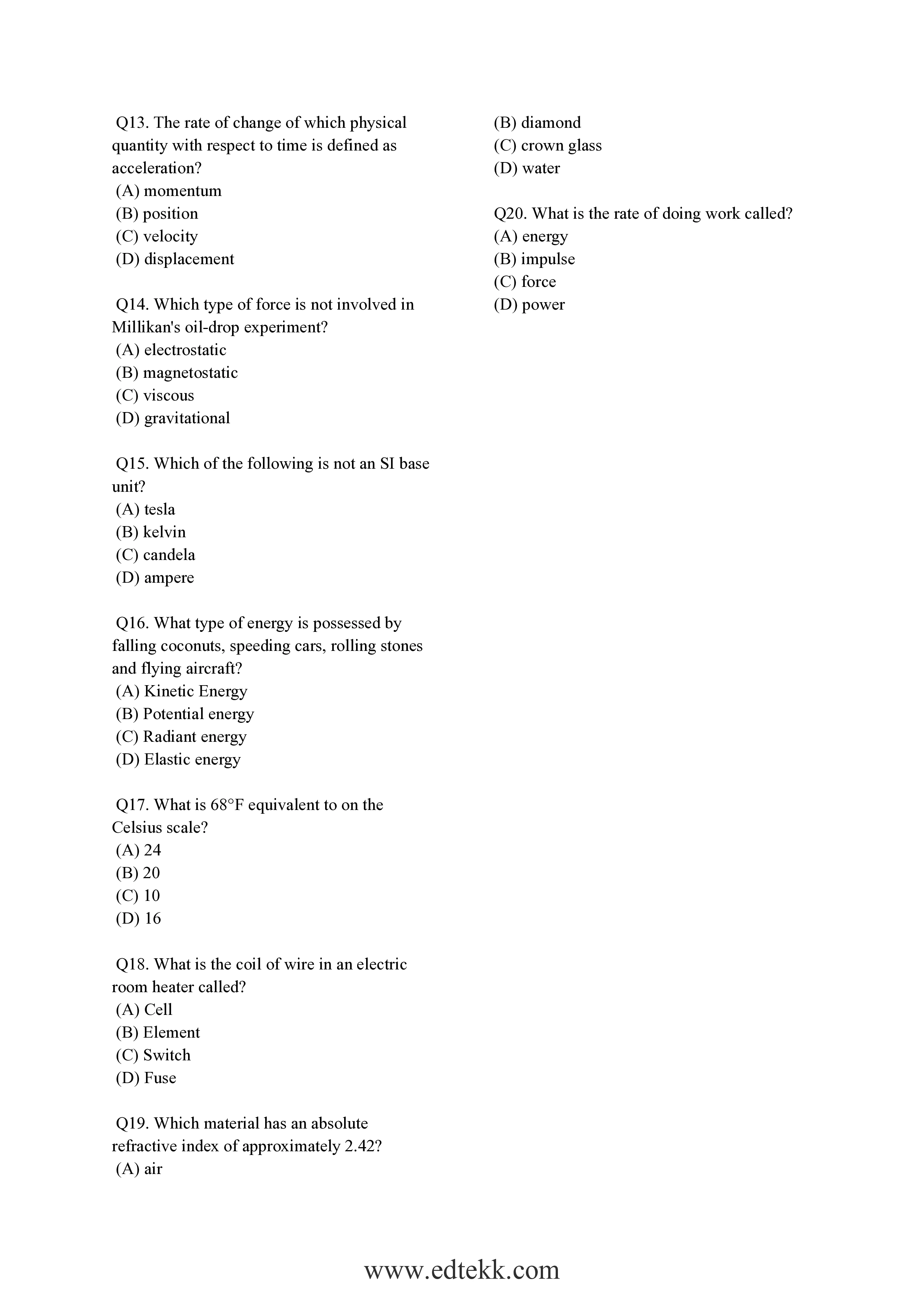
Q13. The rate of change of which physical quantity with respect to time is defined as acceleration?
(A) momentum
(B) position
(C) velocity
(D) displacement
Explanation: Acceleration is the rate of change of velocity with respect to time. It is a vector quantity and is mathematically expressed as (a=Delta v/Delta t). Its SI unit is metre per second squared (m/s²).
Q14. Which type of force is not involved in Millikan’s oil-drop experiment?
(A) electrostatic
(B) magnetostatic
(C) viscous
(D) gravitational
Explanation: In Millikan’s oil-drop experiment, the forces acting on an oil drop include gravitational force, electrostatic force, viscous drag and buoyant force. These forces are considered to determine the charge on the oil drops. Magnetostatic force is not involved in the standard experiment.
Q15. Which of the following is not an SI base unit?
(A) tesla
(B) kelvin
(C) candela
(D) ampere
Explanation: Tesla (T) is a derived SI unit used to measure magnetic flux density, not an SI base unit. The seven SI base units include kelvin for thermodynamic temperature, candela for luminous intensity and ampere for electric current. Therefore, tesla is the correct answer.
Q16. What type of energy is possessed by falling coconuts, speeding cars, rolling stones and flying aircraft?
(A) Kinetic Energy
(B) Potential energy
(C) Radiant energy
(D) Elastic energy
Explanation: Kinetic energy is the energy possessed by an object due to its motion. Falling coconuts, speeding cars, rolling stones and flying aircraft all possess kinetic energy. It depends on the object’s mass and the square of its speed and is expressed as KE = ½mv², where m is mass and v is speed.
Q17. What is 68°F equivalent to on the Celsius scale?
(A) 24
(B) 20
(C) 10
(D) 16
Explanation: Fahrenheit temperature is converted into Celsius using the formula (C=(F-32)times5/9). Substituting 68°F gives ((68-32)times5/9=20°C). Therefore, 68 degrees Fahrenheit is equivalent to 20 degrees Celsius.
Q18. What is the coil of wire in an electric room heater called?
(A) Cell
(B) Element
(C) Switch
(D) Fuse
Explanation: The coil of wire in an electric room heater is called the heating element. It is generally made of a high-resistivity alloy such as nichrome. When electric current passes through it, electrical energy is converted into heat due to its resistance, producing the heating effect.
Q19. Which material has an absolute refractive index of approximately 2.42?
(A) air
(B) diamond
(C) crown glass
(D) water
Explanation: Diamond has an absolute refractive index of approximately 2.42. The absolute refractive index of a medium is the ratio of the speed of light in vacuum to its speed in that medium. Diamond has a high refractive index because light travels considerably slower through it than through air or water.
Q20. What is the rate of doing work called?
(A) energy
(B) impulse
(C) force
(D) power
Explanation: Power is defined as the rate of doing work or transferring energy per unit time. Mathematically, average power is expressed as (P=W/t), where (W) represents the work done and (t) represents the time taken. Its SI unit is the watt (W), equivalent to one joule per second.
Question Paper Images