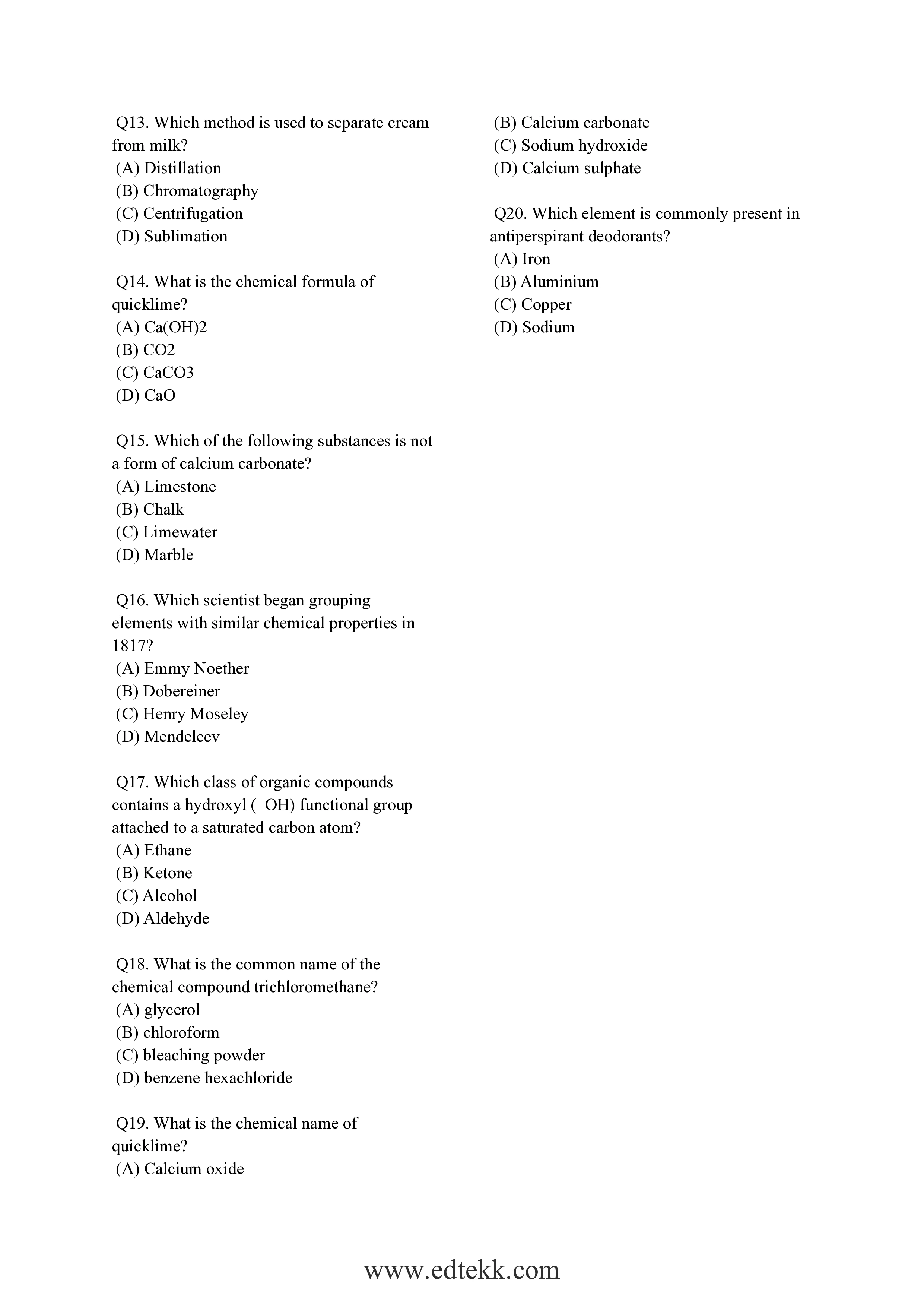
Enhance your Chemistry preparation with this second topicwise MCQ paper under SSC General Science. This practice set includes 20 objective questions on important Chemistry concepts, accompanied by correct answers and explanations for better understanding and revision. It supports preparation for SSC CGL, CHSL, CPO, MTS, GD and Selection Post examinations.
Test Details
Topic: Chemistry
Total Questions: 20
Question Format: MCQs – Single Correct Answer
Suitable for: SSC CGL, CHSL, CPO, MTS, GD, Selection Post
Download All Papers in This Series (PDF)
Questions and Answers
Q1. What is the electrochemical process used to form a thick oxide layer on aluminium called?
(A) Galvanisation
(B) Anodising
(C) Corrosion
(D) Ductility
Explanation: Anodising is an electrochemical process used to form a thick, protective aluminium oxide layer on the surface of aluminium. It improves corrosion resistance, increases surface hardness and provides a suitable surface for colouring.
Q2. Which of the following does NOT belong to the family of organic compounds?
(A) Nonane
(B) Furan
(C) Ammonia
(D) Decane
Explanation: Ammonia (NH₃) is an inorganic compound consisting of nitrogen and hydrogen. Nonane and decane are alkanes, while furan is a heterocyclic aromatic organic compound containing oxygen in its ring. Therefore, ammonia is the only inorganic compound among the given options.
Q3. What is the maximum number of electrons that can occupy a shell with principal quantum number ‘n’?
(A) 2n
(B) 2n^2
(C) n^2
(D) n
Explanation: The maximum number of electrons that can occupy a shell is given by 2n², where n is the principal quantum number. Accordingly, the first shell (n = 1) accommodates 2 electrons, the second (n = 2) accommodates 8, the third (n = 3) accommodates 18 and the fourth (n = 4) accommodates 32 electrons.
Q4. Titanium dioxide, used as a white pigment in products such as toothpaste, is derived from which mineral?
(A) Ilmenite
(B) Fluorite
(C) Silica
(D) Mica
Explanation: Ilmenite (FeTiO₃) is an important naturally occurring mineral source of titanium dioxide (TiO₂). Titanium dioxide is widely used as a white pigment because of its high refractive index, brightness and opacity. It is used in paints, plastics, paper, cosmetics and certain toothpaste formulations.
Q5. Which chemical law explains why soft drinks and soda bottles are sealed under high pressure to increase the solubility of carbon dioxide?
(A) Dalton’s law
(B) Raoult’s law
(C) Ohm’s law
(D) Henry’s law
Explanation: Henry’s law states that, at constant temperature, the amount of a gas dissolved in a liquid is directly proportional to the partial pressure of that gas above the liquid. Soft drinks are bottled under high carbon dioxide pressure to increase the quantity of CO₂ dissolved in the beverage.
Q6. Which type of chemical process causes iron to rust?
(A) combustion
(B) evaporation
(C) corrosion
(D) condensation
Explanation: Rusting of iron is an example of corrosion, which involves the gradual deterioration of a metal through chemical or electrochemical reactions with its surroundings. Iron reacts with oxygen and moisture to form hydrated iron(III) oxide, commonly called rust. Painting, galvanisation and protective coatings help prevent rusting.
Q7. Which letter is used to represent the atomic number of an element?
(A) A
(B) N
(C) Z
(D) E
Explanation: The atomic number of an element is represented by the symbol Z. It equals the number of protons present in an atom’s nucleus and determines the identity of the element. In an electrically neutral atom, the number of electrons equals the atomic number. However, this equality does not hold for ions.
Q8. What is formed when a neutral helium atom loses one electron?
(A) Proton
(B) Negative helium ion
(C) Positive helium ion (He⁺)
(D) Alpha particle
Explanation: A neutral helium atom contains two protons and two electrons. When it loses one electron, it forms a singly positively charged helium ion (He⁺), which retains one electron. An alpha particle, by contrast, is a helium-4 nucleus containing two protons and two neutrons but no electrons, with a charge of +2e.
Q9. Which of the following is not an alkaline earth metal?
(A) Mg
(B) Na
(C) Ca
(D) Be
Explanation: Sodium (Na) is not an alkaline earth metal; it is an alkali metal belonging to Group 1 of the periodic table. Magnesium (Mg), calcium (Ca) and beryllium (Be) are alkaline earth metals belonging to Group 2.
Q10. Polycot is a blend of which two materials?
(A) Rayon and cotton
(B) Polyester and wool
(C) Polyester and cotton
(D) Rayon and wool
Explanation: Polycot, also known as polycotton, is a blended fabric made from polyester and cotton fibres. Polyester provides strength, durability and wrinkle resistance, while cotton contributes softness, comfort and moisture absorption. The blend combines the useful properties of both fibres.
Q11. Which of the following substances is commonly known as marsh gas?
(A) Chlorine
(B) Methane
(C) Ethyne
(D) Ethane
Explanation: Methane (CH₄) is commonly known as marsh gas because it is produced during the anaerobic decomposition of organic matter in waterlogged environments such as marshes and swamps. It is the simplest alkane and the principal component of natural gas. Methane is also a potent greenhouse gas.
Q12. What is the chemical name of slaked lime?
(A) Sodium Chloride
(B) Calcium Nitrate
(C) Calcium Hydroxide
(D) Calcium Chloride
Explanation: Slaked lime is the common name for calcium hydroxide, with the chemical formula Ca(OH)₂. It is produced by adding water to quicklime (calcium oxide) in a process called slaking. It is widely used in whitewashing, construction, water treatment and various industrial processes.
Q13. Which method is used to separate cream from milk?
(A) Distillation
(B) Chromatography
(C) Centrifugation
(D) Sublimation
Explanation: Centrifugation separates cream from milk based on differences in density. During rapid rotation, the denser aqueous portion moves outward more strongly, while the less dense fat-rich portion collects closer to the axis of rotation. This technique is widely used in dairy processing to separate cream from skimmed milk.
Q14. What is the chemical formula of quicklime?
(A) Ca(OH)2
(B) CO2
(C) CaCO3
(D) CaO
Explanation: Quicklime is calcium oxide (CaO). It is produced by heating limestone (calcium carbonate, CaCO₃) strongly, causing it to decompose into calcium oxide and carbon dioxide. Calcium hydroxide [Ca(OH)₂] is known as slaked lime.
Q15. Which of the following substances is not a form of calcium carbonate?
(A) Limestone
(B) Chalk
(C) Limewater
(D) Marble
Explanation: Limewater is a dilute aqueous solution of calcium hydroxide, Ca(OH)₂, and is not a form of calcium carbonate. Limestone, chalk and marble are naturally occurring rocks composed predominantly of calcium carbonate (CaCO₃).
Q16. Which scientist began grouping elements with similar chemical properties in 1817?
(A) Emmy Noether
(B) Dobereiner
(C) Henry Moseley
(D) Mendeleev
Explanation: Johann Wolfgang Döbereiner began classifying elements with similar chemical properties in 1817. He subsequently developed the concept of triads, grouping three elements with similar properties. The atomic mass of the middle element was approximately the arithmetic mean of the other two.
Q17. Which class of organic compounds contains a hydroxyl (–OH) functional group attached to a saturated carbon atom?
(A) Ethane
(B) Ketone
(C) Alcohol
(D) Aldehyde
Explanation: Alcohols are organic compounds containing a hydroxyl (–OH) functional group attached to a saturated carbon atom. Their general structure is represented as R–OH, where R denotes an alkyl group. Ethanol and methanol are common examples of alcohols used in laboratories and industries.
Q18. What is the common name of the chemical compound trichloromethane?
(A) glycerol
(B) chloroform
(C) bleaching powder
(D) benzene hexachloride
Explanation: Trichloromethane (CHCl₃) is the IUPAC name of chloroform. It is a colourless, volatile liquid historically used as an anaesthetic and now mainly used as an industrial solvent and chemical intermediate. Its molecule contains one carbon atom, one hydrogen atom and three chlorine atoms.
Q19. What is the chemical name of quicklime?
(A) Calcium oxide
(B) Calcium carbonate
(C) Sodium hydroxide
(D) Calcium sulphate
Explanation: Quicklime is the common name for calcium oxide (CaO). It is produced by heating limestone (calcium carbonate, CaCO₃) strongly through a process called calcination, releasing carbon dioxide (CO₂).
Q20. Which element is commonly present in antiperspirant deodorants?
(A) Iron
(B) Aluminium
(C) Copper
(D) Sodium
Explanation: Aluminium is commonly used in antiperspirants in the form of salts such as aluminium chlorohydrate. These compounds temporarily obstruct sweat ducts near the skin’s surface, reducing perspiration. Ordinary deodorants primarily control or mask unpleasant body odour rather than directly reducing sweat production.
Question Paper Images