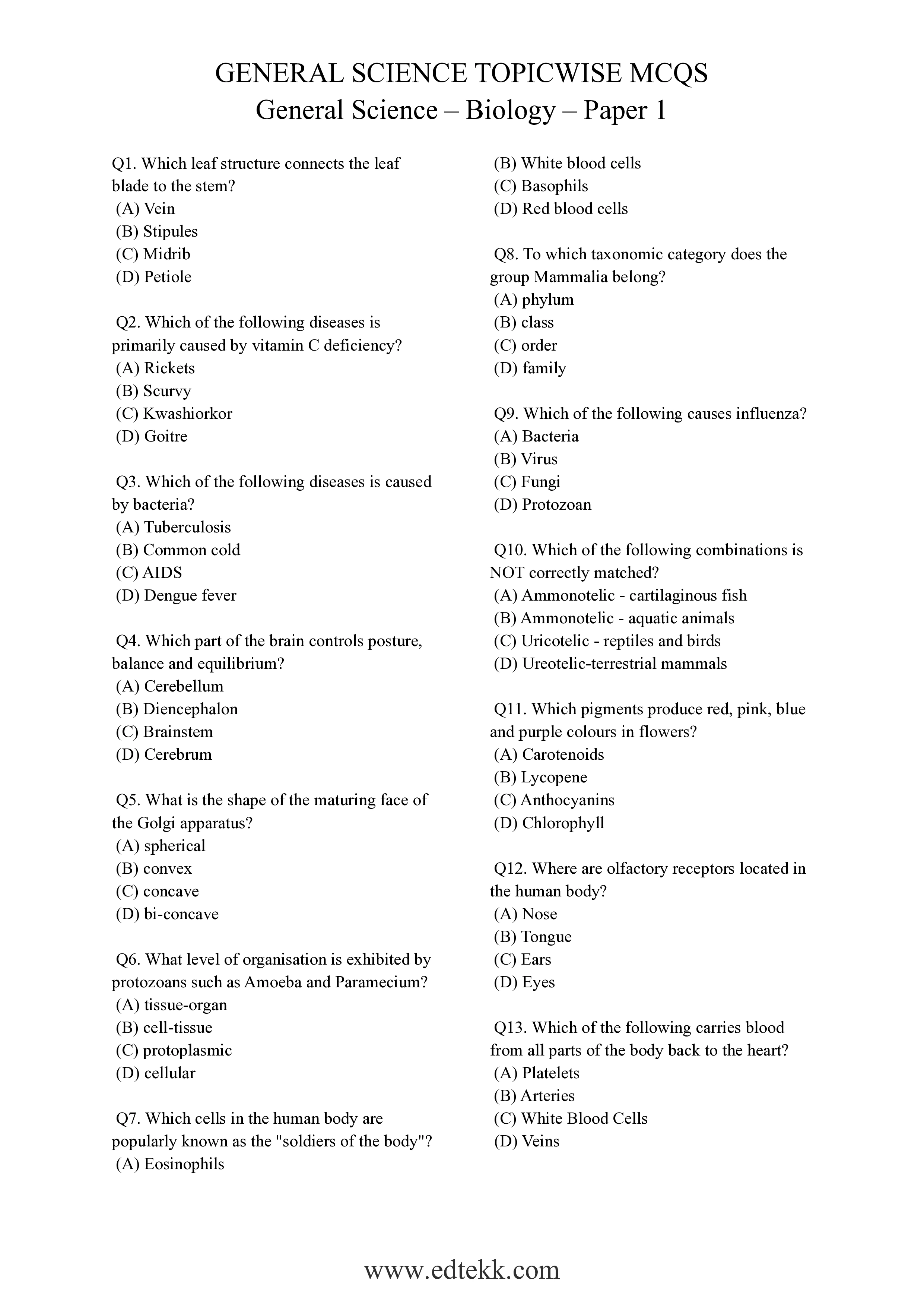
Strengthen your Biology preparation with this General Science topicwise MCQ practice set. Biology Paper 1 covers important biological concepts through objective questions with correct answers and explanations. This resource is designed for candidates preparing for SSC exams, Railway exams, State PSC, Police Constable and Police SI examinations.
Test Details
Topic: Biology
Total Questions: 20
Question Format: MCQs – Single Correct Answer
Suitable for: SSC exams, Railway exams, State PSC, Police Constable, Police SI
Download All Papers in This Series (PDF)
Questions and Answers
Q1. Which leaf structure connects the leaf blade to the stem?
(A) Vein
(B) Stipules
(C) Midrib
(D) Petiole
Explanation: The petiole is the stalk-like structure that connects the leaf blade (lamina) to the stem. It supports the leaf and provides a passage for vascular tissues that transport water, minerals and manufactured food. Some leaves are sessile and lack a petiole.
Q2. Which of the following diseases is primarily caused by vitamin C deficiency?
(A) Rickets
(B) Scurvy
(C) Kwashiorkor
(D) Goitre
Explanation: Scurvy is caused by a prolonged deficiency of vitamin C (ascorbic acid). Vitamin C is essential for collagen synthesis, wound healing and maintaining healthy connective tissues. Its deficiency can cause bleeding gums, poor wound healing, joint pain, fatigue and general weakness.
Q3. Which of the following diseases is caused by bacteria?
(A) Tuberculosis
(B) Common cold
(C) AIDS
(D) Dengue fever
Explanation: Tuberculosis (TB) is caused by bacteria belonging to the Mycobacterium tuberculosis complex. It most commonly affects the lungs and spreads through the air when a person with infectious TB releases airborne particles. The common cold and dengue are generally caused by viruses, while AIDS results from infection with HIV.
Q4. Which part of the brain controls posture, balance and equilibrium?
(A) Cerebellum
(B) Diencephalon
(C) Brainstem
(D) Cerebrum
Explanation: The cerebellum coordinates voluntary movements and plays a central role in maintaining posture, balance and equilibrium. It integrates information from the vestibular system, sensory receptors and other parts of the nervous system to produce smooth, coordinated movements. Damage to the cerebellum can cause impaired balance, uncoordinated movements and an unsteady gait.
Q5. What is the shape of the maturing face of the Golgi apparatus?
(A) spherical
(B) convex
(C) concave
(D) bi-concave
Explanation: The maturing face of the Golgi apparatus is generally convex in shape and is also called the trans face. It is usually directed towards the plasma membrane and is involved in sorting and packaging processed materials into vesicles for transport. The forming face, or cis face, is generally concave.
Q6. What level of organisation is exhibited by protozoans such as Amoeba and Paramecium?
(A) tissue-organ
(B) cell-tissue
(C) protoplasmic
(D) cellular
Explanation: Protozoans such as Paramecium, Amoeba and Euglena exhibit protoplasmic-level organisation. Their bodies consist of a single cell in which the protoplasm performs all essential life functions. They lack specialised tissues and organs, although different cellular structures perform specific functions.
Q7. Which cells in the human body are popularly known as the “soldiers of the body”?
(A) Eosinophils
(B) White blood cells
(C) Basophils
(D) Red blood cells
Explanation: White blood cells, also known as leukocytes, are popularly called the soldiers of the human body because they protect the body against infections and foreign substances. Different types of white blood cells perform specialised immune functions, including engulfing pathogens, producing antibodies and coordinating immune responses.
Q8. To which taxonomic category does the group Mammalia belong?
(A) phylum
(B) class
(C) order
(D) family
Explanation: Mammalia is a class in the taxonomic hierarchy. It includes humans, whales, bats and elephants. Mammals are characterised by mammary glands, hair at some stage of life, and three middle-ear bones. Most mammals possess external ears (pinnae), although these are absent in some groups, such as whales.
Q9. Which of the following causes influenza?
(A) Bacteria
(B) Virus
(C) Fungi
(D) Protozoan
Explanation: Influenza is an infectious disease caused by influenza viruses. These viruses primarily affect the respiratory system, including the nose, throat and lungs. Common symptoms include fever, cough, sore throat, muscle aches and fatigue. Because influenza is a viral infection, antibiotics do not treat the virus itself.
Q10. Which of the following combinations is NOT correctly matched?
(A) Ammonotelic – cartilaginous fish
(B) Ammonotelic – aquatic animals
(C) Uricotelic – reptiles and birds
(D) Ureotelic-terrestrial mammals
Explanation: Cartilaginous fishes, including sharks and rays, are predominantly ureotelic because they excrete nitrogenous waste mainly as urea. Many aquatic animals, especially freshwater bony fishes, are ammonotelic. Birds and most reptiles are uricotelic, while terrestrial mammals are generally ureotelic. Therefore, the incorrectly matched pair is Ammonotelic – cartilaginous fish.
Q11. Which pigments produce red, pink, blue and purple colours in flowers?
(A) Carotenoids
(B) Lycopene
(C) Anthocyanins
(D) Chlorophyll
Explanation: Anthocyanins are water-soluble pigments responsible for many red, pink, blue and purple colours in flowers. Their colour can vary depending on cellular pH, pigment concentration and interactions with metal ions and other compounds.
Q12. Where are olfactory receptors located in the human body?
(A) Nose
(B) Tongue
(C) Ears
(D) Eyes
Explanation: Olfactory receptors are specialised sensory cells located in the olfactory epithelium in the upper region of the nasal cavity. They detect airborne chemical substances responsible for smell and transmit sensory signals to the brain through the olfactory nerve, enabling the perception of different odours.
Q13. Which of the following carries blood from all parts of the body back to the heart?
(A) Platelets
(B) Arteries
(C) White Blood Cells
(D) Veins
Explanation: Veins generally carry blood from body tissues towards the heart. Most veins transport deoxygenated blood, although pulmonary veins carry oxygenated blood from the lungs to the heart. In contrast, arteries carry blood away from the heart, while white blood cells and platelets are components of blood.
Q14. Which of the following plants has leaves modified into spines as an adaptation?
(A) Opuntia
(B) Mimosa
(C) Rose
(D) Hibiscus
Explanation: Opuntia, commonly known as prickly pear cactus, is a xerophytic plant adapted to dry environments. Its leaves are modified into spines, reducing water loss through transpiration and providing protection against herbivores. Its flattened, green stems perform photosynthesis and store water.
Q15. How many eyes does a typical adult bee have?
(A) Five
(B) Two
(C) Four
(D) Three
Explanation: A typical adult bee has five eyes: two large compound eyes and three small simple eyes called ocelli. The compound eyes help detect movement and form images, while the ocelli primarily detect light intensity and help maintain orientation.
Q16. What is the normal resting respiratory rate of a healthy adult, measured in breaths per minute?
(A) 25–30
(B) 9–11
(C) 21–24
(D) 12–20
Explanation: The normal resting respiratory rate of a healthy adult is approximately 12–20 breaths per minute. Breathing is regulated primarily by respiratory centres in the brainstem. Exercise, fever, anxiety and certain illnesses can increase the respiratory rate. Persistent abnormalities may warrant medical evaluation.
Q17. Which sensation is primarily detected by somatosensory receptors in the skin?
(A) Hearing
(B) Taste
(C) Smell
(D) Touch
Explanation: Touch is detected by somatosensory receptors in the skin, including mechanoreceptors that respond to pressure, vibration and skin deformation. Other sensory receptors detect temperature and potentially damaging stimuli. Taste, smell and hearing depend on specialised receptors located primarily in the tongue, nasal cavity and inner ear, respectively.
Q18. Which animal phylum is commonly known as the flatworms?
(A) Cnidaria
(B) Ctenophora
(C) Porifera
(D) Platyhelminthes
Explanation: Platyhelminthes is the phylum commonly known as flatworms because its members have dorsoventrally flattened bodies. They are bilaterally symmetrical, triploblastic and acoelomate animals. Examples include planarians, tapeworms and liver flukes. Many species are parasitic, while others are free-living.
Q19. Which of the following is NOT a part of a flower?
(A) Petiole
(B) Stamen
(C) Sepal
(D) Pistil
Explanation: A petiole is the stalk that connects a leaf blade to the stem. It is not a floral part. The four principal floral whorls are calyx (sepals), corolla (petals), androecium (stamens) and gynoecium (carpels or pistil).
Q20. Which part of the human body is commonly described as its “chemical factory”?
(A) Kidneys
(B) Liver
(C) Stomach
(D) Lungs
Explanation: The liver is commonly described as the chemical factory of the human body because it performs numerous metabolic and biochemical functions. It processes nutrients, detoxifies many harmful substances, produces bile, synthesises important blood proteins and regulates the metabolism of carbohydrates, fats and proteins.
Question Paper Images