Prepare for competitive examinations with this General Science Physics MCQ practice set. This paper covers important Physics concepts through topicwise multiple-choice questions designed for SSC, Railway, State PSC, Police Constable and Police SI exams, with correct answers and detailed explanations to strengthen conceptual understanding and exam preparation.
Test Details
Topic: Physics
Total Questions: 20
Question Format: MCQs – Single Correct Answer
Suitable for: SSC exams, Railway exams, State PSC, Police Constable, Police SI
Download All Papers in This Series (PDF)
Questions and Answers
Q1. Which of Newton’s laws provides a quantitative definition of force?
(A) Universal law of gravitation
(B) Second law of motion
(C) First law of motion
(D) Third law of motion
Explanation: Newton’s second law provides a quantitative relationship between net force and the rate of change of momentum. For an object of constant mass, it is expressed as (F=ma). Newton’s first law explains inertia, while the third law describes action–reaction pairs. The law of universal gravitation explains gravitational attraction between masses.
Q2. What is the SI unit of work?
(A) Ampere
(B) Watt
(C) Decibel
(D) Joule
Explanation: Work is the product of force and displacement in the direction of the applied force. Its SI unit is the joule (J), equivalent to one newton-metre (N·m). One joule of work is done when a force of one newton displaces an object by one metre in the direction of the force.
Q3. Which type of friction is considered a self-adjusting force?
(A) Rolling Friction
(B) Kinetic Friction
(C) Centripetal Friction
(D) Static Friction
Explanation: Static friction is a self-adjusting force that prevents relative motion between two surfaces in contact. Its magnitude adjusts to match the applied tangential force until it reaches the maximum limiting friction. When the applied force exceeds this limit, sliding begins and kinetic friction acts.
Q4. What is the frequency, in kilohertz, of an object that completes 10 oscillations per second?
(A) 1
(B) 0.01
(C) 10
(D) 0.1
Explanation: Frequency is the number of oscillations completed per second. An object executing 10 oscillations per second has a frequency of 10 Hz. Since 1 kHz equals 1,000 Hz, its frequency in kilohertz is (10/1000=0.01) kHz.
Q5. Which unit is commonly used to measure the energy content of food?
(A) Kelvin
(B) Calorie
(C) Watt
(D) Celsius
Explanation: The calorie is a commonly used unit for measuring the energy content of food. Food energy is generally expressed in kilocalories (kcal) or kilojoules (kJ). One kilocalorie is approximately equal to 4.184 kilojoules. Kelvin and Celsius are units of temperature, not energy.
Q6. What type of energy is possessed by falling coconuts, speeding cars, rolling stones and flying aircraft?
(A) Potential energy
(B) Radiant energy
(C) Kinetic Energy
(D) Elastic energy
Explanation: Kinetic energy is the energy possessed by an object due to its motion. Falling coconuts, speeding cars, rolling stones and flying aircraft all possess kinetic energy. It depends on the object’s mass and the square of its speed and is expressed as KE = ½mv², where m is mass and v is speed.
Q7. What is the process involving the successive stages of vaporisation and condensation called?
(A) Sublimation
(B) Distillation
(C) Chromatography
(D) Crystallisation
Explanation: Distillation is a separation process involving vaporisation followed by condensation. The liquid mixture is heated to convert a component into vapour, which is subsequently cooled to obtain it in liquid form. It is commonly used to separate liquids with different boiling points or recover a solvent from a solution.
Q8. Which of the following elements has the highest electrical conductivity?
(A) Lead
(B) Copper
(C) Zinc
(D) Silver
Explanation: Silver has the highest electrical conductivity among the four listed metals under ordinary conditions. Its electrical resistivity is lower than that of copper, zinc and lead. Although copper is more commonly used in electrical wiring because of its lower cost, silver is the better electrical conductor.
Q9. Which type of mirror always forms a virtual, erect and diminished image of a real object placed in front of it?
(A) Plane mirror
(B) Convex mirror
(C) Cylindrical mirror
(D) Concave mirror
Explanation: A convex mirror always forms a virtual, erect and diminished image of a real object placed in front of it. The image appears behind the mirror, irrespective of the object’s position. Convex mirrors provide a wide field of view and are commonly used as rear-view and side-view mirrors in vehicles.
Q10. What is the energy derived from the Earth’s internal heat called?
(A) Geothermal Energy
(B) Solar Energy
(C) Biogas
(D) Tidal Energy
Explanation: Geothermal energy is the energy obtained from the Earth’s internal heat. This heat originates primarily from the Earth’s formation and the radioactive decay of elements within its interior. It is used for electricity generation, heating buildings and various industrial applications.
Q11. Which colour in the VIBGYOR spectrum has the lowest energy?
(A) Green
(B) Red
(C) Yellow
(D) Violet
Explanation: Red light has the longest wavelength and the lowest frequency among the seven colours of visible light (VIBGYOR). Since the energy of a photon is directly proportional to its frequency, according to E = hν, red light has the minimum energy, whereas violet light has the maximum energy.
Q12. How does the magnetic field vary inside a sufficiently long solenoid?
(A) increases
(B) remains same
(C) decreases
(D) first increases then decreases
Explanation: Inside a sufficiently long solenoid, the magnetic field is approximately uniform. Its magnitude and direction remain nearly constant throughout the interior. However, near the ends of a finite solenoid, the magnetic field becomes non-uniform due to edge effects.
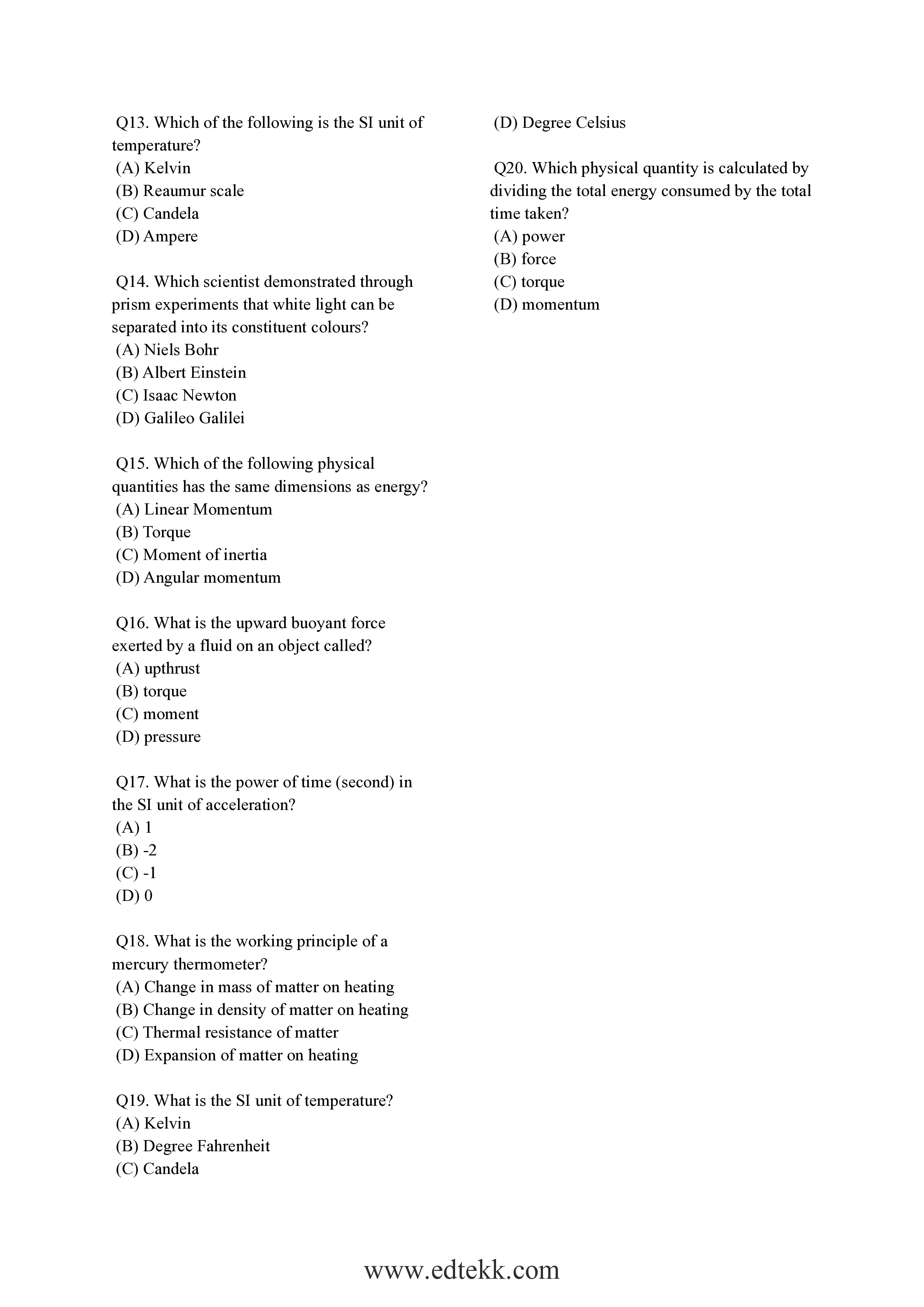
Q13. Which of the following is the SI unit of temperature?
(A) Kelvin
(B) Reaumur scale
(C) Candela
(D) Ampere
Explanation: The kelvin (K) is the SI base unit of thermodynamic temperature. It is used in scientific measurements and is distinct from the Celsius and Fahrenheit scales commonly used for everyday temperature measurements.
Q14. Which scientist demonstrated through prism experiments that white light can be separated into its constituent colours?
(A) Niels Bohr
(B) Albert Einstein
(C) Isaac Newton
(D) Galileo Galilei
Explanation: Isaac Newton demonstrated the dispersion of white light through prism experiments. He showed that white light separates into its constituent colours when passed through a glass prism and that these colours can be recombined to produce white light. This established that white light contains light of different visible wavelengths.
Q15. Which of the following physical quantities has the same dimensions as energy?
(A) Linear Momentum
(B) Torque
(C) Moment of inertia
(D) Angular momentum
Explanation: Torque and energy have the same dimensions, (ML^2T^{-2}). Torque is the product of force and perpendicular distance, whereas work is the product of force and displacement in the direction of the force. However, they represent different physical quantities: torque is expressed in N·m and energy in joules (J).
Q16. What is the upward buoyant force exerted by a fluid on an object called?
(A) upthrust
(B) torque
(C) moment
(D) pressure
Explanation: An object immersed wholly or partially in a fluid experiences an upward force called upthrust or buoyant force. According to Archimedes’ principle, the magnitude of this force equals the weight of the fluid displaced by the object.
Q17. What is the power of time (second) in the SI unit of acceleration?
(A) 1
(B) -2
(C) -1
(D) 0
Explanation: Acceleration is the rate of change of velocity with respect to time. Its SI unit is metre per second squared (m/s²), which can be expressed as (LT^{-2}). Therefore, the power of the second in the SI unit of acceleration is −2.
Q18. What is the working principle of a mercury thermometer?
(A) Change in mass of matter on heating
(B) Change in density of matter on heating
(C) Thermal resistance of matter
(D) Expansion of matter on heating
Explanation: A mercury thermometer works on the principle of thermal expansion of matter. When temperature increases, mercury expands and rises through the narrow capillary tube. When temperature decreases, it contracts and its level falls. The change in mercury volume is used to indicate temperature.
Q19. What is the SI unit of temperature?
(A) Kelvin
(B) Degree Fahrenheit
(C) Candela
(D) Degree Celsius
Explanation: The kelvin (K) is the SI base unit of thermodynamic temperature. Although degrees Celsius are widely used in everyday life and scientific applications, kelvin is the standard SI unit. Both scales have equal-sized increments, but their zero points differ by 273.15 degrees.
Q20. Which physical quantity is calculated by dividing the total energy consumed by the total time taken?
(A) power
(B) force
(C) torque
(D) momentum
Explanation: Average power is calculated by dividing the total energy consumed by the total time taken. Mathematically, (P_{text{average}}=E_{text{total}}/t_{text{total}}). Its SI unit is the watt (W), equivalent to one joule per second.
Question Paper Images