Enhance your Chemistry preparation with this General Science topicwise MCQ practice paper. Paper 2 provides multiple-choice questions on important Chemistry concepts, along with accurate answers and explanations for better understanding and revision. It supports candidates preparing for SSC, Railway, State PSC, Police Constable and Police SI examinations.
Test Details
Topic: Chemistry
Total Questions: 20
Question Format: MCQs – Single Correct Answer
Suitable for: SSC exams, Railway exams, State PSC, Police Constable, Police SI
Download All Papers in This Series (PDF)
Questions and Answers
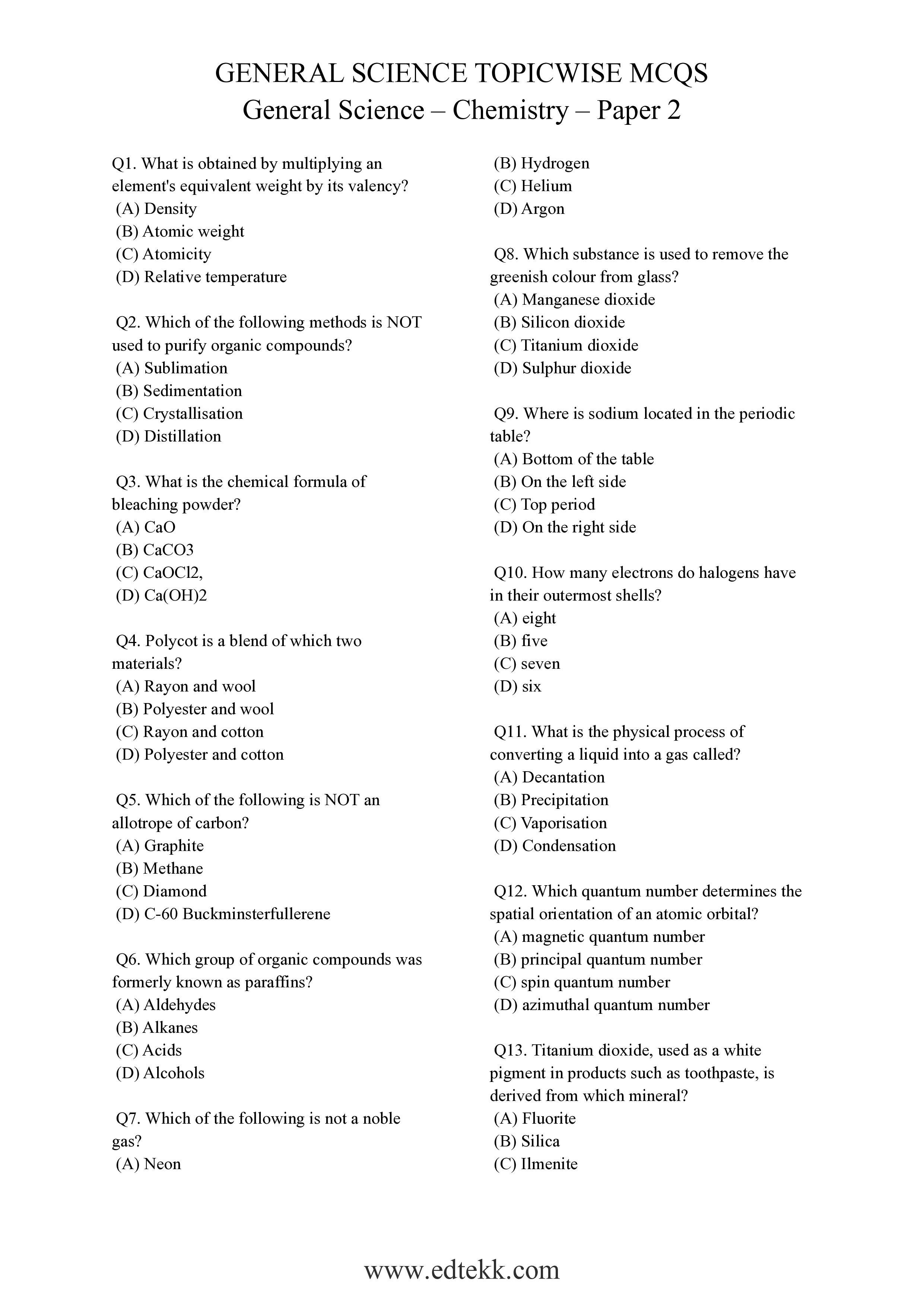
Q1. What is obtained by multiplying an element’s equivalent weight by its valency?
(A) Density
(B) Atomic weight
(C) Atomicity
(D) Relative temperature
Explanation: The equivalent weight of an element is calculated by dividing its atomic weight by its applicable valency. Thus, Equivalent weight = Atomic weight/Valency. Rearranging gives Atomic weight = Equivalent weight × Valency. For elements exhibiting variable valency, equivalent weight depends on the valency involved in the particular chemical reaction.
Q2. Which of the following methods is NOT used to purify organic compounds?
(A) Sublimation
(B) Sedimentation
(C) Crystallisation
(D) Distillation
Explanation: Sedimentation is not a standard method for purifying organic compounds. It is primarily used to separate suspended solid particles from liquids based on differences in density. Common methods for purifying organic compounds include crystallisation, sublimation, distillation and chromatography.
Q3. What is the chemical formula of bleaching powder?
(A) CaO
(B) CaCO3
(C) CaOCl2,
(D) Ca(OH)2
Explanation: Bleaching powder is conventionally represented by the chemical formula CaOCl₂ and is commonly known as calcium oxychloride. It is prepared by passing chlorine gas over dry slaked lime [Ca(OH)₂]. It is widely used for bleaching textiles and paper and for disinfecting drinking water.
Q4. Polycot is a blend of which two materials?
(A) Rayon and wool
(B) Polyester and wool
(C) Rayon and cotton
(D) Polyester and cotton
Explanation: Polycot, also known as polycotton, is a blended fabric made from polyester and cotton fibres. Polyester provides strength, durability and wrinkle resistance, while cotton contributes softness, comfort and moisture absorption. The blend combines the useful properties of both fibres.
Q5. Which of the following is NOT an allotrope of carbon?
(A) Graphite
(B) Methane
(C) Diamond
(D) C-60 Buckminsterfullerene
Explanation: Methane (CH₄) is not an allotrope of carbon because it contains both carbon and hydrogen atoms. Graphite, diamond and Buckminsterfullerene (C₆₀) are allotropes of carbon because they consist entirely of carbon atoms arranged in different structural configurations.
Q6. Which group of organic compounds was formerly known as paraffins?
(A) Aldehydes
(B) Alkanes
(C) Acids
(D) Alcohols
Explanation: Alkanes were historically known as paraffins. The term originates from the Latin words parum affinis, meaning little affinity, referring to their relatively low chemical reactivity. Alkanes are saturated hydrocarbons containing only carbon–carbon single bonds and generally follow the formula CₙH₂ₙ₊₂ for open-chain structures.
Q7. Which of the following is not a noble gas?
(A) Neon
(B) Hydrogen
(C) Helium
(D) Argon
Explanation: Hydrogen is not a noble gas. Noble gases belong to Group 18 of the periodic table and include helium, neon and argon. They generally possess completely filled outermost electron shells, making them relatively unreactive. Hydrogen is a non-metal placed in Group 1.
Q8. Which substance is used to remove the greenish colour from glass?
(A) Manganese dioxide
(B) Silicon dioxide
(C) Titanium dioxide
(D) Sulphur dioxide
Explanation: Manganese dioxide (MnO₂) is used as a decolourising agent in glass manufacturing to remove or offset the greenish tint caused by iron impurities. It helps neutralise unwanted colouring through oxidation and the development of a complementary colour. Excess manganese compounds can impart a purple or pink tint to glass.
Q9. Where is sodium located in the periodic table?
(A) Bottom of the table
(B) On the left side
(C) Top period
(D) On the right side
Explanation: Sodium (Na), with atomic number 11, is located on the left side of the periodic table in Group 1 and Period 3. It is an alkali metal with one electron in its outermost shell and readily loses this electron to form a positively charged sodium ion (Na⁺).
Q10. How many electrons do halogens have in their outermost shells?
(A) eight
(B) five
(C) seven
(D) six
Explanation: Halogens belong to Group 17 of the modern periodic table and have seven electrons in their outermost shells. They tend to gain one electron to achieve a stable noble gas electronic configuration.
Q11. What is the physical process of converting a liquid into a gas called?
(A) Decantation
(B) Precipitation
(C) Vaporisation
(D) Condensation
Explanation: Vaporisation is the physical process in which a liquid changes into a gaseous state. It occurs through evaporation or boiling. Evaporation takes place at the liquid’s surface and can occur below its boiling point, whereas boiling occurs throughout the liquid when its vapour pressure equals the external pressure.
Q12. Which quantum number determines the spatial orientation of an atomic orbital?
(A) magnetic quantum number
(B) principal quantum number
(C) spin quantum number
(D) azimuthal quantum number
Explanation: The magnetic quantum number (mₗ) specifies the spatial orientation of an atomic orbital relative to a chosen axis. The principal quantum number (n) indicates the main energy level, while the azimuthal quantum number (l) determines the subshell and orbital angular momentum. The spin quantum number (mₛ) describes electron spin orientation.
Q13. Titanium dioxide, used as a white pigment in products such as toothpaste, is derived from which mineral?
(A) Fluorite
(B) Silica
(C) Ilmenite
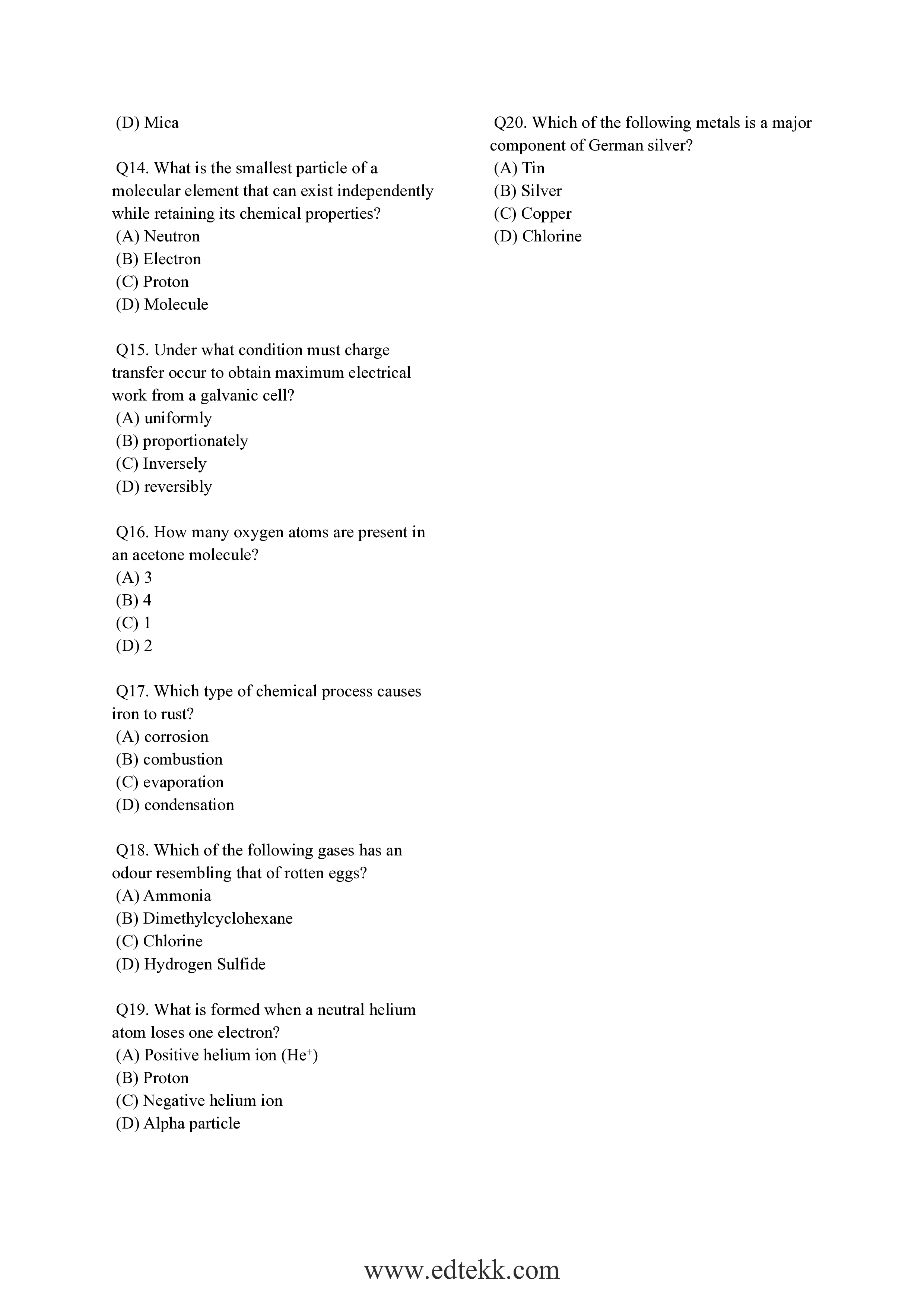
(D) Mica
Explanation: Ilmenite (FeTiO₃) is an important naturally occurring mineral source of titanium dioxide (TiO₂). Titanium dioxide is widely used as a white pigment because of its high refractive index, brightness and opacity. It is used in paints, plastics, paper, cosmetics and certain toothpaste formulations.
Q14. What is the smallest particle of a molecular element that can exist independently while retaining its chemical properties?
(A) Neutron
(B) Electron
(C) Proton
(D) Molecule
Explanation: A molecule is the smallest independently existing particle of a molecular element that retains its chemical properties. Molecules of elements may contain two or more chemically bonded atoms, such as oxygen (O₂), nitrogen (N₂) and hydrogen (H₂). However, not all elements exist as molecules; noble gases generally exist as individual atoms.
Q15. Under what condition must charge transfer occur to obtain maximum electrical work from a galvanic cell?
(A) uniformly
(B) proportionately
(C) Inversely
(D) reversibly
Explanation: A galvanic cell delivers maximum useful electrical work when the charge is transferred reversibly. Reversible operation involves an infinitesimally small potential difference between the cell and the external circuit, minimising irreversible energy losses. Thus, reversible charge transfer is necessary to obtain maximum electrical work.
Q16. How many oxygen atoms are present in an acetone molecule?
(A) 3
(B) 4
(C) 1
(D) 2
Explanation: Acetone has the molecular formula C₃H₆O and is commonly written as CH₃COCH₃. Its structure contains a carbonyl group (C=O), which contributes exactly one oxygen atom to each molecule. Acetone is the simplest ketone and is widely used as an industrial solvent and cleaning agent.
Q17. Which type of chemical process causes iron to rust?
(A) corrosion
(B) combustion
(C) evaporation
(D) condensation
Explanation: Rusting of iron is an example of corrosion, which involves the gradual deterioration of a metal through chemical or electrochemical reactions with its surroundings. Iron reacts with oxygen and moisture to form hydrated iron(III) oxide, commonly called rust. Painting, galvanisation and protective coatings help prevent rusting.
Q18. Which of the following gases has an odour resembling that of rotten eggs?
(A) Ammonia
(B) Dimethylcyclohexane
(C) Chlorine
(D) Hydrogen Sulfide
Explanation: Hydrogen sulphide (H₂S) is a colourless, highly toxic gas with a characteristic rotten-egg smell. It is produced naturally during the decomposition of sulphur-containing organic matter and is also found in sewage and volcanic gases. Its odour should not be relied upon as a safety warning because prolonged exposure can impair the sense of smell.
Q19. What is formed when a neutral helium atom loses one electron?
(A) Positive helium ion (He⁺)
(B) Proton
(C) Negative helium ion
(D) Alpha particle
Explanation: A neutral helium atom contains two protons and two electrons. When it loses one electron, it forms a singly positively charged helium ion (He⁺), which retains one electron. An alpha particle, by contrast, is a helium-4 nucleus containing two protons and two neutrons but no electrons, with a charge of +2e.
Q20. Which of the following metals is a major component of German silver?
(A) Tin
(B) Silver
(C) Copper
(D) Chlorine
Explanation: German silver, also known as nickel silver, is an alloy primarily composed of copper, nickel and zinc. Despite its name, it does not contain actual silver. Copper is generally its major constituent, while nickel and zinc contribute to its strength, corrosion resistance and silvery appearance.
Question Paper Images