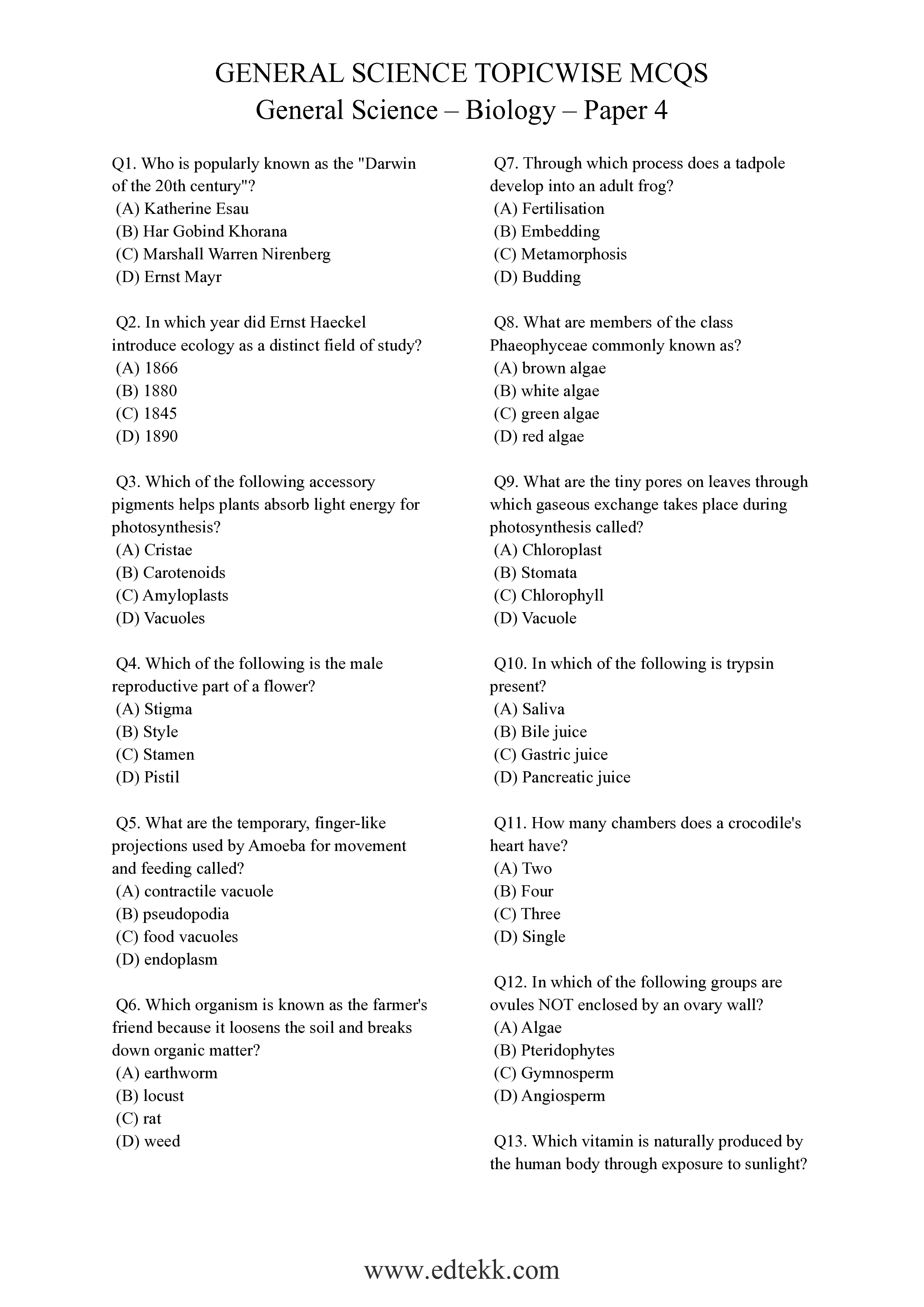
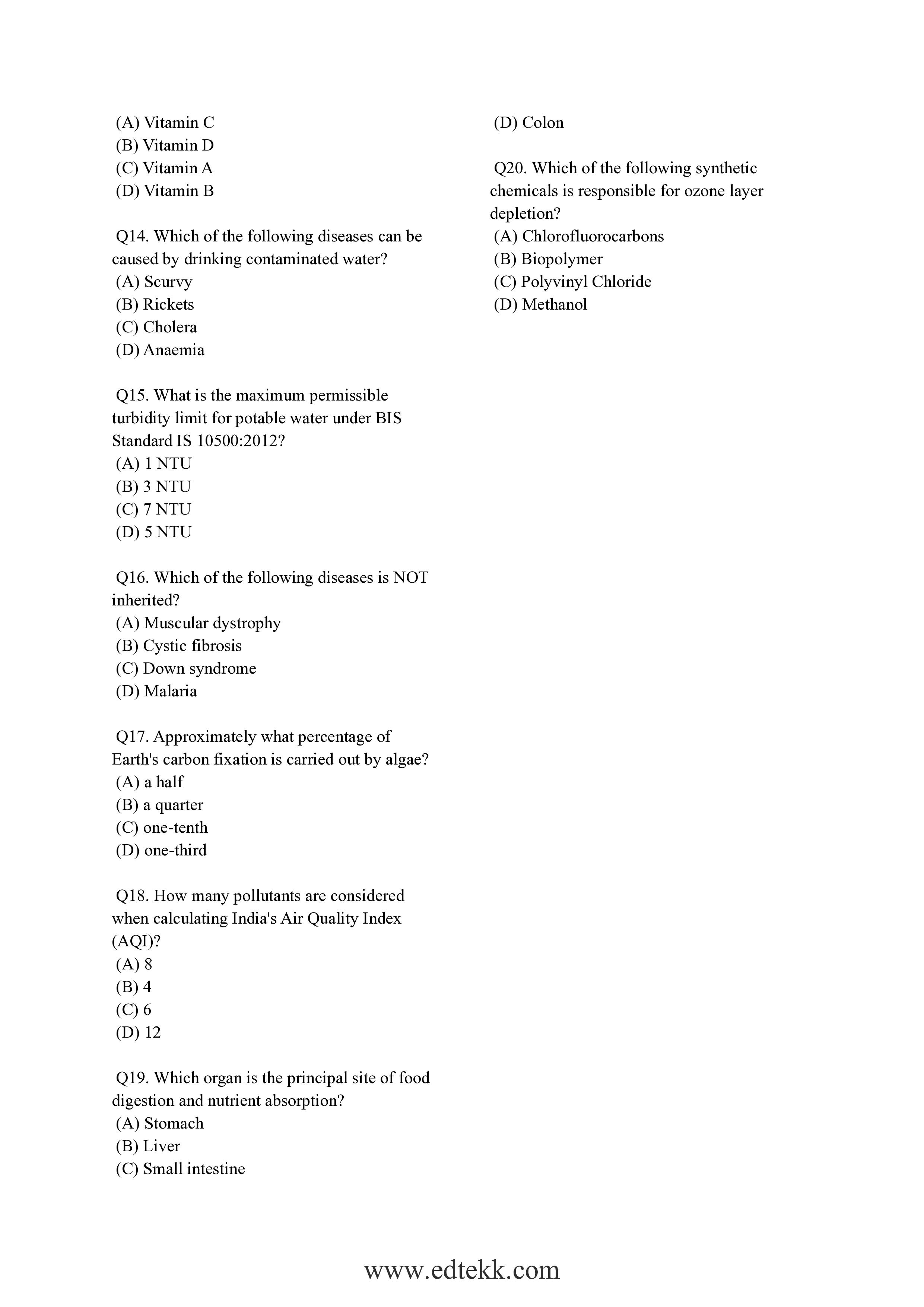
Prepare for government recruitment examinations with this General Science Biology topicwise MCQ practice paper. Paper 4 offers objective questions covering important Biology concepts, with correct answers and explanations to improve subject knowledge and revision. It is useful for SSC, Railway, State PSC, Police Constable and Police SI aspirants.
Test Details
Topic: Biology
Total Questions: 20
Question Format: MCQs – Single Correct Answer
Suitable for: SSC exams, Railway exams, State PSC, Police Constable, Police SI
Download All Papers in This Series (PDF)
Questions and Answers
Q1. Who is popularly known as the “Darwin of the 20th century”?
(A) Katherine Esau
(B) Har Gobind Khorana
(C) Marshall Warren Nirenberg
(D) Ernst Mayr
Explanation: Ernst Mayr was a prominent evolutionary biologist and a major contributor to the modern evolutionary synthesis. He is widely referred to as the Darwin of the 20th century for his contributions to evolutionary biology, speciation and systematics. His biological species concept significantly advanced the understanding of species formation and evolution.
Q2. In which year did Ernst Haeckel introduce ecology as a distinct field of study?
(A) 1866
(B) 1880
(C) 1845
(D) 1890
Explanation: Ernst Haeckel, a German zoologist, introduced the term ecology in 1866. He used it to describe the study of relationships between organisms and their surrounding environment. The term originates from the Greek words oikos (house or dwelling) and logos (study).
Q3. Which of the following accessory pigments helps plants absorb light energy for photosynthesis?
(A) Cristae
(B) Carotenoids
(C) Amyloplasts
(D) Vacuoles
Explanation: Carotenoids are accessory photosynthetic pigments that absorb light at wavelengths not efficiently absorbed by chlorophyll. They transfer some of the captured energy to chlorophyll for photosynthesis and also protect photosynthetic structures from damage caused by excessive light. Examples include carotenes and xanthophylls.
Q4. Which of the following is the male reproductive part of a flower?
(A) Stigma
(B) Style
(C) Stamen
(D) Pistil
Explanation: The stamen is the male reproductive organ of a flower. It generally consists of an anther and a filament. The anther produces pollen grains containing male gametophytes, which give rise to male gametes. The stigma, style and ovary are components of the female reproductive structure, the pistil.
Q5. What are the temporary, finger-like projections used by Amoeba for movement and feeding called?
(A) contractile vacuole
(B) pseudopodia
(C) food vacuoles
(D) endoplasm
Explanation: Pseudopodia are temporary, finger-like projections of the cytoplasm formed by Amoeba. The term literally means ‘false feet’. They help the organism move and capture food through phagocytosis. During feeding, pseudopodia surround food particles and enclose them within food vacuoles for digestion.
Q6. Which organism is known as the farmer’s friend because it loosens the soil and breaks down organic matter?
(A) earthworm
(B) locust
(C) rat
(D) weed
Explanation: Earthworms are known as farmers’ friends because they improve soil fertility and structure. Their burrowing activities loosen and aerate the soil, improving water infiltration and root penetration. They consume decomposing organic matter and produce nutrient-rich castings that contribute to soil fertility.
Q7. Through which process does a tadpole develop into an adult frog?
(A) Fertilisation
(B) Embedding
(C) Metamorphosis
(D) Budding
Explanation: Metamorphosis is the biological process through which a tadpole transforms into an adult frog. During this process, limbs develop, the tail is gradually absorbed, and the respiratory system changes from primarily gill-based respiration to lung-based respiration, supplemented by cutaneous respiration.
Q8. What are members of the class Phaeophyceae commonly known as?
(A) brown algae
(B) white algae
(C) green algae
(D) red algae
Explanation: Phaeophyceae is the class of algae commonly known as brown algae. Their characteristic brown colour results primarily from the pigment fucoxanthin, which masks the green colour of chlorophyll. Most members are marine and include genera such as Sargassum, Laminaria and Fucus.
Q9. What are the tiny pores on leaves through which gaseous exchange takes place during photosynthesis called?
(A) Chloroplast
(B) Stomata
(C) Chlorophyll
(D) Vacuole
Explanation: Stomata are microscopic pores found mainly on the epidermis of leaves. They facilitate gaseous exchange, allowing carbon dioxide to enter for photosynthesis and oxygen and water vapour to move out. Each stoma is surrounded by specialised guard cells.
Q10. In which of the following is trypsin present?
(A) Saliva
(B) Bile juice
(C) Gastric juice
(D) Pancreatic juice
Explanation: Trypsin is a protein-digesting enzyme produced by the pancreas and released into pancreatic juice in its inactive form, trypsinogen. In the small intestine, trypsinogen is activated by enteropeptidase, and active trypsin helps digest proteins into smaller peptides. Trypsin functions optimally in the alkaline environment of the small intestine.
Q11. How many chambers does a crocodile’s heart have?
(A) Two
(B) Four
(C) Three
(D) Single
Explanation: Crocodiles possess a four-chambered heart consisting of two atria and two ventricles. Unlike most reptiles, which generally have a three-chambered heart, crocodilians have complete separation between the right and left ventricles. However, specialised blood vessels permit controlled blood shunting under certain physiological conditions.
Q12. In which of the following groups are ovules NOT enclosed by an ovary wall?
(A) Algae
(B) Pteridophytes
(C) Gymnosperm
(D) Angiosperm
Explanation: Gymnosperms possess naked ovules that are not enclosed within an ovary wall. Their seeds develop exposed on specialised structures, commonly associated with cones. This distinguishes them from angiosperms, in which ovules are enclosed within an ovary that generally develops into a fruit after fertilisation.
Q13. Which vitamin is naturally produced by the human body through exposure to sunlight?
(A) Vitamin C
(B) Vitamin D
(C) Vitamin A
(D) Vitamin B
Explanation: Sunlight is the primary natural source that enables the human body to produce vitamin D. When ultraviolet B (UVB) radiation reaches the skin, it converts 7-dehydrocholesterol into previtamin D3, which subsequently forms vitamin D3. Vitamin D is essential for calcium absorption and maintaining healthy bones.
Q14. Which of the following diseases can be caused by drinking contaminated water?
(A) Scurvy
(B) Rickets
(C) Cholera
(D) Anaemia
Explanation: Cholera is an infectious disease caused by the bacterium Vibrio cholerae. It commonly spreads through drinking water or consuming food contaminated with the bacterium. The disease causes severe watery diarrhoea and vomiting, which can lead to dangerous dehydration and electrolyte loss if left untreated.
Q15. What is the maximum permissible turbidity limit for potable water under BIS Standard IS 10500:2012?
(A) 1 NTU
(B) 3 NTU
(C) 7 NTU
(D) 5 NTU
Explanation: Turbidity measures the cloudiness of water caused by suspended particles. Under BIS IS 10500:2012, the acceptable limit for drinking water is 1 NTU, while the permissible limit in the absence of an alternative source is 5 NTU. Therefore, 5 NTU is the correct answer because the question asks for the maximum permissible limit.
Q16. Which of the following diseases is NOT inherited?
(A) Muscular dystrophy
(B) Cystic fibrosis
(C) Down syndrome
(D) Malaria
Explanation: Malaria is an infectious disease caused by Plasmodium parasites and transmitted primarily through the bites of infected female Anopheles mosquitoes. It is acquired through infection rather than inherited genetically. Cystic fibrosis and muscular dystrophy are inherited genetic disorders, while Down syndrome usually results from a chromosomal abnormality.
Q17. Approximately what percentage of Earth’s carbon fixation is carried out by algae?
(A) a half
(B) a quarter
(C) one-tenth
(D) one-third
Explanation: Algae, particularly microscopic marine phytoplankton, play a major role in global photosynthesis and carbon fixation. They account for approximately half of the Earth’s photosynthetic carbon fixation. By utilising dissolved carbon dioxide during photosynthesis, they contribute significantly to the global carbon cycle.
Q18. How many pollutants are considered when calculating India’s Air Quality Index (AQI)?
(A) 8
(B) 4
(C) 6
(D) 12
Explanation: India’s National Air Quality Index (NAQI) considers eight pollutants: particulate matter (PM10 and PM2.5), nitrogen dioxide (NO2), sulphur dioxide (SO2), carbon monoxide (CO), ozone (O3), ammonia (NH3) and lead (Pb). Their concentrations are monitored to assess ambient air quality and communicate associated health risks.
Q19. Which organ is the principal site of food digestion and nutrient absorption?
(A) Stomach
(B) Liver
(C) Small intestine
(D) Colon
Explanation: The small intestine is the principal site of chemical digestion and nutrient absorption in humans. It receives digestive enzymes from the pancreas and bile from the liver, facilitating the digestion of carbohydrates, proteins and fats. Its numerous villi and microvilli provide a large surface area for efficient nutrient absorption.
Q20. Which of the following synthetic chemicals is responsible for ozone layer depletion?
(A) Chlorofluorocarbons
(B) Biopolymer
(C) Polyvinyl Chloride
(D) Methanol
Explanation: Chlorofluorocarbons (CFCs) are synthetic chemical compounds that contribute significantly to ozone layer depletion. In the stratosphere, ultraviolet radiation breaks down CFC molecules, releasing chlorine atoms that catalytically destroy ozone molecules. Their production and consumption have been substantially phased out under the Montreal Protocol.
Question Paper Images