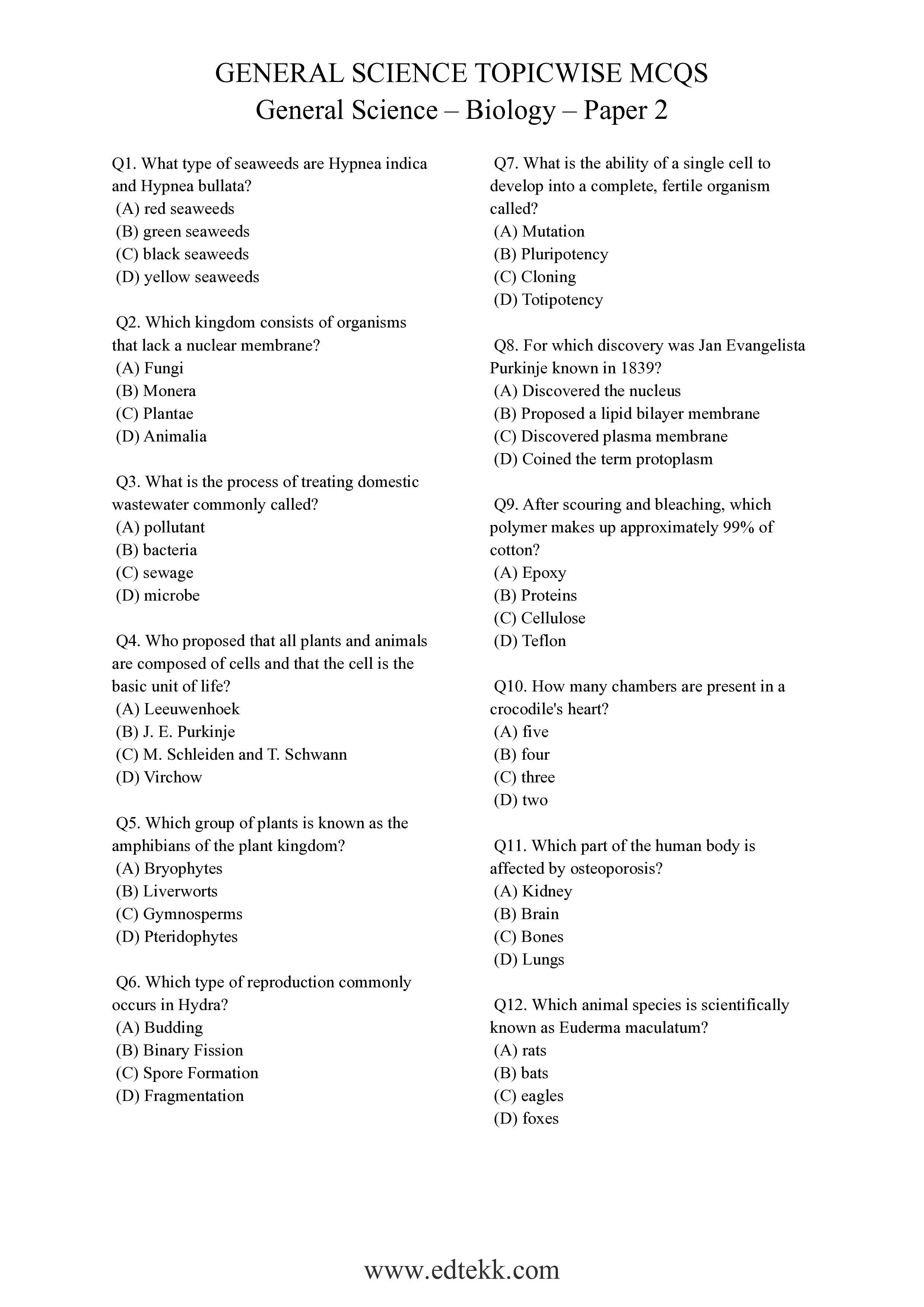
Improve your understanding of Biology with this General Science topicwise MCQ practice paper. Paper 2 features objective questions on important biological concepts, supported by correct answers and explanations for effective preparation. It is suitable for aspirants appearing in SSC, Railway, State PSC, Police Constable and Police SI examinations.
Test Details
Topic: Biology
Total Questions: 20
Question Format: MCQs – Single Correct Answer
Suitable for: SSC exams, Railway exams, State PSC, Police Constable, Police SI
Download All Papers in This Series (PDF)
Questions and Answers
Q1. What type of seaweeds are Hypnea indica and Hypnea bullata?
(A) red seaweeds
(B) green seaweeds
(C) black seaweeds
(D) yellow seaweeds
Explanation: Hypnea indica and Hypnea bullata are species of red seaweeds belonging to the genus Hypnea and the class Rhodophyceae. Members of this genus are marine macroalgae and are commercially important sources of carrageenan, a polysaccharide widely used as a thickening and gelling agent in food and other industries.
Q2. Which kingdom consists of organisms that lack a nuclear membrane?
(A) Fungi
(B) Monera
(C) Plantae
(D) Animalia
Explanation: Monera includes prokaryotic organisms such as bacteria, which lack a membrane-bound nucleus. Their genetic material is located in a region called the nucleoid rather than being enclosed within a nuclear membrane. In contrast, organisms belonging to Fungi, Animalia and Plantae are eukaryotic and possess a true nucleus.
Q3. What is the process of treating domestic wastewater commonly called?
(A) pollutant
(B) bacteria
(C) sewage
(D) microbe
Explanation: Domestic wastewater is commonly referred to as sewage, and its treatment is called sewage treatment. It involves physical, biological and sometimes chemical processes to remove suspended solids, organic matter, harmful microorganisms and other pollutants before the treated water is discharged or reused.
Q4. Who proposed that all plants and animals are composed of cells and that the cell is the basic unit of life?
(A) Leeuwenhoek
(B) J. E. Purkinje
(C) M. Schleiden and T. Schwann
(D) Virchow
Explanation: Matthias Schleiden and Theodor Schwann jointly developed the classical cell theory. Schleiden established that plants are composed of cells, while Schwann extended this principle to animals. Their work established the cell as the fundamental structural and functional unit of living organisms.
Q5. Which group of plants is known as the amphibians of the plant kingdom?
(A) Bryophytes
(B) Liverworts
(C) Gymnosperms
(D) Pteridophytes
Explanation: Bryophytes are called the amphibians of the plant kingdom because they are primarily terrestrial but require water for sexual reproduction. Their motile male gametes swim through a film of water to reach the female reproductive structure. They include mosses, liverworts and hornworts and generally grow in moist environments.
Q6. Which type of reproduction commonly occurs in Hydra?
(A) Budding
(B) Binary Fission
(C) Spore Formation
(D) Fragmentation
Explanation: Hydra commonly reproduces asexually through budding. A small outgrowth develops on the parent’s body through repeated cell division, gradually forming a mouth and tentacles. Once fully developed, the bud separates from the parent and becomes an independent individual. Hydra can also reproduce sexually under certain environmental conditions.
Q7. What is the ability of a single cell to develop into a complete, fertile organism called?
(A) Mutation
(B) Pluripotency
(C) Cloning
(D) Totipotency
Explanation: Totipotency is the ability of a single cell to develop into a complete organism under suitable conditions. A totipotent cell can give rise to all cell types, including embryonic and extraembryonic tissues. The zygote is a classic example of a totipotent cell.
Q8. For which discovery was Jan Evangelista Purkinje known in 1839?
(A) Discovered the nucleus
(B) Proposed a lipid bilayer membrane
(C) Discovered plasma membrane
(D) Coined the term protoplasm
Explanation: Jan Evangelista Purkinje introduced the term protoplasm in 1839 to describe the living substance within cells. The term subsequently became important in cell biology for referring to the living contents of a cell. Purkinje also made significant contributions to physiology and the study of nervous tissue.
Q9. After scouring and bleaching, which polymer makes up approximately 99% of cotton?
(A) Epoxy
(B) Proteins
(C) Cellulose
(D) Teflon
Explanation: Cellulose is the principal structural polymer of cotton fibres. After thorough scouring and bleaching, highly purified cotton may contain approximately 99% cellulose, depending on processing conditions. Cellulose is a natural polysaccharide composed of β-D-glucose units joined by β-1,4-glycosidic bonds.
Q10. How many chambers are present in a crocodile’s heart?
(A) five
(B) four
(C) three
(D) two
Explanation: Crocodiles possess a four-chambered heart consisting of two atria and two ventricles. This distinguishes them from most other reptiles, which generally have a three-chambered heart. Crocodiles also possess specialised circulatory adaptations, including the ability to redirect blood through alternative pathways under particular physiological conditions.
Q11. Which part of the human body is affected by osteoporosis?
(A) Kidney
(B) Brain
(C) Bones
(D) Lungs
Explanation: Osteoporosis is a skeletal disorder characterised by reduced bone density and deterioration of bone tissue. It makes bones weak, brittle and more susceptible to fractures, particularly in the hip, spine and wrist.
Q12. Which animal species is scientifically known as Euderma maculatum?
(A) rats
(B) bats
(C) eagles
(D) foxes
Explanation: Euderma maculatum is the scientific name of the spotted bat, a species native to western North America. It is recognised by its distinctive three white spots on its dark-coloured back and exceptionally large ears. It is one of the most distinctive bat species found in North America.
Q13. What is the scientific study of fungi called?
(A) Gerontology
(B) Geobiology
(C) Chronobiology
(D) Mycology
Explanation: Mycology is the branch of biology concerned with the study of fungi, including yeasts, moulds and mushrooms. It deals with their classification, structure, reproduction, physiology and ecological roles. Mycology also examines fungal diseases and the economic importance of fungi in agriculture, medicine and industry.
Q14. What is the transport of soluble products of photosynthesis called?
(A) translocation
(B) transpiration
(C) transportation
(D) concentration
Explanation: Translocation is the movement of soluble products of photosynthesis, particularly sucrose, from source regions such as leaves to sink regions such as roots, fruits and growing tissues. This transport occurs through the phloem.
Q15. The Bacille Calmette–Guérin (BCG) vaccine is used to prevent which disease?
(A) Tuberculosis
(B) Jaundice
(C) Typhoid
(D) Polio
Explanation: The Bacille Calmette–Guérin (BCG) vaccine is used to protect against tuberculosis (TB), an infectious disease caused by bacteria belonging to the Mycobacterium tuberculosis complex. It is particularly effective in protecting children against severe forms of tuberculosis, including tuberculous meningitis and disseminated TB. Its effectiveness against pulmonary tuberculosis varies across populations.
Q16. Which of the following plants is carnivorous?
(A) Cypress Vine
(B) Amaryllis
(C) Venus Flytrap
(D) Hyacinth
Explanation: Venus flytrap (Dionaea muscipula) is a carnivorous plant that captures and digests insects using specialised trap-like leaves. It obtains nutrients, particularly nitrogen and phosphorus, from its prey because it typically grows in nutrient-poor soils.
Q17. Which of the following is NOT a storage root?
(A) Napiform root
(B) Breathing root
(C) Conical root
(D) Fusiform root
Explanation: Breathing roots, or pneumatophores, are specialised roots that grow upward from waterlogged, oxygen-deficient soil and facilitate gaseous exchange through lenticels. They occur in certain mangroves, such as Avicennia. Napiform, conical and fusiform roots are storage modifications of taproots. Therefore, breathing roots are not storage roots.
Q18. Which of the following substances has the greatest affinity for haemoglobin?
(A) Oxygen
(B) Carbon dioxide
(C) Carbon monoxide
(D) Nitrogen
Explanation: Haemoglobin has a much greater affinity for carbon monoxide than for oxygen, approximately 200–250 times greater under commonly cited physiological conditions. Carbon monoxide forms carboxyhaemoglobin, reducing the blood’s oxygen-carrying capacity and impairing oxygen release to tissues. Exposure can cause severe, potentially fatal poisoning.
Q19. Which of the following is an essential micronutrient required by plants?
(A) Phosphorus
(B) Zinc
(C) Nitrogen
(D) Calcium
Explanation: Zinc is an essential plant micronutrient required in small quantities for normal growth and development. It contributes to enzyme activity, protein synthesis, and the regulation of growth-related processes. Although phosphorus, calcium, and nitrogen are also essential plant nutrients, they are classified as macronutrients because plants generally require them in substantially larger quantities than zinc.
Q20. What is the scientific term for the fear of heights?
(A) ophidiophobia
(B) haemophobia
(C) acrophobia
(D) tachophobia
Explanation: Acrophobia is an excessive or irrational fear of heights. It is classified as a specific phobia and may cause anxiety, dizziness or panic when a person is exposed to elevated places. Ophidiophobia refers to the fear of snakes, haemophobia to the fear of blood and tachophobia to the fear of speed.
Question Paper Images