Enhance your General Science preparation with Biology topicwise MCQs – Paper 3. This practice paper covers important Biology concepts through multiple-choice questions, accompanied by correct answers and explanations. It provides useful revision and practice for candidates preparing for SSC exams, Railway exams, State PSC, Police Constable and Police SI examinations.
Test Details
Topic: Biology
Total Questions: 20
Question Format: MCQs – Single Correct Answer
Suitable for: SSC exams, Railway exams, State PSC, Police Constable, Police SI
Download All Papers in This Series (PDF)
Questions and Answers
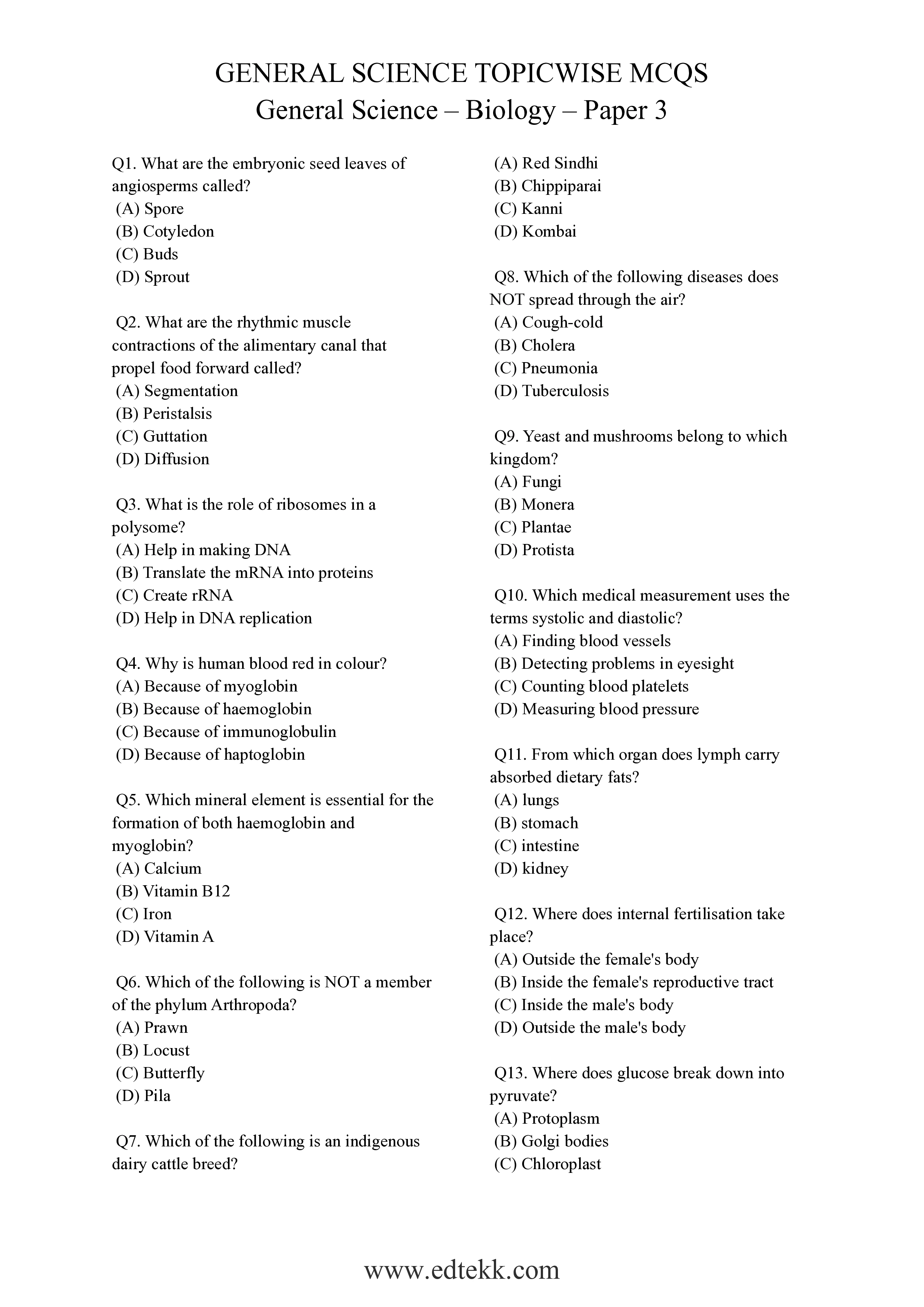
Q1. What are the embryonic seed leaves of angiosperms called?
(A) Spore
(B) Cotyledon
(C) Buds
(D) Sprout
Explanation: Cotyledons are embryonic seed leaves present in angiosperm embryos. Monocotyledonous plants possess one cotyledon, whereas dicotyledonous plants generally possess two. Cotyledons may store food or absorb and transfer nutrients from stored food reserves to the developing embryo.
Q2. What are the rhythmic muscle contractions of the alimentary canal that propel food forward called?
(A) Segmentation
(B) Peristalsis
(C) Guttation
(D) Diffusion
Explanation: Peristalsis refers to coordinated, wave-like contractions and relaxations of the smooth muscles lining the alimentary canal. These movements propel food through the digestive tract, moving it along the oesophagus and through the stomach and intestines. Peristalsis is essential for the onward transport of food during digestion.
Q3. What is the role of ribosomes in a polysome?
(A) Help in making DNA
(B) Translate the mRNA into proteins
(C) Create rRNA
(D) Help in DNA replication
Explanation: Polysomes, or polyribosomes, consist of multiple ribosomes simultaneously attached to a single messenger RNA (mRNA) molecule. Each ribosome translates the mRNA sequence to synthesise a polypeptide chain. Thus, polysomes increase the efficiency of protein synthesis by enabling several ribosomes to produce protein molecules from the same mRNA simultaneously.
Q4. Why is human blood red in colour?
(A) Because of myoglobin
(B) Because of haemoglobin
(C) Because of immunoglobulin
(D) Because of haptoglobin
Explanation: Haemoglobin is an iron-containing protein present in red blood cells that gives human blood its characteristic red colour. Its colour varies with oxygenation: oxygenated blood is bright red, whereas deoxygenated blood is darker red. Myoglobin, in contrast, is primarily an oxygen-binding protein found in muscle tissue.
Q5. Which mineral element is essential for the formation of both haemoglobin and myoglobin?
(A) Calcium
(B) Vitamin B12
(C) Iron
(D) Vitamin A
Explanation: Iron is essential for the formation and functioning of both haemoglobin and myoglobin. Haemoglobin transports oxygen in red blood cells, whereas myoglobin stores and facilitates oxygen availability in muscle cells. Both proteins contain a haem group with an iron atom that binds oxygen.
Q6. Which of the following is NOT a member of the phylum Arthropoda?
(A) Prawn
(B) Locust
(C) Butterfly
(D) Pila
Explanation: Pila, commonly known as the apple snail, belongs to the phylum Mollusca and is therefore not an arthropod. Locusts and butterflies belong to the class Insecta, while prawns are crustaceans. All three belong to the phylum Arthropoda.
Q7. Which of the following is an indigenous dairy cattle breed?
(A) Red Sindhi
(B) Chippiparai
(C) Kanni
(D) Kombai
Explanation: Red Sindhi is an indigenous Indian dairy cattle breed originating from the Sindh region of the Indian subcontinent. It is valued for its heat tolerance, disease resistance and milk production. Chippiparai, Kanni and Kombai are indigenous Indian dog breeds rather than cattle breeds.
Q8. Which of the following diseases does NOT spread through the air?
(A) Cough-cold
(B) Cholera
(C) Pneumonia
(D) Tuberculosis
Explanation: Cholera is primarily transmitted through food or water contaminated with Vibrio cholerae, commonly due to inadequate sanitation. In contrast, tuberculosis spreads through airborne particles, while respiratory infections causing colds and some forms of pneumonia may spread through respiratory particles, depending on the causative pathogen.
Q9. Yeast and mushrooms belong to which kingdom?
(A) Fungi
(B) Monera
(C) Plantae
(D) Protista
Explanation: Yeast and mushrooms belong to kingdom Fungi. Fungi are eukaryotic, heterotrophic organisms that obtain nutrients through absorption. Yeast is generally unicellular and reproduces mainly by budding, whereas mushrooms are multicellular fungi with specialised reproductive structures.
Q10. Which medical measurement uses the terms systolic and diastolic?
(A) Finding blood vessels
(B) Detecting problems in eyesight
(C) Counting blood platelets
(D) Measuring blood pressure
Explanation: Systolic and diastolic are terms used in measuring blood pressure. Systolic pressure represents the pressure in the arteries when the heart contracts, whereas diastolic pressure represents the pressure when the heart relaxes between beats. Blood pressure is conventionally expressed as systolic pressure over diastolic pressure and measured in millimetres of mercury (mmHg).
Q11. From which organ does lymph carry absorbed dietary fats?
(A) lungs
(B) stomach
(C) intestine
(D) kidney
Explanation: Lymph carries absorbed dietary fats from the small intestine through specialised lymphatic capillaries called lacteals. These vessels absorb fats packaged into chylomicrons. The resulting fat-rich lymph, known as chyle, travels through the lymphatic vessels and eventually enters the bloodstream, mainly through the thoracic duct.
Q12. Where does internal fertilisation take place?
(A) Outside the female’s body
(B) Inside the female’s reproductive tract
(C) Inside the male’s body
(D) Outside the male’s body
Explanation: Internal fertilisation occurs when male and female gametes fuse within the female reproductive tract. It occurs in humans and many other animals, including birds, reptiles and mammals. In humans, fertilisation normally takes place in the fallopian tube, usually in its ampullary region. In external fertilisation, gamete fusion occurs outside the female’s body.
Q13. Where does glucose break down into pyruvate?
(A) Protoplasm
(B) Golgi bodies
(C) Chloroplast
(D) Cytoplasm
Explanation: Glycolysis is the metabolic pathway in which one molecule of glucose is converted into two molecules of pyruvate. It occurs in the cytoplasm of cells and does not directly require oxygen. The process produces a net gain of two ATP molecules and two NADH molecules per glucose molecule and constitutes the first stage of cellular respiration.
Q14. Which cell structure regulates the entry and exit of substances into and out of the cell?
(A) Cytoplasm
(B) Protoplasm
(C) Plasma membrane
(D) Cell wall
Explanation: The plasma membrane, also called the cell membrane, is selectively permeable. It regulates the movement of substances into and out of the cell, allowing certain materials to pass while restricting others. This selective permeability helps maintain the internal environment necessary for cellular activities.
Q15. Which of the following is NOT a form of cancer?
(A) Lymphoma
(B) Glaucoma
(C) Sarcoma
(D) Carcinoma
Explanation: Glaucoma is an eye disease that damages the optic nerve, often associated with increased intraocular pressure. It is not a form of cancer. In contrast, lymphoma, carcinoma and sarcoma are major categories of cancer. Lymphoma affects lymphatic tissues, carcinoma arises from epithelial cells, and sarcoma develops from connective or supporting tissues.
Q16. Which of the following diseases is generally caused by a virus?
(A) Typhoid
(B) Dengue fever
(C) Tuberculosis
(D) Cholera
Explanation: Dengue fever is caused by the dengue virus and is transmitted primarily through the bite of infected female Aedes mosquitoes. Typhoid and tuberculosis are bacterial diseases caused by Salmonella Typhi and Mycobacterium tuberculosis, respectively. Cholera is caused by the bacterium Vibrio cholerae.
Q17. Which syndrome is characterised by a fatty hump between the shoulders, a rounded face and pink or purple stretch marks on the skin?
(A) Cushing syndrome
(B) Down syndrome
(C) Marfan syndrome
(D) Angelman syndrome
Explanation: Cushing syndrome results from prolonged exposure to excessive cortisol. Its characteristic features include a rounded face (moon face), fat accumulation between the shoulders (buffalo hump) and pink or purple stretch marks (striae). Other symptoms may include weight gain, muscle weakness and high blood pressure.
Q18. Which branch of biology studies the microscopic structure of cells, tissues and organs?
(A) Histology
(B) Paleontology
(C) Ichthyology
(D) Entomology
Explanation: Histology is the branch of biology concerned primarily with the microscopic study of tissues and their organisation. It examines tissue structure and the relationship between structure and function using microscopes. It is particularly important in anatomy, pathology and medical diagnosis.
Q19. Which structures constitute the central nervous system in the human body?
(A) Only brain
(B) Only blood
(C) Both brain and spinal cord
(D) Only spinal cord
Explanation: The human central nervous system (CNS) consists of the brain and spinal cord. It receives and processes sensory information, coordinates responses and regulates various bodily functions. The peripheral nervous system comprises nerves and ganglia outside the CNS and connects it with the rest of the body.
Q20. What are the water-holding compounds produced in large quantities by marine brown and red algae called?
(A) Lipids
(B) Hydrocolloids
(C) Carbohydrates
(D) Gelatin
Explanation: Marine brown and red algae produce large quantities of hydrocolloids, which are water-absorbing, gel-forming substances. Important examples include alginates from brown algae, agar from red algae and carrageenan from red algae. These compounds are commercially useful as thickening, stabilising and gelling agents in food, pharmaceutical and cosmetic industries.
Question Paper Images