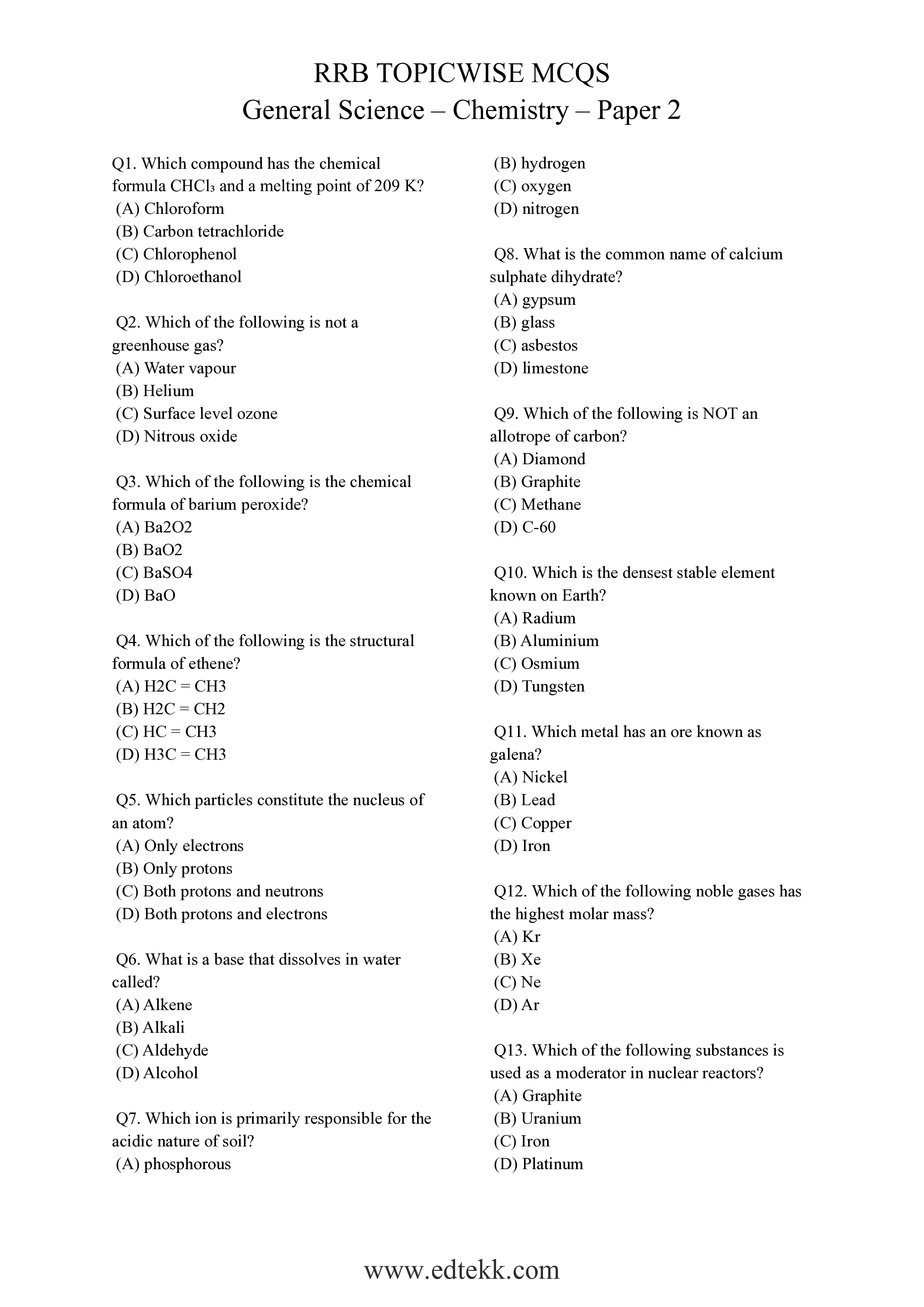
Strengthen your Railway exam preparation with General Science Chemistry MCQs – Paper 2. This practice set features topicwise Chemistry questions with answers and explanations for effective revision. Suitable for RRB NTPC, Group D, ALP and Technician examinations, it helps candidates improve subject knowledge and confidence.
Test Details
Topic: Chemistry
Total Questions: 20
Question Format: MCQs – Single Correct Answer
Suitable for: RRB NTPC, Group D, ALP, Technician
Download All Papers in This Series (PDF)
Questions and Answers
Q1. Which compound has the chemical formula CHCl₃ and a melting point of 209 K?
(A) Chloroform
(B) Carbon tetrachloride
(C) Chlorophenol
(D) Chloroethanol
Explanation: Chloroform (CHCl₃), also known as trichloromethane, has a melting point of approximately 209 K (−64 °C). It is a colourless, volatile liquid with a characteristic sweet smell. Although historically used as an anaesthetic, it is no longer commonly used for this purpose because of its toxicity.
Q2. Which of the following is not a greenhouse gas?
(A) Water vapour
(B) Helium
(C) Surface level ozone
(D) Nitrous oxide
Explanation: Helium is not a greenhouse gas because it does not significantly absorb outgoing infrared radiation. It is a chemically inert noble gas belonging to Group 18. In contrast, water vapour, surface-level ozone and nitrous oxide absorb infrared radiation and contribute to the greenhouse effect.
Q3. Which of the following is the chemical formula of barium peroxide?
(A) Ba2O2
(B) BaO2
(C) BaSO4
(D) BaO
Explanation: Barium peroxide has the chemical formula BaO₂. It consists of barium ions (Ba²⁺) and peroxide ions (O₂²⁻). Barium oxide has the formula BaO, while barium sulphate is represented by BaSO₄.
Q4. Which of the following is the structural formula of ethene?
(A) H2C = CH3
(B) H2C = CH2
(C) HC = CH3
(D) H3C = CH3
Explanation: Ethene (C₂H₄) is the simplest alkene and contains two carbon atoms joined by a double bond. Each carbon atom is bonded to two hydrogen atoms. Therefore, its structural formula is CH₂=CH₂. Ethene is an unsaturated hydrocarbon and an important raw material in the manufacture of polyethylene.
Q5. Which particles constitute the nucleus of an atom?
(A) Only electrons
(B) Only protons
(C) Both protons and neutrons
(D) Both protons and electrons
Explanation: The nucleus of most atoms contains positively charged protons and electrically neutral neutrons, collectively called nucleons. Electrons occupy regions outside the nucleus. An important exception is ordinary hydrogen (protium or hydrogen-1), whose nucleus contains only one proton and no neutrons.
Q6. What is a base that dissolves in water called?
(A) Alkene
(B) Alkali
(C) Aldehyde
(D) Alcohol
Explanation: An alkali is a base that dissolves in water and produces hydroxide ions in aqueous solution. Common examples include sodium hydroxide and potassium hydroxide. All alkalis are bases, but not all bases are alkalis because some bases are insoluble or only sparingly soluble in water.
Q7. Which ion is primarily responsible for the acidic nature of soil?
(A) phosphorous
(B) hydrogen
(C) oxygen
(D) nitrogen
Explanation: Acidic soil is characterised by a relatively high concentration of hydrogen ions (H⁺), resulting in a pH below 7. As hydrogen ion activity increases, soil pH decreases and acidity increases. Soil pH influences nutrient availability and plant growth.
Q8. What is the common name of calcium sulphate dihydrate?
(A) gypsum
(B) glass
(C) asbestos
(D) limestone
Explanation: Calcium sulphate dihydrate (CaSO₄·2H₂O) is commonly known as gypsum. It is a naturally occurring mineral used in the manufacture of plaster of Paris, cement and various building materials.
Q9. Which of the following is NOT an allotrope of carbon?
(A) Diamond
(B) Graphite
(C) Methane
(D) C-60
Explanation: Methane (CH₄) is not an allotrope of carbon because it contains both carbon and hydrogen atoms. Diamond, graphite and C₆₀ (Buckminsterfullerene) are allotropes of carbon, as they consist entirely of carbon atoms arranged in different structural forms.
Q10. Which is the densest stable element known on Earth?
(A) Radium
(B) Aluminium
(C) Osmium
(D) Tungsten
Explanation: Osmium (Os), atomic number 76, is conventionally recognised as the densest naturally occurring stable element, with a density of approximately 22.59 g/cm³ at room temperature. Iridium has a very similar density of approximately 22.56 g/cm³.
Q11. Which metal has an ore known as galena?
(A) Nickel
(B) Lead
(C) Copper
(D) Iron
Explanation: Galena is the principal ore of lead and has the chemical formula PbS (lead sulphide). It is a naturally occurring mineral characterised by its metallic lustre and is an important source of lead extraction.
Q12. Which of the following noble gases has the highest molar mass?
(A) Kr
(B) Xe
(C) Ne
(D) Ar
Explanation: Xenon (Xe) has the highest molar mass among the four given noble gases, with a standard atomic mass of approximately 131.29 u. Krypton has an atomic mass of approximately 83.80 u, argon 39.95 u and neon 20.18 u.
Q13. Which of the following substances is used as a moderator in nuclear reactors?
(A) Graphite
(B) Uranium
(C) Iron
(D) Platinum
Explanation: Graphite is used as a neutron moderator in several nuclear reactors. It slows down fast neutrons to thermal energies without absorbing a significant number of them. These slow neutrons increase the probability of further nuclear fission, thereby helping sustain the chain reaction.
Q14. Which of the following is not an electrical insulator?
(A) Mercury
(B) Glass
(C) Ebonite
(D) Dry Paper
Explanation: Mercury is a metal and an electrical conductor; therefore, it is not an insulator. It is liquid at room temperature and allows electric current to pass through it. Dry paper, glass and ebonite are generally electrical insulators because they do not allow electric current to flow easily under ordinary conditions.
Q15. What is the phenomenon called in which fats and oils develop unpleasant smells and tastes due to deterioration?
(A) Corrosion
(B) Ductility
(C) Erosion
(D) Rancidity
Explanation: Rancidity is the deterioration of fats and oils that produces unpleasant smells and tastes. It commonly occurs through oxidation or hydrolysis, particularly when food containing fats is exposed to air, moisture, heat or light. Storing food in airtight containers and protecting it from excessive heat and light helps prevent rancidity.
Q16. Which of the following is NOT an allotrope of carbon?
(A) Graphite
(B) Methane
(C) Diamond
(D) C-60 Buckminsterfullerene
Explanation: Methane (CH₄) is not an allotrope of carbon because it contains both carbon and hydrogen atoms. Graphite, diamond and Buckminsterfullerene (C₆₀) are allotropes of carbon because they consist entirely of carbon atoms arranged in different structural configurations.
Q17. What is heavy water primarily used for?
(A) In both Nuclear reactors and Fire extinguisher
(B) In washing cloth
(C) In nuclear reactors
(D) In fire extinguisher
Explanation: Heavy water (D₂O) is primarily used as a neutron moderator in nuclear reactors. It slows down fast neutrons without absorbing many of them, thereby helping sustain the nuclear fission chain reaction. It is also used as a coolant in certain types of nuclear reactors.
Q18. Which of the following yeast species is used in the manufacture of alcoholic beverages?
(A) Cryptococcus neoformans
(B) Kluyveromyces lactis
(C) Pichia pastoris
(D) Saccharomyces cerevisiae
Explanation: Saccharomyces cerevisiae is commonly known as baker’s yeast and brewer’s yeast. It carries out alcoholic fermentation by converting sugars into ethanol and carbon dioxide. This property makes it important in the production of beer, wine and other alcoholic beverages, as well as in bread-making.
Q19. What is obtained by multiplying an element’s equivalent weight by its valency?
(A) Atomicity
(B) Density
(C) Relative temperature
(D) Atomic weight
Explanation: The equivalent weight of an element is calculated by dividing its atomic weight by its applicable valency. Thus, Equivalent weight = Atomic weight/Valency. Rearranging gives Atomic weight = Equivalent weight × Valency. For elements exhibiting variable valency, equivalent weight depends on the valency involved in the particular chemical reaction.
Q20. Who is regarded as the Father of Modern Atomic Theory?
(A) Robert Boyle
(B) John Dalton
(C) Willard Gibbs
(D) Otto Hahn
Explanation: John Dalton is regarded as the Father of Modern Atomic Theory. He proposed that all matter consists of tiny particles called atoms and explained how atoms combine in fixed proportions to form chemical compounds. His atomic theory laid the foundation for modern chemistry.
Question Paper Images