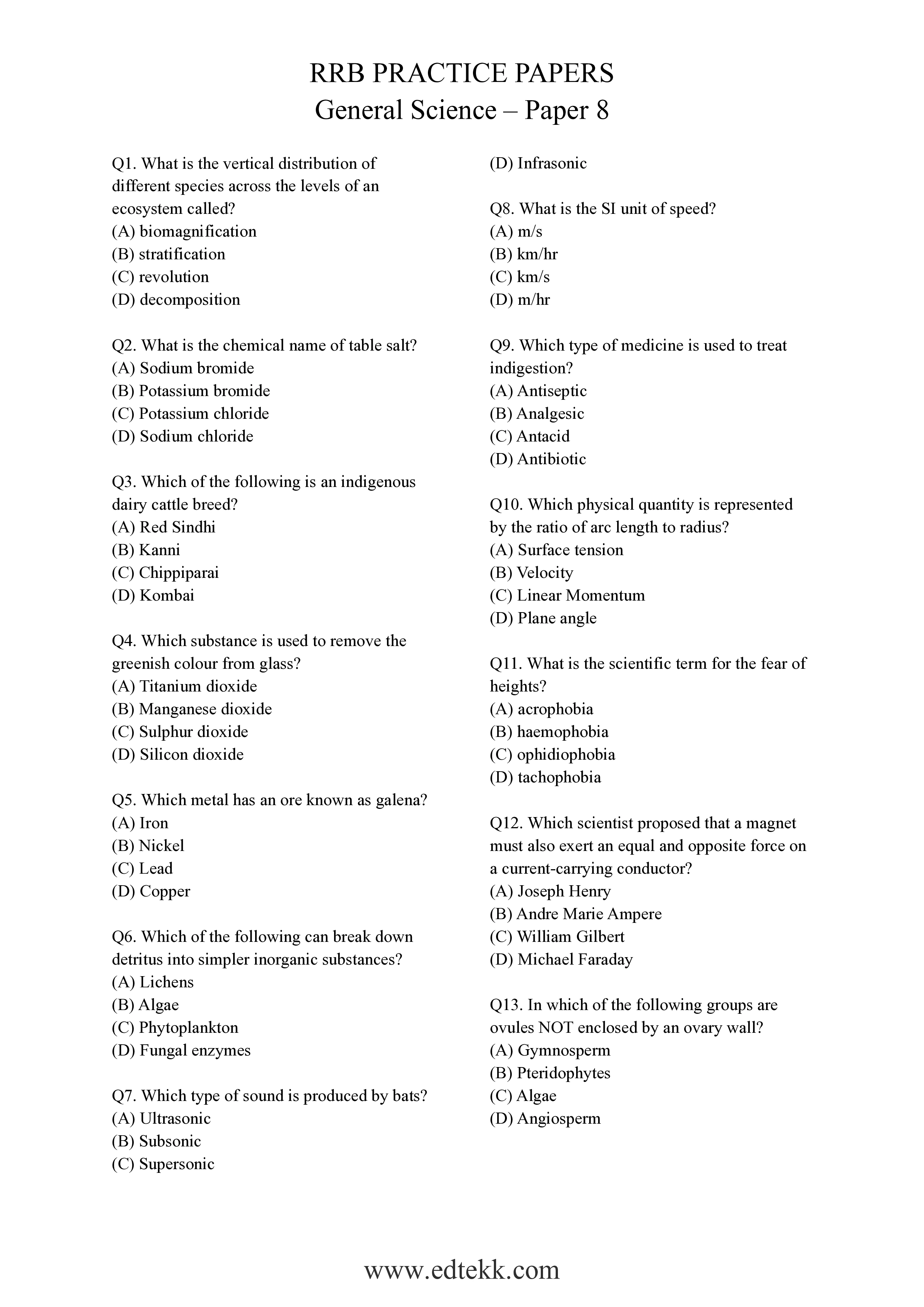
Boost your preparation for Railway Recruitment Board examinations with General Science Practice Paper 8. This set contains 20 multiple-choice questions to help aspirants practise essential science concepts, check their understanding and revise through answers and explanations for RRB NTPC, Group D, ALP and Technician examinations.
Test Details
Topic: General Science
Total Questions: 20
Question Format: MCQs – Single Correct Answer
Suitable for: RRB NTPC, Group D, ALP, Technician
Download All Papers in This Series (PDF)
Questions and Answers
Q1. What is the vertical distribution of different species across the levels of an ecosystem called?
(A) biomagnification
(B) stratification
(C) revolution
(D) decomposition
Explanation: Stratification refers to the vertical distribution of different species or communities at different levels in an ecosystem. For example, forest vegetation may be arranged into distinct layers, including the canopy, understory, shrub layer and forest floor.
Q2. What is the chemical name of table salt?
(A) Sodium bromide
(B) Potassium bromide
(C) Potassium chloride
(D) Sodium chloride
Explanation: Table salt is chemically known as sodium chloride (NaCl). It consists of sodium ions and chloride ions arranged in an ionic crystal lattice. It is commonly used for seasoning and preserving food.
Q3. Which of the following is an indigenous dairy cattle breed?
(A) Red Sindhi
(B) Kanni
(C) Chippiparai
(D) Kombai
Explanation: Red Sindhi is an indigenous Indian dairy cattle breed originating from the Sindh region of the Indian subcontinent. It is valued for its heat tolerance, disease resistance and milk production. Chippiparai, Kanni and Kombai are indigenous Indian dog breeds rather than cattle breeds.
Q4. Which substance is used to remove the greenish colour from glass?
(A) Titanium dioxide
(B) Manganese dioxide
(C) Sulphur dioxide
(D) Silicon dioxide
Explanation: Manganese dioxide (MnO₂) is used as a decolourising agent in glass manufacturing to remove or offset the greenish tint caused by iron impurities. It helps neutralise unwanted colouring through oxidation and the development of a complementary colour. Excess manganese compounds can impart a purple or pink tint to glass.
Q5. Which metal has an ore known as galena?
(A) Iron
(B) Nickel
(C) Lead
(D) Copper
Explanation: Galena is the principal ore of lead and has the chemical formula PbS (lead sulphide). It is a naturally occurring mineral characterised by its metallic lustre and is an important source of lead extraction.
Q6. Which of the following can break down detritus into simpler inorganic substances?
(A) Lichens
(B) Algae
(C) Phytoplankton
(D) Fungal enzymes
Explanation: Decomposers, particularly fungi and bacteria, break down detritus (dead organic matter) into simpler substances through enzymatic activity. Fungal enzymes help decompose complex organic materials, facilitating mineralisation and the recycling of nutrients within ecosystems.
Q7. Which type of sound is produced by bats?
(A) Ultrasonic
(B) Subsonic
(C) Supersonic
(D) Infrasonic
Explanation: Bats produce and use ultrasonic sounds for echolocation. They emit high-frequency sound waves and detect the returning echoes to locate prey, identify obstacles and navigate in darkness. These sounds generally have frequencies above the upper limit of human hearing (20 kHz).
Q8. What is the SI unit of speed?
(A) m/s
(B) km/hr
(C) km/s
(D) m/hr
Explanation: The SI unit of speed is metre per second (m/s). Speed is defined as the distance travelled per unit time. Although kilometres per hour (km/h) is commonly used in everyday life, it is not the SI unit of speed.
Q9. Which type of medicine is used to treat indigestion?
(A) Antiseptic
(B) Analgesic
(C) Antacid
(D) Antibiotic
Explanation: Antacids are medicines used to relieve indigestion associated with excess stomach acid, acidity and heartburn. They neutralise hydrochloric acid in the stomach. Common ingredients include magnesium hydroxide, aluminium hydroxide and calcium carbonate. Antacids provide symptomatic relief but do not treat every cause of indigestion.
Q10. Which physical quantity is represented by the ratio of arc length to radius?
(A) Surface tension
(B) Velocity
(C) Linear Momentum
(D) Plane angle
Explanation: The ratio of arc length to radius, (s/r), gives the plane angle in radians when both measurements are expressed in the same units. The radian is the SI-derived unit of plane angle. Although this ratio is dimensionless, it represents a specific geometric quantity.
Q11. What is the scientific term for the fear of heights?
(A) acrophobia
(B) haemophobia
(C) ophidiophobia
(D) tachophobia
Explanation: Acrophobia is an excessive or irrational fear of heights. It is classified as a specific phobia and may cause anxiety, dizziness or panic when a person is exposed to elevated places. Ophidiophobia refers to the fear of snakes, haemophobia to the fear of blood and tachophobia to the fear of speed.
Q12. Which scientist proposed that a magnet must also exert an equal and opposite force on a current-carrying conductor?
(A) Joseph Henry
(B) Andre Marie Ampere
(C) William Gilbert
(D) Michael Faraday
Explanation: André-Marie Ampère proposed that a magnet exerts an equal and opposite force on a current-carrying conductor, consistent with Newton’s third law of motion. His investigations into the interaction between electric currents and magnets contributed significantly to the development of electrodynamics.
Q13. In which of the following groups are ovules NOT enclosed by an ovary wall?
(A) Gymnosperm
(B) Pteridophytes
(C) Algae
(D) Angiosperm
Explanation: Gymnosperms possess naked ovules that are not enclosed within an ovary wall. Their seeds develop exposed on specialised structures, commonly associated with cones. This distinguishes them from angiosperms, in which ovules are enclosed within an ovary that generally develops into a fruit after fertilisation.
Q14. What is the phenomenon called in which fats and oils develop unpleasant smells and tastes due to deterioration?
(A) Corrosion
(B) Ductility
(C) Erosion
(D) Rancidity
Explanation: Rancidity is the deterioration of fats and oils that produces unpleasant smells and tastes. It commonly occurs through oxidation or hydrolysis, particularly when food containing fats is exposed to air, moisture, heat or light. Storing food in airtight containers and protecting it from excessive heat and light helps prevent rancidity.
Q15. Which of the following is not a naturally occurring greenhouse gas?
(A) Methane
(B) Carbon dioxide
(C) Nitrogen
(D) Water vapour
Explanation: Nitrogen (N₂) is not a greenhouse gas because its homonuclear diatomic molecules do not absorb infrared radiation effectively. In contrast, carbon dioxide, water vapour and methane absorb outgoing infrared radiation and contribute to the greenhouse effect.
Q16. Which of the following is the equivalent SI unit expression for one pascal (Pa)?
(A) N m⁻²
(B) N m⁻¹
(C) N m
(D) N m²
Explanation: One pascal (Pa) is the SI unit of pressure and is defined as one newton of force acting perpendicularly over an area of one square metre. Therefore, (1text{ Pa} = 1text{ N/m}^2 = 1text{ N m}^{-2}).
Q17. Deficiency of which nutrient is the most common nutritional cause of goitre?
(A) Vitamin C
(B) Iodine
(C) Calcium
(D) Iron
Explanation: Iodine deficiency is the most common nutritional cause of goitre worldwide. Iodine is essential for the production of thyroid hormones. Insufficient iodine intake can reduce thyroid hormone production and stimulate the thyroid gland to enlarge. However, goitre can also result from autoimmune disorders and other thyroid conditions.
Q18. Yeast and mushrooms belong to which kingdom?
(A) Plantae
(B) Fungi
(C) Protista
(D) Monera
Explanation: Yeast and mushrooms belong to kingdom Fungi. Fungi are eukaryotic, heterotrophic organisms that obtain nutrients through absorption. Yeast is generally unicellular and reproduces mainly by budding, whereas mushrooms are multicellular fungi with specialised reproductive structures.
Q19. What are the temporary, finger-like projections used by Amoeba for movement and feeding called?
(A) contractile vacuole
(B) pseudopodia
(C) endoplasm
(D) food vacuoles
Explanation: Pseudopodia are temporary, finger-like projections of the cytoplasm formed by Amoeba. The term literally means ‘false feet’. They help the organism move and capture food through phagocytosis. During feeding, pseudopodia surround food particles and enclose them within food vacuoles for digestion.
Q20. Who is popularly known as the “Darwin of the 20th century”?
(A) Ernst Mayr
(B) Katherine Esau
(C) Marshall Warren Nirenberg
(D) Har Gobind Khorana
Explanation: Ernst Mayr was a prominent evolutionary biologist and a major contributor to the modern evolutionary synthesis. He is widely referred to as the Darwin of the 20th century for his contributions to evolutionary biology, speciation and systematics. His biological species concept significantly advanced the understanding of species formation and evolution.
Question Paper Images