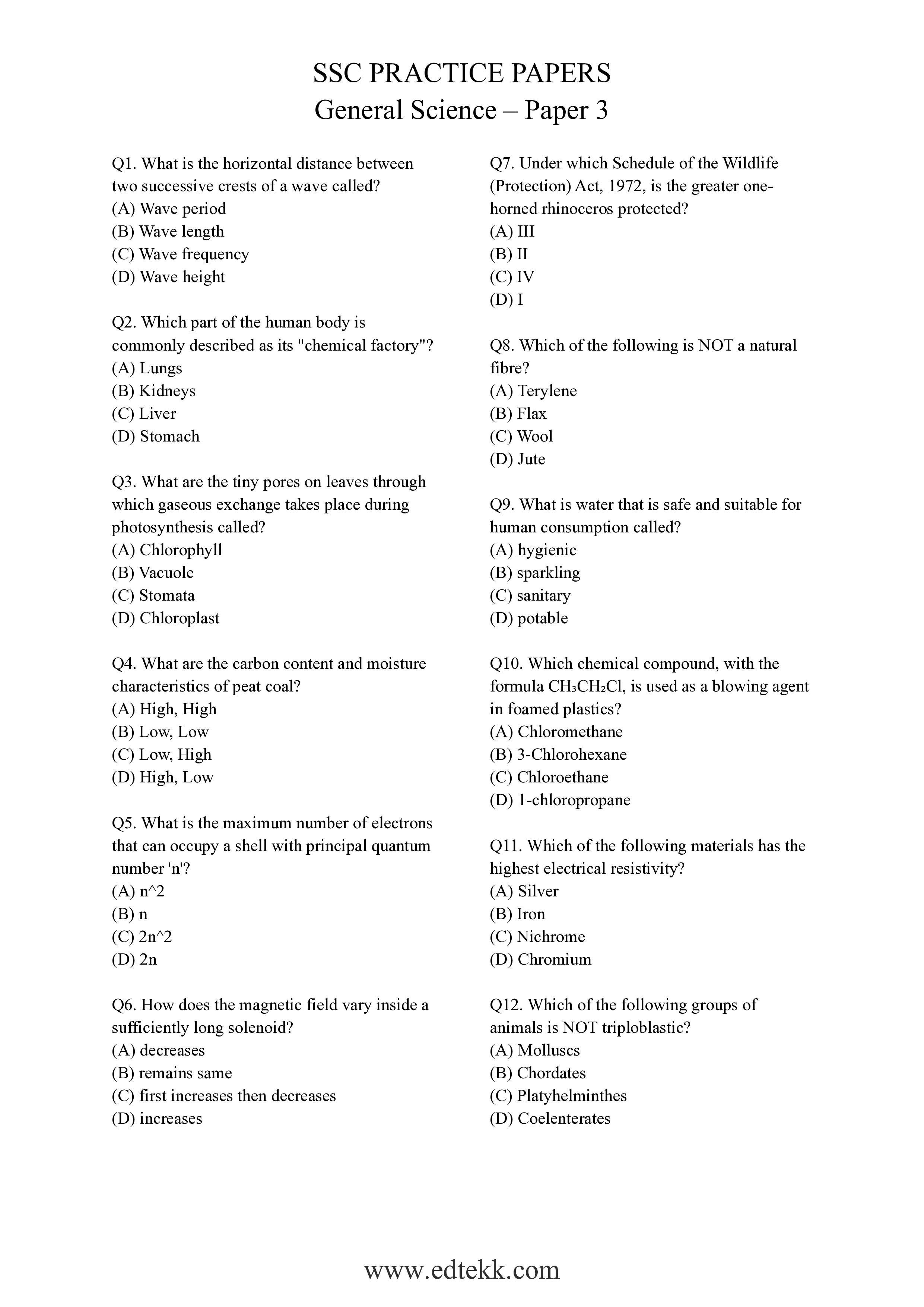
Test and strengthen your scientific knowledge with SSC General Science Practice Paper 3. This set features 20 objective-type MCQs designed for competitive-exam preparation, with correct answers and explanations for effective learning. It is useful for candidates preparing for SSC CGL, CHSL, CPO, MTS, GD and Selection Post exams.
Test Details
Topic: General Science
Total Questions: 20
Question Format: MCQs – Single Correct Answer
Suitable for: SSC CGL, CHSL, CPO, MTS, GD, Selection Post
Download All Papers in This Series (PDF)
Questions and Answers
Q1. What is the horizontal distance between two successive crests of a wave called?
(A) Wave period
(B) Wave length
(C) Wave frequency
(D) Wave height
Explanation: Wavelength is the horizontal distance between two successive corresponding points on a wave, such as consecutive crests or troughs. It is represented by the Greek letter λ and measured in metres. The wave period, by contrast, is the time required to complete one oscillation.
Q2. Which part of the human body is commonly described as its “chemical factory”?
(A) Lungs
(B) Kidneys
(C) Liver
(D) Stomach
Explanation: The liver is commonly described as the chemical factory of the human body because it performs numerous metabolic and biochemical functions. It processes nutrients, detoxifies many harmful substances, produces bile, synthesises important blood proteins and regulates the metabolism of carbohydrates, fats and proteins.
Q3. What are the tiny pores on leaves through which gaseous exchange takes place during photosynthesis called?
(A) Chlorophyll
(B) Vacuole
(C) Stomata
(D) Chloroplast
Explanation: Stomata are microscopic pores found mainly on the epidermis of leaves. They facilitate gaseous exchange, allowing carbon dioxide to enter for photosynthesis and oxygen and water vapour to move out. Each stoma is surrounded by specialised guard cells.
Q4. What are the carbon content and moisture characteristics of peat coal?
(A) High, High
(B) Low, Low
(C) Low, High
(D) High, Low
Explanation: Peat is the earliest stage of coal formation and contains a relatively low percentage of carbon compared with more mature coal varieties. It has a high moisture content and relatively low calorific value. With increasing burial, pressure and temperature, peat gradually transforms into lignite and higher grades of coal.
Q5. What is the maximum number of electrons that can occupy a shell with principal quantum number ‘n’?
(A) n^2
(B) n
(C) 2n^2
(D) 2n
Explanation: The maximum number of electrons that can occupy a shell is given by 2n², where n is the principal quantum number. Accordingly, the first shell (n = 1) accommodates 2 electrons, the second (n = 2) accommodates 8, the third (n = 3) accommodates 18 and the fourth (n = 4) accommodates 32 electrons.
Q6. How does the magnetic field vary inside a sufficiently long solenoid?
(A) decreases
(B) remains same
(C) first increases then decreases
(D) increases
Explanation: Inside a sufficiently long solenoid, the magnetic field is approximately uniform. Its magnitude and direction remain nearly constant throughout the interior. However, near the ends of a finite solenoid, the magnetic field becomes non-uniform due to edge effects.
Q7. Under which Schedule of the Wildlife (Protection) Act, 1972, is the greater one-horned rhinoceros protected?
(A) III
(B) II
(C) IV
(D) I
Explanation: The greater one-horned rhinoceros (Rhinoceros unicornis) is listed under Schedule I of India’s Wildlife (Protection) Act, 1972, as amended. Schedule I provides the highest level of statutory protection to listed wildlife species. Hunting and other prohibited activities involving this species attract stringent legal penalties.
Q8. Which of the following is NOT a natural fibre?
(A) Terylene
(B) Flax
(C) Wool
(D) Jute
Explanation: Terylene is a synthetic fibre made from polyethylene terephthalate (PET), a type of polyester. In contrast, jute and flax are natural plant fibres, while wool is a natural animal fibre. Therefore, Terylene is the only synthetic fibre among the given options.
Q9. What is water that is safe and suitable for human consumption called?
(A) hygienic
(B) sparkling
(C) sanitary
(D) potable
Explanation: Potable water is water that is safe and suitable for human consumption. It should be free from harmful microorganisms and dangerous concentrations of chemical contaminants. Drinking water must meet prescribed quality standards to prevent waterborne diseases and protect human health.
Q10. Which chemical compound, with the formula CH₃CH₂Cl, is used as a blowing agent in foamed plastics?
(A) Chloromethane
(B) 3-Chlorohexane
(C) Chloroethane
(D) 1-chloropropane
Explanation: Chloroethane (CH₃CH₂Cl), also known as ethyl chloride, is a volatile, colourless compound that has been used as a blowing agent in the manufacture of foamed plastics. Its molecular formula contains two carbon atoms, five hydrogen atoms and one chlorine atom, distinguishing it from the other chlorinated compounds listed.
Q11. Which of the following materials has the highest electrical resistivity?
(A) Silver
(B) Iron
(C) Nichrome
(D) Chromium
Explanation: Among silver, chromium, iron and nichrome, nichrome has the highest electrical resistivity. Nichrome is an alloy primarily composed of nickel and chromium. Its high resistivity, oxidation resistance and ability to withstand elevated temperatures make it suitable for heating elements in electric heaters, toasters and other electrical appliances.
Q12. Which of the following groups of animals is NOT triploblastic?
(A) Molluscs
(B) Chordates
(C) Platyhelminthes
(D) Coelenterates
Explanation: Coelenterates, traditionally called cnidarians, are diploblastic animals. They develop from two primary germ layers, the ectoderm and endoderm, with mesoglea between them. Molluscs, chordates and platyhelminthes are triploblastic animals possessing three primary germ layers.
Q13. How many electrons do halogens have in their outermost shells?
(A) five
(B) seven
(C) eight
(D) six
Explanation: Halogens belong to Group 17 of the modern periodic table and have seven electrons in their outermost shells. They tend to gain one electron to achieve a stable noble gas electronic configuration.
Q14. Which medical condition involves progressive damage to the optic nerve?
(A) Glaucoma
(B) Cataract
(C) Dry Eye
(D) Age-related Macular Degeneration (AMD)
Explanation: Glaucoma is a group of eye diseases characterised by progressive damage to the optic nerve, often associated with elevated intraocular pressure. However, increased eye pressure is not present in every case. Without appropriate treatment, glaucoma can cause irreversible vision loss, initially affecting peripheral vision and potentially progressing to blindness.
Q15. What is formed when a neutral helium atom loses one electron?
(A) Positive helium ion (He⁺)
(B) Proton
(C) Negative helium ion
(D) Alpha particle
Explanation: A neutral helium atom contains two protons and two electrons. When it loses one electron, it forms a singly positively charged helium ion (He⁺), which retains one electron. An alpha particle, by contrast, is a helium-4 nucleus containing two protons and two neutrons but no electrons, with a charge of +2e.
Q16. What are the elements belonging to Group 18 of the periodic table commonly called?
(A) Noble Gases
(B) Radioactive Gases
(C) Volatile Gases
(D) Reactive Gases
Explanation: Group 18 elements of the periodic table are commonly known as noble gases. They include helium, neon, argon, krypton, xenon, radon and oganesson. They generally possess completely filled outermost electron shells, making them relatively unreactive. However, some heavier noble gases can form compounds under specific conditions.
Q17. What is the energy derived from the Earth’s internal heat called?
(A) Solar Energy
(B) Biogas
(C) Tidal Energy
(D) Geothermal Energy
Explanation: Geothermal energy is the energy obtained from the Earth’s internal heat. This heat originates primarily from the Earth’s formation and the radioactive decay of elements within its interior. It is used for electricity generation, heating buildings and various industrial applications.
Q18. Which chemical compound is used in the manufacture of certain hard plastics, such as polycarbonate?
(A) Heptachlor
(B) Trifluralin
(C) Bisphenol A (BPA)
(D) Chrome alum
Explanation: Bisphenol A (BPA) is an organic compound used in the manufacture of polycarbonate plastics and epoxy resins. Polycarbonate is a strong, transparent and rigid plastic used in protective glazing and various other applications. BPA is an important starting material in its production.
Q19. Which human limb contains the humerus, radius, ulna, carpals and metacarpals?
(A) hindlimb / lower limb
(B) pelvic girdle
(C) forelimb/upper limb
(D) vertebral column
Explanation: The forelimb, or upper limb, includes the humerus, radius, ulna, carpals, metacarpals and phalanges. The humerus forms the upper arm, while the radius and ulna form the forearm. Carpals constitute the wrist bones, and metacarpals form the framework of the palm.
Q20. How much heat energy, in joules, is released by a 20 W heating filament operating for 2 seconds?
(A) 80
(B) 20
(C) 40
(D) 10
Explanation: The heat energy produced by an electrical device is calculated using the formula (H=Ptimes t). Here, power is 20 W and time is 2 seconds. Therefore, (H=20times2=40) joules. This assumes that the filament operates at its rated power and all electrical energy is converted into heat.
Question Paper Images