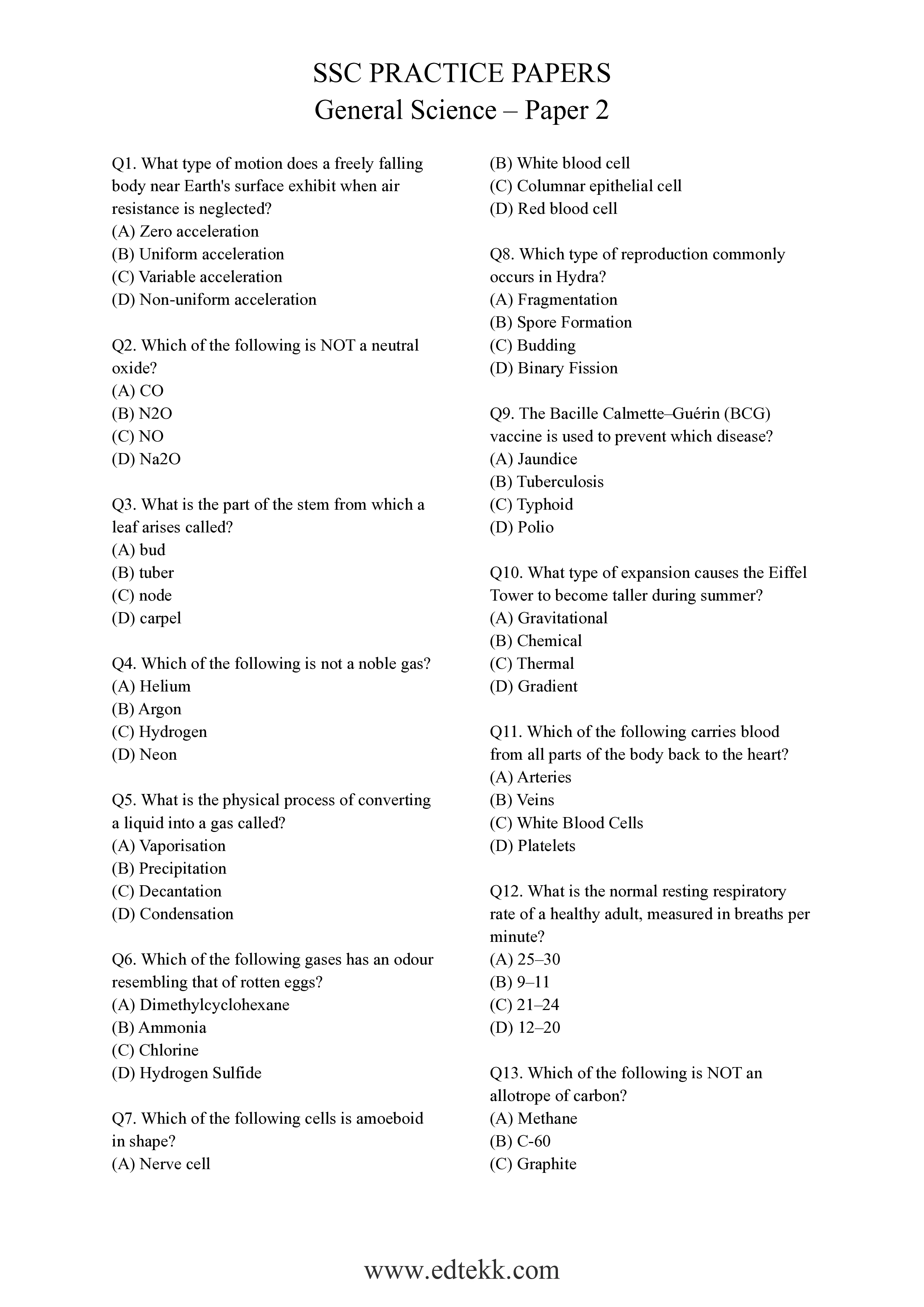
Improve your science preparation with SSC General Science Practice Paper 2, containing 20 objective-type questions on important General Science concepts. The practice set provides questions, correct answers and explanations to support revision and exam readiness for SSC CGL, CHSL, CPO, MTS, GD and Selection Post examinations.
Test Details
Topic: General Science
Total Questions: 20
Question Format: MCQs – Single Correct Answer
Suitable for: SSC CGL, CHSL, CPO, MTS, GD, Selection Post
Download All Papers in This Series (PDF)
Questions and Answers
Q1. What type of motion does a freely falling body near Earth’s surface exhibit when air resistance is neglected?
(A) Zero acceleration
(B) Uniform acceleration
(C) Variable acceleration
(D) Non-uniform acceleration
Explanation: A freely falling body near Earth’s surface experiences approximately constant gravitational acceleration when air resistance is neglected and the distance travelled is relatively small. This acceleration is approximately 9.8 m/s², directed vertically downward. Hence, its motion is an example of uniformly accelerated motion.
Q2. Which of the following is NOT a neutral oxide?
(A) CO
(B) N2O
(C) NO
(D) Na2O
Explanation: Sodium oxide (Na₂O) is a basic oxide because it reacts with water to form sodium hydroxide. Nitrous oxide (N₂O), nitric oxide (NO) and carbon monoxide (CO) are generally classified as neutral oxides in elementary chemistry.
Q3. What is the part of the stem from which a leaf arises called?
(A) bud
(B) tuber
(C) node
(D) carpel
Explanation: A node is the point on a plant stem from which leaves, branches or buds arise. The portion of the stem between two successive nodes is called an internode. Nodes are important locations for the development of new shoots and leaves.
Q4. Which of the following is not a noble gas?
(A) Helium
(B) Argon
(C) Hydrogen
(D) Neon
Explanation: Hydrogen is not a noble gas. Noble gases belong to Group 18 of the periodic table and include helium, neon and argon. They generally possess completely filled outermost electron shells, making them relatively unreactive. Hydrogen is a non-metal placed in Group 1.
Q5. What is the physical process of converting a liquid into a gas called?
(A) Vaporisation
(B) Precipitation
(C) Decantation
(D) Condensation
Explanation: Vaporisation is the physical process in which a liquid changes into a gaseous state. It occurs through evaporation or boiling. Evaporation takes place at the liquid’s surface and can occur below its boiling point, whereas boiling occurs throughout the liquid when its vapour pressure equals the external pressure.
Q6. Which of the following gases has an odour resembling that of rotten eggs?
(A) Dimethylcyclohexane
(B) Ammonia
(C) Chlorine
(D) Hydrogen Sulfide
Explanation: Hydrogen sulphide (H₂S) is a colourless, highly toxic gas with a characteristic rotten-egg smell. It is produced naturally during the decomposition of sulphur-containing organic matter and is also found in sewage and volcanic gases. Its odour should not be relied upon as a safety warning because prolonged exposure can impair the sense of smell.
Q7. Which of the following cells is amoeboid in shape?
(A) Nerve cell
(B) White blood cell
(C) Columnar epithelial cell
(D) Red blood cell
Explanation: White blood cells, also called leukocytes, are generally amoeboid in shape. They can change their shape and form temporary projections to move through tissues and reach sites of infection. This movement is called amoeboid movement. Red blood cells, in contrast, have a characteristic biconcave disc shape.
Q8. Which type of reproduction commonly occurs in Hydra?
(A) Fragmentation
(B) Spore Formation
(C) Budding
(D) Binary Fission
Explanation: Hydra commonly reproduces asexually through budding. A small outgrowth develops on the parent’s body through repeated cell division, gradually forming a mouth and tentacles. Once fully developed, the bud separates from the parent and becomes an independent individual. Hydra can also reproduce sexually under certain environmental conditions.
Q9. The Bacille Calmette–Guérin (BCG) vaccine is used to prevent which disease?
(A) Jaundice
(B) Tuberculosis
(C) Typhoid
(D) Polio
Explanation: The Bacille Calmette–Guérin (BCG) vaccine is used to protect against tuberculosis (TB), an infectious disease caused by bacteria belonging to the Mycobacterium tuberculosis complex. It is particularly effective in protecting children against severe forms of tuberculosis, including tuberculous meningitis and disseminated TB. Its effectiveness against pulmonary tuberculosis varies across populations.
Q10. What type of expansion causes the Eiffel Tower to become taller during summer?
(A) Gravitational
(B) Chemical
(C) Thermal
(D) Gradient
Explanation: Thermal expansion refers to the increase in the dimensions of a material when its temperature rises. The Eiffel Tower, which is primarily made of iron, expands during summer due to higher temperatures, resulting in a slight increase in its height. It contracts again when temperatures decrease.
Q11. Which of the following carries blood from all parts of the body back to the heart?
(A) Arteries
(B) Veins
(C) White Blood Cells
(D) Platelets
Explanation: Veins generally carry blood from body tissues towards the heart. Most veins transport deoxygenated blood, although pulmonary veins carry oxygenated blood from the lungs to the heart. In contrast, arteries carry blood away from the heart, while white blood cells and platelets are components of blood.
Q12. What is the normal resting respiratory rate of a healthy adult, measured in breaths per minute?
(A) 25–30
(B) 9–11
(C) 21–24
(D) 12–20
Explanation: The normal resting respiratory rate of a healthy adult is approximately 12–20 breaths per minute. Breathing is regulated primarily by respiratory centres in the brainstem. Exercise, fever, anxiety and certain illnesses can increase the respiratory rate. Persistent abnormalities may warrant medical evaluation.
Q13. Which of the following is NOT an allotrope of carbon?
(A) Methane
(B) C-60
(C) Graphite
(D) Diamond
Explanation: Methane (CH₄) is not an allotrope of carbon because it contains both carbon and hydrogen atoms. Diamond, graphite and C₆₀ (Buckminsterfullerene) are allotropes of carbon, as they consist entirely of carbon atoms arranged in different structural forms.
Q14. What is the SI unit of radioactive activity?
(A) ampere
(B) decibel
(C) cobolt
(D) becquerel
Explanation: The becquerel (Bq) is the SI unit of radioactivity, more precisely called radioactive activity. One becquerel corresponds to one nuclear disintegration per second. The ampere measures electric current, the decibel expresses a logarithmic level, and cobalt is a chemical element.
Q15. Who discovered in 1820 that an electric current could deflect a nearby magnetic needle, thereby establishing the connection between electricity and magnetism?
(A) Andre-Marie Ampere
(B) James Clerk Maxwell
(C) Hans Christian Oersted
(D) Benjamin Franklin
Explanation: Hans Christian Ørsted discovered the connection between electricity and magnetism in 1820. He observed that a compass needle deflected when placed near a current-carrying wire. This experiment demonstrated that an electric current produces a magnetic field and laid the foundation for the development of electromagnetism.
Q16. Which unit is commonly used to measure the energy content of food?
(A) Watt
(B) Kelvin
(C) Celsius
(D) Calorie
Explanation: The calorie is a commonly used unit for measuring the energy content of food. Food energy is generally expressed in kilocalories (kcal) or kilojoules (kJ). One kilocalorie is approximately equal to 4.184 kilojoules. Kelvin and Celsius are units of temperature, not energy.
Q17. Which gas is dissolved in carbonated beverages?
(A) CO2
(B) N2
(C) O2
(D) CH4
Explanation: Carbonated beverages contain dissolved carbon dioxide (CO₂), which is introduced under pressure. A small amount reacts with water to form carbonic acid. When the pressure is released, carbon dioxide escapes as bubbles, producing the characteristic fizz.
Q18. Which part of the human body is affected by osteoporosis?
(A) Bones
(B) Lungs
(C) Brain
(D) Kidney
Explanation: Osteoporosis is a skeletal disorder characterised by reduced bone density and deterioration of bone tissue. It makes bones weak, brittle and more susceptible to fractures, particularly in the hip, spine and wrist.
Q19. What is the distinctive characteristic of marsupials?
(A) They migrate from one place to another
(B) They lay eggs
(C) They hibernate in winter
(D) They carry young ones in pouches
Explanation: Marsupials are mammals that generally give birth to relatively underdeveloped young. Their offspring continue developing after birth, usually attached to a teat and often protected inside a pouch called the marsupium. Kangaroos, koalas and wombats are well-known examples of marsupials.
Q20. What is the term for the entire living content of a cell, including its cytoplasm and nucleus?
(A) cell membrane
(B) lysosomes
(C) protoplasm
(D) mitochondria
Explanation: Protoplasm refers to the living contents of a cell, comprising the cytoplasm and nucleus. It includes the cellular components responsible for essential life processes. The cytoplasm contains organelles suspended in the cytosol, while the nucleus contains most of the cell’s genetic material in eukaryotic organisms.
Question Paper Images