Prepare for SSC examinations with General Science Practice Paper 1, featuring 20 objective-type MCQs covering important science concepts. This practice set includes questions, correct answers and detailed explanations to strengthen scientific knowledge and improve accuracy for SSC CGL, CHSL, CPO, MTS, GD and Selection Post exams.
Test Details
Topic: General Science
Total Questions: 20
Question Format: MCQs – Single Correct Answer
Suitable for: SSC CGL, CHSL, CPO, MTS, GD, Selection Post
Download All Papers in This Series (PDF)
Questions and Answers
Q1. Buckminsterfullerene is an allotrope of which element?
(A) Phosphorus
(B) Iron
(C) Carbon
(D) Boron
Explanation: Buckminsterfullerene (C₆₀) is an allotrope of carbon belonging to the fullerene family. It consists of 60 carbon atoms arranged in a hollow spherical structure resembling a football, with 12 pentagonal and 20 hexagonal rings.
Q2. What are the symbiotic organisms that form slow-growing coloured patches on tree bark called?
(A) Egrets
(B) Lichens
(C) Shrimps
(D) Aphids
Explanation: Lichens are associations between a fungus and a photosynthetic partner, usually a green alga or cyanobacterium. They commonly grow slowly on tree bark, rocks and other surfaces, forming coloured patches. The fungal partner provides structural support and helps retain moisture, while the photosynthetic partner produces organic nutrients.
Q3. For which discovery was Jan Evangelista Purkinje known in 1839?
(A) Proposed a lipid bilayer membrane
(B) Discovered the nucleus
(C) Coined the term protoplasm
(D) Discovered plasma membrane
Explanation: Jan Evangelista Purkinje introduced the term protoplasm in 1839 to describe the living substance within cells. The term subsequently became important in cell biology for referring to the living contents of a cell. Purkinje also made significant contributions to physiology and the study of nervous tissue.
Q4. Titanium dioxide, used as a white pigment in products such as toothpaste, is derived from which mineral?
(A) Ilmenite
(B) Silica
(C) Fluorite
(D) Mica
Explanation: Ilmenite (FeTiO₃) is an important naturally occurring mineral source of titanium dioxide (TiO₂). Titanium dioxide is widely used as a white pigment because of its high refractive index, brightness and opacity. It is used in paints, plastics, paper, cosmetics and certain toothpaste formulations.
Q5. Who coined the phrase “survival of the fittest” to describe natural selection?
(A) Herbert Spencer
(B) Marie Curie
(C) Charles Babbage
(D) Louis Pasteur
Explanation: The phrase “survival of the fittest” was coined by Herbert Spencer in his work on evolutionary theory. Charles Darwin subsequently adopted the expression in the fifth edition of On the Origin of Species (1869). It describes the differential survival and reproductive success of organisms better adapted to their environments.
Q6. What is methyl ethyl ketone also known as?
(A) 2-butanone
(B) propanone
(C) methyl pentanone
(D) 2-butanol
Explanation: Methyl ethyl ketone (MEK) is the common name for 2-butanone, an organic compound with the molecular formula C₄H₈O. It is a colourless, volatile liquid widely used as an industrial solvent in paints, coatings, adhesives and cleaning products.
Q7. Which animal phylum is commonly known as the flatworms?
(A) Ctenophora
(B) Cnidaria
(C) Porifera
(D) Platyhelminthes
Explanation: Platyhelminthes is the phylum commonly known as flatworms because its members have dorsoventrally flattened bodies. They are bilaterally symmetrical, triploblastic and acoelomate animals. Examples include planarians, tapeworms and liver flukes. Many species are parasitic, while others are free-living.
Q8. Which cells in the human body are popularly known as the “soldiers of the body”?
(A) Red blood cells
(B) White blood cells
(C) Basophils
(D) Eosinophils
Explanation: White blood cells, also known as leukocytes, are popularly called the soldiers of the human body because they protect the body against infections and foreign substances. Different types of white blood cells perform specialised immune functions, including engulfing pathogens, producing antibodies and coordinating immune responses.
Q9. Who established the relationship between the electric current flowing through a metallic wire and the potential difference across its terminals?
(A) Rutherford
(B) Niels Bohr
(C) Georg Simon Ohm
(D) Albert Einstein
Explanation: Georg Simon Ohm established the relationship between electric current and potential difference in a conductor. His work led to Ohm’s law, which states that current through a conductor is directly proportional to the potential difference across it, provided temperature and other physical conditions remain constant.
Q10. Which of the following compounds is known as slaked lime?
(A) CaCO3
(B) CaCl2
(C) Ca(OH)2
(D) CaO
Explanation: Slaked lime is calcium hydroxide, Ca(OH)₂. It is produced by adding water to quicklime (calcium oxide, CaO), a process known as slaking. It is widely used in construction, water treatment and soil conditioning.
Q11. Which of the following elements has the highest electrical conductivity?
(A) Copper
(B) Zinc
(C) Lead
(D) Silver
Explanation: Silver has the highest electrical conductivity among the four listed metals under ordinary conditions. Its electrical resistivity is lower than that of copper, zinc and lead. Although copper is more commonly used in electrical wiring because of its lower cost, silver is the better electrical conductor.
Q12. Which colour in the VIBGYOR spectrum has the lowest energy?
(A) Green
(B) Yellow
(C) Red
(D) Violet
Explanation: Red light has the longest wavelength and the lowest frequency among the seven colours of visible light (VIBGYOR). Since the energy of a photon is directly proportional to its frequency, according to E = hν, red light has the minimum energy, whereas violet light has the maximum energy.
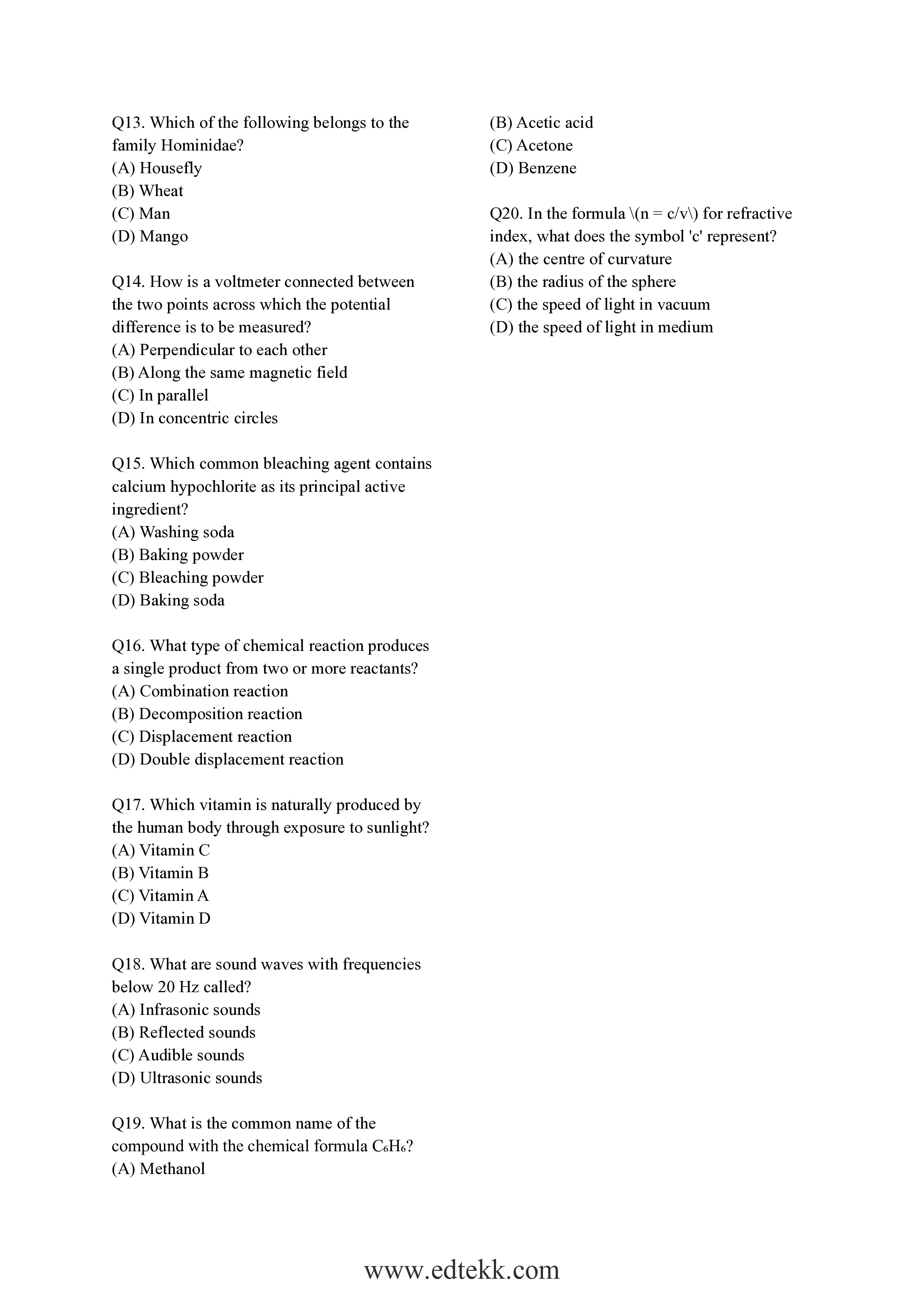
Q13. Which of the following belongs to the family Hominidae?
(A) Housefly
(B) Wheat
(C) Man
(D) Mango
Explanation: Humans belong to the family Hominidae, which includes the great apes, namely chimpanzees, gorillas, orangutans and humans. Mango and wheat are plants, while houseflies belong to the phylum Arthropoda.
Q14. How is a voltmeter connected between the two points across which the potential difference is to be measured?
(A) Perpendicular to each other
(B) Along the same magnetic field
(C) In parallel
(D) In concentric circles
Explanation: A voltmeter is connected in parallel across the two points between which the potential difference is to be measured. It has very high resistance, so it draws negligible current from the circuit and minimises disturbance to the potential difference being measured.
Q15. Which common bleaching agent contains calcium hypochlorite as its principal active ingredient?
(A) Washing soda
(B) Baking powder
(C) Bleaching powder
(D) Baking soda
Explanation: Bleaching powder is a commonly used bleaching and disinfecting agent containing calcium hypochlorite and other calcium-containing chlorine compounds. It releases available chlorine, which forms disinfecting and oxidising species in water. It is used for water disinfection, surface sanitation and bleaching textiles and paper.
Q16. What type of chemical reaction produces a single product from two or more reactants?
(A) Combination reaction
(B) Decomposition reaction
(C) Displacement reaction
(D) Double displacement reaction
Explanation: A combination reaction is a chemical reaction in which two or more reactants combine to form a single product. It is generally represented as A + B → AB. Decomposition reactions involve the opposite process, in which a single compound breaks down into two or more simpler substances.
Q17. Which vitamin is naturally produced by the human body through exposure to sunlight?
(A) Vitamin C
(B) Vitamin B
(C) Vitamin A
(D) Vitamin D
Explanation: Sunlight is the primary natural source that enables the human body to produce vitamin D. When ultraviolet B (UVB) radiation reaches the skin, it converts 7-dehydrocholesterol into previtamin D3, which subsequently forms vitamin D3. Vitamin D is essential for calcium absorption and maintaining healthy bones.
Q18. What are sound waves with frequencies below 20 Hz called?
(A) Infrasonic sounds
(B) Reflected sounds
(C) Audible sounds
(D) Ultrasonic sounds
Explanation: Sound waves with frequencies below 20 Hz are called infrasonic sounds. These frequencies are below the lower limit of normal human hearing. Humans generally hear sounds ranging from 20 Hz to 20,000 Hz. Sounds with frequencies above 20,000 Hz are called ultrasonic sounds.
Q19. What is the common name of the compound with the chemical formula C₆H₆?
(A) Methanol
(B) Acetic acid
(C) Acetone
(D) Benzene
Explanation: Benzene is the common name of the compound with the molecular formula C₆H₆. It is an aromatic hydrocarbon consisting of a six-carbon ring with delocalised pi electrons. Benzene is an important industrial chemical used in the manufacture of plastics, synthetic fibres, detergents and other chemical products.
Q20. In the formula (n = c/v) for refractive index, what does the symbol ‘c’ represent?
(A) the centre of curvature
(B) the radius of the sphere
(C) the speed of light in vacuum
(D) the speed of light in medium
Explanation: The absolute refractive index of a medium is given by n = c/v, where c is the speed of light in vacuum and v is the speed of light in the medium. For ordinary transparent materials, light travels more slowly than in a vacuum, so the refractive index is generally greater than one.
Question Paper Images