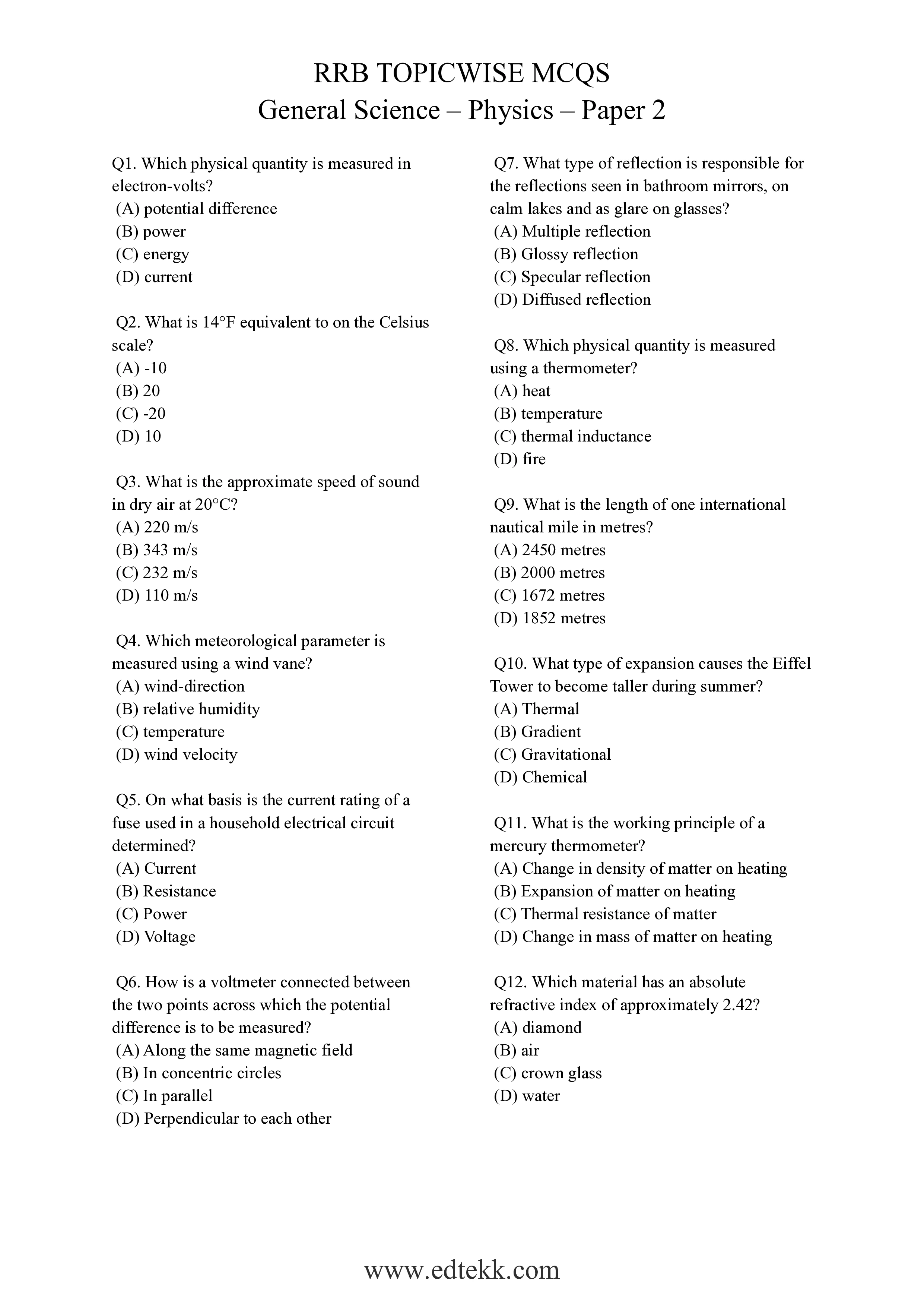
Enhance your Railway exam preparation with General Science Physics MCQs – Paper 2. This question set provides topicwise Physics practice with answers and explanations to reinforce essential concepts. It is suitable for RRB NTPC, Group D, ALP and Technician aspirants seeking better accuracy and exam readiness.
Test Details
Topic: Physics
Total Questions: 20
Question Format: MCQs – Single Correct Answer
Suitable for: RRB NTPC, Group D, ALP, Technician
Download All Papers in This Series (PDF)
Questions and Answers
Q1. Which physical quantity is measured in electron-volts?
(A) potential difference
(B) power
(C) energy
(D) current
Explanation: An electron-volt (eV) is a unit of energy. It is defined as the energy gained by an elementary charge when it moves through a potential difference of one volt. One electron-volt is approximately 1.602 × 10⁻¹⁹ joules. It is commonly used in atomic, nuclear and particle physics.
Q2. What is 14°F equivalent to on the Celsius scale?
(A) -10
(B) 20
(C) -20
(D) 10
Explanation: Fahrenheit temperature is converted into Celsius using the formula (C=(F-32)times5/9). For 14°F, the calculation is ((14-32)times5/9=-10°C). Therefore, 14 degrees Fahrenheit is equivalent to minus 10 degrees Celsius.
Q3. What is the approximate speed of sound in dry air at 20°C?
(A) 220 m/s
(B) 343 m/s
(C) 232 m/s
(D) 110 m/s
Explanation: The approximate speed of sound in dry air at 20°C under ordinary atmospheric conditions is 343 m/s. Sound travels through air as a longitudinal mechanical wave consisting of successive compressions and rarefactions. Its speed depends primarily on temperature and increases as the temperature of air rises.
Q4. Which meteorological parameter is measured using a wind vane?
(A) wind-direction
(B) relative humidity
(C) temperature
(D) wind velocity
Explanation: A wind vane is an instrument used to determine wind direction. It generally rotates around a vertical axis and indicates the direction from which the wind is blowing. Wind speed is measured using an anemometer, while temperature and relative humidity are measured using other instruments.
Q5. On what basis is the current rating of a fuse used in a household electrical circuit determined?
(A) Current
(B) Resistance
(C) Power
(D) Voltage
Explanation: A household electric fuse is rated according to the maximum current it can safely carry. If the current exceeds its rated value for sufficient time, the fuse wire heats up and melts, breaking the circuit. Fuse ratings are expressed in amperes and are selected according to the electrical load and circuit requirements.
Q6. How is a voltmeter connected between the two points across which the potential difference is to be measured?
(A) Along the same magnetic field
(B) In concentric circles
(C) In parallel
(D) Perpendicular to each other
Explanation: A voltmeter is connected in parallel across the two points between which the potential difference is to be measured. It has very high resistance, so it draws negligible current from the circuit and minimises disturbance to the potential difference being measured.
Q7. What type of reflection is responsible for the reflections seen in bathroom mirrors, on calm lakes and as glare on glasses?
(A) Multiple reflection
(B) Glossy reflection
(C) Specular reflection
(D) Diffused reflection
Explanation: Specular reflection occurs when light reflects from a smooth surface, with parallel incident rays remaining parallel after reflection. Bathroom mirrors and calm lake surfaces can produce clear reflections because their surfaces are relatively smooth. Glasses can also produce specular glare, although anti-reflective coatings reduce this effect.
Q8. Which physical quantity is measured using a thermometer?
(A) heat
(B) temperature
(C) thermal inductance
(D) fire
Explanation: A thermometer is an instrument used to measure temperature, which indicates the degree of hotness or coldness of a body. Heat is energy transferred between bodies due to a temperature difference, whereas temperature is a measurable physical quantity.
Q9. What is the length of one international nautical mile in metres?
(A) 2450 metres
(B) 2000 metres
(C) 1672 metres
(D) 1852 metres
Explanation: One international nautical mile is exactly 1,852 metres. It is commonly used in maritime and aviation navigation and corresponds approximately to one minute of latitude.
Q10. What type of expansion causes the Eiffel Tower to become taller during summer?
(A) Thermal
(B) Gradient
(C) Gravitational
(D) Chemical
Explanation: Thermal expansion refers to the increase in the dimensions of a material when its temperature rises. The Eiffel Tower, which is primarily made of iron, expands during summer due to higher temperatures, resulting in a slight increase in its height. It contracts again when temperatures decrease.
Q11. What is the working principle of a mercury thermometer?
(A) Change in density of matter on heating
(B) Expansion of matter on heating
(C) Thermal resistance of matter
(D) Change in mass of matter on heating
Explanation: A mercury thermometer works on the principle of thermal expansion of matter. When temperature increases, mercury expands and rises through the narrow capillary tube. When temperature decreases, it contracts and its level falls. The change in mercury volume is used to indicate temperature.
Q12. Which material has an absolute refractive index of approximately 2.42?
(A) diamond
(B) air
(C) crown glass
(D) water
Explanation: Diamond has an absolute refractive index of approximately 2.42. The absolute refractive index of a medium is the ratio of the speed of light in vacuum to its speed in that medium. Diamond has a high refractive index because light travels considerably slower through it than through air or water.
Q13. During winter in cold regions, lakes freeze at the surface, leaving the water below at approximately what temperature?
(A) 4°C
(B) 0°C
(C) 0°F
(D) 4°F
Explanation: Water has maximum density at approximately 4°C. During winter, water colder than 4°C becomes less dense and remains near the surface, eventually freezing. Consequently, the deeper water generally remains close to 4°C, allowing aquatic organisms to survive beneath the ice.
Q14. What is the frequency range of ultrasonic sound?
(A) higher than 20 kHz
(B) higher than 40 kHz
(C) higher than 50 kHz
(D) higher than 30 kHz
Explanation: Ultrasonic sounds are sound waves having frequencies greater than 20,000 Hz (20 kHz), approximately the upper limit of normal human hearing. Humans generally cannot hear these frequencies. Ultrasound is widely used in medical imaging, industrial testing and distance measurement.
Q15. Which law gives the expression for the electrostatic force between two stationary point charges in a vacuum?
(A) Ohm’s Law
(B) Gauss’s Law
(C) Coulomb’s Law
(D) Lenz’s Law
Explanation: Coulomb’s law describes the electrostatic force between two stationary point charges in vacuum. The magnitude of this force is directly proportional to the product of the charges and inversely proportional to the square of the distance between them. The force acts along the line joining the charges and may be attractive or repulsive.
Q16. In optics, what term refers to the opening of a lens diaphragm that limits the passage of light?
(A) Collimator
(B) Apostilb
(C) Aperture
(D) Meniscus
Explanation: Aperture refers to the opening in an optical instrument through which light enters or passes. It determines the amount of light admitted by the optical system. A larger aperture generally allows more light to enter, while the diaphragm can regulate the effective aperture.
Q17. What are sound waves with frequencies below 20 Hz called?
(A) Infrasonic sounds
(B) Ultrasonic sounds
(C) Audible sounds
(D) Reflected sounds
Explanation: Sound waves with frequencies below 20 Hz are called infrasonic sounds. These frequencies are below the lower limit of normal human hearing. Humans generally hear sounds ranging from 20 Hz to 20,000 Hz. Sounds with frequencies above 20,000 Hz are called ultrasonic sounds.
Q18. Which type of friction is considered a self-adjusting force?
(A) Static Friction
(B) Kinetic Friction
(C) Centripetal Friction
(D) Rolling Friction
Explanation: Static friction is a self-adjusting force that prevents relative motion between two surfaces in contact. Its magnitude adjusts to match the applied tangential force until it reaches the maximum limiting friction. When the applied force exceeds this limit, sliding begins and kinetic friction acts.
Q19. What is the horizontal distance between two successive crests of a wave called?
(A) Wave height
(B) Wave length
(C) Wave period
(D) Wave frequency
Explanation: Wavelength is the horizontal distance between two successive corresponding points on a wave, such as consecutive crests or troughs. It is represented by the Greek letter λ and measured in metres. The wave period, by contrast, is the time required to complete one oscillation.
Q20. What is the CGS unit of magnetic field intensity?
(A) oersted
(B) gauss
(C) candela
(D) weber
Explanation: Oersted (Oe) is the CGS unit of magnetic field intensity (magnetic field strength). Gauss (G) is the CGS unit of magnetic flux density, whereas weber (Wb) is the SI unit of magnetic flux. Candela (cd) is the SI base unit of luminous intensity.
Question Paper Images