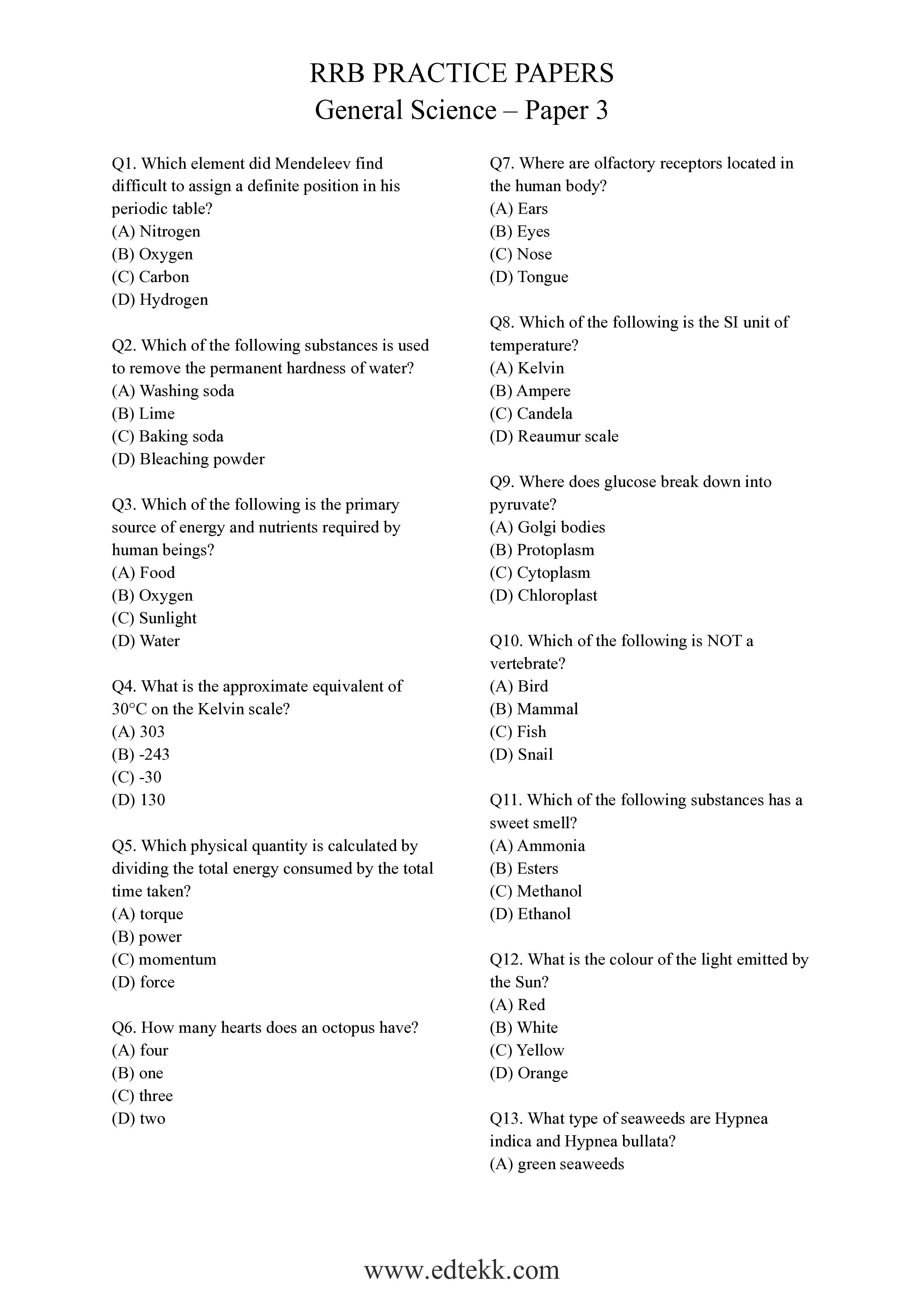
Strengthen your science preparation for Railway Recruitment Board examinations with General Science Practice Paper 3. This set includes 20 MCQs covering important General Science concepts, along with answers and explanations to support revision and improve performance in RRB NTPC, Group D, ALP and Technician exams.
Test Details
Topic: General Science
Total Questions: 20
Question Format: MCQs – Single Correct Answer
Suitable for: RRB NTPC, Group D, ALP, Technician
Download All Papers in This Series (PDF)
Questions and Answers
Q1. Which element did Mendeleev find difficult to assign a definite position in his periodic table?
(A) Nitrogen
(B) Oxygen
(C) Carbon
(D) Hydrogen
Explanation: Hydrogen was difficult for Dmitri Mendeleev to assign a definite position in his periodic table because it exhibits similarities with both alkali metals and halogens. Like alkali metals, it has one electron in its outermost shell, but it can also gain an electron to form a negative ion, resembling halogens.
Q2. Which of the following substances is used to remove the permanent hardness of water?
(A) Washing soda
(B) Lime
(C) Baking soda
(D) Bleaching powder
Explanation: Washing soda (Na₂CO₃·10H₂O), also known as hydrated sodium carbonate, is used to remove permanent hardness of water. It reacts with dissolved calcium and magnesium salts to form insoluble carbonates, which precipitate and can subsequently be removed.
Q3. Which of the following is the primary source of energy and nutrients required by human beings?
(A) Food
(B) Oxygen
(C) Sunlight
(D) Water
Explanation: Food is the primary source of energy and essential nutrients for human beings. It supplies carbohydrates, fats and proteins needed for energy production, growth and tissue repair, as well as vitamins and minerals required for normal physiological functioning. Water and oxygen are essential for survival but do not provide dietary energy.
Q4. What is the approximate equivalent of 30°C on the Kelvin scale?
(A) 303
(B) -243
(C) -30
(D) 130
Explanation: Celsius temperature is converted into Kelvin using the formula (K=°C+273.15). For 30°C, (K=30+273.15=303.15) K. Rounded to the nearest whole number, the temperature is approximately 303 K. Kelvin is the SI unit of thermodynamic temperature.
Q5. Which physical quantity is calculated by dividing the total energy consumed by the total time taken?
(A) torque
(B) power
(C) momentum
(D) force
Explanation: Average power is calculated by dividing the total energy consumed by the total time taken. Mathematically, (P_{text{average}}=E_{text{total}}/t_{text{total}}). Its SI unit is the watt (W), equivalent to one joule per second.
Q6. How many hearts does an octopus have?
(A) four
(B) one
(C) three
(D) two
Explanation: Octopuses possess three hearts. Two branchial hearts pump blood through the gills for oxygenation, while one systemic heart pumps oxygenated blood to the rest of the body. Their blood contains haemocyanin, a copper-containing respiratory pigment that gives it a bluish colour.
Q7. Where are olfactory receptors located in the human body?
(A) Ears
(B) Eyes
(C) Nose
(D) Tongue
Explanation: Olfactory receptors are specialised sensory cells located in the olfactory epithelium in the upper region of the nasal cavity. They detect airborne chemical substances responsible for smell and transmit sensory signals to the brain through the olfactory nerve, enabling the perception of different odours.
Q8. Which of the following is the SI unit of temperature?
(A) Kelvin
(B) Ampere
(C) Candela
(D) Reaumur scale
Explanation: The kelvin (K) is the SI base unit of thermodynamic temperature. It is used in scientific measurements and is distinct from the Celsius and Fahrenheit scales commonly used for everyday temperature measurements.
Q9. Where does glucose break down into pyruvate?
(A) Golgi bodies
(B) Protoplasm
(C) Cytoplasm
(D) Chloroplast
Explanation: Glycolysis is the metabolic pathway in which one molecule of glucose is converted into two molecules of pyruvate. It occurs in the cytoplasm of cells and does not directly require oxygen. The process produces a net gain of two ATP molecules and two NADH molecules per glucose molecule and constitutes the first stage of cellular respiration.
Q10. Which of the following is NOT a vertebrate?
(A) Bird
(B) Mammal
(C) Fish
(D) Snail
Explanation: A snail is an invertebrate because it lacks a vertebral column or backbone. It belongs to the phylum Mollusca and possesses a soft body, usually protected by a shell. Mammals, fish and birds are vertebrates because they possess a backbone and an internal skeletal framework.
Q11. Which of the following substances has a sweet smell?
(A) Ammonia
(B) Esters
(C) Methanol
(D) Ethanol
Explanation: Esters are generally characterised by pleasant, sweet or fruity odours. They are widely used in perfumes, food flavourings and fragrance products. Many naturally occurring fruit aromas are associated with esters and their characteristic volatile compounds.
Q12. What is the colour of the light emitted by the Sun?
(A) Red
(B) White
(C) Yellow
(D) Orange
Explanation: The Sun emits light across a broad range of visible wavelengths, and their combination is perceived as white. From space, the Sun appears white. From Earth’s surface, atmospheric scattering can make it appear yellow, orange or red, particularly near the horizon. Therefore, white is the most appropriate answer.
Q13. What type of seaweeds are Hypnea indica and Hypnea bullata?
(A) green seaweeds
(B) red seaweeds
(C) black seaweeds
(D) yellow seaweeds
Explanation: Hypnea indica and Hypnea bullata are species of red seaweeds belonging to the genus Hypnea and the class Rhodophyceae. Members of this genus are marine macroalgae and are commercially important sources of carrageenan, a polysaccharide widely used as a thickening and gelling agent in food and other industries.
Q14. Which of the following diseases can be caused by drinking contaminated water?
(A) Scurvy
(B) Anaemia
(C) Cholera
(D) Rickets
Explanation: Cholera is an infectious disease caused by the bacterium Vibrio cholerae. It commonly spreads through drinking water or consuming food contaminated with the bacterium. The disease causes severe watery diarrhoea and vomiting, which can lead to dangerous dehydration and electrolyte loss if left untreated.
Q15. Which of the following does NOT belong to the family of organic compounds?
(A) Furan
(B) Ammonia
(C) Decane
(D) Nonane
Explanation: Ammonia (NH₃) is an inorganic compound consisting of nitrogen and hydrogen. Nonane and decane are alkanes, while furan is a heterocyclic aromatic organic compound containing oxygen in its ring. Therefore, ammonia is the only inorganic compound among the given options.
Q16. Which of the following noble gases has the highest molar mass?
(A) Ar
(B) Kr
(C) Xe
(D) Ne
Explanation: Xenon (Xe) has the highest molar mass among the four given noble gases, with a standard atomic mass of approximately 131.29 u. Krypton has an atomic mass of approximately 83.80 u, argon 39.95 u and neon 20.18 u.
Q17. What type of spherical mirror has an inward-curved reflecting surface?
(A) Convex
(B) Concave
(C) Plano Convex
(D) Plane
Explanation: A spherical mirror whose reflecting surface curves inward is called a concave mirror. It converges parallel incident rays towards its principal focus and can form real or virtual images depending on the object’s position. A convex mirror has an outward-curving reflecting surface, whereas a plane mirror has a flat reflecting surface.
Q18. Which type of friction is considered a self-adjusting force?
(A) Centripetal Friction
(B) Static Friction
(C) Rolling Friction
(D) Kinetic Friction
Explanation: Static friction is a self-adjusting force that prevents relative motion between two surfaces in contact. Its magnitude adjusts to match the applied tangential force until it reaches the maximum limiting friction. When the applied force exceeds this limit, sliding begins and kinetic friction acts.
Q19. What is the common name of ascorbic acid?
(A) Vitamin A
(B) Vitamin K
(C) Vitamin C
(D) Vitamin B12
Explanation: Ascorbic acid is the chemical name of vitamin C, a water-soluble vitamin essential for collagen synthesis, wound healing and normal immune function. Severe vitamin C deficiency causes scurvy, which may result in bleeding gums, easy bruising, poor wound healing and fatigue.
Q20. Which of Newton’s laws provides a quantitative definition of force?
(A) Second law of motion
(B) First law of motion
(C) Universal law of gravitation
(D) Third law of motion
Explanation: Newton’s second law provides a quantitative relationship between net force and the rate of change of momentum. For an object of constant mass, it is expressed as (F=ma). Newton’s first law explains inertia, while the third law describes action–reaction pairs. The law of universal gravitation explains gravitational attraction between masses.
Question Paper Images