Prepare effectively for Railway competitive examinations through General Science Practice Paper 5. This practice set features 20 multiple-choice questions to help candidates revise essential science concepts, evaluate their preparation and understand correct answers through explanations for RRB NTPC, Group D, ALP and Technician exams.
Test Details
Topic: General Science
Total Questions: 20
Question Format: MCQs – Single Correct Answer
Suitable for: RRB NTPC, Group D, ALP, Technician
Download All Papers in This Series (PDF)
Questions and Answers
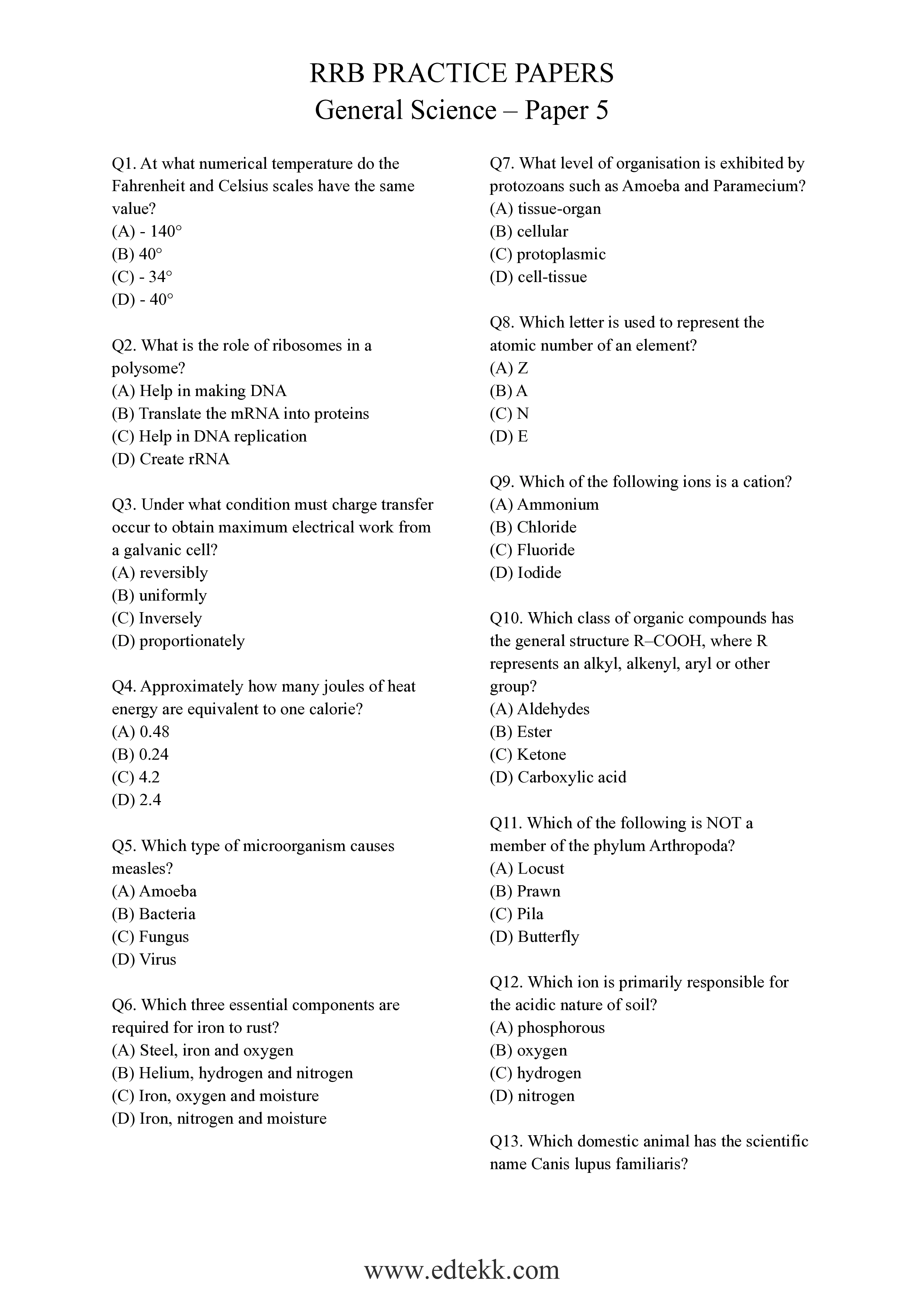
Q1. At what numerical temperature do the Fahrenheit and Celsius scales have the same value?
(A) – 140°
(B) 40°
(C) – 34°
(D) – 40°
Explanation: The Fahrenheit and Celsius scales have the same numerical value at −40 degrees. This can be verified using the conversion formula (F=frac{9}{5}C+32). Substituting −40°C gives −40°F. Thus, −40 is the common numerical value on both scales.
Q2. What is the role of ribosomes in a polysome?
(A) Help in making DNA
(B) Translate the mRNA into proteins
(C) Help in DNA replication
(D) Create rRNA
Explanation: Polysomes, or polyribosomes, consist of multiple ribosomes simultaneously attached to a single messenger RNA (mRNA) molecule. Each ribosome translates the mRNA sequence to synthesise a polypeptide chain. Thus, polysomes increase the efficiency of protein synthesis by enabling several ribosomes to produce protein molecules from the same mRNA simultaneously.
Q3. Under what condition must charge transfer occur to obtain maximum electrical work from a galvanic cell?
(A) reversibly
(B) uniformly
(C) Inversely
(D) proportionately
Explanation: A galvanic cell delivers maximum useful electrical work when the charge is transferred reversibly. Reversible operation involves an infinitesimally small potential difference between the cell and the external circuit, minimising irreversible energy losses. Thus, reversible charge transfer is necessary to obtain maximum electrical work.
Q4. Approximately how many joules of heat energy are equivalent to one calorie?
(A) 0.48
(B) 0.24
(C) 4.2
(D) 2.4
Explanation: One calorie is approximately the amount of heat required to raise the temperature of 1 gram of water by 1°C. Its mechanical equivalent is approximately 4.184 joules. Therefore, one calorie is conventionally rounded to 4.2 joules.
Q5. Which type of microorganism causes measles?
(A) Amoeba
(B) Bacteria
(C) Fungus
(D) Virus
Explanation: Measles is a highly contagious viral disease caused by the measles virus, which belongs to the genus Morbillivirus. It spreads primarily through airborne particles and respiratory secretions. Common symptoms include fever, cough, runny nose, conjunctivitis and a characteristic skin rash. Vaccination provides effective protection against measles.
Q6. Which three essential components are required for iron to rust?
(A) Steel, iron and oxygen
(B) Helium, hydrogen and nitrogen
(C) Iron, oxygen and moisture
(D) Iron, nitrogen and moisture
Explanation: Rusting of iron requires three essential components: iron, oxygen and moisture. In the presence of water and oxygen, iron undergoes corrosion and forms hydrated iron(III) oxide, commonly known as rust. Preventing contact with moisture or oxygen can significantly slow down or prevent rust formation.
Q7. What level of organisation is exhibited by protozoans such as Amoeba and Paramecium?
(A) tissue-organ
(B) cellular
(C) protoplasmic
(D) cell-tissue
Explanation: Protozoans such as Paramecium, Amoeba and Euglena exhibit protoplasmic-level organisation. Their bodies consist of a single cell in which the protoplasm performs all essential life functions. They lack specialised tissues and organs, although different cellular structures perform specific functions.
Q8. Which letter is used to represent the atomic number of an element?
(A) Z
(B) A
(C) N
(D) E
Explanation: The atomic number of an element is represented by the symbol Z. It equals the number of protons present in an atom’s nucleus and determines the identity of the element. In an electrically neutral atom, the number of electrons equals the atomic number. However, this equality does not hold for ions.
Q9. Which of the following ions is a cation?
(A) Ammonium
(B) Chloride
(C) Fluoride
(D) Iodide
Explanation: Ammonium (NH₄⁺) is a positively charged polyatomic ion and is therefore classified as a cation. Iodide (I⁻), fluoride (F⁻) and chloride (Cl⁻) are negatively charged ions and are classified as anions.
Q10. Which class of organic compounds has the general structure R–COOH, where R represents an alkyl, alkenyl, aryl or other group?
(A) Aldehydes
(B) Ester
(C) Ketone
(D) Carboxylic acid
Explanation: Carboxylic acids contain the functional group –COOH, in which a carbonyl group (C=O) and a hydroxyl group (–OH) are attached to the same carbon atom. Their general structural formula is R–COOH, where R can represent an alkyl, alkenyl, aryl or other organic group.
Q11. Which of the following is NOT a member of the phylum Arthropoda?
(A) Locust
(B) Prawn
(C) Pila
(D) Butterfly
Explanation: Pila, commonly known as the apple snail, belongs to the phylum Mollusca and is therefore not an arthropod. Locusts and butterflies belong to the class Insecta, while prawns are crustaceans. All three belong to the phylum Arthropoda.
Q12. Which ion is primarily responsible for the acidic nature of soil?
(A) phosphorous
(B) oxygen
(C) hydrogen
(D) nitrogen
Explanation: Acidic soil is characterised by a relatively high concentration of hydrogen ions (H⁺), resulting in a pH below 7. As hydrogen ion activity increases, soil pH decreases and acidity increases. Soil pH influences nutrient availability and plant growth.
Q13. Which domestic animal has the scientific name Canis lupus familiaris?
(A) buffalo
(B) dog
(C) cat
(D) cow
Explanation: The domestic dog is scientifically classified as Canis lupus familiaris, a subspecies of the grey wolf (Canis lupus) under a widely accepted taxonomic classification. It belongs to the family Canidae and the order Carnivora.
Q14. Which of the following is NOT an unsaturated carbon compound?
(A) Pentene
(B) Butane
(C) Benzene
(D) Acetylene
Explanation: Butane (C₄H₁₀) is a saturated hydrocarbon because all its carbon-carbon bonds are single bonds. Acetylene contains a triple bond, pentene contains a double bond, and benzene has a delocalised aromatic pi-electron system. Therefore, butane is the correct answer.
Q15. Which of the following is a non-biodegradable form of waste?
(A) Dead animals
(B) Plastic
(C) Flowers
(D) Vegetables
Explanation: Plastic is generally classified as non-biodegradable because conventional plastics resist decomposition by naturally occurring microorganisms. Unlike vegetables, dead animals and flowers, which decompose through biological processes, conventional plastic can persist in the environment for decades or even centuries.
Q16. Which enzyme in the human body helps break down carbohydrates?
(A) Lipase
(B) Peptidase
(C) Amylase
(D) Protease
Explanation: Amylase is an enzyme that breaks down starch into smaller carbohydrates, including maltose and oligosaccharides. It is produced primarily by the salivary glands and pancreas. Peptidases and proteases digest proteins, whereas lipase breaks down fats. Thus, amylase is the correct answer for carbohydrate digestion.
Q17. In which year did Ernst Haeckel introduce ecology as a distinct field of study?
(A) 1845
(B) 1866
(C) 1890
(D) 1880
Explanation: Ernst Haeckel, a German zoologist, introduced the term ecology in 1866. He used it to describe the study of relationships between organisms and their surrounding environment. The term originates from the Greek words oikos (house or dwelling) and logos (study).
Q18. What is the common name of Parthenium hysterophorus?
(A) Carrot grass
(B) Lawn grass
(C) Horse grass
(D) Lemongrass
Explanation: Parthenium hysterophorus is commonly known as carrot grass, congress grass or congress weed. It is an invasive weed that adversely affects agricultural productivity and biodiversity. Its pollen can cause allergic reactions, while contact with the plant may cause dermatitis and other allergic symptoms.
Q19. Which of the following substances can be classified as a solution?
(A) Coal
(B) Salt
(C) Sea Water
(D) Diamond
Explanation: Sea water is considered a solution because it contains dissolved salts, primarily sodium chloride, uniformly distributed in water. It is a homogeneous mixture of dissolved substances. Diamond is a pure form of carbon, coal is a heterogeneous material, and ordinary solid salt is a chemical compound rather than a solution.
Q20. What is the smallest particle of a molecular element that can exist independently while retaining its chemical properties?
(A) Molecule
(B) Proton
(C) Neutron
(D) Electron
Explanation: A molecule is the smallest independently existing particle of a molecular element that retains its chemical properties. Molecules of elements may contain two or more chemically bonded atoms, such as oxygen (O₂), nitrogen (N₂) and hydrogen (H₂). However, not all elements exist as molecules; noble gases generally exist as individual atoms.
Question Paper Images