Prepare confidently for Railway examinations with the third Chemistry revision paper in this General Science series. This practice set includes 20 multiple-choice questions to help assess subject knowledge and reinforce important concepts. Practise objective questions with correct answers and explanations for better preparation for RRB NTPC, Group D, ALP and Technician examinations.
Test Details
Topic: Chemistry
Total Questions: 20
Question Format: MCQs – Single Correct Answer
Suitable for: RRB NTPC, Group D, ALP, Technician
Download All Papers in This Series (PDF)
Questions and Answers
Q1. Which method is used to separate cream from milk?
(A) Distillation
(B) Centrifugation
(C) Sublimation
(D) Chromatography
Explanation: Centrifugation separates cream from milk based on differences in density. During rapid rotation, the denser aqueous portion moves outward more strongly, while the less dense fat-rich portion collects closer to the axis of rotation. This technique is widely used in dairy processing to separate cream from skimmed milk.
Q2. Which inert gas is most commonly used in traditional incandescent light bulbs?
(A) Argon
(B) Oxygen
(C) Hydrogen
(D) Radon
Explanation: Argon is the inert gas most commonly used in traditional incandescent light bulbs. As a noble gas, it is chemically unreactive and helps protect the hot tungsten filament from oxidation while reducing its evaporation rate. This increases the operating life of the bulb.
Q3. Which of the following pure metals has the highest melting point?
(A) Copper
(B) Platinum
(C) Tungsten
(D) Gold
Explanation: Tungsten has the highest melting point among the listed metals, approximately 3,422°C. Its exceptionally high melting point makes it suitable for applications involving extreme temperatures. It was historically used in incandescent light-bulb filaments because it can withstand very high temperatures without melting.
Q4. Which chemical compound is used in the manufacture of certain hard plastics, such as polycarbonate?
(A) Bisphenol A (BPA)
(B) Trifluralin
(C) Chrome alum
(D) Heptachlor
Explanation: Bisphenol A (BPA) is an organic compound used in the manufacture of polycarbonate plastics and epoxy resins. Polycarbonate is a strong, transparent and rigid plastic used in protective glazing and various other applications. BPA is an important starting material in its production.
Q5. Which of the following is not an electrical insulator?
(A) Mercury
(B) Dry Paper
(C) Glass
(D) Ebonite
Explanation: Mercury is a metal and an electrical conductor; therefore, it is not an insulator. It is liquid at room temperature and allows electric current to pass through it. Dry paper, glass and ebonite are generally electrical insulators because they do not allow electric current to flow easily under ordinary conditions.
Q6. Which of the following is NOT an allotrope of carbon?
(A) Graphite
(B) Methane
(C) Diamond
(D) C-60 Buckminsterfullerene
Explanation: Methane (CH₄) is not an allotrope of carbon because it contains both carbon and hydrogen atoms. Graphite, diamond and Buckminsterfullerene (C₆₀) are allotropes of carbon because they consist entirely of carbon atoms arranged in different structural configurations.
Q7. Which ion is primarily responsible for the acidic nature of soil?
(A) hydrogen
(B) phosphorous
(C) nitrogen
(D) oxygen
Explanation: Acidic soil is characterised by a relatively high concentration of hydrogen ions (H⁺), resulting in a pH below 7. As hydrogen ion activity increases, soil pH decreases and acidity increases. Soil pH influences nutrient availability and plant growth.
Q8. Ozone is an allotrope of which chemical element?
(A) oxygen
(B) carbon dioxide
(C) hydrogen
(D) nitrogen
Explanation: Ozone (O₃) is an allotrope of oxygen. Allotropy refers to the existence of an element in two or more different structural forms. Oxygen also exists as diatomic oxygen (O₂), which is essential for respiration.
Q9. Who proposed the ‘Law of Octaves’ in the classification of elements?
(A) Lavoisier
(B) Mendeleev
(C) Newlands
(D) Dobereiner
Explanation: The Law of Octaves was proposed by John Newlands in 1865. He arranged elements in increasing order of their atomic masses and observed that every eighth element exhibited properties similar to those of the first element. He compared this periodic repetition of properties to the repetition of musical notes.
Q10. What is the maximum number of electrons that can occupy a shell with principal quantum number ‘n’?
(A) 2n
(B) n
(C) 2n^2
(D) n^2
Explanation: The maximum number of electrons that can occupy a shell is given by 2n², where n is the principal quantum number. Accordingly, the first shell (n = 1) accommodates 2 electrons, the second (n = 2) accommodates 8, the third (n = 3) accommodates 18 and the fourth (n = 4) accommodates 32 electrons.
Q11. Which of the following is the primary constituent of pearls?
(A) Calcium carbonate
(B) Sodium bicarbonate
(C) Magnesium peroxide
(D) Calcium sulphate
Explanation: Pearls consist predominantly of calcium carbonate (CaCO₃), mainly in the crystalline form of aragonite, along with small amounts of calcite. These mineral components are embedded in an organic protein matrix called conchiolin, making calcium carbonate their principal inorganic constituent.
Q12. Which common bleaching agent contains calcium hypochlorite as its principal active ingredient?
(A) Baking soda
(B) Washing soda
(C) Bleaching powder
(D) Baking powder
Explanation: Bleaching powder is a commonly used bleaching and disinfecting agent containing calcium hypochlorite and other calcium-containing chlorine compounds. It releases available chlorine, which forms disinfecting and oxidising species in water. It is used for water disinfection, surface sanitation and bleaching textiles and paper.
Q13. Which of the following is NOT a chemical coagulant used in water treatment?
(A) Polyaluminium chloride (PAC)
(B) Nitrogen dioxide
(C) Aluminium sulfate (Alum)
(D) Aluminium chloride
Explanation: Nitrogen dioxide (NO₂) is not a chemical coagulant used in conventional water treatment. Polyaluminium chloride (PAC), aluminium sulphate (alum) and aluminium chloride are aluminium-based coagulants that destabilise suspended and colloidal particles, facilitating their removal from water.
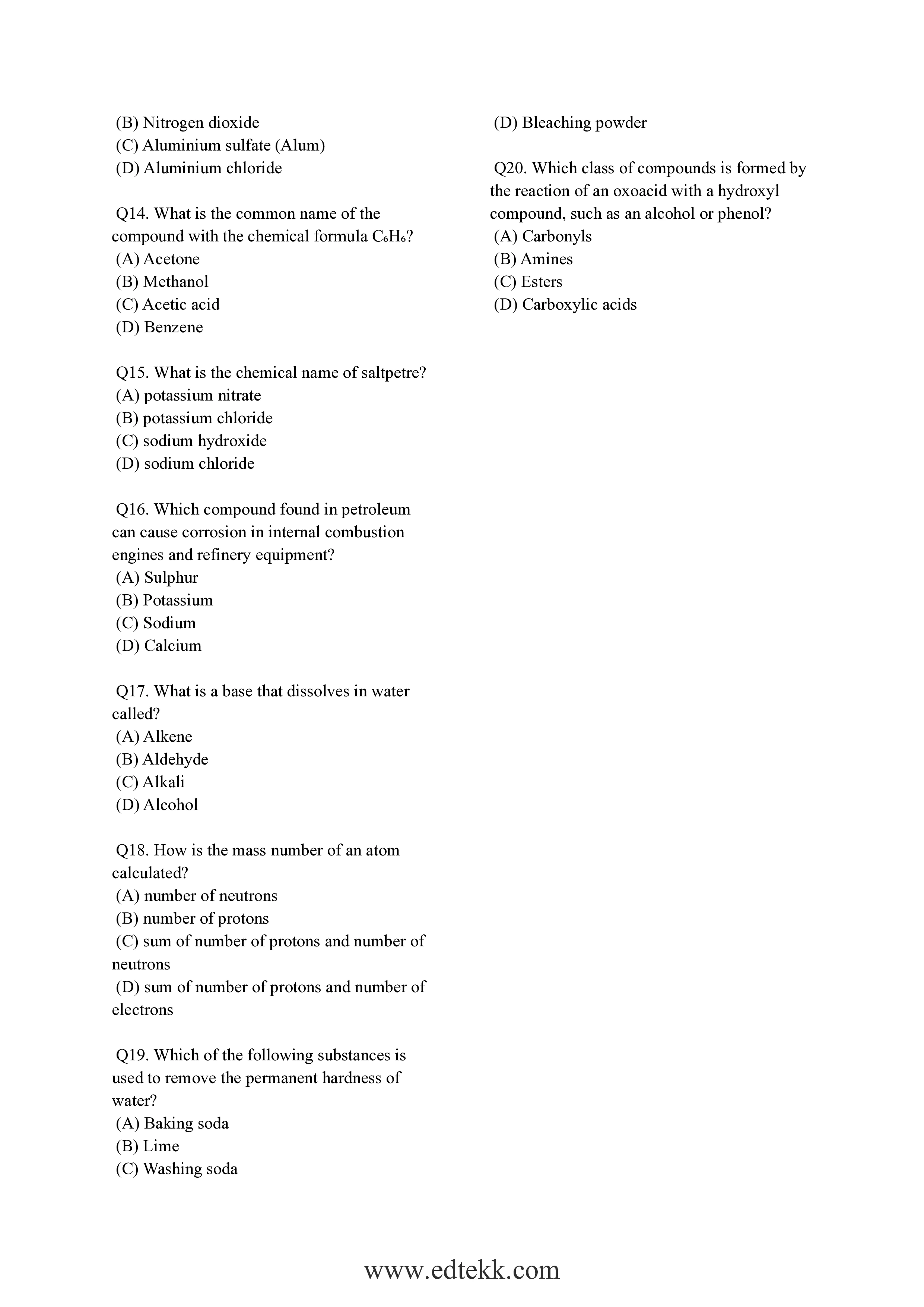
Q14. What is the common name of the compound with the chemical formula C₆H₆?
(A) Acetone
(B) Methanol
(C) Acetic acid
(D) Benzene
Explanation: Benzene is the common name of the compound with the molecular formula C₆H₆. It is an aromatic hydrocarbon consisting of a six-carbon ring with delocalised pi electrons. Benzene is an important industrial chemical used in the manufacture of plastics, synthetic fibres, detergents and other chemical products.
Q15. What is the chemical name of saltpetre?
(A) potassium nitrate
(B) potassium chloride
(C) sodium hydroxide
(D) sodium chloride
Explanation: Saltpetre, also spelled saltpeter, is the common name for potassium nitrate (KNO₃). It is used in fertilisers and in the manufacture of explosives. Sodium chloride, in contrast, is commonly known as common salt.
Q16. Which compound found in petroleum can cause corrosion in internal combustion engines and refinery equipment?
(A) Sulphur
(B) Potassium
(C) Sodium
(D) Calcium
Explanation: Sulphur compounds present in petroleum can cause corrosion in internal combustion engines, pipelines and refinery equipment. During combustion, sulphur-containing compounds may produce sulphur oxides, which react with moisture to form corrosive acids. Petroleum refining therefore includes desulphurisation processes to reduce sulphur content and minimise corrosion and pollution.
Q17. What is a base that dissolves in water called?
(A) Alkene
(B) Aldehyde
(C) Alkali
(D) Alcohol
Explanation: An alkali is a base that dissolves in water and produces hydroxide ions in aqueous solution. Common examples include sodium hydroxide and potassium hydroxide. All alkalis are bases, but not all bases are alkalis because some bases are insoluble or only sparingly soluble in water.
Q18. How is the mass number of an atom calculated?
(A) number of neutrons
(B) number of protons
(C) sum of number of protons and number of neutrons
(D) sum of number of protons and number of electrons
Explanation: The mass number (A) of an atom equals the total number of protons (Z) and neutrons (N) in its nucleus: A = Z + N. Electrons are not included in the mass number. For example, carbon-12 contains six protons and six neutrons, giving A = 12.
Q19. Which of the following substances is used to remove the permanent hardness of water?
(A) Baking soda
(B) Lime
(C) Washing soda
(D) Bleaching powder
Explanation: Washing soda (Na₂CO₃·10H₂O), also known as hydrated sodium carbonate, is used to remove permanent hardness of water. It reacts with dissolved calcium and magnesium salts to form insoluble carbonates, which precipitate and can subsequently be removed.
Q20. Which class of compounds is formed by the reaction of an oxoacid with a hydroxyl compound, such as an alcohol or phenol?
(A) Carbonyls
(B) Amines
(C) Esters
(D) Carboxylic acids
Explanation: Esters are formed through esterification, a reaction between an oxoacid, commonly a carboxylic acid, and a hydroxyl-containing compound such as an alcohol or phenol. The reaction generally involves the elimination of water. Esters commonly have fruity odours and are widely used in perfumes, flavourings and solvents.
Question Paper Images