Strengthen your Physics preparation with this second General Science revision practice paper for Railway examinations. It features 20 examination-oriented multiple-choice questions designed to reinforce important Physics concepts. Explore objective questions, correct answers and explanations to improve accuracy and prepare effectively for RRB NTPC, Group D, ALP and Technician examinations.
Test Details
Topic: Physics
Total Questions: 20
Question Format: MCQs – Single Correct Answer
Suitable for: RRB NTPC, Group D, ALP, Technician
Download All Papers in This Series (PDF)
Questions and Answers
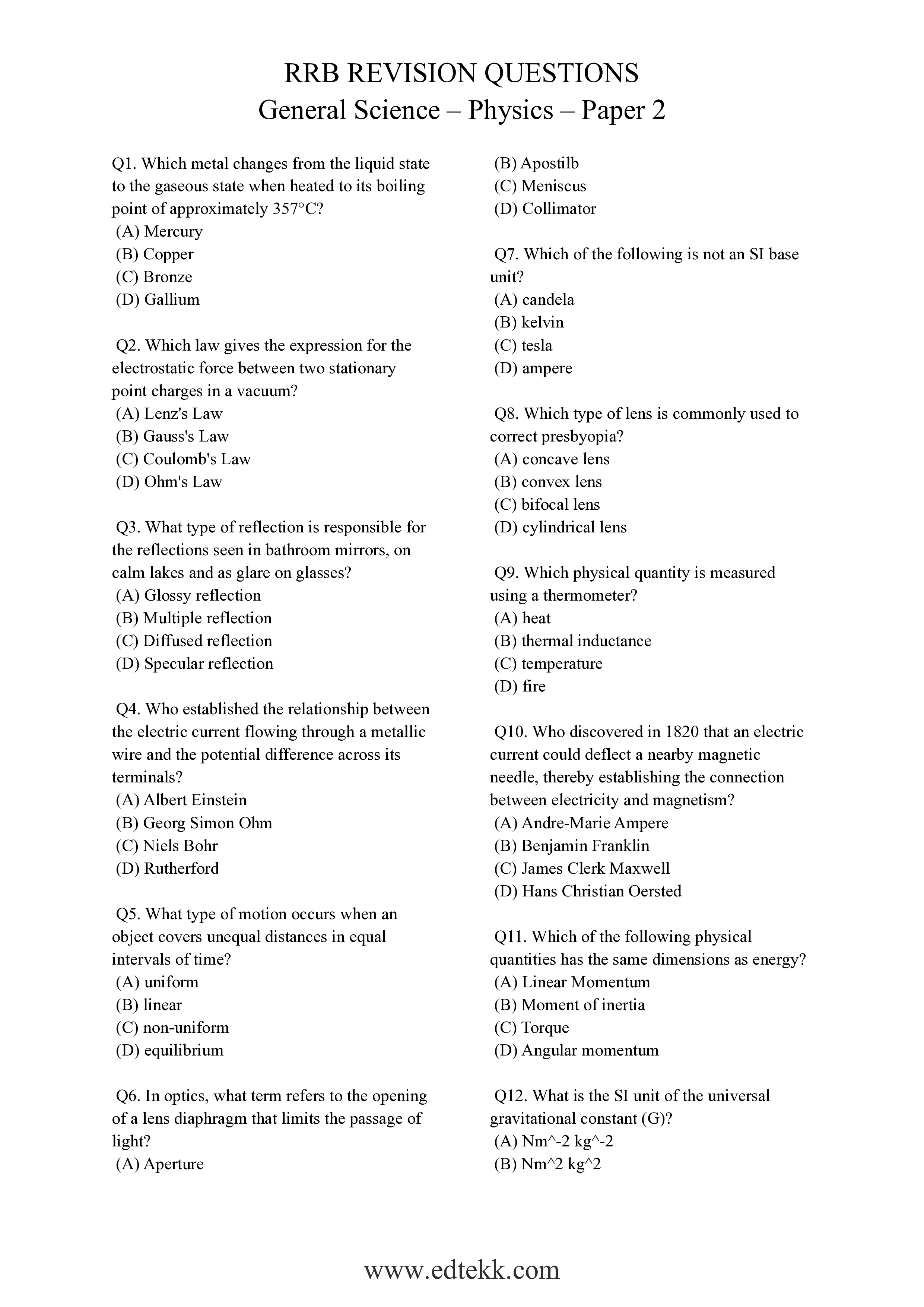
Q1. Which metal changes from the liquid state to the gaseous state when heated to its boiling point of approximately 357°C?
(A) Mercury
(B) Copper
(C) Bronze
(D) Gallium
Explanation: Mercury has a boiling point of approximately 357°C at standard atmospheric pressure. When heated to this temperature, liquid mercury changes into mercury vapour. Mercury is unusual because it is a metal that remains liquid at ordinary room temperatures due to its relatively low melting point.
Q2. Which law gives the expression for the electrostatic force between two stationary point charges in a vacuum?
(A) Lenz’s Law
(B) Gauss’s Law
(C) Coulomb’s Law
(D) Ohm’s Law
Explanation: Coulomb’s law describes the electrostatic force between two stationary point charges in vacuum. The magnitude of this force is directly proportional to the product of the charges and inversely proportional to the square of the distance between them. The force acts along the line joining the charges and may be attractive or repulsive.
Q3. What type of reflection is responsible for the reflections seen in bathroom mirrors, on calm lakes and as glare on glasses?
(A) Glossy reflection
(B) Multiple reflection
(C) Diffused reflection
(D) Specular reflection
Explanation: Specular reflection occurs when light reflects from a smooth surface, with parallel incident rays remaining parallel after reflection. Bathroom mirrors and calm lake surfaces can produce clear reflections because their surfaces are relatively smooth. Glasses can also produce specular glare, although anti-reflective coatings reduce this effect.
Q4. Who established the relationship between the electric current flowing through a metallic wire and the potential difference across its terminals?
(A) Albert Einstein
(B) Georg Simon Ohm
(C) Niels Bohr
(D) Rutherford
Explanation: Georg Simon Ohm established the relationship between electric current and potential difference in a conductor. His work led to Ohm’s law, which states that current through a conductor is directly proportional to the potential difference across it, provided temperature and other physical conditions remain constant.
Q5. What type of motion occurs when an object covers unequal distances in equal intervals of time?
(A) uniform
(B) linear
(C) non-uniform
(D) equilibrium
Explanation: Non-uniform motion occurs when an object covers unequal distances in equal intervals of time or equal distances in unequal intervals of time. In contrast, uniform motion involves covering equal distances in equal intervals of time.
Q6. In optics, what term refers to the opening of a lens diaphragm that limits the passage of light?
(A) Aperture
(B) Apostilb
(C) Meniscus
(D) Collimator
Explanation: Aperture refers to the opening in an optical instrument through which light enters or passes. It determines the amount of light admitted by the optical system. A larger aperture generally allows more light to enter, while the diaphragm can regulate the effective aperture.
Q7. Which of the following is not an SI base unit?
(A) candela
(B) kelvin
(C) tesla
(D) ampere
Explanation: Tesla (T) is a derived SI unit used to measure magnetic flux density, not an SI base unit. The seven SI base units include kelvin for thermodynamic temperature, candela for luminous intensity and ampere for electric current. Therefore, tesla is the correct answer.
Q8. Which type of lens is commonly used to correct presbyopia?
(A) concave lens
(B) convex lens
(C) bifocal lens
(D) cylindrical lens
Explanation: Presbyopia is an age-related reduction in the eye’s ability to accommodate, making it difficult to focus on nearby objects. Bifocal lenses provide separate optical powers for distance and near vision. Progressive lenses are another common option, providing a gradual change in optical power without a visible dividing line.
Q9. Which physical quantity is measured using a thermometer?
(A) heat
(B) thermal inductance
(C) temperature
(D) fire
Explanation: A thermometer is an instrument used to measure temperature, which indicates the degree of hotness or coldness of a body. Heat is energy transferred between bodies due to a temperature difference, whereas temperature is a measurable physical quantity.
Q10. Who discovered in 1820 that an electric current could deflect a nearby magnetic needle, thereby establishing the connection between electricity and magnetism?
(A) Andre-Marie Ampere
(B) Benjamin Franklin
(C) James Clerk Maxwell
(D) Hans Christian Oersted
Explanation: Hans Christian Ørsted discovered the connection between electricity and magnetism in 1820. He observed that a compass needle deflected when placed near a current-carrying wire. This experiment demonstrated that an electric current produces a magnetic field and laid the foundation for the development of electromagnetism.
Q11. Which of the following physical quantities has the same dimensions as energy?
(A) Linear Momentum
(B) Moment of inertia
(C) Torque
(D) Angular momentum
Explanation: Torque and energy have the same dimensions, (ML^2T^{-2}). Torque is the product of force and perpendicular distance, whereas work is the product of force and displacement in the direction of the force. However, they represent different physical quantities: torque is expressed in N·m and energy in joules (J).
Q12. What is the SI unit of the universal gravitational constant (G)?
(A) Nm^-2 kg^-2
(B) Nm^2 kg^2
(C) Nm^2 kg^-2
(D) Nm^-2 kg^2
Explanation: The SI unit of the universal gravitational constant ((G)) is N m² kg⁻². According to Newton’s law of universal gravitation, it relates the gravitational force between two masses to their masses and the square of the distance between them. Its approximate value is (6.674 times 10^{-11}) N m² kg⁻².
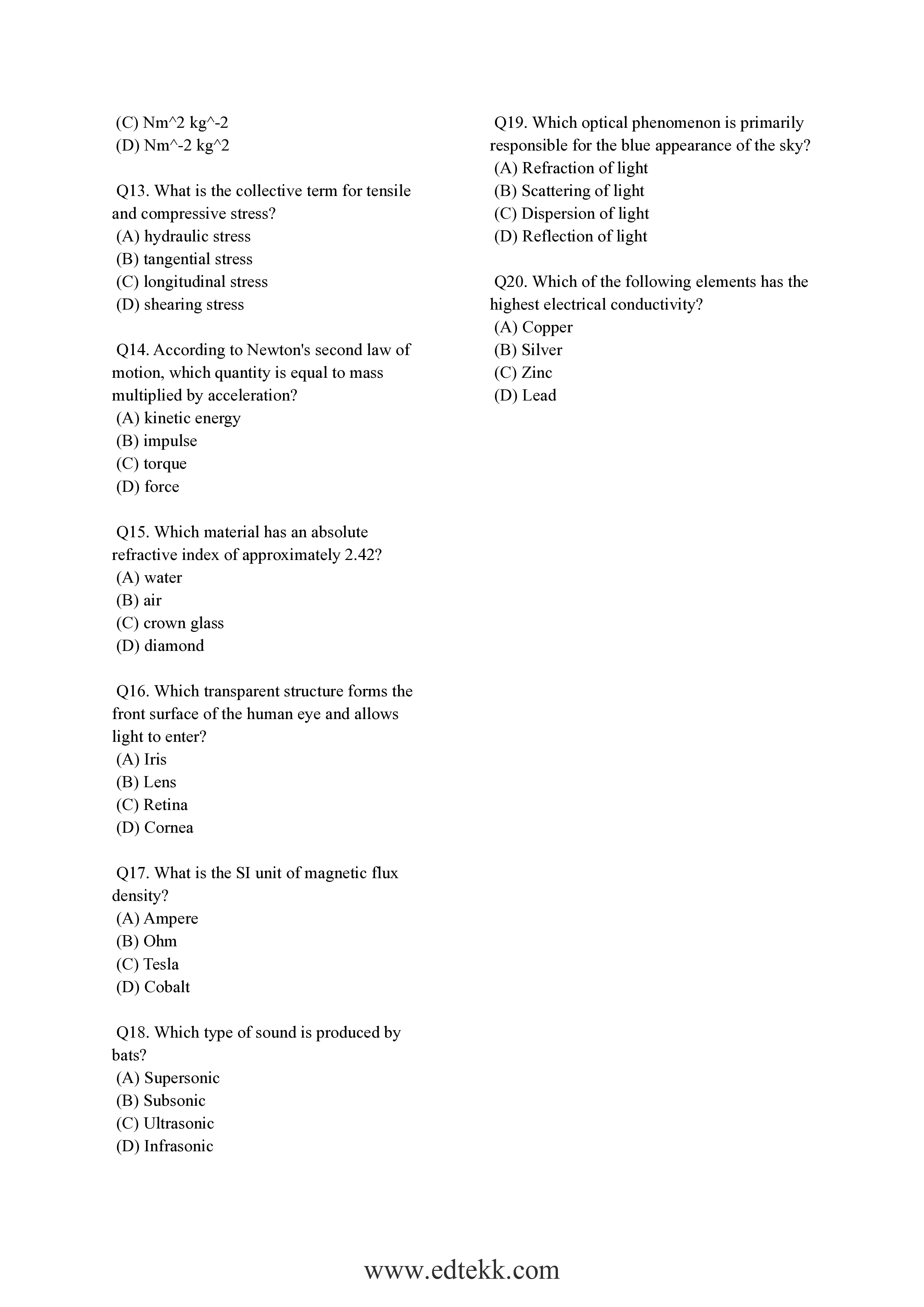
Q13. What is the collective term for tensile and compressive stress?
(A) hydraulic stress
(B) tangential stress
(C) longitudinal stress
(D) shearing stress
Explanation: Tensile and compressive stresses are collectively called longitudinal stresses because they act perpendicular to the cross-sectional area of a body and produce changes in its length. Tensile stress tends to increase the body’s length, whereas compressive stress tends to decrease it. Shearing stress acts parallel to the surface.
Q14. According to Newton’s second law of motion, which quantity is equal to mass multiplied by acceleration?
(A) kinetic energy
(B) impulse
(C) torque
(D) force
Explanation: According to Newton’s second law of motion, the net force acting on a body equals the product of its mass and acceleration. Mathematically, (F = ma), where (F) represents force, (m) represents mass and (a) represents acceleration. The SI unit of force is the newton (N).
Q15. Which material has an absolute refractive index of approximately 2.42?
(A) water
(B) air
(C) crown glass
(D) diamond
Explanation: Diamond has an absolute refractive index of approximately 2.42. The absolute refractive index of a medium is the ratio of the speed of light in vacuum to its speed in that medium. Diamond has a high refractive index because light travels considerably slower through it than through air or water.
Q16. Which transparent structure forms the front surface of the human eye and allows light to enter?
(A) Iris
(B) Lens
(C) Retina
(D) Cornea
Explanation: The cornea is the transparent, dome-shaped front surface of the human eye. It allows light to enter and provides much of the eye’s refractive power by bending incoming light. It also helps protect the eye from dust and microorganisms. The iris regulates pupil size, while the retina detects light and converts it into nerve signals.
Q17. What is the SI unit of magnetic flux density?
(A) Ampere
(B) Ohm
(C) Tesla
(D) Cobalt
Explanation: Tesla (T) is the SI unit of magnetic flux density, commonly called the magnetic field in elementary physics. One tesla is equivalent to one weber per square metre (Wb/m²). It is named after the scientist and inventor Nikola Tesla.
Q18. Which type of sound is produced by bats?
(A) Supersonic
(B) Subsonic
(C) Ultrasonic
(D) Infrasonic
Explanation: Bats produce and use ultrasonic sounds for echolocation. They emit high-frequency sound waves and detect the returning echoes to locate prey, identify obstacles and navigate in darkness. These sounds generally have frequencies above the upper limit of human hearing (20 kHz).
Q19. Which optical phenomenon is primarily responsible for the blue appearance of the sky?
(A) Refraction of light
(B) Scattering of light
(C) Dispersion of light
(D) Reflection of light
Explanation: The sky appears blue primarily because of Rayleigh scattering of sunlight by molecules in the atmosphere. Shorter visible wavelengths are scattered more strongly than longer wavelengths. Although violet light scatters even more strongly than blue light, the solar spectrum and the sensitivity of human vision contribute to the sky appearing blue.
Q20. Which of the following elements has the highest electrical conductivity?
(A) Copper
(B) Silver
(C) Zinc
(D) Lead
Explanation: Silver has the highest electrical conductivity among the four listed metals under ordinary conditions. Its electrical resistivity is lower than that of copper, zinc and lead. Although copper is more commonly used in electrical wiring because of its lower cost, silver is the better electrical conductor.
Question Paper Images