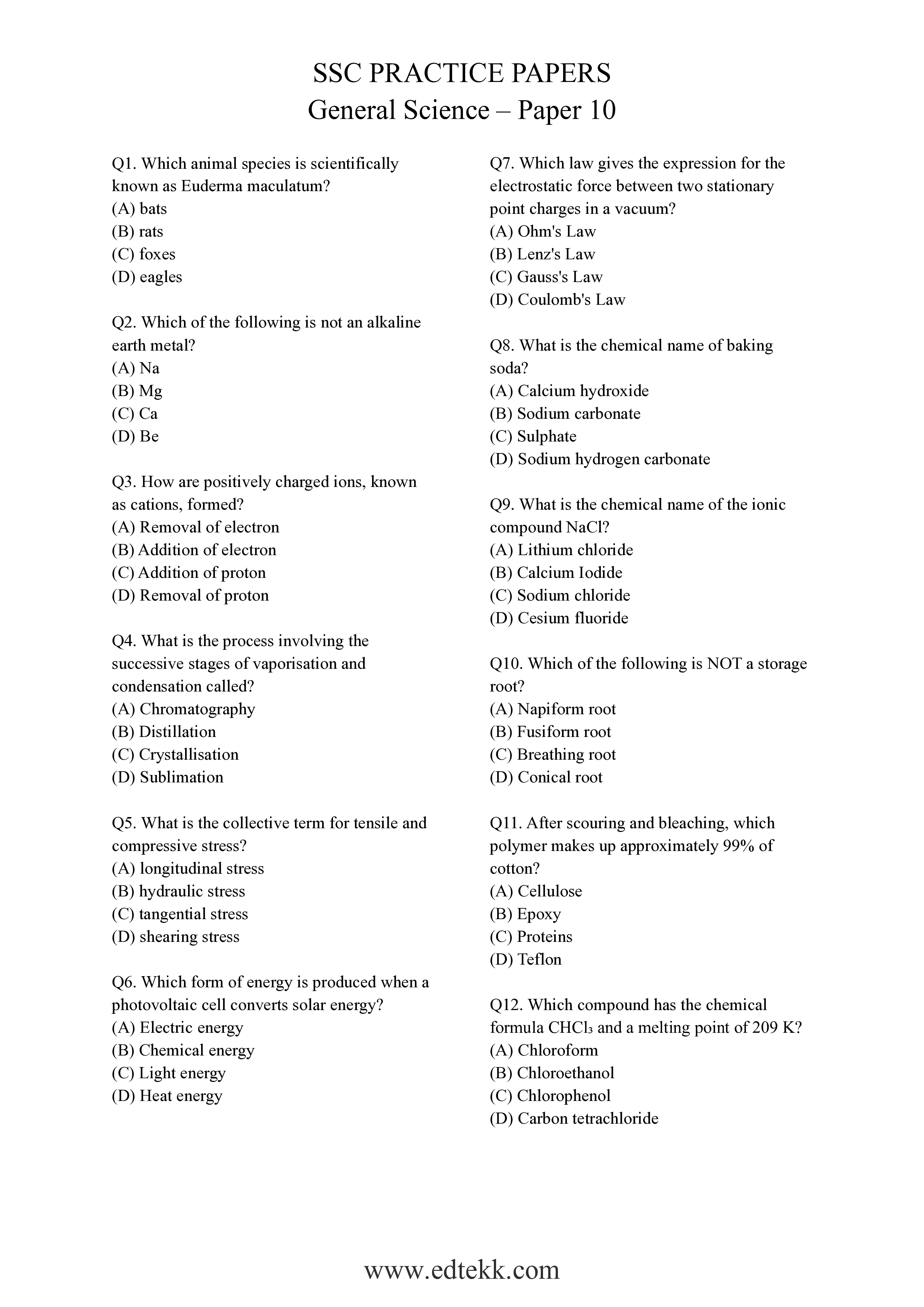
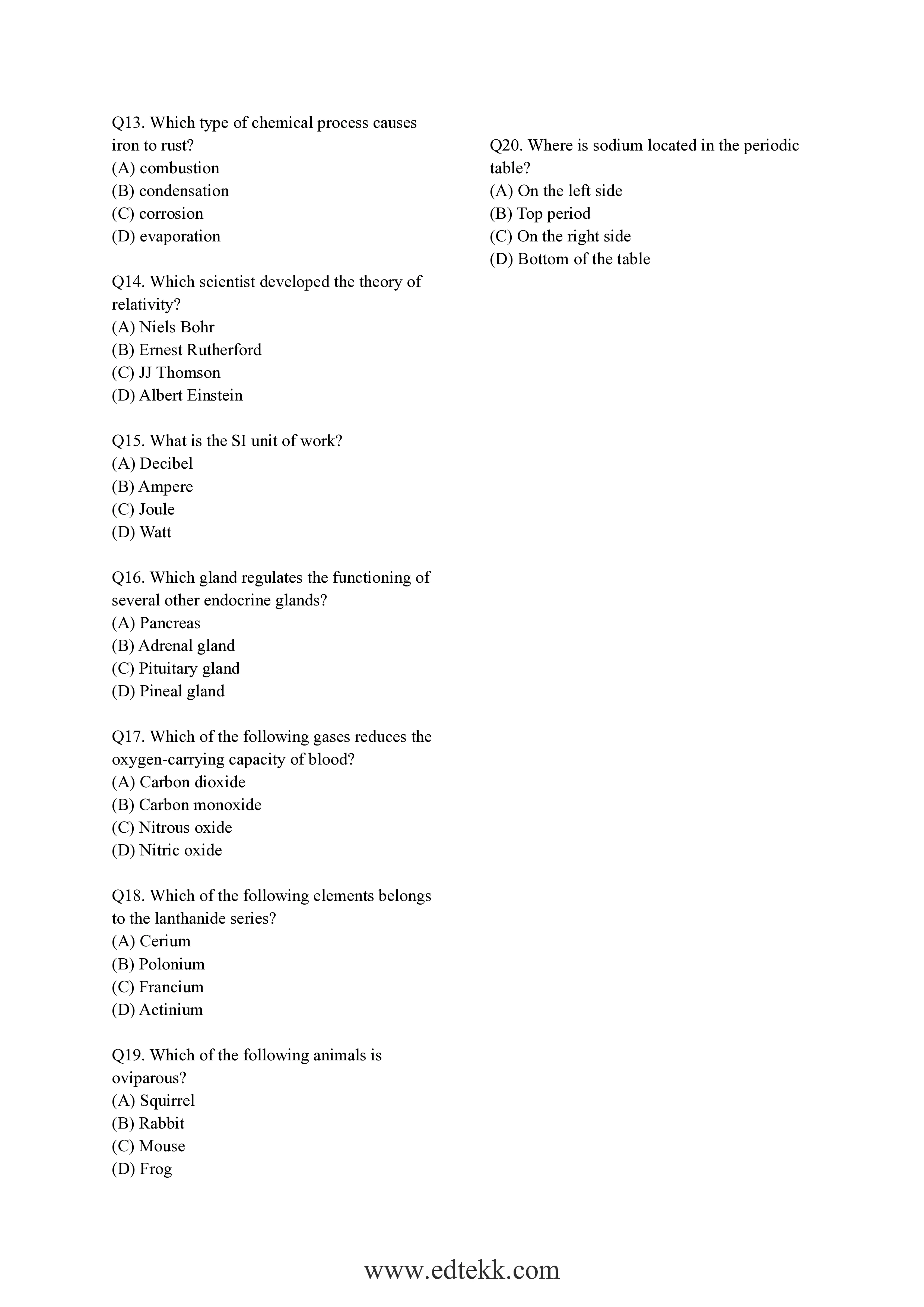
Complete another stage of your SSC science preparation with General Science Practice Paper 10, containing 20 objective-type MCQs. This practice set includes questions, correct answers and explanations to help candidates assess their knowledge, revise scientific concepts and improve exam readiness for SSC CGL, CHSL, CPO, MTS, GD and Selection Post examinations.
Test Details
Topic: General Science
Total Questions: 20
Question Format: MCQs – Single Correct Answer
Suitable for: SSC CGL, CHSL, CPO, MTS, GD, Selection Post
Download All Papers in This Series (PDF)
Questions and Answers
Q1. Which animal species is scientifically known as Euderma maculatum?
(A) bats
(B) rats
(C) foxes
(D) eagles
Explanation: Euderma maculatum is the scientific name of the spotted bat, a species native to western North America. It is recognised by its distinctive three white spots on its dark-coloured back and exceptionally large ears. It is one of the most distinctive bat species found in North America.
Q2. Which of the following is not an alkaline earth metal?
(A) Na
(B) Mg
(C) Ca
(D) Be
Explanation: Sodium (Na) is not an alkaline earth metal; it is an alkali metal belonging to Group 1 of the periodic table. Magnesium (Mg), calcium (Ca) and beryllium (Be) are alkaline earth metals belonging to Group 2.
Q3. How are positively charged ions, known as cations, formed?
(A) Removal of electron
(B) Addition of electron
(C) Addition of proton
(D) Removal of proton
Explanation: Cations are positively charged ions commonly formed when neutral atoms lose one or more electrons. Electron loss leaves the species with more protons than electrons, producing a net positive charge. For example, sodium forms Na⁺ by losing one electron: Na → Na⁺ + e⁻. Electron gain generally produces anions.
Q4. What is the process involving the successive stages of vaporisation and condensation called?
(A) Chromatography
(B) Distillation
(C) Crystallisation
(D) Sublimation
Explanation: Distillation is a separation process involving vaporisation followed by condensation. The liquid mixture is heated to convert a component into vapour, which is subsequently cooled to obtain it in liquid form. It is commonly used to separate liquids with different boiling points or recover a solvent from a solution.
Q5. What is the collective term for tensile and compressive stress?
(A) longitudinal stress
(B) hydraulic stress
(C) tangential stress
(D) shearing stress
Explanation: Tensile and compressive stresses are collectively called longitudinal stresses because they act perpendicular to the cross-sectional area of a body and produce changes in its length. Tensile stress tends to increase the body’s length, whereas compressive stress tends to decrease it. Shearing stress acts parallel to the surface.
Q6. Which form of energy is produced when a photovoltaic cell converts solar energy?
(A) Electric energy
(B) Chemical energy
(C) Light energy
(D) Heat energy
Explanation: A photovoltaic cell converts solar energy directly into electrical energy through the photovoltaic effect. When sunlight falls on its semiconductor material, photons generate electron–hole pairs, producing an electric current through the cell. This principle is widely used in solar panels for electricity generation.
Q7. Which law gives the expression for the electrostatic force between two stationary point charges in a vacuum?
(A) Ohm’s Law
(B) Lenz’s Law
(C) Gauss’s Law
(D) Coulomb’s Law
Explanation: Coulomb’s law describes the electrostatic force between two stationary point charges in vacuum. The magnitude of this force is directly proportional to the product of the charges and inversely proportional to the square of the distance between them. The force acts along the line joining the charges and may be attractive or repulsive.
Q8. What is the chemical name of baking soda?
(A) Calcium hydroxide
(B) Sodium carbonate
(C) Sulphate
(D) Sodium hydrogen carbonate
Explanation: Baking soda is the common name for sodium hydrogen carbonate, also known as sodium bicarbonate. Its chemical formula is NaHCO₃. It is a mildly alkaline compound used as a leavening agent in baking. It releases carbon dioxide when heated or when it reacts with acids.
Q9. What is the chemical name of the ionic compound NaCl?
(A) Lithium chloride
(B) Calcium Iodide
(C) Sodium chloride
(D) Cesium fluoride
Explanation: NaCl is the chemical formula of sodium chloride, an ionic compound formed by sodium ions (Na⁺) and chloride ions (Cl⁻). It is commonly known as common salt or table salt and is widely used in food preparation and preservation.
Q10. Which of the following is NOT a storage root?
(A) Napiform root
(B) Fusiform root
(C) Breathing root
(D) Conical root
Explanation: Breathing roots, or pneumatophores, are specialised roots that grow upward from waterlogged, oxygen-deficient soil and facilitate gaseous exchange through lenticels. They occur in certain mangroves, such as Avicennia. Napiform, conical and fusiform roots are storage modifications of taproots. Therefore, breathing roots are not storage roots.
Q11. After scouring and bleaching, which polymer makes up approximately 99% of cotton?
(A) Cellulose
(B) Epoxy
(C) Proteins
(D) Teflon
Explanation: Cellulose is the principal structural polymer of cotton fibres. After thorough scouring and bleaching, highly purified cotton may contain approximately 99% cellulose, depending on processing conditions. Cellulose is a natural polysaccharide composed of β-D-glucose units joined by β-1,4-glycosidic bonds.
Q12. Which compound has the chemical formula CHCl₃ and a melting point of 209 K?
(A) Chloroform
(B) Chloroethanol
(C) Chlorophenol
(D) Carbon tetrachloride
Explanation: Chloroform (CHCl₃), also known as trichloromethane, has a melting point of approximately 209 K (−64 °C). It is a colourless, volatile liquid with a characteristic sweet smell. Although historically used as an anaesthetic, it is no longer commonly used for this purpose because of its toxicity.
Q13. Which type of chemical process causes iron to rust?
(A) combustion
(B) condensation
(C) corrosion
(D) evaporation
Explanation: Rusting of iron is an example of corrosion, which involves the gradual deterioration of a metal through chemical or electrochemical reactions with its surroundings. Iron reacts with oxygen and moisture to form hydrated iron(III) oxide, commonly called rust. Painting, galvanisation and protective coatings help prevent rusting.
Q14. Which scientist developed the theory of relativity?
(A) Niels Bohr
(B) Ernest Rutherford
(C) JJ Thomson
(D) Albert Einstein
Explanation: Albert Einstein developed the special theory of relativity in 1905 and the general theory of relativity, published in its final form in 1915. These theories revolutionised the understanding of space, time, gravity and motion. Niels Bohr, Ernest Rutherford and J. J. Thomson contributed significantly to atomic physics.
Q15. What is the SI unit of work?
(A) Decibel
(B) Ampere
(C) Joule
(D) Watt
Explanation: Work is the product of force and displacement in the direction of the applied force. Its SI unit is the joule (J), equivalent to one newton-metre (N·m). One joule of work is done when a force of one newton displaces an object by one metre in the direction of the force.
Q16. Which gland regulates the functioning of several other endocrine glands?
(A) Pancreas
(B) Adrenal gland
(C) Pituitary gland
(D) Pineal gland
Explanation: The pituitary gland is commonly called the master gland because it secretes hormones that regulate several other endocrine glands, including the thyroid, adrenal glands and gonads. However, the hypothalamus plays a major role in controlling pituitary function by regulating its hormone secretion.
Q17. Which of the following gases reduces the oxygen-carrying capacity of blood?
(A) Carbon dioxide
(B) Carbon monoxide
(C) Nitrous oxide
(D) Nitric oxide
Explanation: Carbon monoxide reduces the oxygen-carrying capacity of blood by binding to haemoglobin with an affinity approximately 200–250 times greater than that of oxygen. This forms carboxyhaemoglobin, reducing oxygen transport and impairing oxygen release to tissues. Severe carbon monoxide poisoning can cause tissue hypoxia, unconsciousness and death.
Q18. Which of the following elements belongs to the lanthanide series?
(A) Cerium
(B) Polonium
(C) Francium
(D) Actinium
Explanation: Cerium (Ce), with atomic number 58, belongs to the lanthanide series of the periodic table. Lanthanides generally extend from lanthanum (atomic number 57) to lutetium (atomic number 71). They are classified as rare-earth elements and are associated with the filling of the 4f subshell.
Q19. Which of the following animals is oviparous?
(A) Squirrel
(B) Rabbit
(C) Mouse
(D) Frog
Explanation: Frogs are oviparous animals, meaning they reproduce by laying eggs. Most frogs lay their eggs in water, where fertilisation generally occurs externally. Rabbits, mice and squirrels are mammals that give birth to live young. Therefore, frog is the correct answer.
Q20. Where is sodium located in the periodic table?
(A) On the left side
(B) Top period
(C) On the right side
(D) Bottom of the table
Explanation: Sodium (Na), with atomic number 11, is located on the left side of the periodic table in Group 1 and Period 3. It is an alkali metal with one electron in its outermost shell and readily loses this electron to form a positively charged sodium ion (Na⁺).
Question Paper Images