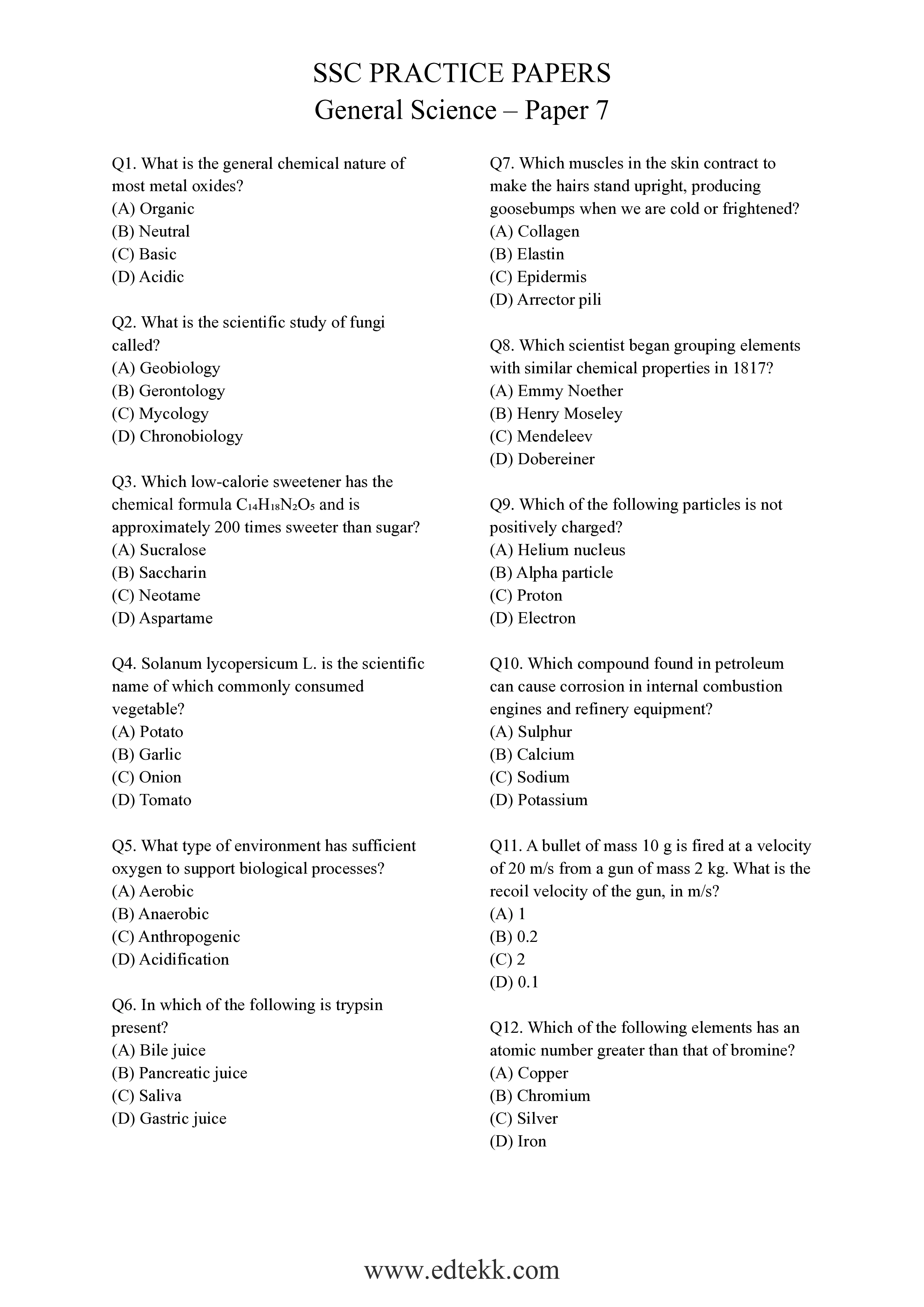
Strengthen your General Science preparation with SSC Practice Paper 7, containing 20 multiple-choice questions for competitive-exam practice. This question set provides correct answers and explanations to support concept revision, knowledge assessment and exam preparation for SSC CGL, CHSL, CPO, MTS, GD and Selection Post examinations.
Test Details
Topic: General Science
Total Questions: 20
Question Format: MCQs – Single Correct Answer
Suitable for: SSC CGL, CHSL, CPO, MTS, GD, Selection Post
Download All Papers in This Series (PDF)
Questions and Answers
Q1. What is the general chemical nature of most metal oxides?
(A) Organic
(B) Neutral
(C) Basic
(D) Acidic
Explanation: Most metal oxides are generally basic in nature and react with acids to produce salt and water. Magnesium oxide and calcium oxide are examples of basic oxides. However, some metal oxides, such as aluminium oxide and zinc oxide, are amphoteric because they react with both acids and bases.
Q2. What is the scientific study of fungi called?
(A) Geobiology
(B) Gerontology
(C) Mycology
(D) Chronobiology
Explanation: Mycology is the branch of biology concerned with the study of fungi, including yeasts, moulds and mushrooms. It deals with their classification, structure, reproduction, physiology and ecological roles. Mycology also examines fungal diseases and the economic importance of fungi in agriculture, medicine and industry.
Q3. Which low-calorie sweetener has the chemical formula C₁₄H₁₈N₂O₅ and is approximately 200 times sweeter than sugar?
(A) Sucralose
(B) Saccharin
(C) Neotame
(D) Aspartame
Explanation: Aspartame has the molecular formula C₁₄H₁₈N₂O₅ and is an artificial low-calorie sweetener approximately 200 times sweeter than sucrose. It is used in various sugar-free and reduced-calorie food products. Due to its high sweetness, only a small quantity is required compared with ordinary sugar.
Q4. Solanum lycopersicum L. is the scientific name of which commonly consumed vegetable?
(A) Potato
(B) Garlic
(C) Onion
(D) Tomato
Explanation: Solanum lycopersicum L. is the scientific name of tomato, which belongs to the family Solanaceae. Although commonly used as a vegetable in cooking, tomato is botanically classified as a fruit because it develops from the ovary of a flower and contains seeds.
Q5. What type of environment has sufficient oxygen to support biological processes?
(A) Aerobic
(B) Anaerobic
(C) Anthropogenic
(D) Acidification
Explanation: An aerobic environment is one in which oxygen is readily available. Aerobic organisms and processes require oxygen for their functioning, whereas anaerobic conditions refer to environments where oxygen is absent or present in insufficient quantities for aerobic processes.
Q6. In which of the following is trypsin present?
(A) Bile juice
(B) Pancreatic juice
(C) Saliva
(D) Gastric juice
Explanation: Trypsin is a protein-digesting enzyme produced by the pancreas and released into pancreatic juice in its inactive form, trypsinogen. In the small intestine, trypsinogen is activated by enteropeptidase, and active trypsin helps digest proteins into smaller peptides. Trypsin functions optimally in the alkaline environment of the small intestine.
Q7. Which muscles in the skin contract to make the hairs stand upright, producing goosebumps when we are cold or frightened?
(A) Collagen
(B) Elastin
(C) Epidermis
(D) Arrector pili
Explanation: Arrector pili are small, involuntary smooth muscles attached to hair follicles. When these muscles contract, they pull the hairs upright and produce small elevations on the skin, commonly known as goosebumps. This response occurs during exposure to cold or in response to emotional stimuli such as fear.
Q8. Which scientist began grouping elements with similar chemical properties in 1817?
(A) Emmy Noether
(B) Henry Moseley
(C) Mendeleev
(D) Dobereiner
Explanation: Johann Wolfgang Döbereiner began classifying elements with similar chemical properties in 1817. He subsequently developed the concept of triads, grouping three elements with similar properties. The atomic mass of the middle element was approximately the arithmetic mean of the other two.
Q9. Which of the following particles is not positively charged?
(A) Helium nucleus
(B) Alpha particle
(C) Proton
(D) Electron
Explanation: An electron carries a negative electric charge (−1e), whereas a proton carries a positive charge (+1e). An alpha particle is the nucleus of a helium-4 atom, containing two protons and two neutrons, and has a charge of +2e. Therefore, the electron is the only negatively charged particle among the options.
Q10. Which compound found in petroleum can cause corrosion in internal combustion engines and refinery equipment?
(A) Sulphur
(B) Calcium
(C) Sodium
(D) Potassium
Explanation: Sulphur compounds present in petroleum can cause corrosion in internal combustion engines, pipelines and refinery equipment. During combustion, sulphur-containing compounds may produce sulphur oxides, which react with moisture to form corrosive acids. Petroleum refining therefore includes desulphurisation processes to reduce sulphur content and minimise corrosion and pollution.
Q11. A bullet of mass 10 g is fired at a velocity of 20 m/s from a gun of mass 2 kg. What is the recoil velocity of the gun, in m/s?
(A) 1
(B) 0.2
(C) 2
(D) 0.1
Explanation: According to the law of conservation of momentum, the initial total momentum of the gun–bullet system is zero. Therefore, (0.01 times 20 + 2v = 0), giving (v = -0.1text{ m/s}). The negative sign indicates that the gun recoils in the direction opposite to the bullet’s motion.
Q12. Which of the following elements has an atomic number greater than that of bromine?
(A) Copper
(B) Chromium
(C) Silver
(D) Iron
Explanation: Silver has atomic number 47, which is greater than bromine’s atomic number of 35. Copper has atomic number 29, iron 26 and chromium 24. Atomic number is determined by the number of protons present in an atom’s nucleus.
Q13. Who proposed that all plants and animals are composed of cells and that the cell is the basic unit of life?
(A) M. Schleiden and T. Schwann
(B) Virchow
(C) J. E. Purkinje
(D) Leeuwenhoek
Explanation: Matthias Schleiden and Theodor Schwann jointly developed the classical cell theory. Schleiden established that plants are composed of cells, while Schwann extended this principle to animals. Their work established the cell as the fundamental structural and functional unit of living organisms.
Q14. What is the scientific study of viruses called?
(A) Protozoology
(B) Parasitology
(C) Virology
(D) Mycology
Explanation: Virology is the branch of science concerned with the study of viruses. It examines their structure, classification, replication, genetics, evolution and interactions with host organisms. Virology also investigates viral diseases and contributes to the development of vaccines and antiviral treatments.
Q15. Which of the following is an essential micronutrient required by plants?
(A) Phosphorus
(B) Nitrogen
(C) Zinc
(D) Calcium
Explanation: Zinc is an essential plant micronutrient required in small quantities for normal growth and development. It contributes to enzyme activity, protein synthesis, and the regulation of growth-related processes. Although phosphorus, calcium, and nitrogen are also essential plant nutrients, they are classified as macronutrients because plants generally require them in substantially larger quantities than zinc.
Q16. Which of the following is the male reproductive part of a flower?
(A) Style
(B) Stamen
(C) Pistil
(D) Stigma
Explanation: The stamen is the male reproductive organ of a flower. It generally consists of an anther and a filament. The anther produces pollen grains containing male gametophytes, which give rise to male gametes. The stigma, style and ovary are components of the female reproductive structure, the pistil.
Q17. What are hydrocarbons containing exactly two carbon–carbon double bonds called?
(A) Trialkyne
(B) Dienes
(C) Dialkyne
(D) Terpenes
Explanation: Dienes are hydrocarbons containing two carbon–carbon double bonds (C=C). Depending on the arrangement of these bonds, they are classified as conjugated, isolated or cumulated dienes. Dialkynes, in contrast, contain two carbon–carbon triple bonds.
Q18. How are negatively charged ions, known as anions, formed?
(A) Addition of electron
(B) Addition of proton
(C) Removal of electron
(D) Removal of proton
Explanation: Anions are negatively charged ions commonly formed when neutral atoms gain one or more electrons. The additional electrons produce a net negative charge. For example, chlorine gains an electron to form chloride: Cl + e⁻ → Cl⁻. Conversely, the loss of electrons generally produces positively charged cations.
Q19. Which principle of physics is illustrated by a horse pulling a carriage?
(A) Newton’s third law
(B) Ohm’s law
(C) Archimedes principle
(D) Avogadro’s law
Explanation: A horse pulling a carriage illustrates Newton’s third law of motion. The horse pushes the ground backwards, and the ground exerts an equal and opposite forward frictional force on the horse. This forward force enables the horse to pull the carriage. The action and reaction forces act on different bodies.
Q20. Who coined the term “mitochondria”?
(A) J E Salk
(B) Antonie van Leeuwenhoek
(C) Charles Laveran
(D) Carl Benda
Explanation: The term mitochondria was coined by German anatomist Carl Benda in 1898. The word is derived from Greek terms meaning thread and granule, reflecting the appearance of these structures under a microscope. Mitochondria are membrane-bound organelles involved in cellular energy production, particularly through aerobic respiration and oxidative phosphorylation.
Question Paper Images