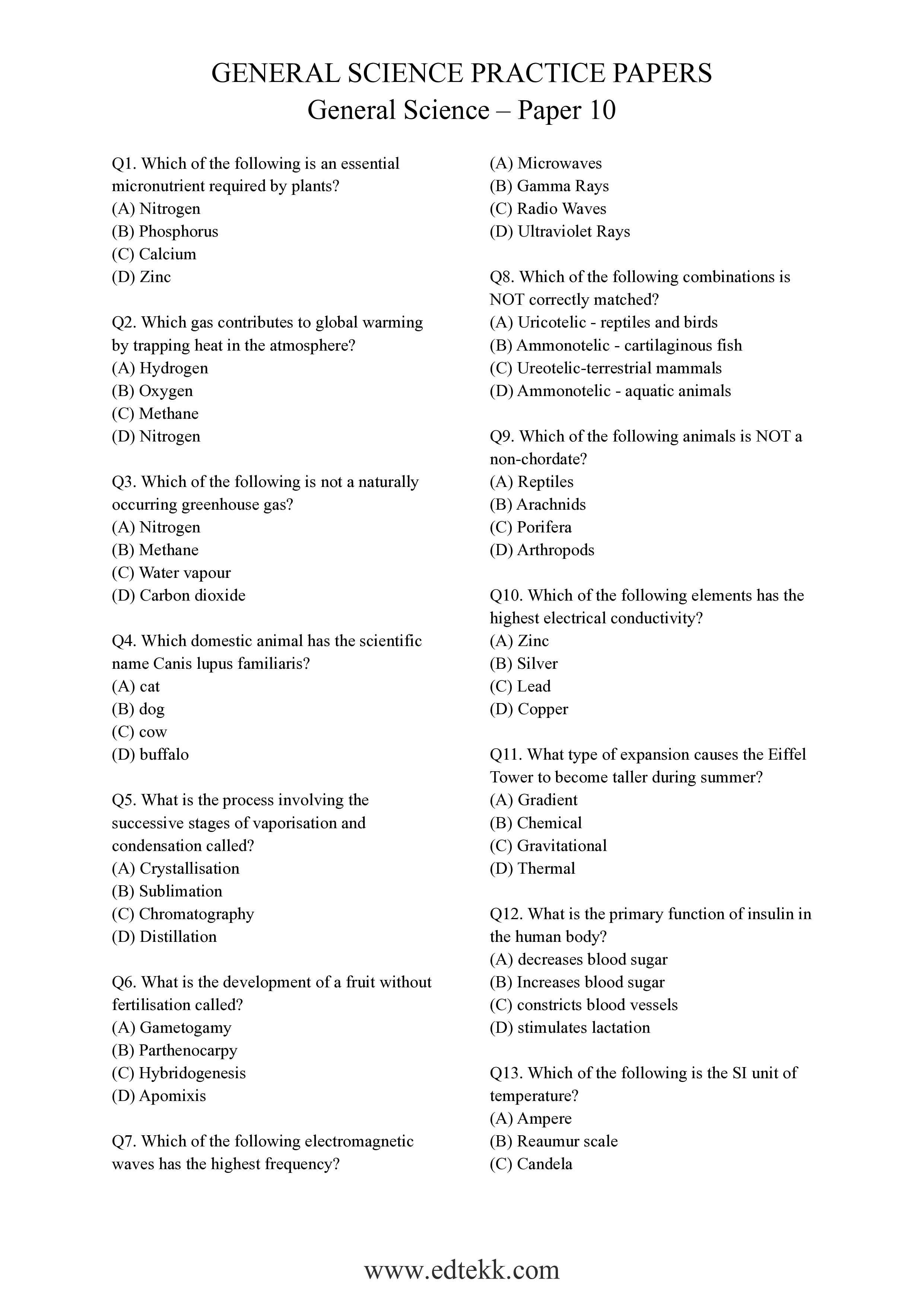
Complete another round of General Science revision with Practice Paper 10, featuring 20 objective-type questions covering essential scientific concepts. Ideal for SSC, Railway, State PSC, Police Constable and Police SI aspirants, this practice set offers answers and explanations to assess preparation, reinforce learning and build confidence for competitive examinations.
Test Details
Topic: General Science
Total Questions: 20
Question Format: MCQs – Single Correct Answer
Suitable for: SSC exams, Railway exams, State PSC, Police Constable, Police SI
Download All Papers in This Series (PDF)
Questions and Answers
Q1. Which of the following is an essential micronutrient required by plants?
(A) Nitrogen
(B) Phosphorus
(C) Calcium
(D) Zinc
Explanation: Zinc is an essential plant micronutrient required in small quantities for normal growth and development. It contributes to enzyme activity, protein synthesis, and the regulation of growth-related processes. Although phosphorus, calcium, and nitrogen are also essential plant nutrients, they are classified as macronutrients because plants generally require them in substantially larger quantities than zinc.
Q2. Which gas contributes to global warming by trapping heat in the atmosphere?
(A) Hydrogen
(B) Oxygen
(C) Methane
(D) Nitrogen
Explanation: Methane is a greenhouse gas that contributes to global warming by absorbing and re-emitting infrared radiation in the atmosphere. Although present in much lower concentrations than carbon dioxide, methane has a substantially higher global warming potential per unit mass over a 100-year period.
Q3. Which of the following is not a naturally occurring greenhouse gas?
(A) Nitrogen
(B) Methane
(C) Water vapour
(D) Carbon dioxide
Explanation: Nitrogen (N₂) is not a greenhouse gas because its homonuclear diatomic molecules do not absorb infrared radiation effectively. In contrast, carbon dioxide, water vapour and methane absorb outgoing infrared radiation and contribute to the greenhouse effect.
Q4. Which domestic animal has the scientific name Canis lupus familiaris?
(A) cat
(B) dog
(C) cow
(D) buffalo
Explanation: The domestic dog is scientifically classified as Canis lupus familiaris, a subspecies of the grey wolf (Canis lupus) under a widely accepted taxonomic classification. It belongs to the family Canidae and the order Carnivora.
Q5. What is the process involving the successive stages of vaporisation and condensation called?
(A) Crystallisation
(B) Sublimation
(C) Chromatography
(D) Distillation
Explanation: Distillation is a separation process involving vaporisation followed by condensation. The liquid mixture is heated to convert a component into vapour, which is subsequently cooled to obtain it in liquid form. It is commonly used to separate liquids with different boiling points or recover a solvent from a solution.
Q6. What is the development of a fruit without fertilisation called?
(A) Gametogamy
(B) Parthenocarpy
(C) Hybridogenesis
(D) Apomixis
Explanation: Parthenocarpy is the development of a fruit without fertilisation, generally resulting in seedless fruits. It may occur naturally or be induced by plant growth regulators. Certain bananas and pineapples are examples. In contrast, apomixis refers to asexual seed formation without fertilisation.
Q7. Which of the following electromagnetic waves has the highest frequency?
(A) Microwaves
(B) Gamma Rays
(C) Radio Waves
(D) Ultraviolet Rays
Explanation: Gamma rays have the highest frequency and shortest wavelength among the given electromagnetic waves. Their photon energies are higher than those of ultraviolet rays, microwaves and radio waves. According to the relationship c = νλ, frequency and wavelength are inversely proportional in a vacuum.
Q8. Which of the following combinations is NOT correctly matched?
(A) Uricotelic – reptiles and birds
(B) Ammonotelic – cartilaginous fish
(C) Ureotelic-terrestrial mammals
(D) Ammonotelic – aquatic animals
Explanation: Cartilaginous fishes, including sharks and rays, are predominantly ureotelic because they excrete nitrogenous waste mainly as urea. Many aquatic animals, especially freshwater bony fishes, are ammonotelic. Birds and most reptiles are uricotelic, while terrestrial mammals are generally ureotelic. Therefore, the incorrectly matched pair is Ammonotelic – cartilaginous fish.
Q9. Which of the following animals is NOT a non-chordate?
(A) Reptiles
(B) Arachnids
(C) Porifera
(D) Arthropods
Explanation: Reptiles are chordates and vertebrates, whereas arthropods, poriferans and arachnids are non-chordates. Chordates possess a notochord at least during some stage of development. Reptiles have a vertebral column and a well-developed internal skeleton.
Q10. Which of the following elements has the highest electrical conductivity?
(A) Zinc
(B) Silver
(C) Lead
(D) Copper
Explanation: Silver has the highest electrical conductivity among the four listed metals under ordinary conditions. Its electrical resistivity is lower than that of copper, zinc and lead. Although copper is more commonly used in electrical wiring because of its lower cost, silver is the better electrical conductor.
Q11. What type of expansion causes the Eiffel Tower to become taller during summer?
(A) Gradient
(B) Chemical
(C) Gravitational
(D) Thermal
Explanation: Thermal expansion refers to the increase in the dimensions of a material when its temperature rises. The Eiffel Tower, which is primarily made of iron, expands during summer due to higher temperatures, resulting in a slight increase in its height. It contracts again when temperatures decrease.
Q12. What is the primary function of insulin in the human body?
(A) decreases blood sugar
(B) Increases blood sugar
(C) constricts blood vessels
(D) stimulates lactation
Explanation: Insulin is a hormone secreted by the beta cells of the pancreas. It decreases blood glucose levels by promoting glucose uptake in insulin-sensitive tissues and stimulating glycogen synthesis, particularly in the liver and skeletal muscles. Insufficient insulin production or impaired insulin action can lead to diabetes mellitus.
Q13. Which of the following is the SI unit of temperature?
(A) Ampere
(B) Reaumur scale
(C) Candela
(D) Kelvin
Explanation: The kelvin (K) is the SI base unit of thermodynamic temperature. It is used in scientific measurements and is distinct from the Celsius and Fahrenheit scales commonly used for everyday temperature measurements.
Q14. Which of the following is a thermosetting plastic?
(A) Bakelite
(B) Bioplastic
(C) Bagasse
(D) Mycotecture
Explanation: Bakelite is a thermosetting plastic produced by the condensation polymerisation of phenol and formaldehyde. Once heated and moulded, it forms a rigid, cross-linked structure that cannot be softened and reshaped by reheating. Due to its excellent electrical insulating properties, it is commonly used in electrical switches and insulating components.
Q15. Which of the following particles is not positively charged?
(A) Electron
(B) Alpha particle
(C) Proton
(D) Helium nucleus
Explanation: An electron carries a negative electric charge (−1e), whereas a proton carries a positive charge (+1e). An alpha particle is the nucleus of a helium-4 atom, containing two protons and two neutrons, and has a charge of +2e. Therefore, the electron is the only negatively charged particle among the options.
Q16. Which group of organic compounds was formerly known as paraffins?
(A) Alkanes
(B) Acids
(C) Alcohols
(D) Aldehydes
Explanation: Alkanes were historically known as paraffins. The term originates from the Latin words parum affinis, meaning little affinity, referring to their relatively low chemical reactivity. Alkanes are saturated hydrocarbons containing only carbon–carbon single bonds and generally follow the formula CₙH₂ₙ₊₂ for open-chain structures.
Q17. Which of the following is the smallest bird in the world?
(A) Diamond Firetail
(B) Finch
(C) Robin
(D) Bee Hummingbird
Explanation: The bee hummingbird (Mellisuga helenae), native to Cuba, is recognised as the world’s smallest living bird. Adults measure approximately 5–6 cm in length and weigh around 1.6–2 grams. Its exceptionally small body size distinguishes it from all other living bird species.
Q18. During winter in cold regions, lakes freeze at the surface, leaving the water below at approximately what temperature?
(A) 0°F
(B) 4°F
(C) 4°C
(D) 0°C
Explanation: Water has maximum density at approximately 4°C. During winter, water colder than 4°C becomes less dense and remains near the surface, eventually freezing. Consequently, the deeper water generally remains close to 4°C, allowing aquatic organisms to survive beneath the ice.
Q19. What is a base that dissolves in water called?
(A) Alkali
(B) Alcohol
(C) Aldehyde
(D) Alkene
Explanation: An alkali is a base that dissolves in water and produces hydroxide ions in aqueous solution. Common examples include sodium hydroxide and potassium hydroxide. All alkalis are bases, but not all bases are alkalis because some bases are insoluble or only sparingly soluble in water.
Q20. What is the equivalent resistance of two resistors, R₁ and R₂, connected in series?
(A) R1 + R2
(B) (R2 + R1)/R1R2
(C) R1 – R2
(D) 2R1R2/(R1 + R2)
Explanation: When two resistors are connected in series, their equivalent resistance is the sum of their individual resistances: R = R₁ + R₂. The same current flows through both resistors, while the total potential difference across the combination equals the sum of the potential differences across the individual resistors.
Question Paper Images