Improve your Biology preparation with this General Science topicwise MCQ practice set, Paper 2. It provides objective questions covering important Biology concepts, along with correct answers and explanations for effective learning and revision. Designed for SSC, Railway, State PSC, Police Constable and Police SI examinations.
Test Details
Topic: Biology
Total Questions: 20
Question Format: MCQs – Single Correct Answer
Suitable for: SSC exams, Railway exams, State PSC, Police Constable, Police SI
Download All Papers in This Series (PDF)
Questions and Answers
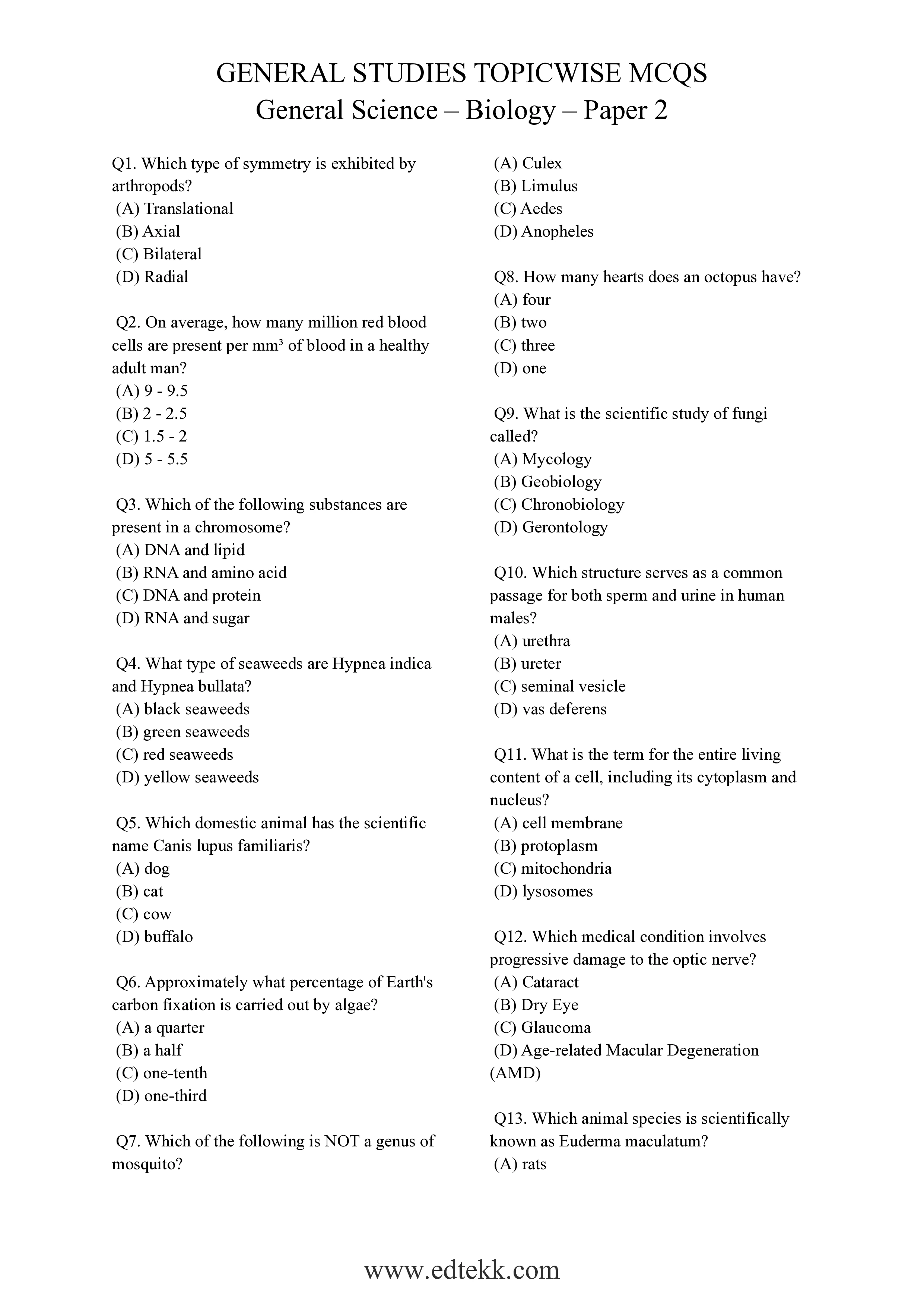
Q1. Which type of symmetry is exhibited by arthropods?
(A) Translational
(B) Axial
(C) Bilateral
(D) Radial
Explanation: Arthropods exhibit bilateral symmetry, meaning their bodies can generally be divided into two approximately mirror-image halves along a single longitudinal plane. This characteristic is observed in insects, arachnids, crustaceans and myriapods. Their bodies also commonly exhibit segmentation and jointed appendages.
Q2. On average, how many million red blood cells are present per mm³ of blood in a healthy adult man?
(A) 9 – 9.5
(B) 2 – 2.5
(C) 1.5 – 2
(D) 5 – 5.5
Explanation: A healthy adult man typically has approximately 4.5–5.5 million red blood cells per mm³ (or microlitre) of blood. The range of 5–5.5 million is an approximate examination value. The actual count varies with age, altitude, hydration, health status and laboratory reference ranges.
Q3. Which of the following substances are present in a chromosome?
(A) DNA and lipid
(B) RNA and amino acid
(C) DNA and protein
(D) RNA and sugar
Explanation: Chromosomes consist primarily of DNA and proteins, particularly histones. DNA stores genetic information, while histone and other associated proteins help package and organise it into a compact structure. Although RNA may also be associated with chromosomes, DNA and proteins are their principal components.
Q4. What type of seaweeds are Hypnea indica and Hypnea bullata?
(A) black seaweeds
(B) green seaweeds
(C) red seaweeds
(D) yellow seaweeds
Explanation: Hypnea indica and Hypnea bullata are species of red seaweeds belonging to the genus Hypnea and the class Rhodophyceae. Members of this genus are marine macroalgae and are commercially important sources of carrageenan, a polysaccharide widely used as a thickening and gelling agent in food and other industries.
Q5. Which domestic animal has the scientific name Canis lupus familiaris?
(A) dog
(B) cat
(C) cow
(D) buffalo
Explanation: The domestic dog is scientifically classified as Canis lupus familiaris, a subspecies of the grey wolf (Canis lupus) under a widely accepted taxonomic classification. It belongs to the family Canidae and the order Carnivora.
Q6. Approximately what percentage of Earth’s carbon fixation is carried out by algae?
(A) a quarter
(B) a half
(C) one-tenth
(D) one-third
Explanation: Algae, particularly microscopic marine phytoplankton, play a major role in global photosynthesis and carbon fixation. They account for approximately half of the Earth’s photosynthetic carbon fixation. By utilising dissolved carbon dioxide during photosynthesis, they contribute significantly to the global carbon cycle.
Q7. Which of the following is NOT a genus of mosquito?
(A) Culex
(B) Limulus
(C) Aedes
(D) Anopheles
Explanation: Limulus, commonly known as the horseshoe crab, belongs to the group Chelicerata and is not a mosquito. Culex, Aedes and Anopheles are mosquito genera, several species of which are vectors of diseases affecting humans.
Q8. How many hearts does an octopus have?
(A) four
(B) two
(C) three
(D) one
Explanation: Octopuses possess three hearts. Two branchial hearts pump blood through the gills for oxygenation, while one systemic heart pumps oxygenated blood to the rest of the body. Their blood contains haemocyanin, a copper-containing respiratory pigment that gives it a bluish colour.
Q9. What is the scientific study of fungi called?
(A) Mycology
(B) Geobiology
(C) Chronobiology
(D) Gerontology
Explanation: Mycology is the branch of biology concerned with the study of fungi, including yeasts, moulds and mushrooms. It deals with their classification, structure, reproduction, physiology and ecological roles. Mycology also examines fungal diseases and the economic importance of fungi in agriculture, medicine and industry.
Q10. Which structure serves as a common passage for both sperm and urine in human males?
(A) urethra
(B) ureter
(C) seminal vesicle
(D) vas deferens
Explanation: The urethra is the common passage through which both urine and semen are discharged from the male body, although they do not normally pass simultaneously. Urine enters the urethra from the urinary bladder, while semen enters it through the ejaculatory ducts during ejaculation.
Q11. What is the term for the entire living content of a cell, including its cytoplasm and nucleus?
(A) cell membrane
(B) protoplasm
(C) mitochondria
(D) lysosomes
Explanation: Protoplasm refers to the living contents of a cell, comprising the cytoplasm and nucleus. It includes the cellular components responsible for essential life processes. The cytoplasm contains organelles suspended in the cytosol, while the nucleus contains most of the cell’s genetic material in eukaryotic organisms.
Q12. Which medical condition involves progressive damage to the optic nerve?
(A) Cataract
(B) Dry Eye
(C) Glaucoma
(D) Age-related Macular Degeneration (AMD)
Explanation: Glaucoma is a group of eye diseases characterised by progressive damage to the optic nerve, often associated with elevated intraocular pressure. However, increased eye pressure is not present in every case. Without appropriate treatment, glaucoma can cause irreversible vision loss, initially affecting peripheral vision and potentially progressing to blindness.
Q13. Which animal species is scientifically known as Euderma maculatum?
(A) rats
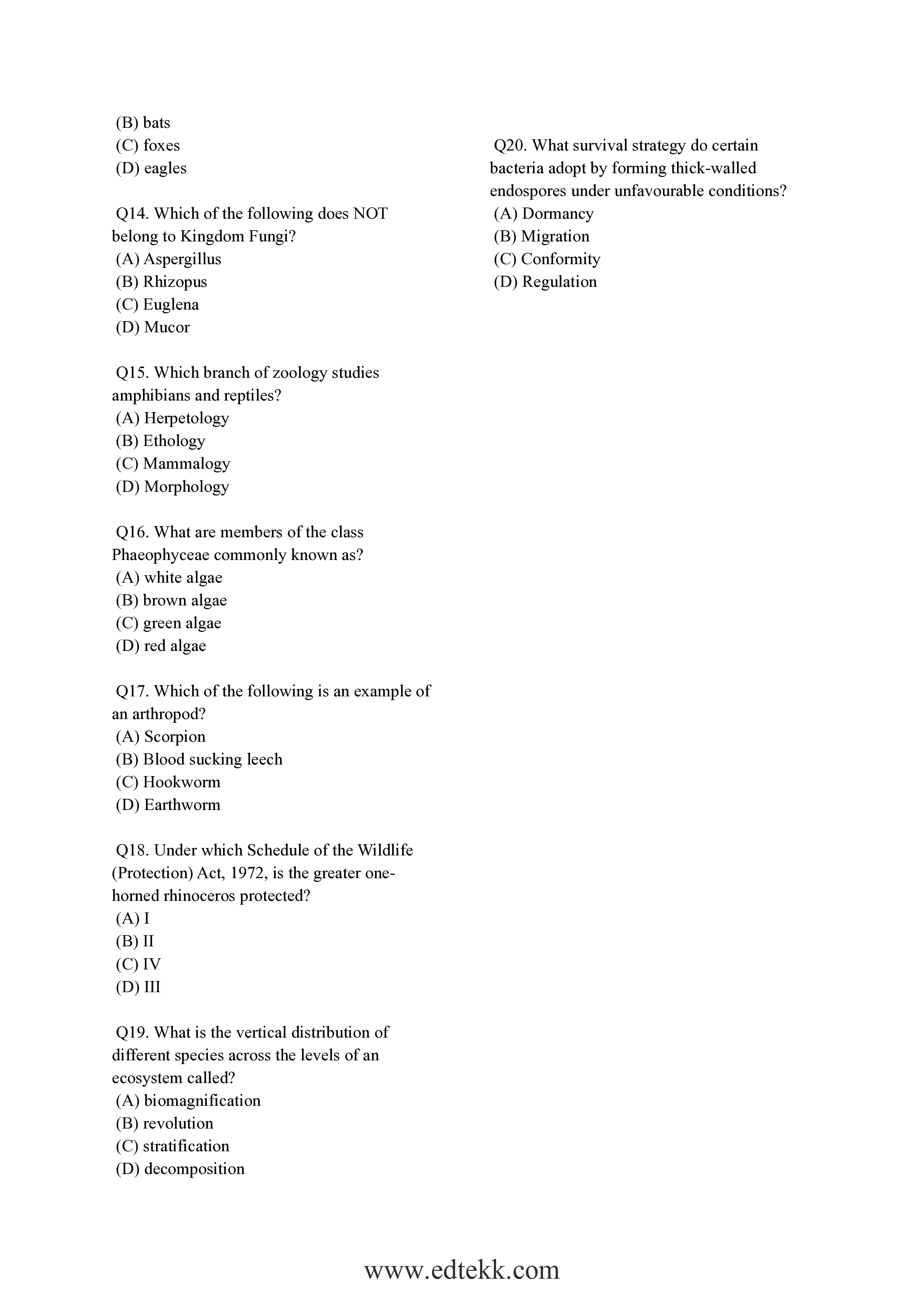
(B) bats
(C) foxes
(D) eagles
Explanation: Euderma maculatum is the scientific name of the spotted bat, a species native to western North America. It is recognised by its distinctive three white spots on its dark-coloured back and exceptionally large ears. It is one of the most distinctive bat species found in North America.
Q14. Which of the following does NOT belong to Kingdom Fungi?
(A) Aspergillus
(B) Rhizopus
(C) Euglena
(D) Mucor
Explanation: Euglena does not belong to Kingdom Fungi. It is a unicellular, flagellated eukaryotic organism traditionally classified under Kingdom Protista. Aspergillus, Rhizopus and Mucor belong to Kingdom Fungi. Euglena possesses chloroplasts in photosynthetic species and can also obtain nutrients heterotrophically.
Q15. Which branch of zoology studies amphibians and reptiles?
(A) Herpetology
(B) Ethology
(C) Mammalogy
(D) Morphology
Explanation: Herpetology is the branch of zoology concerned with the scientific study of amphibians and reptiles. It includes the study of frogs, toads, salamanders, snakes and lizards. Ethology deals with animal behaviour, mammalogy focuses on mammals, and morphology examines the form and structure of organisms.
Q16. What are members of the class Phaeophyceae commonly known as?
(A) white algae
(B) brown algae
(C) green algae
(D) red algae
Explanation: Phaeophyceae is the class of algae commonly known as brown algae. Their characteristic brown colour results primarily from the pigment fucoxanthin, which masks the green colour of chlorophyll. Most members are marine and include genera such as Sargassum, Laminaria and Fucus.
Q17. Which of the following is an example of an arthropod?
(A) Scorpion
(B) Blood sucking leech
(C) Hookworm
(D) Earthworm
Explanation: Scorpions are arthropods belonging to the class Arachnida. They possess jointed appendages, a segmented body and a chitinous exoskeleton. Leeches and earthworms belong to the phylum Annelida, while hookworms are roundworms belonging to the phylum Nematoda.
Q18. Under which Schedule of the Wildlife (Protection) Act, 1972, is the greater one-horned rhinoceros protected?
(A) I
(B) II
(C) IV
(D) III
Explanation: The greater one-horned rhinoceros (Rhinoceros unicornis) is listed under Schedule I of India’s Wildlife (Protection) Act, 1972, as amended. Schedule I provides the highest level of statutory protection to listed wildlife species. Hunting and other prohibited activities involving this species attract stringent legal penalties.
Q19. What is the vertical distribution of different species across the levels of an ecosystem called?
(A) biomagnification
(B) revolution
(C) stratification
(D) decomposition
Explanation: Stratification refers to the vertical distribution of different species or communities at different levels in an ecosystem. For example, forest vegetation may be arranged into distinct layers, including the canopy, understory, shrub layer and forest floor.
Q20. What survival strategy do certain bacteria adopt by forming thick-walled endospores under unfavourable conditions?
(A) Dormancy
(B) Migration
(C) Conformity
(D) Regulation
Explanation: Certain bacteria, including species of Bacillus and Clostridium, survive unfavourable environmental conditions by forming thick-walled endospores. These structures are highly resistant to heat, radiation, drying and chemicals. Endospore formation is a survival mechanism involving a dormant state, not a method of reproduction. The bacteria become active again when favourable conditions return.
Question Paper Images