Strengthen your General Science preparation with Physics Paper 2, featuring a collection of topicwise multiple-choice practice questions. Test your understanding of important Physics concepts with correct answers and explanations. This practice set is relevant for SSC, Railway, State PSC, Police Constable and Police SI examinations.
Test Details
Topic: Physics
Total Questions: 20
Question Format: MCQs – Single Correct Answer
Suitable for: SSC exams, Railway exams, State PSC, Police Constable, Police SI
Download All Papers in This Series (PDF)
Questions and Answers
Q1. What is the SI unit of magnetic flux density?
(A) Cobalt
(B) Tesla
(C) Ohm
(D) Ampere
Explanation: Tesla (T) is the SI unit of magnetic flux density, commonly called the magnetic field in elementary physics. One tesla is equivalent to one weber per square metre (Wb/m²). It is named after the scientist and inventor Nikola Tesla.
Q2. Which of the following is not an SI base unit?
(A) kelvin
(B) candela
(C) tesla
(D) ampere
Explanation: Tesla (T) is a derived SI unit used to measure magnetic flux density, not an SI base unit. The seven SI base units include kelvin for thermodynamic temperature, candela for luminous intensity and ampere for electric current. Therefore, tesla is the correct answer.
Q3. What type of motion does a freely falling body near Earth’s surface exhibit when air resistance is neglected?
(A) Non-uniform acceleration
(B) Uniform acceleration
(C) Zero acceleration
(D) Variable acceleration
Explanation: A freely falling body near Earth’s surface experiences approximately constant gravitational acceleration when air resistance is neglected and the distance travelled is relatively small. This acceleration is approximately 9.8 m/s², directed vertically downward. Hence, its motion is an example of uniformly accelerated motion.
Q4. What is the equivalent resistance of two resistors, R₁ and R₂, connected in series?
(A) R1 – R2
(B) R1 + R2
(C) (R2 + R1)/R1R2
(D) 2R1R2/(R1 + R2)
Explanation: When two resistors are connected in series, their equivalent resistance is the sum of their individual resistances: R = R₁ + R₂. The same current flows through both resistors, while the total potential difference across the combination equals the sum of the potential differences across the individual resistors.
Q5. Which physical quantity is measured in electron-volts?
(A) energy
(B) current
(C) power
(D) potential difference
Explanation: An electron-volt (eV) is a unit of energy. It is defined as the energy gained by an elementary charge when it moves through a potential difference of one volt. One electron-volt is approximately 1.602 × 10⁻¹⁹ joules. It is commonly used in atomic, nuclear and particle physics.
Q6. What type of image does the eye lens form on the retina?
(A) Erect and real
(B) Erect and virtual
(C) Inverted and real
(D) Inverted and virtual
Explanation: The eye lens forms a real, inverted image of an object on the retina. The lens refracts incoming light rays and focuses them onto the light-sensitive retinal surface. Although the retinal image is inverted, the brain processes visual information to enable our perception of the surrounding world in its normal orientation.
Q7. What is the study of the production and propagation of sound waves called?
(A) Optics
(B) Photonics
(C) Acoustics
(D) Astrophysics
Explanation: Acoustics is the branch of physics concerned with the production, transmission, propagation and effects of sound waves. It includes phenomena such as reflection, absorption, resonance and interference of sound. Optics deals with light, while astrophysics studies physical processes in celestial objects.
Q8. What is 68°F equivalent to on the Celsius scale?
(A) 24
(B) 20
(C) 10
(D) 16
Explanation: Fahrenheit temperature is converted into Celsius using the formula (C=(F-32)times5/9). Substituting 68°F gives ((68-32)times5/9=20°C). Therefore, 68 degrees Fahrenheit is equivalent to 20 degrees Celsius.
Q9. On what basis is the current rating of a fuse used in a household electrical circuit determined?
(A) Resistance
(B) Current
(C) Power
(D) Voltage
Explanation: A household electric fuse is rated according to the maximum current it can safely carry. If the current exceeds its rated value for sufficient time, the fuse wire heats up and melts, breaking the circuit. Fuse ratings are expressed in amperes and are selected according to the electrical load and circuit requirements.
Q10. What is the colour of the light emitted by the Sun?
(A) Orange
(B) Yellow
(C) White
(D) Red
Explanation: The Sun emits light across a broad range of visible wavelengths, and their combination is perceived as white. From space, the Sun appears white. From Earth’s surface, atmospheric scattering can make it appear yellow, orange or red, particularly near the horizon. Therefore, white is the most appropriate answer.
Q11. According to Newton’s second law of motion, which quantity is equal to mass multiplied by acceleration?
(A) kinetic energy
(B) torque
(C) force
(D) impulse
Explanation: According to Newton’s second law of motion, the net force acting on a body equals the product of its mass and acceleration. Mathematically, (F = ma), where (F) represents force, (m) represents mass and (a) represents acceleration. The SI unit of force is the newton (N).
Q12. During winter in cold regions, lakes freeze at the surface, leaving the water below at approximately what temperature?
(A) 4°C
(B) 0°F
(C) 4°F
(D) 0°C
Explanation: Water has maximum density at approximately 4°C. During winter, water colder than 4°C becomes less dense and remains near the surface, eventually freezing. Consequently, the deeper water generally remains close to 4°C, allowing aquatic organisms to survive beneath the ice.
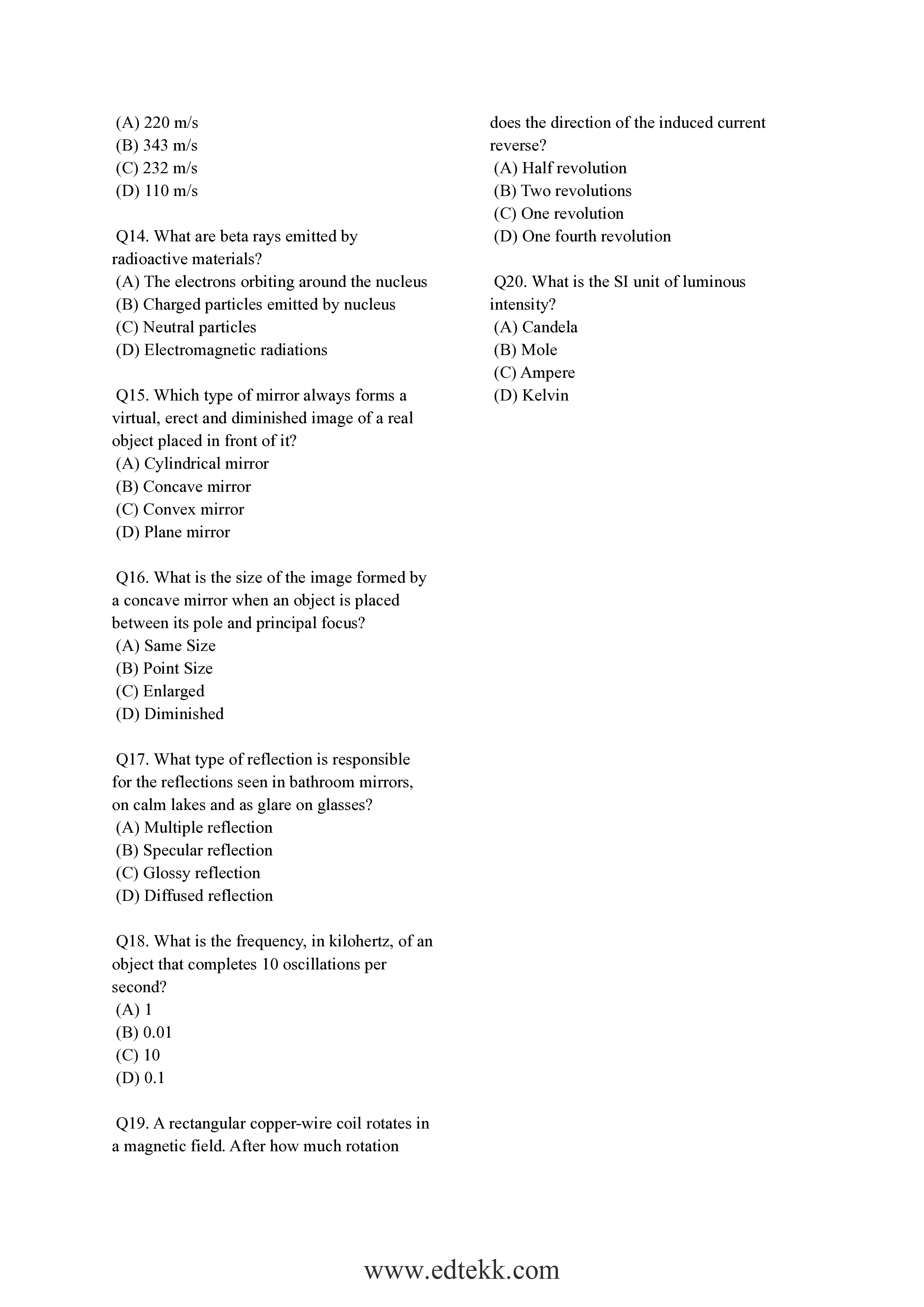
Q13. What is the approximate speed of sound in dry air at 20°C?
(A) 220 m/s
(B) 343 m/s
(C) 232 m/s
(D) 110 m/s
Explanation: The approximate speed of sound in dry air at 20°C under ordinary atmospheric conditions is 343 m/s. Sound travels through air as a longitudinal mechanical wave consisting of successive compressions and rarefactions. Its speed depends primarily on temperature and increases as the temperature of air rises.
Q14. What are beta rays emitted by radioactive materials?
(A) The electrons orbiting around the nucleus
(B) Charged particles emitted by nucleus
(C) Neutral particles
(D) Electromagnetic radiations
Explanation: Beta rays consist of high-speed charged particles emitted during radioactive decay. Beta-minus (β⁻) particles are electrons, while beta-plus (β⁺) particles are positrons. These particles are produced during nuclear transformations and are not ordinary orbital electrons. Unlike gamma rays, beta rays are particulate radiation rather than electromagnetic radiation.
Q15. Which type of mirror always forms a virtual, erect and diminished image of a real object placed in front of it?
(A) Cylindrical mirror
(B) Concave mirror
(C) Convex mirror
(D) Plane mirror
Explanation: A convex mirror always forms a virtual, erect and diminished image of a real object placed in front of it. The image appears behind the mirror, irrespective of the object’s position. Convex mirrors provide a wide field of view and are commonly used as rear-view and side-view mirrors in vehicles.
Q16. What is the size of the image formed by a concave mirror when an object is placed between its pole and principal focus?
(A) Same Size
(B) Point Size
(C) Enlarged
(D) Diminished
Explanation: When an object is placed between the pole and principal focus of a concave mirror, the reflected rays diverge and their extensions meet behind the mirror. The resulting image is virtual, erect and enlarged. This property makes concave mirrors useful in shaving and makeup mirrors.
Q17. What type of reflection is responsible for the reflections seen in bathroom mirrors, on calm lakes and as glare on glasses?
(A) Multiple reflection
(B) Specular reflection
(C) Glossy reflection
(D) Diffused reflection
Explanation: Specular reflection occurs when light reflects from a smooth surface, with parallel incident rays remaining parallel after reflection. Bathroom mirrors and calm lake surfaces can produce clear reflections because their surfaces are relatively smooth. Glasses can also produce specular glare, although anti-reflective coatings reduce this effect.
Q18. What is the frequency, in kilohertz, of an object that completes 10 oscillations per second?
(A) 1
(B) 0.01
(C) 10
(D) 0.1
Explanation: Frequency is the number of oscillations completed per second. An object executing 10 oscillations per second has a frequency of 10 Hz. Since 1 kHz equals 1,000 Hz, its frequency in kilohertz is (10/1000=0.01) kHz.
Q19. A rectangular copper-wire coil rotates in a magnetic field. After how much rotation does the direction of the induced current reverse?
(A) Half revolution
(B) Two revolutions
(C) One revolution
(D) One fourth revolution
Explanation: The direction of induced current in a rotating rectangular coil reverses after every half revolution (180°). This occurs because the direction of motion of the coil’s sides relative to the magnetic field reverses. This principle is used in an alternating-current (AC) generator.
Q20. What is the SI unit of luminous intensity?
(A) Candela
(B) Mole
(C) Ampere
(D) Kelvin
Explanation: The candela (cd) is the SI base unit of luminous intensity, which measures the intensity of light emitted in a particular direction. The mole measures the amount of substance, the ampere measures electric current, and the kelvin measures thermodynamic temperature.
Question Paper Images