Enhance your Chemistry preparation with General Science Chemistry Paper 2. This topicwise MCQ practice set helps candidates revise important Chemistry concepts through objective questions, correct answers and detailed explanations. It supports preparation for SSC, Railway, State PSC, Police Constable and Police SI competitive examinations.
Test Details
Topic: Chemistry
Total Questions: 20
Question Format: MCQs – Single Correct Answer
Suitable for: SSC exams, Railway exams, State PSC, Police Constable, Police SI
Download All Papers in This Series (PDF)
Questions and Answers
Q1. Which of the following elements belongs to the actinide series?
(A) Curium
(B) Ytterbium
(C) Lutetium
(D) Erbium
Explanation: Curium (Cm), with atomic number 96, is an actinide element. The actinide series generally extends from actinium (atomic number 89) to lawrencium (atomic number 103). These elements are associated with the filling of the 5f subshell. Curium is a radioactive synthetic element named after Marie and Pierre Curie.
Q2. Which type of acid is initially formed when the enzyme alliinase acts on amino acid sulfoxides in onions?
(A) Sulfenic acid
(B) Citric acid
(C) Nitric acid
(D) Sulphuric acid
Explanation: Sulfenic acid is initially formed when alliinase acts on S-alk(en)yl cysteine sulfoxides in onion tissues. These unstable intermediates undergo further reactions. In onions, the lachrymatory factor synthase converts 1-propenesulfenic acid into syn-propanethial-S-oxide, which causes eye irritation and tears.
Q3. How many oxygen atoms are present in an acetone molecule?
(A) 3
(B) 4
(C) 1
(D) 2
Explanation: Acetone has the molecular formula C₃H₆O and is commonly written as CH₃COCH₃. Its structure contains a carbonyl group (C=O), which contributes exactly one oxygen atom to each molecule. Acetone is the simplest ketone and is widely used as an industrial solvent and cleaning agent.
Q4. Which of the following substances has a strong fruity fragrance?
(A) Methyl chloride
(B) Methanoic acid
(C) Ethyl acetate
(D) Methanol
Explanation: Ethyl acetate is an ester with a characteristic pleasant, fruity odour. Esters are commonly responsible for the fruity fragrances of many fruits and are widely used in perfumes, artificial flavourings and as organic solvents in paints, adhesives and nail polish removers.
Q5. What are the elements belonging to Group 18 of the periodic table commonly called?
(A) Reactive Gases
(B) Volatile Gases
(C) Radioactive Gases
(D) Noble Gases
Explanation: Group 18 elements of the periodic table are commonly known as noble gases. They include helium, neon, argon, krypton, xenon, radon and oganesson. They generally possess completely filled outermost electron shells, making them relatively unreactive. However, some heavier noble gases can form compounds under specific conditions.
Q6. Which chemical law explains why soft drinks and soda bottles are sealed under high pressure to increase the solubility of carbon dioxide?
(A) Henry’s law
(B) Raoult’s law
(C) Ohm’s law
(D) Dalton’s law
Explanation: Henry’s law states that, at constant temperature, the amount of a gas dissolved in a liquid is directly proportional to the partial pressure of that gas above the liquid. Soft drinks are bottled under high carbon dioxide pressure to increase the quantity of CO₂ dissolved in the beverage.
Q7. Which of the following is the chemical formula of barium peroxide?
(A) BaO2
(B) Ba2O2
(C) BaSO4
(D) BaO
Explanation: Barium peroxide has the chemical formula BaO₂. It consists of barium ions (Ba²⁺) and peroxide ions (O₂²⁻). Barium oxide has the formula BaO, while barium sulphate is represented by BaSO₄.
Q8. Which gas can cause explosions in coal mines?
(A) Butane
(B) Carbon dioxide
(C) Nitrogen
(D) Methane
Explanation: Methane is the principal combustible component of firedamp, a gas mixture found in coal mines. When methane mixes with air in concentrations of approximately 5–15% by volume, it forms an explosive mixture. A spark or flame can ignite this mixture, causing dangerous explosions.
Q9. Which gas is dissolved in carbonated beverages?
(A) CH4
(B) N2
(C) O2
(D) CO2
Explanation: Carbonated beverages contain dissolved carbon dioxide (CO₂), which is introduced under pressure. A small amount reacts with water to form carbonic acid. When the pressure is released, carbon dioxide escapes as bubbles, producing the characteristic fizz.
Q10. Which of the following is not an ore of iron?
(A) Haematite
(B) Cuprite
(C) Magnetite
(D) Siderite
Explanation: Cuprite (Cu₂O) is an ore of copper, not iron. It is also known as red copper ore. Haematite (Fe₂O₃), magnetite (Fe₃O₄) and siderite (FeCO₃) are important ores of iron and are used in its extraction.
Q11. What is the general formula of alkenes?
(A) C(n)H(2n-1)
(B) C(n)H(2n-2)
(C) C(n)H(2n)
(D) C(n)H(2n+2)
Explanation: The general formula of acyclic alkenes containing one carbon-carbon double bond is CₙH₂ₙ, where n represents the number of carbon atoms. This formula applies to open-chain monoalkenes and does not apply to cyclic compounds or compounds containing multiple double bonds.
Q12. Which of the following metals has the lowest melting point?
(A) Lead
(B) Zinc
(C) Silver
(D) Tin
Explanation: Tin has the lowest melting point among the listed metals, approximately 231.9°C. The melting points of lead, zinc and silver are approximately 327.5°C, 419.5°C and 961.8°C, respectively. Its relatively low melting point makes tin useful in soldering, protective coatings and alloy manufacturing.
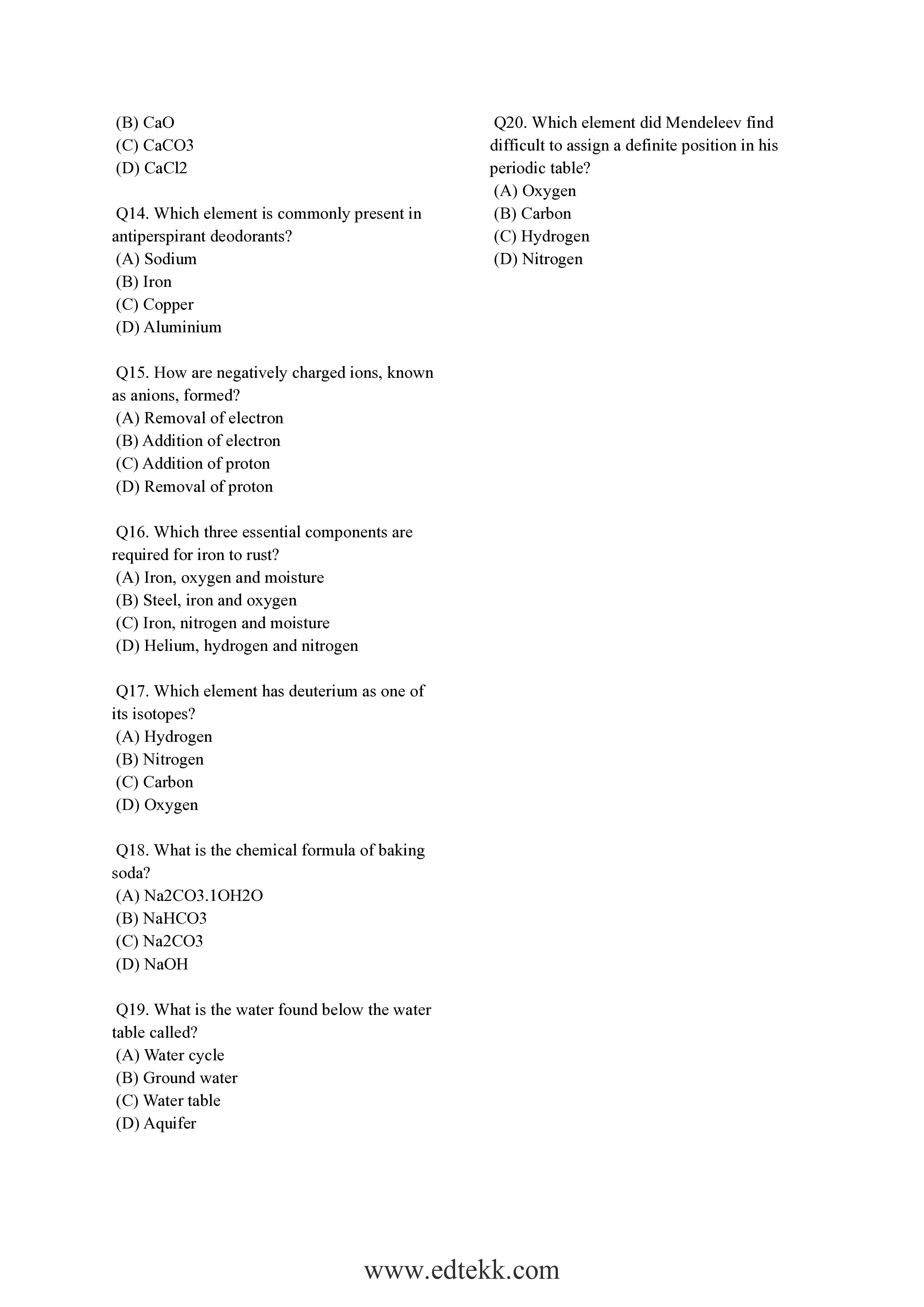
Q13. Which of the following compounds is known as slaked lime?
(A) Ca(OH)2
(B) CaO
(C) CaCO3
(D) CaCl2
Explanation: Slaked lime is calcium hydroxide, Ca(OH)₂. It is produced by adding water to quicklime (calcium oxide, CaO), a process known as slaking. It is widely used in construction, water treatment and soil conditioning.
Q14. Which element is commonly present in antiperspirant deodorants?
(A) Sodium
(B) Iron
(C) Copper
(D) Aluminium
Explanation: Aluminium is commonly used in antiperspirants in the form of salts such as aluminium chlorohydrate. These compounds temporarily obstruct sweat ducts near the skin’s surface, reducing perspiration. Ordinary deodorants primarily control or mask unpleasant body odour rather than directly reducing sweat production.
Q15. How are negatively charged ions, known as anions, formed?
(A) Removal of electron
(B) Addition of electron
(C) Addition of proton
(D) Removal of proton
Explanation: Anions are negatively charged ions commonly formed when neutral atoms gain one or more electrons. The additional electrons produce a net negative charge. For example, chlorine gains an electron to form chloride: Cl + e⁻ → Cl⁻. Conversely, the loss of electrons generally produces positively charged cations.
Q16. Which three essential components are required for iron to rust?
(A) Iron, oxygen and moisture
(B) Steel, iron and oxygen
(C) Iron, nitrogen and moisture
(D) Helium, hydrogen and nitrogen
Explanation: Rusting of iron requires three essential components: iron, oxygen and moisture. In the presence of water and oxygen, iron undergoes corrosion and forms hydrated iron(III) oxide, commonly known as rust. Preventing contact with moisture or oxygen can significantly slow down or prevent rust formation.
Q17. Which element has deuterium as one of its isotopes?
(A) Hydrogen
(B) Nitrogen
(C) Carbon
(D) Oxygen
Explanation: Deuterium is a stable isotope of hydrogen containing one proton and one neutron in its nucleus. Ordinary hydrogen, also called protium, contains one proton and no neutron. Another isotope, tritium, contains one proton and two neutrons and is radioactive.
Q18. What is the chemical formula of baking soda?
(A) Na2CO3.1OH2O
(B) NaHCO3
(C) Na2CO3
(D) NaOH
Explanation: Baking soda is sodium hydrogen carbonate, also known as sodium bicarbonate, with the chemical formula NaHCO₃. It acts as a leavening agent in baking by releasing carbon dioxide when it reacts with acids or decomposes on heating.
Q19. What is the water found below the water table called?
(A) Water cycle
(B) Ground water
(C) Water table
(D) Aquifer
Explanation: Groundwater is the water present beneath the Earth’s surface in the saturated zone, below the water table. It occupies pores, cracks and spaces in soil and rocks. An aquifer is a geological formation capable of storing and transmitting groundwater; it is not another name for groundwater itself.
Q20. Which element did Mendeleev find difficult to assign a definite position in his periodic table?
(A) Oxygen
(B) Carbon
(C) Hydrogen
(D) Nitrogen
Explanation: Hydrogen was difficult for Dmitri Mendeleev to assign a definite position in his periodic table because it exhibits similarities with both alkali metals and halogens. Like alkali metals, it has one electron in its outermost shell, but it can also gain an electron to form a negative ion, resembling halogens.
Question Paper Images