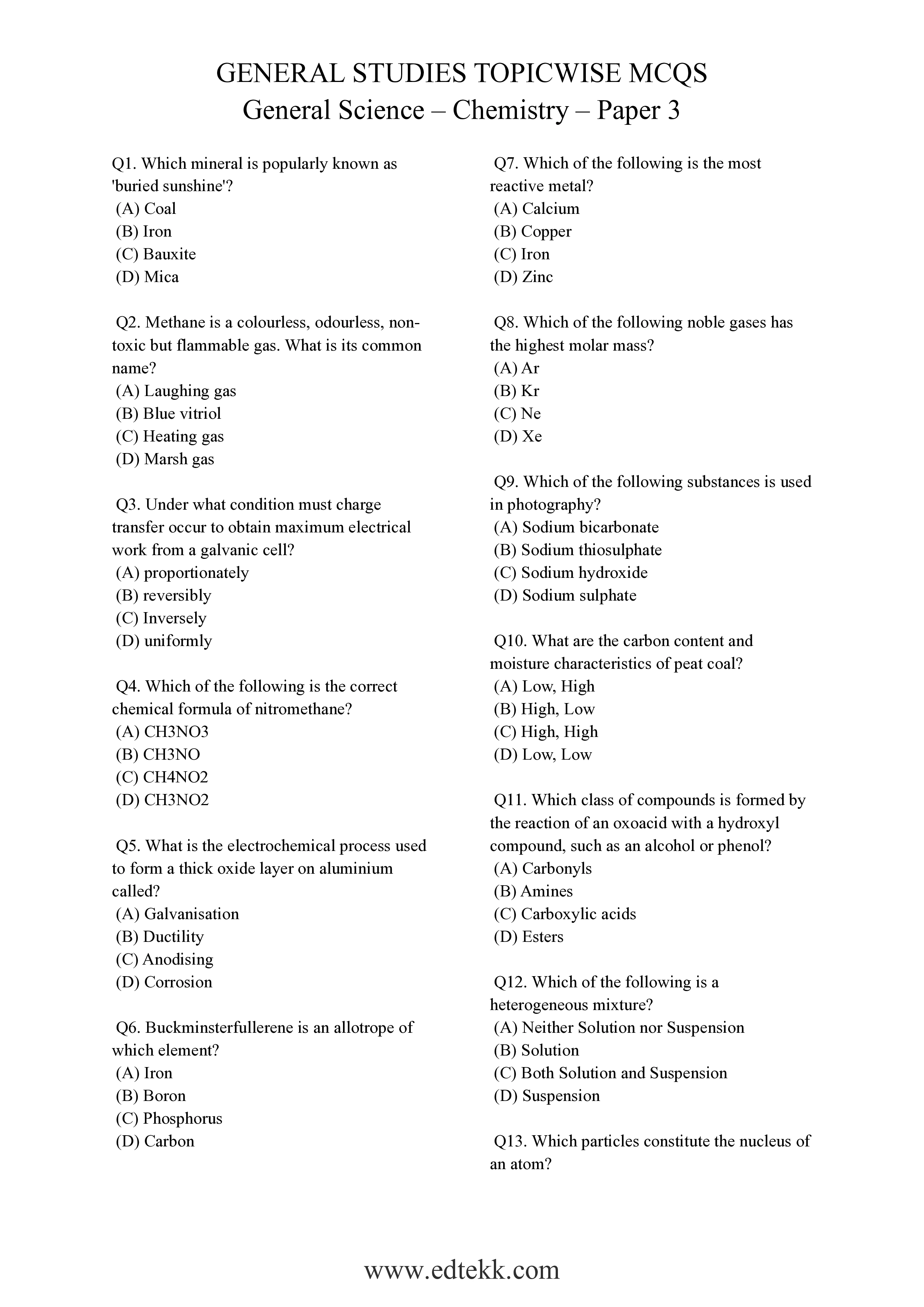
Strengthen your General Science preparation with Chemistry Paper 3, featuring topicwise multiple-choice questions on important Chemistry concepts. This practice set includes correct answers and explanations to support effective revision and self-assessment. It is suitable for SSC, Railway, State PSC, Police Constable and Police SI aspirants.
Test Details
Topic: Chemistry
Total Questions: 20
Question Format: MCQs – Single Correct Answer
Suitable for: SSC exams, Railway exams, State PSC, Police Constable, Police SI
Download All Papers in This Series (PDF)
Questions and Answers
Q1. Which mineral is popularly known as ‘buried sunshine’?
(A) Coal
(B) Iron
(C) Bauxite
(D) Mica
Explanation: Coal is popularly known as buried sunshine because it originated from ancient plant matter that captured solar energy through photosynthesis. Over millions of years, heat and pressure transformed this buried organic material into coal, preserving energy originally derived from sunlight.
Q2. Methane is a colourless, odourless, non-toxic but flammable gas. What is its common name?
(A) Laughing gas
(B) Blue vitriol
(C) Heating gas
(D) Marsh gas
Explanation: Methane (CH₄) is commonly known as marsh gas because it is naturally produced in marshes, swamps and other oxygen-deficient environments through the anaerobic decomposition of organic matter by microorganisms. It is colourless, odourless in its pure form and highly flammable.
Q3. Under what condition must charge transfer occur to obtain maximum electrical work from a galvanic cell?
(A) proportionately
(B) reversibly
(C) Inversely
(D) uniformly
Explanation: A galvanic cell delivers maximum useful electrical work when the charge is transferred reversibly. Reversible operation involves an infinitesimally small potential difference between the cell and the external circuit, minimising irreversible energy losses. Thus, reversible charge transfer is necessary to obtain maximum electrical work.
Q4. Which of the following is the correct chemical formula of nitromethane?
(A) CH3NO3
(B) CH3NO
(C) CH4NO2
(D) CH3NO2
Explanation: Nitromethane has the molecular formula CH₃NO₂. It consists of a methyl group (CH₃) attached to a nitro group (NO₂). It is the simplest organic nitro compound and is used as an industrial solvent and in specialised fuel applications.
Q5. What is the electrochemical process used to form a thick oxide layer on aluminium called?
(A) Galvanisation
(B) Ductility
(C) Anodising
(D) Corrosion
Explanation: Anodising is an electrochemical process used to form a thick, protective aluminium oxide layer on the surface of aluminium. It improves corrosion resistance, increases surface hardness and provides a suitable surface for colouring.
Q6. Buckminsterfullerene is an allotrope of which element?
(A) Iron
(B) Boron
(C) Phosphorus
(D) Carbon
Explanation: Buckminsterfullerene (C₆₀) is an allotrope of carbon belonging to the fullerene family. It consists of 60 carbon atoms arranged in a hollow spherical structure resembling a football, with 12 pentagonal and 20 hexagonal rings.
Q7. Which of the following is the most reactive metal?
(A) Calcium
(B) Copper
(C) Iron
(D) Zinc
Explanation: Calcium is the most reactive metal among the given options. It belongs to Group 2 of the periodic table and readily loses two electrons to form Ca²⁺ ions. In the metal reactivity series, calcium is more reactive than zinc, iron and copper.
Q8. Which of the following noble gases has the highest molar mass?
(A) Ar
(B) Kr
(C) Ne
(D) Xe
Explanation: Xenon (Xe) has the highest molar mass among the four given noble gases, with a standard atomic mass of approximately 131.29 u. Krypton has an atomic mass of approximately 83.80 u, argon 39.95 u and neon 20.18 u.
Q9. Which of the following substances is used in photography?
(A) Sodium bicarbonate
(B) Sodium thiosulphate
(C) Sodium hydroxide
(D) Sodium sulphate
Explanation: Sodium thiosulphate (Na₂S₂O₃) is widely used in traditional photographic processing as a fixing agent. It dissolves unreacted silver halides from photographic film and paper, making the developed image relatively permanent and insensitive to further exposure to light.
Q10. What are the carbon content and moisture characteristics of peat coal?
(A) Low, High
(B) High, Low
(C) High, High
(D) Low, Low
Explanation: Peat is the earliest stage of coal formation and contains a relatively low percentage of carbon compared with more mature coal varieties. It has a high moisture content and relatively low calorific value. With increasing burial, pressure and temperature, peat gradually transforms into lignite and higher grades of coal.
Q11. Which class of compounds is formed by the reaction of an oxoacid with a hydroxyl compound, such as an alcohol or phenol?
(A) Carbonyls
(B) Amines
(C) Carboxylic acids
(D) Esters
Explanation: Esters are formed through esterification, a reaction between an oxoacid, commonly a carboxylic acid, and a hydroxyl-containing compound such as an alcohol or phenol. The reaction generally involves the elimination of water. Esters commonly have fruity odours and are widely used in perfumes, flavourings and solvents.
Q12. Which of the following is a heterogeneous mixture?
(A) Neither Solution nor Suspension
(B) Solution
(C) Both Solution and Suspension
(D) Suspension
Explanation: A suspension is a heterogeneous mixture in which relatively large particles are dispersed throughout a medium without dissolving. These particles may settle on standing and can generally be separated by filtration. In contrast, a true solution is a homogeneous mixture in which the solute is uniformly distributed at the molecular or ionic level.
Q13. Which particles constitute the nucleus of an atom?
(A) Both protons and neutrons
(B) Only electrons
(C) Only protons
(D) Both protons and electrons
Explanation: The nucleus of most atoms contains positively charged protons and electrically neutral neutrons, collectively called nucleons. Electrons occupy regions outside the nucleus. An important exception is ordinary hydrogen (protium or hydrogen-1), whose nucleus contains only one proton and no neutrons.
Q14. Which chemical compound is the main constituent of limestone, chalk and marble?
(A) Calcium phosphate
(B) Calcium hydroxide
(C) Calcium carbonate
(D) Calcium oxide
Explanation: Limestone, chalk and marble are rocks composed predominantly of calcium carbonate (CaCO₃). They differ in geological origin, texture and crystallinity. Limestone and chalk are sedimentary rocks, whereas marble is formed through the metamorphism of carbonate rocks.
Q15. Which of the following is the primary constituent of pearls?
(A) Calcium sulphate
(B) Calcium carbonate
(C) Sodium bicarbonate
(D) Magnesium peroxide
Explanation: Pearls consist predominantly of calcium carbonate (CaCO₃), mainly in the crystalline form of aragonite, along with small amounts of calcite. These mineral components are embedded in an organic protein matrix called conchiolin, making calcium carbonate their principal inorganic constituent.
Q16. What is the physical process of converting a liquid into a gas called?
(A) Precipitation
(B) Vaporisation
(C) Decantation
(D) Condensation
Explanation: Vaporisation is the physical process in which a liquid changes into a gaseous state. It occurs through evaporation or boiling. Evaporation takes place at the liquid’s surface and can occur below its boiling point, whereas boiling occurs throughout the liquid when its vapour pressure equals the external pressure.
Q17. Which of the following substances is not a form of calcium carbonate?
(A) Limestone
(B) Chalk
(C) Limewater
(D) Marble
Explanation: Limewater is a dilute aqueous solution of calcium hydroxide, Ca(OH)₂, and is not a form of calcium carbonate. Limestone, chalk and marble are naturally occurring rocks composed predominantly of calcium carbonate (CaCO₃).
Q18. Which of the following substances has a sweet smell?
(A) Ethanol
(B) Ammonia
(C) Methanol
(D) Esters
Explanation: Esters are generally characterised by pleasant, sweet or fruity odours. They are widely used in perfumes, food flavourings and fragrance products. Many naturally occurring fruit aromas are associated with esters and their characteristic volatile compounds.
Q19. What is heavy water primarily used for?
(A) In fire extinguisher
(B) In washing cloth
(C) In both Nuclear reactors and Fire extinguisher
(D) In nuclear reactors
Explanation: Heavy water (D₂O) is primarily used as a neutron moderator in nuclear reactors. It slows down fast neutrons without absorbing many of them, thereby helping sustain the nuclear fission chain reaction. It is also used as a coolant in certain types of nuclear reactors.
Q20. Titanium dioxide, used as a white pigment in products such as toothpaste, is derived from which mineral?
(A) Fluorite
(B) Ilmenite
(C) Silica
(D) Mica
Explanation: Ilmenite (FeTiO₃) is an important naturally occurring mineral source of titanium dioxide (TiO₂). Titanium dioxide is widely used as a white pigment because of its high refractive index, brightness and opacity. It is used in paints, plastics, paper, cosmetics and certain toothpaste formulations.
Question Paper Images