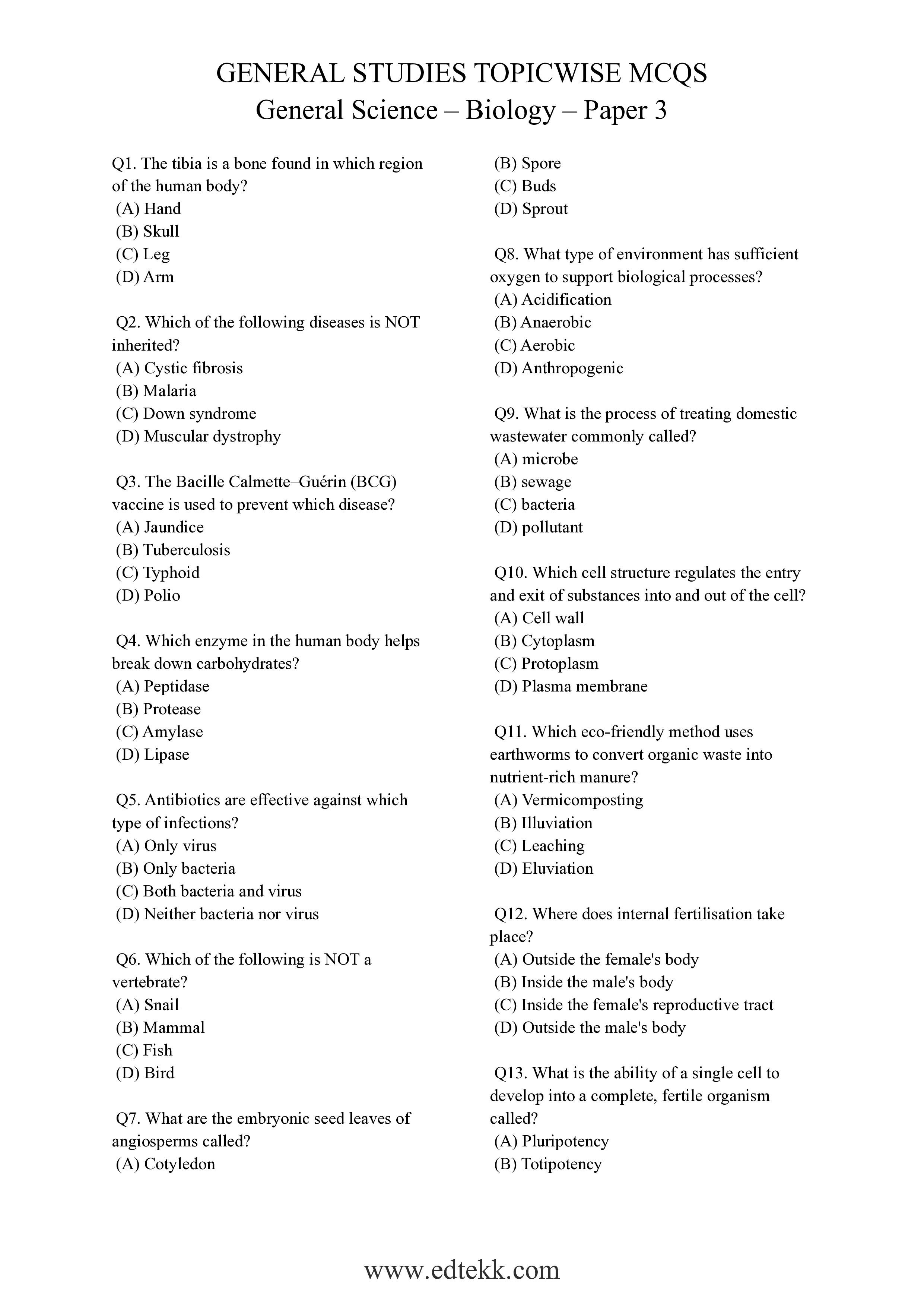
Prepare effectively for competitive examinations with General Science Biology Paper 3. This topicwise practice set features important Biology multiple-choice questions with correct answers and explanations to strengthen conceptual understanding and revision. It is relevant for SSC, Railway, State PSC, Police Constable and Police SI examinations.
Test Details
Topic: Biology
Total Questions: 20
Question Format: MCQs – Single Correct Answer
Suitable for: SSC exams, Railway exams, State PSC, Police Constable, Police SI
Download All Papers in This Series (PDF)
Questions and Answers
Q1. The tibia is a bone found in which region of the human body?
(A) Hand
(B) Skull
(C) Leg
(D) Arm
Explanation: The tibia, commonly known as the shinbone, is the larger weight-bearing bone of the lower leg. It extends from the knee to the ankle and lies alongside the smaller fibula. It forms part of both the knee and ankle joints.
Q2. Which of the following diseases is NOT inherited?
(A) Cystic fibrosis
(B) Malaria
(C) Down syndrome
(D) Muscular dystrophy
Explanation: Malaria is an infectious disease caused by Plasmodium parasites and transmitted primarily through the bites of infected female Anopheles mosquitoes. It is acquired through infection rather than inherited genetically. Cystic fibrosis and muscular dystrophy are inherited genetic disorders, while Down syndrome usually results from a chromosomal abnormality.
Q3. The Bacille Calmette–Guérin (BCG) vaccine is used to prevent which disease?
(A) Jaundice
(B) Tuberculosis
(C) Typhoid
(D) Polio
Explanation: The Bacille Calmette–Guérin (BCG) vaccine is used to protect against tuberculosis (TB), an infectious disease caused by bacteria belonging to the Mycobacterium tuberculosis complex. It is particularly effective in protecting children against severe forms of tuberculosis, including tuberculous meningitis and disseminated TB. Its effectiveness against pulmonary tuberculosis varies across populations.
Q4. Which enzyme in the human body helps break down carbohydrates?
(A) Peptidase
(B) Protease
(C) Amylase
(D) Lipase
Explanation: Amylase is an enzyme that breaks down starch into smaller carbohydrates, including maltose and oligosaccharides. It is produced primarily by the salivary glands and pancreas. Peptidases and proteases digest proteins, whereas lipase breaks down fats. Thus, amylase is the correct answer for carbohydrate digestion.
Q5. Antibiotics are effective against which type of infections?
(A) Only virus
(B) Only bacteria
(C) Both bacteria and virus
(D) Neither bacteria nor virus
Explanation: Antibiotics are used to treat bacterial infections by interfering with processes such as bacterial cell-wall synthesis or protein production. They do not directly treat viral infections because viruses have different structures and replication mechanisms. Antibiotics should be used only when medically indicated.
Q6. Which of the following is NOT a vertebrate?
(A) Snail
(B) Mammal
(C) Fish
(D) Bird
Explanation: A snail is an invertebrate because it lacks a vertebral column or backbone. It belongs to the phylum Mollusca and possesses a soft body, usually protected by a shell. Mammals, fish and birds are vertebrates because they possess a backbone and an internal skeletal framework.
Q7. What are the embryonic seed leaves of angiosperms called?
(A) Cotyledon
(B) Spore
(C) Buds
(D) Sprout
Explanation: Cotyledons are embryonic seed leaves present in angiosperm embryos. Monocotyledonous plants possess one cotyledon, whereas dicotyledonous plants generally possess two. Cotyledons may store food or absorb and transfer nutrients from stored food reserves to the developing embryo.
Q8. What type of environment has sufficient oxygen to support biological processes?
(A) Acidification
(B) Anaerobic
(C) Aerobic
(D) Anthropogenic
Explanation: An aerobic environment is one in which oxygen is readily available. Aerobic organisms and processes require oxygen for their functioning, whereas anaerobic conditions refer to environments where oxygen is absent or present in insufficient quantities for aerobic processes.
Q9. What is the process of treating domestic wastewater commonly called?
(A) microbe
(B) sewage
(C) bacteria
(D) pollutant
Explanation: Domestic wastewater is commonly referred to as sewage, and its treatment is called sewage treatment. It involves physical, biological and sometimes chemical processes to remove suspended solids, organic matter, harmful microorganisms and other pollutants before the treated water is discharged or reused.
Q10. Which cell structure regulates the entry and exit of substances into and out of the cell?
(A) Cell wall
(B) Cytoplasm
(C) Protoplasm
(D) Plasma membrane
Explanation: The plasma membrane, also called the cell membrane, is selectively permeable. It regulates the movement of substances into and out of the cell, allowing certain materials to pass while restricting others. This selective permeability helps maintain the internal environment necessary for cellular activities.
Q11. Which eco-friendly method uses earthworms to convert organic waste into nutrient-rich manure?
(A) Vermicomposting
(B) Illuviation
(C) Leaching
(D) Eluviation
Explanation: Vermicomposting is an environmentally friendly method of converting organic waste into nutrient-rich manure using earthworms and microorganisms. It can process biodegradable household, agricultural and garden waste. The resulting vermicompost improves soil structure, fertility and water-retention capacity.
Q12. Where does internal fertilisation take place?
(A) Outside the female’s body
(B) Inside the male’s body
(C) Inside the female’s reproductive tract
(D) Outside the male’s body
Explanation: Internal fertilisation occurs when male and female gametes fuse within the female reproductive tract. It occurs in humans and many other animals, including birds, reptiles and mammals. In humans, fertilisation normally takes place in the fallopian tube, usually in its ampullary region. In external fertilisation, gamete fusion occurs outside the female’s body.
Q13. What is the ability of a single cell to develop into a complete, fertile organism called?
(A) Pluripotency
(B) Totipotency
(C) Cloning
(D) Mutation
Explanation: Totipotency is the ability of a single cell to develop into a complete organism under suitable conditions. A totipotent cell can give rise to all cell types, including embryonic and extraembryonic tissues. The zygote is a classic example of a totipotent cell.
Q14. What is the primary function of insulin in the human body?
(A) decreases blood sugar
(B) constricts blood vessels
(C) stimulates lactation
(D) Increases blood sugar
Explanation: Insulin is a hormone secreted by the beta cells of the pancreas. It decreases blood glucose levels by promoting glucose uptake in insulin-sensitive tissues and stimulating glycogen synthesis, particularly in the liver and skeletal muscles. Insufficient insulin production or impaired insulin action can lead to diabetes mellitus.
Q15. Which of the following plants has leaves modified into spines as an adaptation?
(A) Rose
(B) Mimosa
(C) Opuntia
(D) Hibiscus
Explanation: Opuntia, commonly known as prickly pear cactus, is a xerophytic plant adapted to dry environments. Its leaves are modified into spines, reducing water loss through transpiration and providing protection against herbivores. Its flattened, green stems perform photosynthesis and store water.
Q16. Why is human blood red in colour?
(A) Because of myoglobin
(B) Because of immunoglobulin
(C) Because of haemoglobin
(D) Because of haptoglobin
Explanation: Haemoglobin is an iron-containing protein present in red blood cells that gives human blood its characteristic red colour. Its colour varies with oxygenation: oxygenated blood is bright red, whereas deoxygenated blood is darker red. Myoglobin, in contrast, is primarily an oxygen-binding protein found in muscle tissue.
Q17. How is methane classified based on its contribution to global warming?
(A) poisonous
(B) carcinogenic
(C) greenhouse
(D) infectious
Explanation: Methane is classified as a greenhouse gas because it absorbs and re-emits infrared radiation, contributing to heat retention in the atmosphere. This process enhances the greenhouse effect and contributes to global warming. Other important greenhouse gases include carbon dioxide, nitrous oxide and water vapour.
Q18. Which animal phylum includes bilaterally symmetrical, segmented animals with an open circulatory system?
(A) Porifera
(B) Chordata
(C) Protozoa
(D) Arthropoda
Explanation: Arthropoda includes bilaterally symmetrical, segmented, triploblastic and coelomate animals with an open circulatory system. Their true coelom is reduced, and the main body cavity is a haemocoel containing haemolymph. Arthropods possess jointed appendages and a chitinous exoskeleton. Examples include insects, spiders and crabs.
Q19. Deficiency of which vitamin is the principal nutritional cause of rickets?
(A) Vitamin A
(B) Vitamin C
(C) Vitamin D
(D) Vitamin B
Explanation: Vitamin D deficiency is the principal nutritional cause of rickets, a disease affecting bone mineralisation in children. Inadequate vitamin D reduces the absorption of calcium and phosphate, resulting in weak, soft bones that may become deformed. Insufficient calcium or phosphate can also cause rickets, but vitamin D is the correct answer among the given options.
Q20. Which of the following gases is used for the artificial ripening of fruits?
(A) Acetylene
(B) Argon
(C) Freon
(D) Helium
Explanation: Acetylene can induce fruit ripening because it produces effects similar to ethylene, the natural plant-ripening hormone. It may be released through the reaction of calcium carbide with moisture. However, calcium carbide is prohibited for artificial fruit ripening in India because of associated health risks. Ethylene gas is the approved alternative when used under prescribed conditions.
Question Paper Images