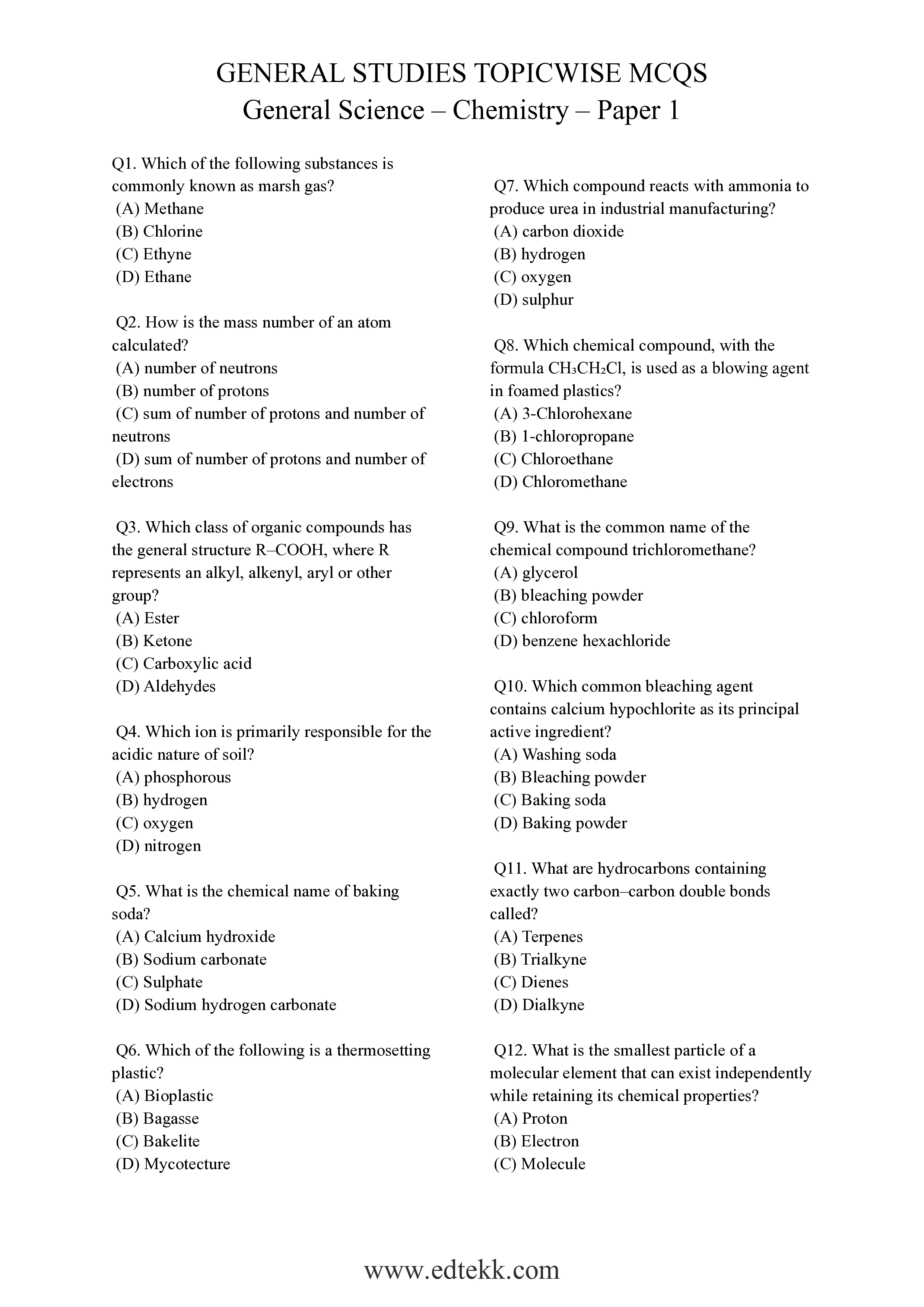
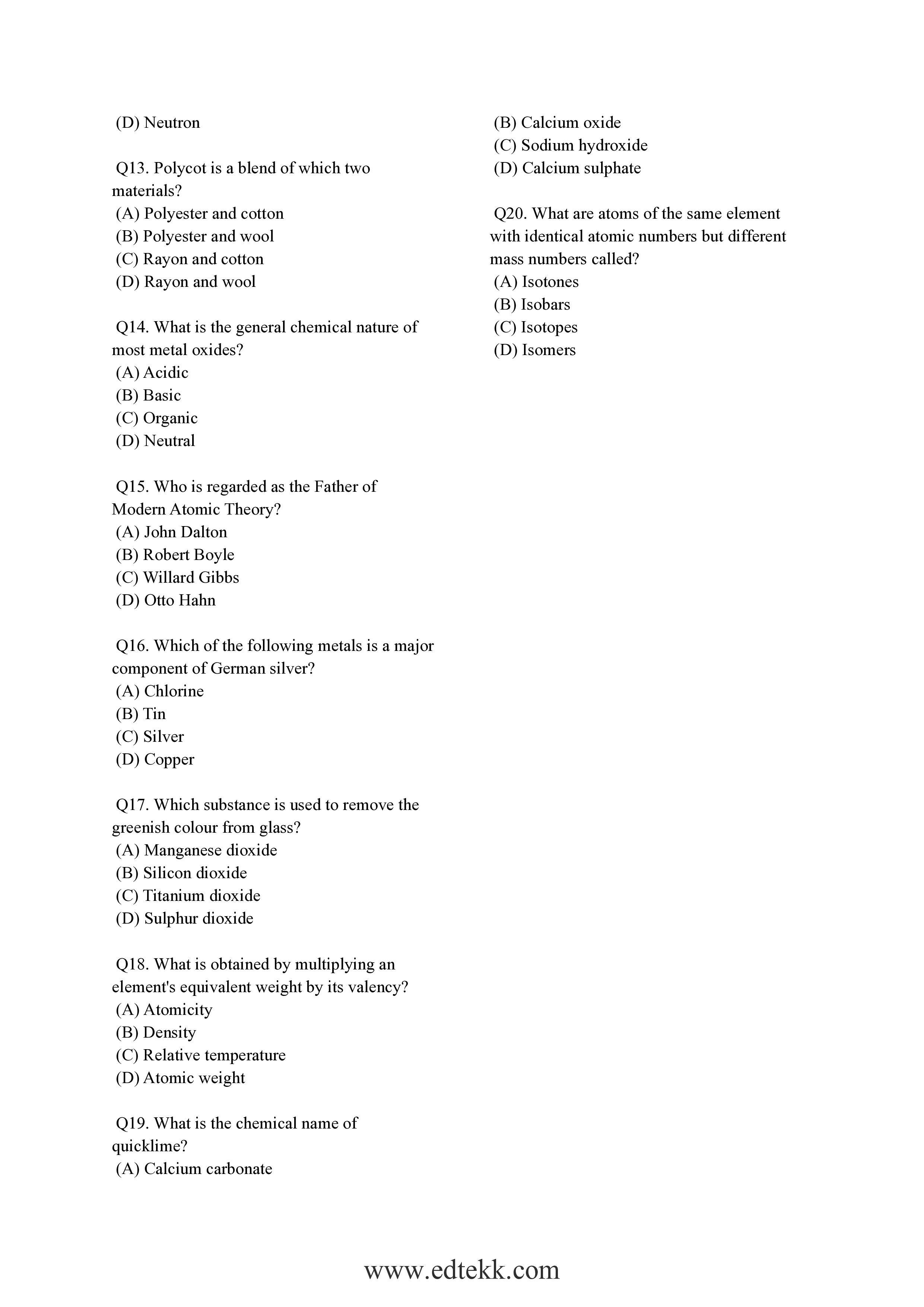
Prepare Chemistry for competitive examinations with this General Science topicwise MCQ practice set. Chemistry Paper 1 covers important subject concepts through multiple-choice questions, supported by correct answers and explanations. It is useful for candidates preparing for SSC, Railway, State PSC, Police Constable and Police SI examinations.
Test Details
Topic: Chemistry
Total Questions: 20
Question Format: MCQs – Single Correct Answer
Suitable for: SSC exams, Railway exams, State PSC, Police Constable, Police SI
Download All Papers in This Series (PDF)
Questions and Answers
Q1. Which of the following substances is commonly known as marsh gas?
(A) Methane
(B) Chlorine
(C) Ethyne
(D) Ethane
Explanation: Methane (CH₄) is commonly known as marsh gas because it is produced during the anaerobic decomposition of organic matter in waterlogged environments such as marshes and swamps. It is the simplest alkane and the principal component of natural gas. Methane is also a potent greenhouse gas.
Q2. How is the mass number of an atom calculated?
(A) number of neutrons
(B) number of protons
(C) sum of number of protons and number of neutrons
(D) sum of number of protons and number of electrons
Explanation: The mass number (A) of an atom equals the total number of protons (Z) and neutrons (N) in its nucleus: A = Z + N. Electrons are not included in the mass number. For example, carbon-12 contains six protons and six neutrons, giving A = 12.
Q3. Which class of organic compounds has the general structure R–COOH, where R represents an alkyl, alkenyl, aryl or other group?
(A) Ester
(B) Ketone
(C) Carboxylic acid
(D) Aldehydes
Explanation: Carboxylic acids contain the functional group –COOH, in which a carbonyl group (C=O) and a hydroxyl group (–OH) are attached to the same carbon atom. Their general structural formula is R–COOH, where R can represent an alkyl, alkenyl, aryl or other organic group.
Q4. Which ion is primarily responsible for the acidic nature of soil?
(A) phosphorous
(B) hydrogen
(C) oxygen
(D) nitrogen
Explanation: Acidic soil is characterised by a relatively high concentration of hydrogen ions (H⁺), resulting in a pH below 7. As hydrogen ion activity increases, soil pH decreases and acidity increases. Soil pH influences nutrient availability and plant growth.
Q5. What is the chemical name of baking soda?
(A) Calcium hydroxide
(B) Sodium carbonate
(C) Sulphate
(D) Sodium hydrogen carbonate
Explanation: Baking soda is the common name for sodium hydrogen carbonate, also known as sodium bicarbonate. Its chemical formula is NaHCO₃. It is a mildly alkaline compound used as a leavening agent in baking. It releases carbon dioxide when heated or when it reacts with acids.
Q6. Which of the following is a thermosetting plastic?
(A) Bioplastic
(B) Bagasse
(C) Bakelite
(D) Mycotecture
Explanation: Bakelite is a thermosetting plastic produced by the condensation polymerisation of phenol and formaldehyde. Once heated and moulded, it forms a rigid, cross-linked structure that cannot be softened and reshaped by reheating. Due to its excellent electrical insulating properties, it is commonly used in electrical switches and insulating components.
Q7. Which compound reacts with ammonia to produce urea in industrial manufacturing?
(A) carbon dioxide
(B) hydrogen
(C) oxygen
(D) sulphur
Explanation: Urea, with the chemical formula CO(NH₂)₂, is manufactured industrially by reacting ammonia (NH₃) with carbon dioxide (CO₂) under elevated pressure and temperature. The process initially produces ammonium carbamate, which subsequently dehydrates to form urea and water. Urea is widely used as a nitrogen-rich fertiliser.
Q8. Which chemical compound, with the formula CH₃CH₂Cl, is used as a blowing agent in foamed plastics?
(A) 3-Chlorohexane
(B) 1-chloropropane
(C) Chloroethane
(D) Chloromethane
Explanation: Chloroethane (CH₃CH₂Cl), also known as ethyl chloride, is a volatile, colourless compound that has been used as a blowing agent in the manufacture of foamed plastics. Its molecular formula contains two carbon atoms, five hydrogen atoms and one chlorine atom, distinguishing it from the other chlorinated compounds listed.
Q9. What is the common name of the chemical compound trichloromethane?
(A) glycerol
(B) bleaching powder
(C) chloroform
(D) benzene hexachloride
Explanation: Trichloromethane (CHCl₃) is the IUPAC name of chloroform. It is a colourless, volatile liquid historically used as an anaesthetic and now mainly used as an industrial solvent and chemical intermediate. Its molecule contains one carbon atom, one hydrogen atom and three chlorine atoms.
Q10. Which common bleaching agent contains calcium hypochlorite as its principal active ingredient?
(A) Washing soda
(B) Bleaching powder
(C) Baking soda
(D) Baking powder
Explanation: Bleaching powder is a commonly used bleaching and disinfecting agent containing calcium hypochlorite and other calcium-containing chlorine compounds. It releases available chlorine, which forms disinfecting and oxidising species in water. It is used for water disinfection, surface sanitation and bleaching textiles and paper.
Q11. What are hydrocarbons containing exactly two carbon–carbon double bonds called?
(A) Terpenes
(B) Trialkyne
(C) Dienes
(D) Dialkyne
Explanation: Dienes are hydrocarbons containing two carbon–carbon double bonds (C=C). Depending on the arrangement of these bonds, they are classified as conjugated, isolated or cumulated dienes. Dialkynes, in contrast, contain two carbon–carbon triple bonds.
Q12. What is the smallest particle of a molecular element that can exist independently while retaining its chemical properties?
(A) Proton
(B) Electron
(C) Molecule
(D) Neutron
Explanation: A molecule is the smallest independently existing particle of a molecular element that retains its chemical properties. Molecules of elements may contain two or more chemically bonded atoms, such as oxygen (O₂), nitrogen (N₂) and hydrogen (H₂). However, not all elements exist as molecules; noble gases generally exist as individual atoms.
Q13. Polycot is a blend of which two materials?
(A) Polyester and cotton
(B) Polyester and wool
(C) Rayon and cotton
(D) Rayon and wool
Explanation: Polycot, also known as polycotton, is a blended fabric made from polyester and cotton fibres. Polyester provides strength, durability and wrinkle resistance, while cotton contributes softness, comfort and moisture absorption. The blend combines the useful properties of both fibres.
Q14. What is the general chemical nature of most metal oxides?
(A) Acidic
(B) Basic
(C) Organic
(D) Neutral
Explanation: Most metal oxides are generally basic in nature and react with acids to produce salt and water. Magnesium oxide and calcium oxide are examples of basic oxides. However, some metal oxides, such as aluminium oxide and zinc oxide, are amphoteric because they react with both acids and bases.
Q15. Who is regarded as the Father of Modern Atomic Theory?
(A) John Dalton
(B) Robert Boyle
(C) Willard Gibbs
(D) Otto Hahn
Explanation: John Dalton is regarded as the Father of Modern Atomic Theory. He proposed that all matter consists of tiny particles called atoms and explained how atoms combine in fixed proportions to form chemical compounds. His atomic theory laid the foundation for modern chemistry.
Q16. Which of the following metals is a major component of German silver?
(A) Chlorine
(B) Tin
(C) Silver
(D) Copper
Explanation: German silver, also known as nickel silver, is an alloy primarily composed of copper, nickel and zinc. Despite its name, it does not contain actual silver. Copper is generally its major constituent, while nickel and zinc contribute to its strength, corrosion resistance and silvery appearance.
Q17. Which substance is used to remove the greenish colour from glass?
(A) Manganese dioxide
(B) Silicon dioxide
(C) Titanium dioxide
(D) Sulphur dioxide
Explanation: Manganese dioxide (MnO₂) is used as a decolourising agent in glass manufacturing to remove or offset the greenish tint caused by iron impurities. It helps neutralise unwanted colouring through oxidation and the development of a complementary colour. Excess manganese compounds can impart a purple or pink tint to glass.
Q18. What is obtained by multiplying an element’s equivalent weight by its valency?
(A) Atomicity
(B) Density
(C) Relative temperature
(D) Atomic weight
Explanation: The equivalent weight of an element is calculated by dividing its atomic weight by its applicable valency. Thus, Equivalent weight = Atomic weight/Valency. Rearranging gives Atomic weight = Equivalent weight × Valency. For elements exhibiting variable valency, equivalent weight depends on the valency involved in the particular chemical reaction.
Q19. What is the chemical name of quicklime?
(A) Calcium carbonate
(B) Calcium oxide
(C) Sodium hydroxide
(D) Calcium sulphate
Explanation: Quicklime is the common name for calcium oxide (CaO). It is produced by heating limestone (calcium carbonate, CaCO₃) strongly through a process called calcination, releasing carbon dioxide (CO₂).
Q20. What are atoms of the same element with identical atomic numbers but different mass numbers called?
(A) Isotones
(B) Isobars
(C) Isotopes
(D) Isomers
Explanation: Isotopes are atoms of the same element having identical atomic numbers but different mass numbers due to differences in neutron count. For example, carbon-12 and carbon-14 both contain six protons but have six and eight neutrons, respectively. Isobars have equal mass numbers, whereas isotones have equal neutron numbers.
Question Paper Images