Prepare for SSC examinations with this third General Science Biology revision practice set. It offers important objective-type Biology questions for SSC CGL, CHSL, CPO, MTS, GD and Selection Post aspirants. Strengthen subject knowledge, practise exam-oriented MCQs and improve accuracy with reliable answers and explanations.
Test Details
Topic: Biology
Total Questions: 20
Question Format: MCQs – Single Correct Answer
Suitable for: SSC CGL, CHSL, CPO, MTS, GD, Selection Post
Download All Papers in This Series (PDF)
Questions and Answers
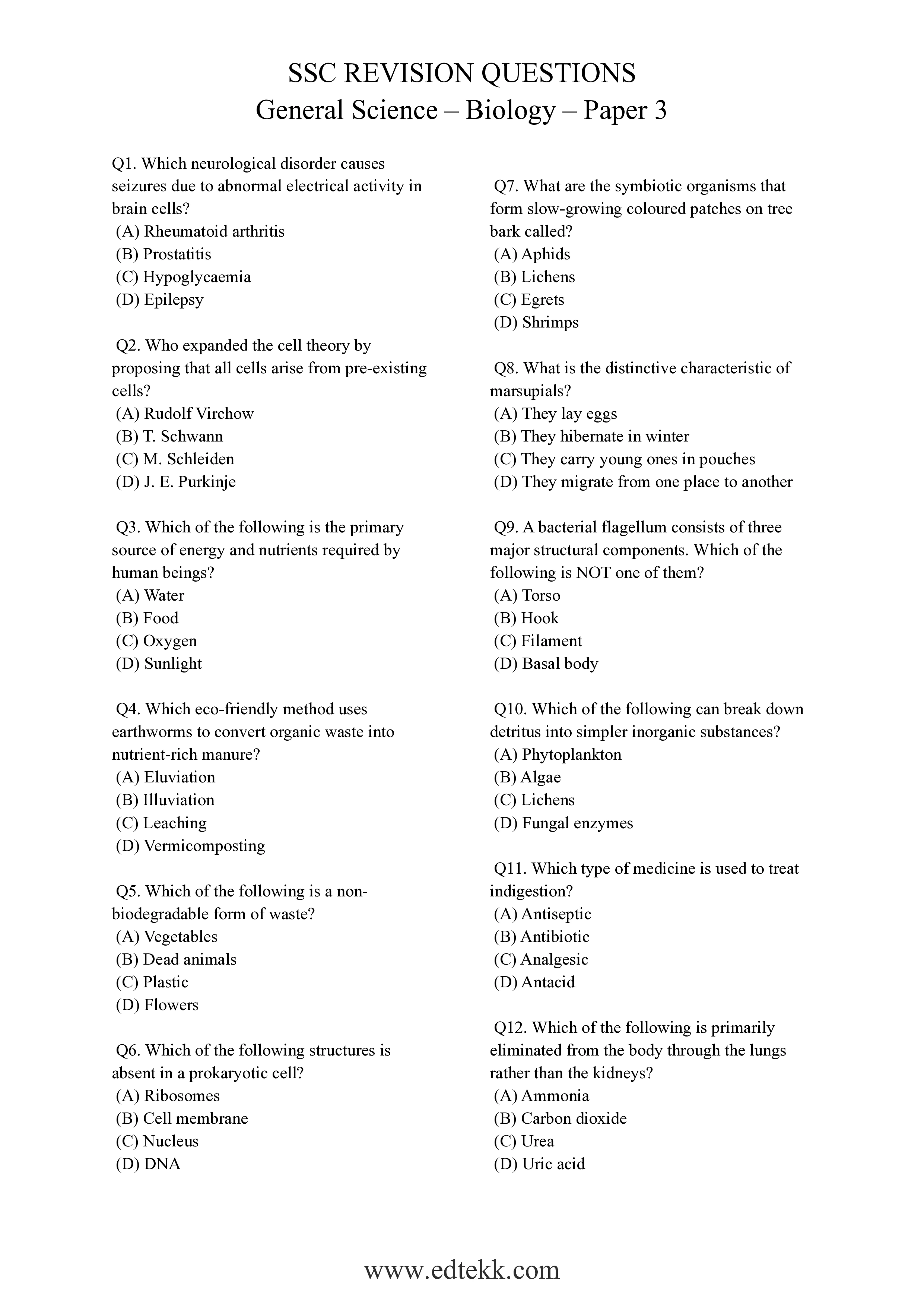
Q1. Which neurological disorder causes seizures due to abnormal electrical activity in brain cells?
(A) Rheumatoid arthritis
(B) Prostatitis
(C) Hypoglycaemia
(D) Epilepsy
Explanation: Epilepsy is a neurological disorder characterised by an enduring predisposition to recurrent, unprovoked seizures. Seizures result from abnormal, excessive or synchronous electrical activity in the brain. Their manifestations vary depending on the brain regions involved and may include involuntary movements, altered awareness and temporary loss of consciousness.
Q2. Who expanded the cell theory by proposing that all cells arise from pre-existing cells?
(A) Rudolf Virchow
(B) T. Schwann
(C) M. Schleiden
(D) J. E. Purkinje
Explanation: Rudolf Virchow expanded the cell theory by proposing that new cells arise from pre-existing cells. This principle is commonly expressed as “Omnis cellula e cellula”. It established that cells do not arise spontaneously but are produced through the division of existing cells.
Q3. Which of the following is the primary source of energy and nutrients required by human beings?
(A) Water
(B) Food
(C) Oxygen
(D) Sunlight
Explanation: Food is the primary source of energy and essential nutrients for human beings. It supplies carbohydrates, fats and proteins needed for energy production, growth and tissue repair, as well as vitamins and minerals required for normal physiological functioning. Water and oxygen are essential for survival but do not provide dietary energy.
Q4. Which eco-friendly method uses earthworms to convert organic waste into nutrient-rich manure?
(A) Eluviation
(B) Illuviation
(C) Leaching
(D) Vermicomposting
Explanation: Vermicomposting is an environmentally friendly method of converting organic waste into nutrient-rich manure using earthworms and microorganisms. It can process biodegradable household, agricultural and garden waste. The resulting vermicompost improves soil structure, fertility and water-retention capacity.
Q5. Which of the following is a non-biodegradable form of waste?
(A) Vegetables
(B) Dead animals
(C) Plastic
(D) Flowers
Explanation: Plastic is generally classified as non-biodegradable because conventional plastics resist decomposition by naturally occurring microorganisms. Unlike vegetables, dead animals and flowers, which decompose through biological processes, conventional plastic can persist in the environment for decades or even centuries.
Q6. Which of the following structures is absent in a prokaryotic cell?
(A) Ribosomes
(B) Cell membrane
(C) Nucleus
(D) DNA
Explanation: Prokaryotic cells lack a membrane-bound nucleus. Their genetic material is located in a region called the nucleoid. However, they possess DNA, ribosomes and a cell membrane. Bacteria and archaea are examples of prokaryotic organisms.
Q7. What are the symbiotic organisms that form slow-growing coloured patches on tree bark called?
(A) Aphids
(B) Lichens
(C) Egrets
(D) Shrimps
Explanation: Lichens are associations between a fungus and a photosynthetic partner, usually a green alga or cyanobacterium. They commonly grow slowly on tree bark, rocks and other surfaces, forming coloured patches. The fungal partner provides structural support and helps retain moisture, while the photosynthetic partner produces organic nutrients.
Q8. What is the distinctive characteristic of marsupials?
(A) They lay eggs
(B) They hibernate in winter
(C) They carry young ones in pouches
(D) They migrate from one place to another
Explanation: Marsupials are mammals that generally give birth to relatively underdeveloped young. Their offspring continue developing after birth, usually attached to a teat and often protected inside a pouch called the marsupium. Kangaroos, koalas and wombats are well-known examples of marsupials.
Q9. A bacterial flagellum consists of three major structural components. Which of the following is NOT one of them?
(A) Torso
(B) Hook
(C) Filament
(D) Basal body
Explanation: A typical bacterial flagellum consists of three major structural components: the filament, hook and basal body. The filament acts as a propeller, the hook connects it to the basal body, and the basal body anchors the structure in the bacterial cell envelope and functions as its motor. Torso is not a component of the bacterial flagellum.
Q10. Which of the following can break down detritus into simpler inorganic substances?
(A) Phytoplankton
(B) Algae
(C) Lichens
(D) Fungal enzymes
Explanation: Decomposers, particularly fungi and bacteria, break down detritus (dead organic matter) into simpler substances through enzymatic activity. Fungal enzymes help decompose complex organic materials, facilitating mineralisation and the recycling of nutrients within ecosystems.
Q11. Which type of medicine is used to treat indigestion?
(A) Antiseptic
(B) Antibiotic
(C) Analgesic
(D) Antacid
Explanation: Antacids are medicines used to relieve indigestion associated with excess stomach acid, acidity and heartburn. They neutralise hydrochloric acid in the stomach. Common ingredients include magnesium hydroxide, aluminium hydroxide and calcium carbonate. Antacids provide symptomatic relief but do not treat every cause of indigestion.
Q12. Which of the following is primarily eliminated from the body through the lungs rather than the kidneys?
(A) Ammonia
(B) Carbon dioxide
(C) Urea
(D) Uric acid
Explanation: Carbon dioxide is primarily eliminated through the lungs during exhalation. It is produced during cellular respiration and transported in the blood mainly as bicarbonate ions. In the lungs, bicarbonate is converted back into carbon dioxide, which diffuses into the alveoli and is exhaled. Urea and uric acid are eliminated mainly through the kidneys.
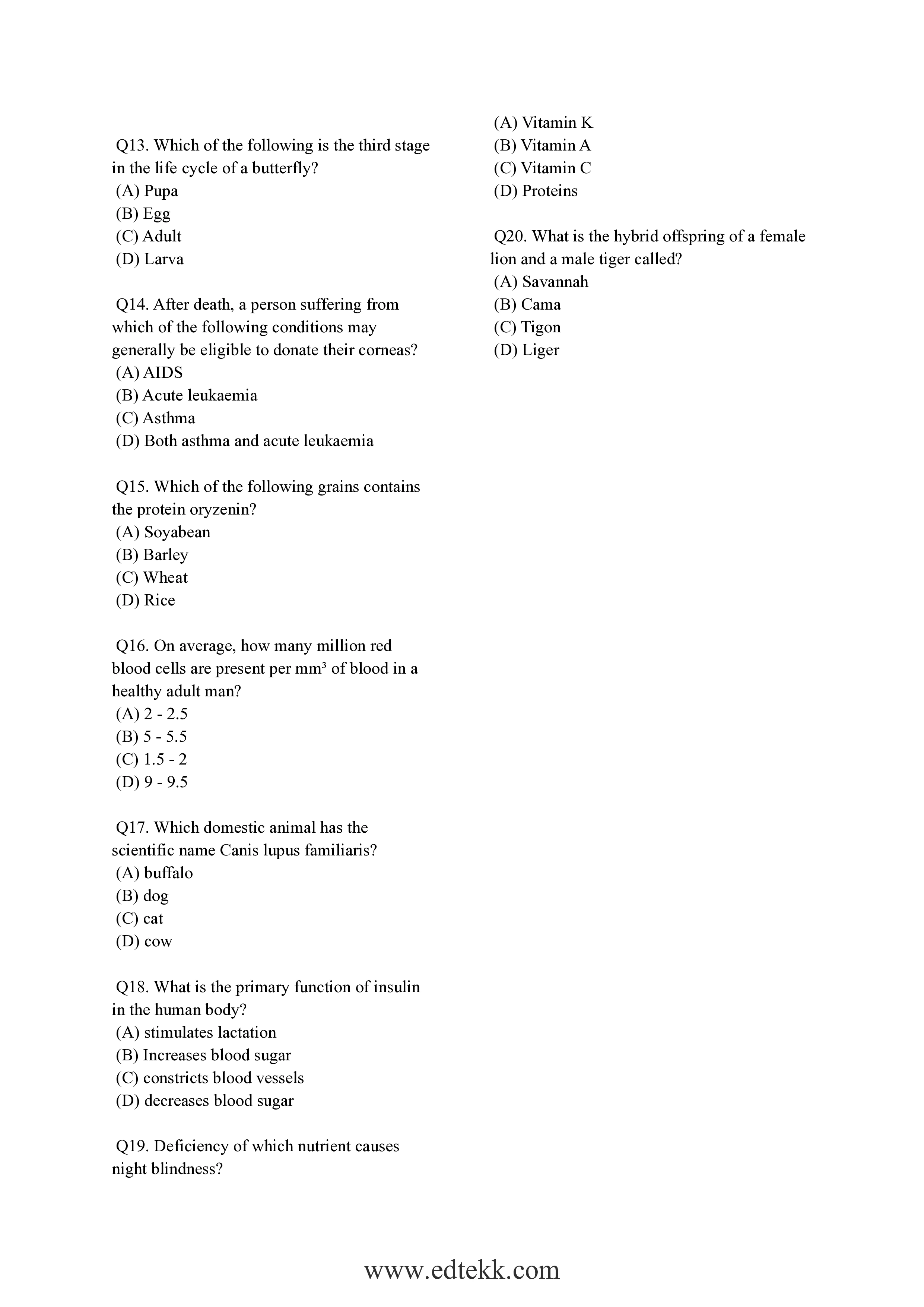
Q13. Which of the following is the third stage in the life cycle of a butterfly?
(A) Pupa
(B) Egg
(C) Adult
(D) Larva
Explanation: The typical life cycle of a butterfly consists of four stages: egg, larva (caterpillar), pupa (chrysalis) and adult. The pupa is the third stage, during which extensive transformation occurs and the adult butterfly develops. This type of development is known as complete metamorphosis.
Q14. After death, a person suffering from which of the following conditions may generally be eligible to donate their corneas?
(A) AIDS
(B) Acute leukaemia
(C) Asthma
(D) Both asthma and acute leukaemia
Explanation: Asthma generally does not prevent cornea donation after death because it does not ordinarily compromise corneal tissue suitability. However, HIV/AIDS and certain malignancies, including acute leukaemia, may exclude a donor under applicable screening criteria. Final eligibility depends on medical history, tissue assessment and the eye bank’s protocols.
Q15. Which of the following grains contains the protein oryzenin?
(A) Soyabean
(B) Barley
(C) Wheat
(D) Rice
Explanation: Oryzenin is the principal storage protein of rice and belongs to the glutelin group of proteins. It is found predominantly in the rice endosperm. Other cereals possess characteristic storage proteins, such as gliadins and glutenins in wheat and hordeins in barley.
Q16. On average, how many million red blood cells are present per mm³ of blood in a healthy adult man?
(A) 2 – 2.5
(B) 5 – 5.5
(C) 1.5 – 2
(D) 9 – 9.5
Explanation: A healthy adult man typically has approximately 4.5–5.5 million red blood cells per mm³ (or microlitre) of blood. The range of 5–5.5 million is an approximate examination value. The actual count varies with age, altitude, hydration, health status and laboratory reference ranges.
Q17. Which domestic animal has the scientific name Canis lupus familiaris?
(A) buffalo
(B) dog
(C) cat
(D) cow
Explanation: The domestic dog is scientifically classified as Canis lupus familiaris, a subspecies of the grey wolf (Canis lupus) under a widely accepted taxonomic classification. It belongs to the family Canidae and the order Carnivora.
Q18. What is the primary function of insulin in the human body?
(A) stimulates lactation
(B) Increases blood sugar
(C) constricts blood vessels
(D) decreases blood sugar
Explanation: Insulin is a hormone secreted by the beta cells of the pancreas. It decreases blood glucose levels by promoting glucose uptake in insulin-sensitive tissues and stimulating glycogen synthesis, particularly in the liver and skeletal muscles. Insufficient insulin production or impaired insulin action can lead to diabetes mellitus.
Q19. Deficiency of which nutrient causes night blindness?
(A) Vitamin K
(B) Vitamin A
(C) Vitamin C
(D) Proteins
Explanation: Vitamin A deficiency can cause night blindness, a condition characterised by difficulty seeing in dim light or darkness. Vitamin A is required for the formation of retinal, a component of rhodopsin, the light-sensitive pigment present in the rod cells of the retina. Prolonged deficiency can cause corneal damage and permanent blindness.
Q20. What is the hybrid offspring of a female lion and a male tiger called?
(A) Savannah
(B) Cama
(C) Tigon
(D) Liger
Explanation: A tigon is the hybrid offspring of a female lion and a male tiger. It may exhibit physical characteristics of both parent species. A tigon is different from a liger, which results from the mating of a male lion and a female tiger.
Question Paper Images