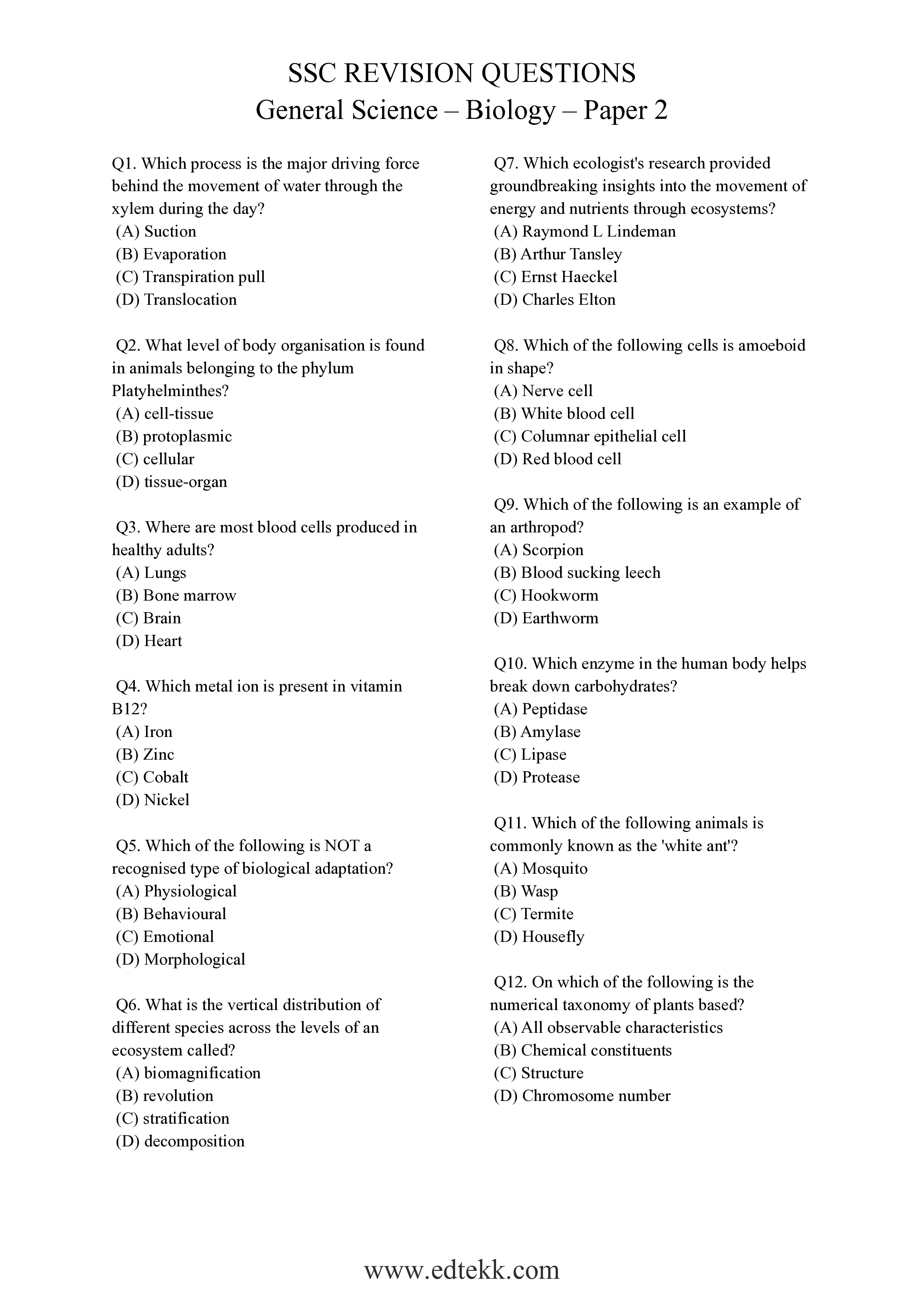
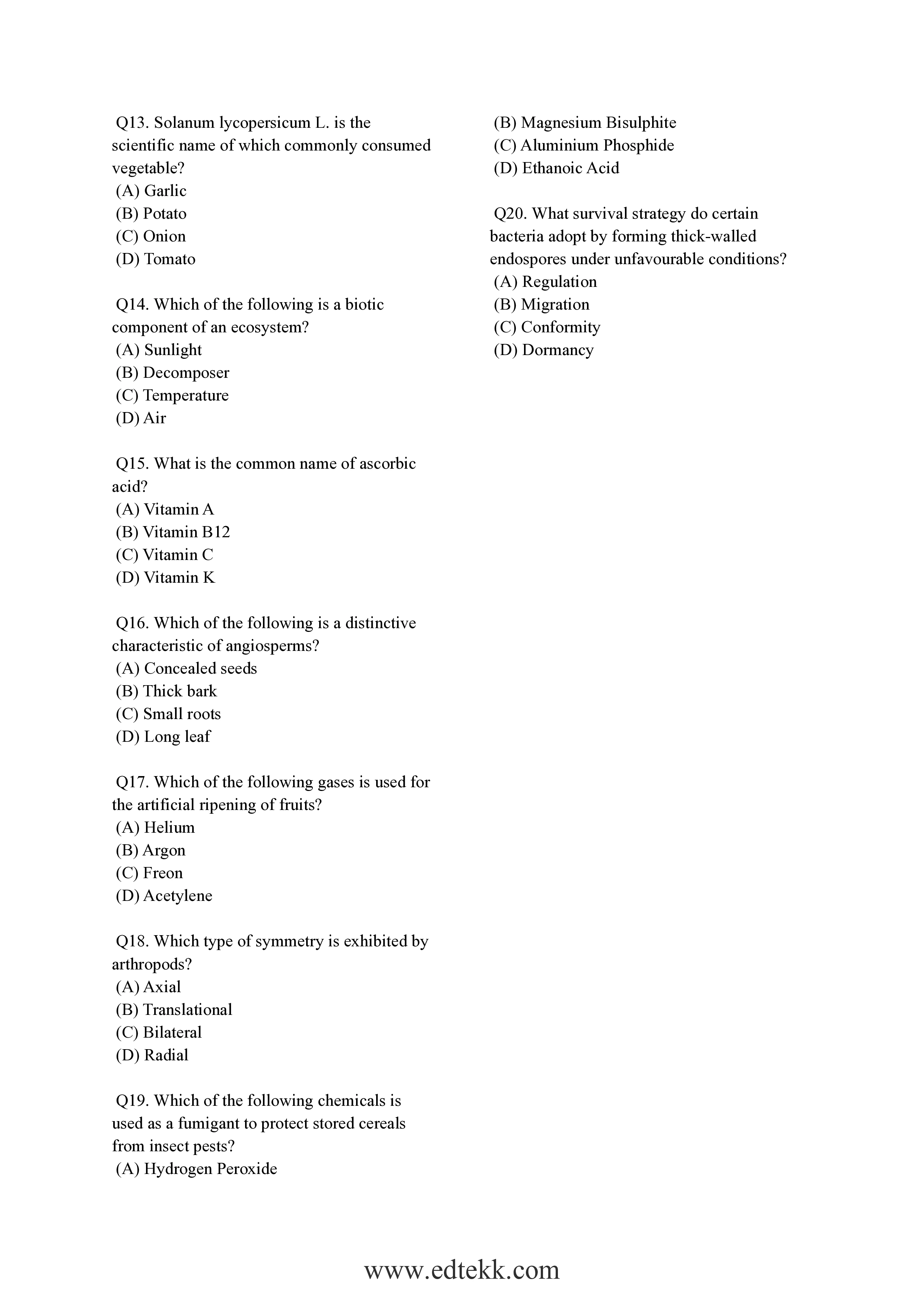
Improve your General Science preparation with the second Biology revision paper for SSC examinations. This practice set includes objective-type Biology questions relevant to SSC CGL, CHSL, CPO, MTS, GD and Selection Post exams. Revise important concepts, assess your knowledge and understand correct answers through detailed explanations.
Test Details
Topic: Biology
Total Questions: 20
Question Format: MCQs – Single Correct Answer
Suitable for: SSC CGL, CHSL, CPO, MTS, GD, Selection Post
Download All Papers in This Series (PDF)
Questions and Answers
Q1. Which process is the major driving force behind the movement of water through the xylem during the day?
(A) Suction
(B) Evaporation
(C) Transpiration pull
(D) Translocation
Explanation: Transpiration pull is the major driving force responsible for the upward movement of water through xylem during the day. Evaporation of water from leaf surfaces generates negative pressure, which pulls the continuous column of water upward from the roots.
Q2. What level of body organisation is found in animals belonging to the phylum Platyhelminthes?
(A) cell-tissue
(B) protoplasmic
(C) cellular
(D) tissue-organ
Explanation: Animals belonging to phylum Platyhelminthes exhibit organ-level organisation. Their bodies contain tissues organised into organs and show bilateral symmetry and triploblastic organisation. They are generally acoelomate animals, meaning they lack a body cavity between the body wall and digestive tract.
Q3. Where are most blood cells produced in healthy adults?
(A) Lungs
(B) Bone marrow
(C) Brain
(D) Heart
Explanation: Bone marrow is the primary site of blood cell production in healthy adults. This process is called haematopoiesis. Red bone marrow produces red blood cells, white blood cells and platelets from haematopoietic stem cells. In adults, active red bone marrow is mainly found in the pelvis, sternum, ribs and vertebrae.
Q4. Which metal ion is present in vitamin B12?
(A) Iron
(B) Zinc
(C) Cobalt
(D) Nickel
Explanation: Vitamin B12, also known as cobalamin, contains cobalt as its central metal ion. This element forms an essential part of the vitamin’s molecular structure. Vitamin B12 is necessary for normal red blood cell formation, DNA synthesis and proper nervous system functioning.
Q5. Which of the following is NOT a recognised type of biological adaptation?
(A) Physiological
(B) Behavioural
(C) Emotional
(D) Morphological
Explanation: Biological adaptations are generally classified into three principal categories: morphological (structural), physiological (functional) and behavioural adaptations. These adaptations involve changes in body structure, internal functioning and behaviour, respectively, that improve an organism’s survival and reproductive success. Emotional adaptation is not recognised as a principal category of biological adaptation.
Q6. What is the vertical distribution of different species across the levels of an ecosystem called?
(A) biomagnification
(B) revolution
(C) stratification
(D) decomposition
Explanation: Stratification refers to the vertical distribution of different species or communities at different levels in an ecosystem. For example, forest vegetation may be arranged into distinct layers, including the canopy, understory, shrub layer and forest floor.
Q7. Which ecologist’s research provided groundbreaking insights into the movement of energy and nutrients through ecosystems?
(A) Raymond L Lindeman
(B) Arthur Tansley
(C) Ernst Haeckel
(D) Charles Elton
Explanation: Raymond L. Lindeman made fundamental contributions to ecosystem ecology through his trophic-dynamic concept. His research explained how energy is transferred through successive trophic levels and how energy availability decreases along food chains. His work significantly advanced the scientific understanding of ecosystem functioning and energy flow.
Q8. Which of the following cells is amoeboid in shape?
(A) Nerve cell
(B) White blood cell
(C) Columnar epithelial cell
(D) Red blood cell
Explanation: White blood cells, also called leukocytes, are generally amoeboid in shape. They can change their shape and form temporary projections to move through tissues and reach sites of infection. This movement is called amoeboid movement. Red blood cells, in contrast, have a characteristic biconcave disc shape.
Q9. Which of the following is an example of an arthropod?
(A) Scorpion
(B) Blood sucking leech
(C) Hookworm
(D) Earthworm
Explanation: Scorpions are arthropods belonging to the class Arachnida. They possess jointed appendages, a segmented body and a chitinous exoskeleton. Leeches and earthworms belong to the phylum Annelida, while hookworms are roundworms belonging to the phylum Nematoda.
Q10. Which enzyme in the human body helps break down carbohydrates?
(A) Peptidase
(B) Amylase
(C) Lipase
(D) Protease
Explanation: Amylase is an enzyme that breaks down starch into smaller carbohydrates, including maltose and oligosaccharides. It is produced primarily by the salivary glands and pancreas. Peptidases and proteases digest proteins, whereas lipase breaks down fats. Thus, amylase is the correct answer for carbohydrate digestion.
Q11. Which of the following animals is commonly known as the ‘white ant’?
(A) Mosquito
(B) Wasp
(C) Termite
(D) Housefly
Explanation: A termite is commonly called a white ant because of its pale appearance and social behaviour. However, termites are not true ants; they belong to a separate insect group and are evolutionarily more closely related to cockroaches. They live in organised colonies consisting of reproductive individuals, workers and soldiers.
Q12. On which of the following is the numerical taxonomy of plants based?
(A) All observable characteristics
(B) Chemical constituents
(C) Structure
(D) Chromosome number
Explanation: Numerical taxonomy classifies organisms by evaluating a large number of observable characteristics and expressing similarities through numerical methods. In classical numerical taxonomy, characters are generally given equal weight, and organisms are grouped according to overall similarity. These characteristics may include morphological, anatomical, physiological and biochemical features.
Q13. Solanum lycopersicum L. is the scientific name of which commonly consumed vegetable?
(A) Garlic
(B) Potato
(C) Onion
(D) Tomato
Explanation: Solanum lycopersicum L. is the scientific name of tomato, which belongs to the family Solanaceae. Although commonly used as a vegetable in cooking, tomato is botanically classified as a fruit because it develops from the ovary of a flower and contains seeds.
Q14. Which of the following is a biotic component of an ecosystem?
(A) Sunlight
(B) Decomposer
(C) Temperature
(D) Air
Explanation: Decomposers are biotic components of an ecosystem because they are living organisms. They include bacteria and fungi, which break down dead plants, animals and organic waste, thereby recycling nutrients. Sunlight, temperature and air are abiotic components because they are non-living environmental factors.
Q15. What is the common name of ascorbic acid?
(A) Vitamin A
(B) Vitamin B12
(C) Vitamin C
(D) Vitamin K
Explanation: Ascorbic acid is the chemical name of vitamin C, a water-soluble vitamin essential for collagen synthesis, wound healing and normal immune function. Severe vitamin C deficiency causes scurvy, which may result in bleeding gums, easy bruising, poor wound healing and fatigue.
Q16. Which of the following is a distinctive characteristic of angiosperms?
(A) Concealed seeds
(B) Thick bark
(C) Small roots
(D) Long leaf
Explanation: Angiosperms are flowering plants characterised by ovules enclosed within an ovary. Following fertilisation, the ovules develop into seeds, and the ovary generally develops into a fruit enclosing them. This distinguishes angiosperms from gymnosperms, whose ovules and seeds are not enclosed within an ovary.
Q17. Which of the following gases is used for the artificial ripening of fruits?
(A) Helium
(B) Argon
(C) Freon
(D) Acetylene
Explanation: Acetylene can induce fruit ripening because it produces effects similar to ethylene, the natural plant-ripening hormone. It may be released through the reaction of calcium carbide with moisture. However, calcium carbide is prohibited for artificial fruit ripening in India because of associated health risks. Ethylene gas is the approved alternative when used under prescribed conditions.
Q18. Which type of symmetry is exhibited by arthropods?
(A) Axial
(B) Translational
(C) Bilateral
(D) Radial
Explanation: Arthropods exhibit bilateral symmetry, meaning their bodies can generally be divided into two approximately mirror-image halves along a single longitudinal plane. This characteristic is observed in insects, arachnids, crustaceans and myriapods. Their bodies also commonly exhibit segmentation and jointed appendages.
Q19. Which of the following chemicals is used as a fumigant to protect stored cereals from insect pests?
(A) Hydrogen Peroxide
(B) Magnesium Bisulphite
(C) Aluminium Phosphide
(D) Ethanoic Acid
Explanation: Aluminium phosphide is used as a fumigant to protect stored cereals and other agricultural commodities against insect pests. On exposure to moisture, it releases phosphine gas, which is highly toxic to insects. However, phosphine is also extremely poisonous to humans and animals, so its application requires strict safety precautions and regulatory compliance.
Q20. What survival strategy do certain bacteria adopt by forming thick-walled endospores under unfavourable conditions?
(A) Regulation
(B) Migration
(C) Conformity
(D) Dormancy
Explanation: Certain bacteria, including species of Bacillus and Clostridium, survive unfavourable environmental conditions by forming thick-walled endospores. These structures are highly resistant to heat, radiation, drying and chemicals. Endospore formation is a survival mechanism involving a dormant state, not a method of reproduction. The bacteria become active again when favourable conditions return.
Question Paper Images