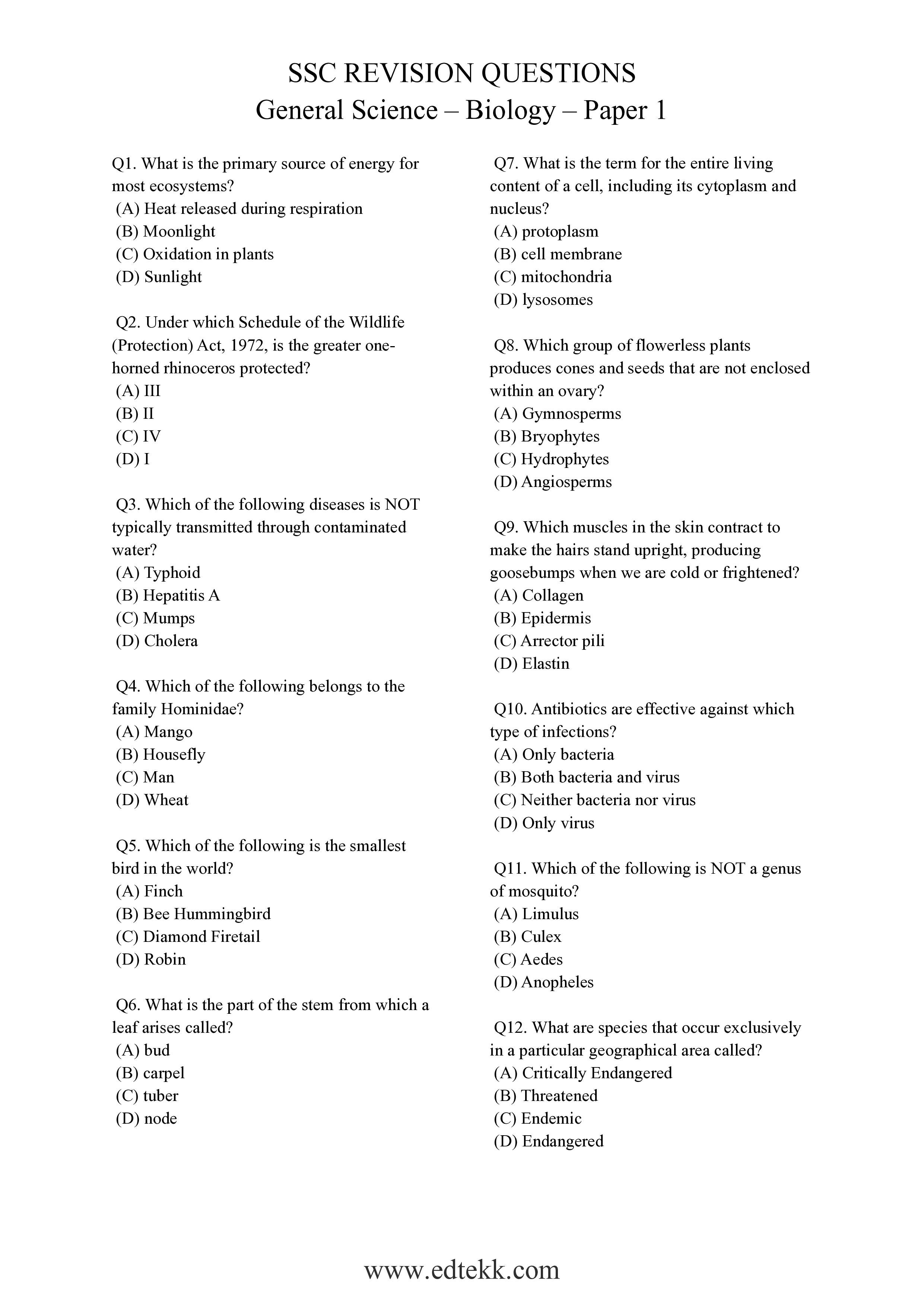
Strengthen your Biology preparation with this General Science revision practice paper for SSC examinations. It features important Biology MCQs suitable for SSC CGL, CHSL, CPO, MTS, GD and Selection Post exams. Practise objective questions, revise essential biological concepts and improve your exam preparation with accurate answers and explanations.
Test Details
Topic: Biology
Total Questions: 20
Question Format: MCQs – Single Correct Answer
Suitable for: SSC CGL, CHSL, CPO, MTS, GD, Selection Post
Download All Papers in This Series (PDF)
Questions and Answers
Q1. What is the primary source of energy for most ecosystems?
(A) Heat released during respiration
(B) Moonlight
(C) Oxidation in plants
(D) Sunlight
Explanation: Sunlight is the primary energy source for most ecosystems. Green plants and other photosynthetic organisms capture solar energy and convert it into chemical energy stored in organic compounds. This energy is transferred through different trophic levels via food chains and food webs. However, some ecosystems, such as deep-sea hydrothermal vent ecosystems, depend on chemical energy rather than sunlight.
Q2. Under which Schedule of the Wildlife (Protection) Act, 1972, is the greater one-horned rhinoceros protected?
(A) III
(B) II
(C) IV
(D) I
Explanation: The greater one-horned rhinoceros (Rhinoceros unicornis) is listed under Schedule I of India’s Wildlife (Protection) Act, 1972, as amended. Schedule I provides the highest level of statutory protection to listed wildlife species. Hunting and other prohibited activities involving this species attract stringent legal penalties.
Q3. Which of the following diseases is NOT typically transmitted through contaminated water?
(A) Typhoid
(B) Hepatitis A
(C) Mumps
(D) Cholera
Explanation: Mumps is primarily transmitted through respiratory droplets and direct contact with infected saliva, not through contaminated water. In contrast, typhoid, hepatitis A and cholera can spread through contaminated food and water. Mumps is a viral disease commonly characterised by painful swelling of the salivary glands, particularly the parotid glands.
Q4. Which of the following belongs to the family Hominidae?
(A) Mango
(B) Housefly
(C) Man
(D) Wheat
Explanation: Humans belong to the family Hominidae, which includes the great apes, namely chimpanzees, gorillas, orangutans and humans. Mango and wheat are plants, while houseflies belong to the phylum Arthropoda.
Q5. Which of the following is the smallest bird in the world?
(A) Finch
(B) Bee Hummingbird
(C) Diamond Firetail
(D) Robin
Explanation: The bee hummingbird (Mellisuga helenae), native to Cuba, is recognised as the world’s smallest living bird. Adults measure approximately 5–6 cm in length and weigh around 1.6–2 grams. Its exceptionally small body size distinguishes it from all other living bird species.
Q6. What is the part of the stem from which a leaf arises called?
(A) bud
(B) carpel
(C) tuber
(D) node
Explanation: A node is the point on a plant stem from which leaves, branches or buds arise. The portion of the stem between two successive nodes is called an internode. Nodes are important locations for the development of new shoots and leaves.
Q7. What is the term for the entire living content of a cell, including its cytoplasm and nucleus?
(A) protoplasm
(B) cell membrane
(C) mitochondria
(D) lysosomes
Explanation: Protoplasm refers to the living contents of a cell, comprising the cytoplasm and nucleus. It includes the cellular components responsible for essential life processes. The cytoplasm contains organelles suspended in the cytosol, while the nucleus contains most of the cell’s genetic material in eukaryotic organisms.
Q8. Which group of flowerless plants produces cones and seeds that are not enclosed within an ovary?
(A) Gymnosperms
(B) Bryophytes
(C) Hydrophytes
(D) Angiosperms
Explanation: Gymnosperms are seed-producing vascular plants whose ovules and seeds are not enclosed within an ovary. They are commonly called naked-seeded plants. Many gymnosperms, such as pines, bear cones, although some, such as Ginkgo, lack typical seed cones. Unlike angiosperms, gymnosperms do not produce true flowers or fruits.
Q9. Which muscles in the skin contract to make the hairs stand upright, producing goosebumps when we are cold or frightened?
(A) Collagen
(B) Epidermis
(C) Arrector pili
(D) Elastin
Explanation: Arrector pili are small, involuntary smooth muscles attached to hair follicles. When these muscles contract, they pull the hairs upright and produce small elevations on the skin, commonly known as goosebumps. This response occurs during exposure to cold or in response to emotional stimuli such as fear.
Q10. Antibiotics are effective against which type of infections?
(A) Only bacteria
(B) Both bacteria and virus
(C) Neither bacteria nor virus
(D) Only virus
Explanation: Antibiotics are used to treat bacterial infections by interfering with processes such as bacterial cell-wall synthesis or protein production. They do not directly treat viral infections because viruses have different structures and replication mechanisms. Antibiotics should be used only when medically indicated.
Q11. Which of the following is NOT a genus of mosquito?
(A) Limulus
(B) Culex
(C) Aedes
(D) Anopheles
Explanation: Limulus, commonly known as the horseshoe crab, belongs to the group Chelicerata and is not a mosquito. Culex, Aedes and Anopheles are mosquito genera, several species of which are vectors of diseases affecting humans.
Q12. What are species that occur exclusively in a particular geographical area called?
(A) Critically Endangered
(B) Threatened
(C) Endemic
(D) Endangered
Explanation: Endemic species are plants or animals naturally restricted to a particular geographical region and not found naturally elsewhere. Their distribution may be limited to an island, mountain range, country or other specific area. Endemism describes geographical restriction and does not necessarily indicate that a species is endangered.
Q13. Phytoplankton, which are small aquatic organisms, belong to which trophic level of the food web?
(A) Primary producers
(B) Primary consumers
(C) Secondary consumers
(D) Decomposers
Explanation: Phytoplankton are microscopic, photosynthetic organisms found in aquatic ecosystems. They prepare their own food through photosynthesis and form the foundation of most aquatic food webs. Therefore, they occupy the first trophic level as primary producers and provide energy to higher-level consumers.
Q14. What is the development of a fruit without fertilisation called?
(A) Hybridogenesis
(B) Gametogamy
(C) Parthenocarpy
(D) Apomixis
Explanation: Parthenocarpy is the development of a fruit without fertilisation, generally resulting in seedless fruits. It may occur naturally or be induced by plant growth regulators. Certain bananas and pineapples are examples. In contrast, apomixis refers to asexual seed formation without fertilisation.
Q15. Which metal ion released by the tannery industry is a major cause of water pollution?
(A) Mg
(B) As
(C) Cr
(D) Zn
Explanation: Chromium is a major pollutant associated with tannery effluents because chromium salts, particularly chromium(III) compounds, are widely used in leather tanning. Improper discharge contaminates water bodies. Hexavalent chromium (Cr(VI)) is particularly toxic, carcinogenic and harmful to aquatic organisms and human health.
Q16. Which technology uses a powerful magnet and radio waves to produce images of internal organs and body structures?
(A) Positron emission tomography
(B) Computed tomography
(C) Fluoroscopy
(D) Magnetic resonance imaging
Explanation: Magnetic resonance imaging (MRI) uses a strong magnetic field and radiofrequency waves to produce detailed images of internal organs, tissues and other body structures. Unlike computed tomography (CT), MRI does not use ionising X-ray radiation. It is particularly useful for examining soft tissues, the brain and spinal cord.
Q17. Who observed cell division in salamander embryos in 1879 and described the process of mitosis?
(A) Walther Flemming
(B) Garth L Nicolson
(C) Edwin Gorter
(D) Albert von Kolliker
Explanation: Walther Flemming systematically studied cell division in animal cells, particularly in salamander tissues, and described mitosis. His research, published in 1879, documented the behaviour of chromosomes during cell division. He is recognised as a pioneer in cytology and the study of chromosome dynamics.
Q18. What is the common name of Parthenium hysterophorus?
(A) Lemongrass
(B) Lawn grass
(C) Carrot grass
(D) Horse grass
Explanation: Parthenium hysterophorus is commonly known as carrot grass, congress grass or congress weed. It is an invasive weed that adversely affects agricultural productivity and biodiversity. Its pollen can cause allergic reactions, while contact with the plant may cause dermatitis and other allergic symptoms.
Q19. Which structure serves as a common passage for both sperm and urine in human males?
(A) vas deferens
(B) seminal vesicle
(C) urethra
(D) ureter
Explanation: The urethra is the common passage through which both urine and semen are discharged from the male body, although they do not normally pass simultaneously. Urine enters the urethra from the urinary bladder, while semen enters it through the ejaculatory ducts during ejaculation.
Q20. Deficiency of which nutrient is the most common nutritional cause of goitre?
(A) Vitamin C
(B) Iron
(C) Iodine
(D) Calcium
Explanation: Iodine deficiency is the most common nutritional cause of goitre worldwide. Iodine is essential for the production of thyroid hormones. Insufficient iodine intake can reduce thyroid hormone production and stimulate the thyroid gland to enlarge. However, goitre can also result from autoimmune disorders and other thyroid conditions.
Question Paper Images