Prepare for SSC examinations with this General Science Physics revision practice set. It covers important Physics MCQs designed for SSC CGL, CHSL, CPO, MTS, GD and Selection Post examinations. Practise exam-oriented questions with correct answers and explanations to strengthen conceptual understanding and improve accuracy.
Test Details
Topic: Physics
Total Questions: 20
Question Format: MCQs – Single Correct Answer
Suitable for: SSC CGL, CHSL, CPO, MTS, GD, Selection Post
Download All Papers in This Series (PDF)
Questions and Answers
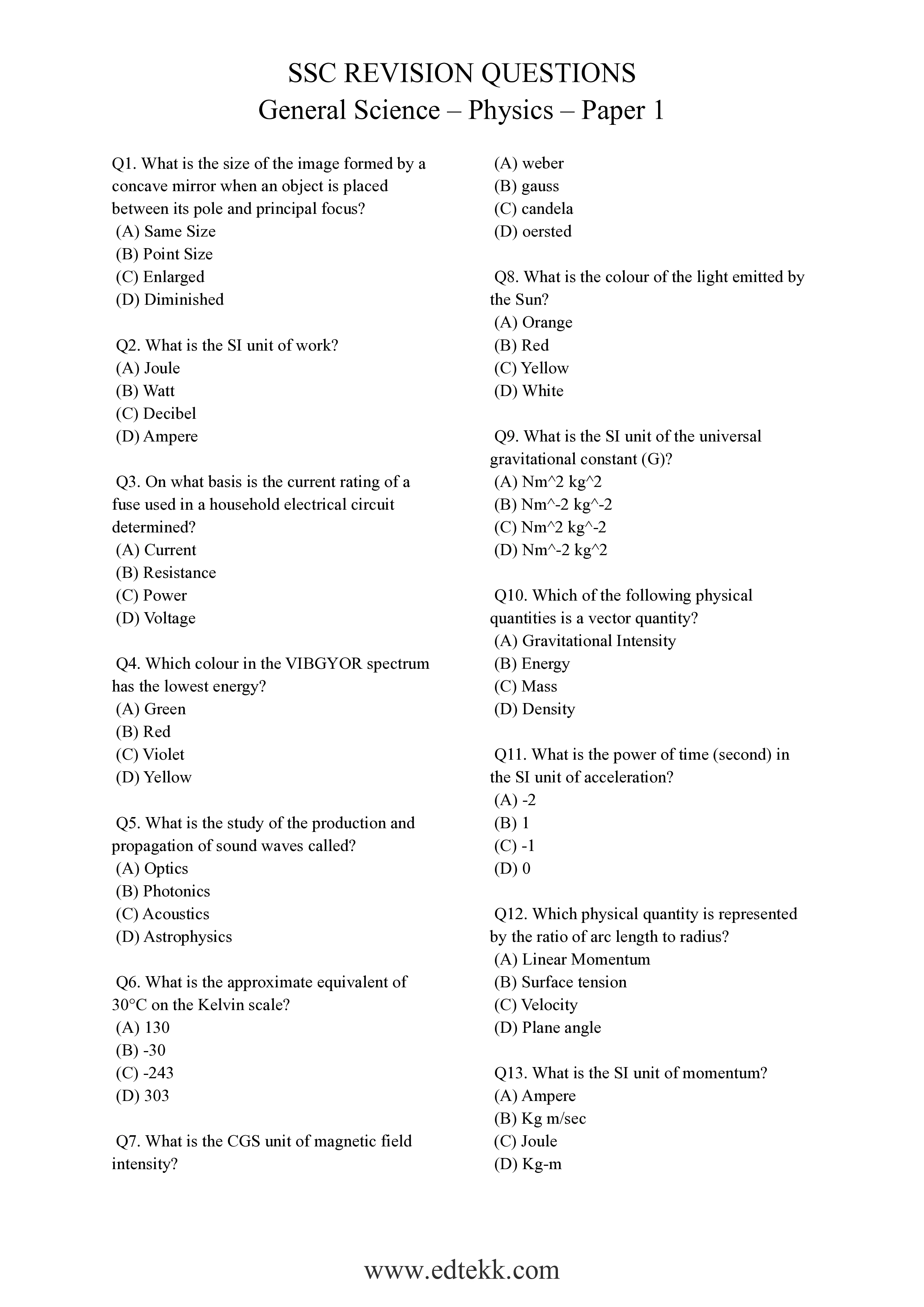
Q1. What is the size of the image formed by a concave mirror when an object is placed between its pole and principal focus?
(A) Same Size
(B) Point Size
(C) Enlarged
(D) Diminished
Explanation: When an object is placed between the pole and principal focus of a concave mirror, the reflected rays diverge and their extensions meet behind the mirror. The resulting image is virtual, erect and enlarged. This property makes concave mirrors useful in shaving and makeup mirrors.
Q2. What is the SI unit of work?
(A) Joule
(B) Watt
(C) Decibel
(D) Ampere
Explanation: Work is the product of force and displacement in the direction of the applied force. Its SI unit is the joule (J), equivalent to one newton-metre (N·m). One joule of work is done when a force of one newton displaces an object by one metre in the direction of the force.
Q3. On what basis is the current rating of a fuse used in a household electrical circuit determined?
(A) Current
(B) Resistance
(C) Power
(D) Voltage
Explanation: A household electric fuse is rated according to the maximum current it can safely carry. If the current exceeds its rated value for sufficient time, the fuse wire heats up and melts, breaking the circuit. Fuse ratings are expressed in amperes and are selected according to the electrical load and circuit requirements.
Q4. Which colour in the VIBGYOR spectrum has the lowest energy?
(A) Green
(B) Red
(C) Violet
(D) Yellow
Explanation: Red light has the longest wavelength and the lowest frequency among the seven colours of visible light (VIBGYOR). Since the energy of a photon is directly proportional to its frequency, according to E = hν, red light has the minimum energy, whereas violet light has the maximum energy.
Q5. What is the study of the production and propagation of sound waves called?
(A) Optics
(B) Photonics
(C) Acoustics
(D) Astrophysics
Explanation: Acoustics is the branch of physics concerned with the production, transmission, propagation and effects of sound waves. It includes phenomena such as reflection, absorption, resonance and interference of sound. Optics deals with light, while astrophysics studies physical processes in celestial objects.
Q6. What is the approximate equivalent of 30°C on the Kelvin scale?
(A) 130
(B) -30
(C) -243
(D) 303
Explanation: Celsius temperature is converted into Kelvin using the formula (K=°C+273.15). For 30°C, (K=30+273.15=303.15) K. Rounded to the nearest whole number, the temperature is approximately 303 K. Kelvin is the SI unit of thermodynamic temperature.
Q7. What is the CGS unit of magnetic field intensity?
(A) weber
(B) gauss
(C) candela
(D) oersted
Explanation: Oersted (Oe) is the CGS unit of magnetic field intensity (magnetic field strength). Gauss (G) is the CGS unit of magnetic flux density, whereas weber (Wb) is the SI unit of magnetic flux. Candela (cd) is the SI base unit of luminous intensity.
Q8. What is the colour of the light emitted by the Sun?
(A) Orange
(B) Red
(C) Yellow
(D) White
Explanation: The Sun emits light across a broad range of visible wavelengths, and their combination is perceived as white. From space, the Sun appears white. From Earth’s surface, atmospheric scattering can make it appear yellow, orange or red, particularly near the horizon. Therefore, white is the most appropriate answer.
Q9. What is the SI unit of the universal gravitational constant (G)?
(A) Nm^2 kg^2
(B) Nm^-2 kg^-2
(C) Nm^2 kg^-2
(D) Nm^-2 kg^2
Explanation: The SI unit of the universal gravitational constant ((G)) is N m² kg⁻². According to Newton’s law of universal gravitation, it relates the gravitational force between two masses to their masses and the square of the distance between them. Its approximate value is (6.674 times 10^{-11}) N m² kg⁻².
Q10. Which of the following physical quantities is a vector quantity?
(A) Gravitational Intensity
(B) Energy
(C) Mass
(D) Density
Explanation: Gravitational intensity, also known as gravitational field strength, is a vector quantity because it has both magnitude and direction. It represents the gravitational force experienced per unit mass at a given point. Energy, mass and density are scalar quantities.
Q11. What is the power of time (second) in the SI unit of acceleration?
(A) -2
(B) 1
(C) -1
(D) 0
Explanation: Acceleration is the rate of change of velocity with respect to time. Its SI unit is metre per second squared (m/s²), which can be expressed as (LT^{-2}). Therefore, the power of the second in the SI unit of acceleration is −2.
Q12. Which physical quantity is represented by the ratio of arc length to radius?
(A) Linear Momentum
(B) Surface tension
(C) Velocity
(D) Plane angle
Explanation: The ratio of arc length to radius, (s/r), gives the plane angle in radians when both measurements are expressed in the same units. The radian is the SI-derived unit of plane angle. Although this ratio is dimensionless, it represents a specific geometric quantity.
Q13. What is the SI unit of momentum?
(A) Ampere
(B) Kg m/sec
(C) Joule
(D) Kg-m
Explanation: Linear momentum is calculated as the product of mass and velocity, expressed as (p = mv). Its SI unit is kilogram metre per second (kg m/s). Ampere is the unit of electric current, while joule is the unit of energy.
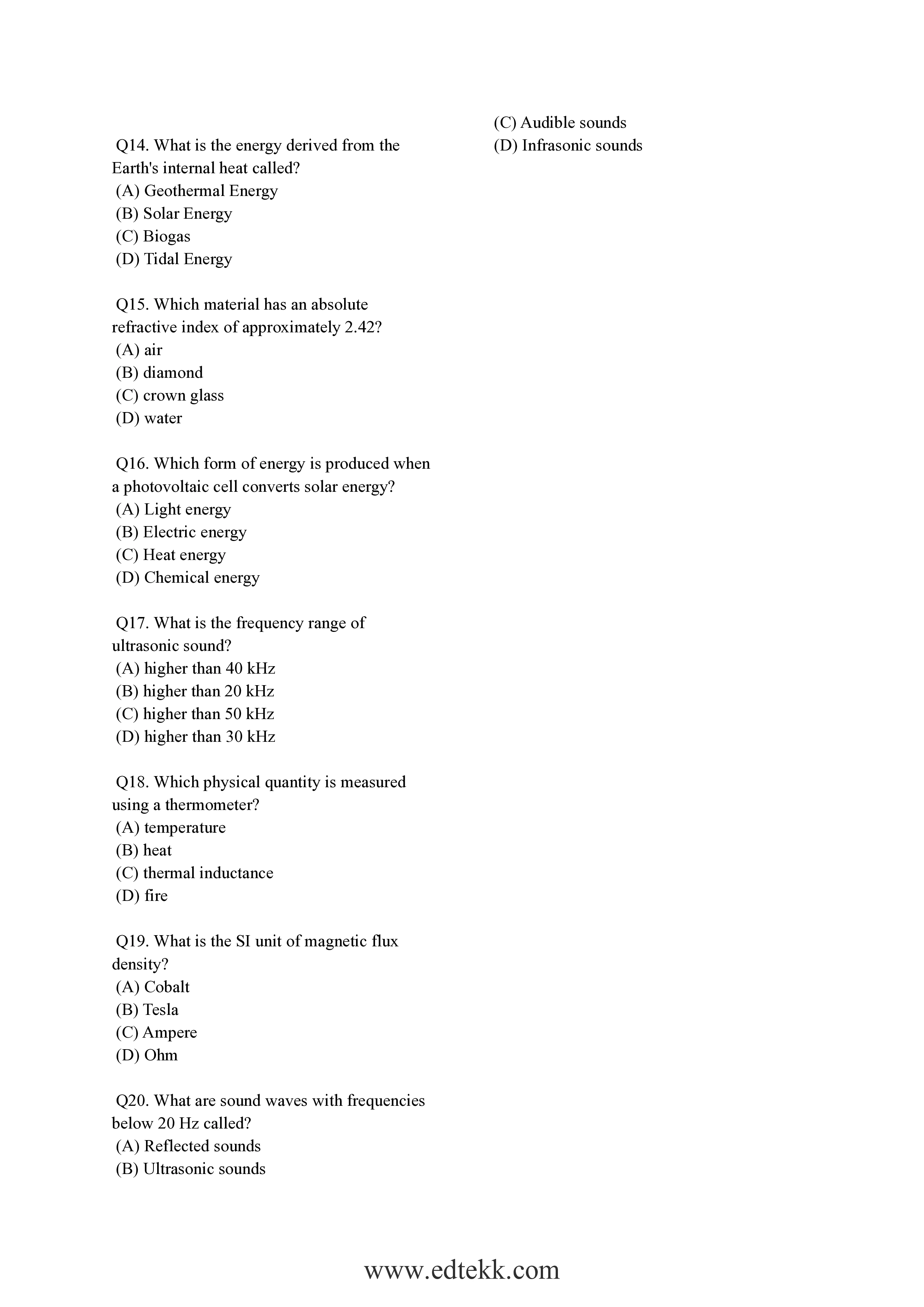
Q14. What is the energy derived from the Earth’s internal heat called?
(A) Geothermal Energy
(B) Solar Energy
(C) Biogas
(D) Tidal Energy
Explanation: Geothermal energy is the energy obtained from the Earth’s internal heat. This heat originates primarily from the Earth’s formation and the radioactive decay of elements within its interior. It is used for electricity generation, heating buildings and various industrial applications.
Q15. Which material has an absolute refractive index of approximately 2.42?
(A) air
(B) diamond
(C) crown glass
(D) water
Explanation: Diamond has an absolute refractive index of approximately 2.42. The absolute refractive index of a medium is the ratio of the speed of light in vacuum to its speed in that medium. Diamond has a high refractive index because light travels considerably slower through it than through air or water.
Q16. Which form of energy is produced when a photovoltaic cell converts solar energy?
(A) Light energy
(B) Electric energy
(C) Heat energy
(D) Chemical energy
Explanation: A photovoltaic cell converts solar energy directly into electrical energy through the photovoltaic effect. When sunlight falls on its semiconductor material, photons generate electron–hole pairs, producing an electric current through the cell. This principle is widely used in solar panels for electricity generation.
Q17. What is the frequency range of ultrasonic sound?
(A) higher than 40 kHz
(B) higher than 20 kHz
(C) higher than 50 kHz
(D) higher than 30 kHz
Explanation: Ultrasonic sounds are sound waves having frequencies greater than 20,000 Hz (20 kHz), approximately the upper limit of normal human hearing. Humans generally cannot hear these frequencies. Ultrasound is widely used in medical imaging, industrial testing and distance measurement.
Q18. Which physical quantity is measured using a thermometer?
(A) temperature
(B) heat
(C) thermal inductance
(D) fire
Explanation: A thermometer is an instrument used to measure temperature, which indicates the degree of hotness or coldness of a body. Heat is energy transferred between bodies due to a temperature difference, whereas temperature is a measurable physical quantity.
Q19. What is the SI unit of magnetic flux density?
(A) Cobalt
(B) Tesla
(C) Ampere
(D) Ohm
Explanation: Tesla (T) is the SI unit of magnetic flux density, commonly called the magnetic field in elementary physics. One tesla is equivalent to one weber per square metre (Wb/m²). It is named after the scientist and inventor Nikola Tesla.
Q20. What are sound waves with frequencies below 20 Hz called?
(A) Reflected sounds
(B) Ultrasonic sounds
(C) Audible sounds
(D) Infrasonic sounds
Explanation: Sound waves with frequencies below 20 Hz are called infrasonic sounds. These frequencies are below the lower limit of normal human hearing. Humans generally hear sounds ranging from 20 Hz to 20,000 Hz. Sounds with frequencies above 20,000 Hz are called ultrasonic sounds.
Question Paper Images