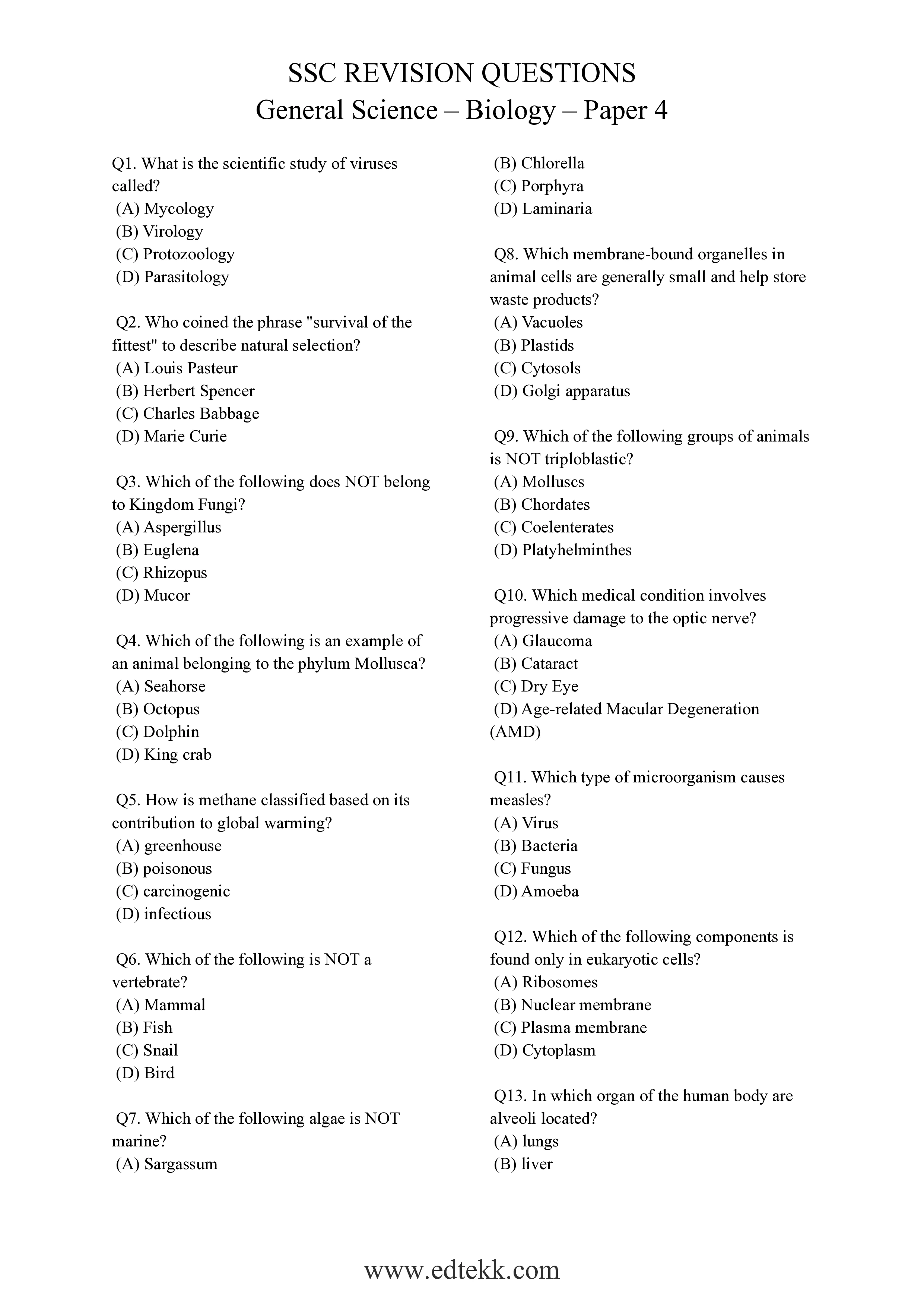
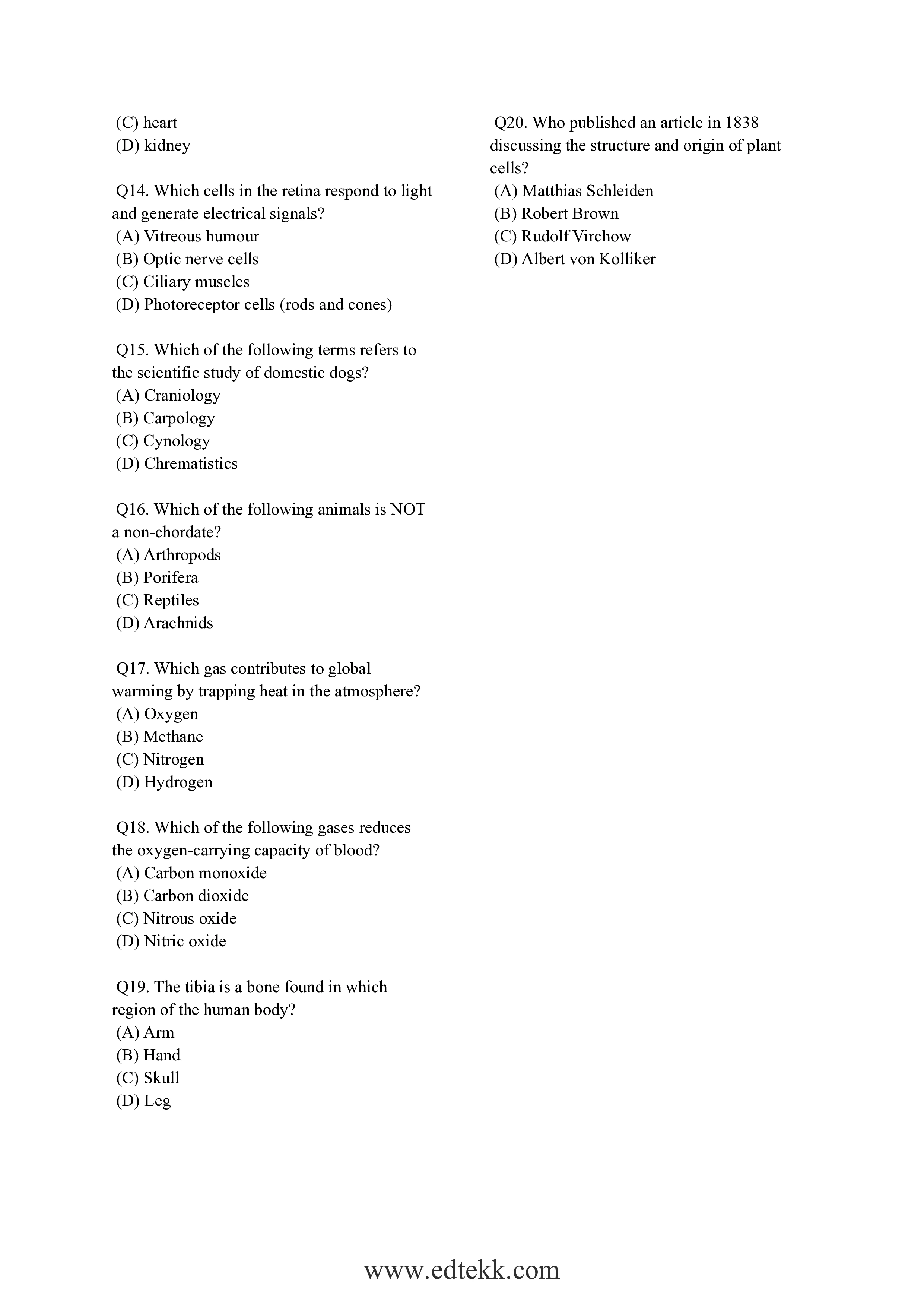
Enhance your SSC General Science preparation with the fourth Biology revision paper. Designed for SSC CGL, CHSL, CPO, MTS, GD and Selection Post aspirants, this practice set features important objective-type Biology questions. Revise key concepts, evaluate your preparation and strengthen understanding with correct answers and explanations.
Test Details
Topic: Biology
Total Questions: 20
Question Format: MCQs – Single Correct Answer
Suitable for: SSC CGL, CHSL, CPO, MTS, GD, Selection Post
Download All Papers in This Series (PDF)
Questions and Answers
Q1. What is the scientific study of viruses called?
(A) Mycology
(B) Virology
(C) Protozoology
(D) Parasitology
Explanation: Virology is the branch of science concerned with the study of viruses. It examines their structure, classification, replication, genetics, evolution and interactions with host organisms. Virology also investigates viral diseases and contributes to the development of vaccines and antiviral treatments.
Q2. Who coined the phrase “survival of the fittest” to describe natural selection?
(A) Louis Pasteur
(B) Herbert Spencer
(C) Charles Babbage
(D) Marie Curie
Explanation: The phrase “survival of the fittest” was coined by Herbert Spencer in his work on evolutionary theory. Charles Darwin subsequently adopted the expression in the fifth edition of On the Origin of Species (1869). It describes the differential survival and reproductive success of organisms better adapted to their environments.
Q3. Which of the following does NOT belong to Kingdom Fungi?
(A) Aspergillus
(B) Euglena
(C) Rhizopus
(D) Mucor
Explanation: Euglena does not belong to Kingdom Fungi. It is a unicellular, flagellated eukaryotic organism traditionally classified under Kingdom Protista. Aspergillus, Rhizopus and Mucor belong to Kingdom Fungi. Euglena possesses chloroplasts in photosynthetic species and can also obtain nutrients heterotrophically.
Q4. Which of the following is an example of an animal belonging to the phylum Mollusca?
(A) Seahorse
(B) Octopus
(C) Dolphin
(D) King crab
Explanation: Octopuses belong to the phylum Mollusca and the class Cephalopoda. They have soft bodies, arms bearing suckers and typically lack an external shell in their adult stage. Seahorses and dolphins belong to Chordata, while king crabs belong to Arthropoda.
Q5. How is methane classified based on its contribution to global warming?
(A) greenhouse
(B) poisonous
(C) carcinogenic
(D) infectious
Explanation: Methane is classified as a greenhouse gas because it absorbs and re-emits infrared radiation, contributing to heat retention in the atmosphere. This process enhances the greenhouse effect and contributes to global warming. Other important greenhouse gases include carbon dioxide, nitrous oxide and water vapour.
Q6. Which of the following is NOT a vertebrate?
(A) Mammal
(B) Fish
(C) Snail
(D) Bird
Explanation: A snail is an invertebrate because it lacks a vertebral column or backbone. It belongs to the phylum Mollusca and possesses a soft body, usually protected by a shell. Mammals, fish and birds are vertebrates because they possess a backbone and an internal skeletal framework.
Q7. Which of the following algae is NOT marine?
(A) Sargassum
(B) Chlorella
(C) Porphyra
(D) Laminaria
Explanation: Chlorella is a unicellular green alga commonly found in freshwater and other non-marine environments. In contrast, Sargassum, Porphyra and Laminaria are predominantly marine algae. Chlorella is also studied for its nutritional value, high protein content and potential applications in biotechnology and biofuel production.
Q8. Which membrane-bound organelles in animal cells are generally small and help store waste products?
(A) Vacuoles
(B) Plastids
(C) Cytosols
(D) Golgi apparatus
Explanation: Vacuoles are membrane-bound organelles that are generally smaller and more numerous in animal cells than in plant cells. They help store water, nutrients and waste materials and participate in intracellular transport and waste management. In contrast, mature plant cells typically possess a large central vacuole.
Q9. Which of the following groups of animals is NOT triploblastic?
(A) Molluscs
(B) Chordates
(C) Coelenterates
(D) Platyhelminthes
Explanation: Coelenterates, traditionally called cnidarians, are diploblastic animals. They develop from two primary germ layers, the ectoderm and endoderm, with mesoglea between them. Molluscs, chordates and platyhelminthes are triploblastic animals possessing three primary germ layers.
Q10. Which medical condition involves progressive damage to the optic nerve?
(A) Glaucoma
(B) Cataract
(C) Dry Eye
(D) Age-related Macular Degeneration (AMD)
Explanation: Glaucoma is a group of eye diseases characterised by progressive damage to the optic nerve, often associated with elevated intraocular pressure. However, increased eye pressure is not present in every case. Without appropriate treatment, glaucoma can cause irreversible vision loss, initially affecting peripheral vision and potentially progressing to blindness.
Q11. Which type of microorganism causes measles?
(A) Virus
(B) Bacteria
(C) Fungus
(D) Amoeba
Explanation: Measles is a highly contagious viral disease caused by the measles virus, which belongs to the genus Morbillivirus. It spreads primarily through airborne particles and respiratory secretions. Common symptoms include fever, cough, runny nose, conjunctivitis and a characteristic skin rash. Vaccination provides effective protection against measles.
Q12. Which of the following components is found only in eukaryotic cells?
(A) Ribosomes
(B) Nuclear membrane
(C) Plasma membrane
(D) Cytoplasm
Explanation: The nuclear membrane, also called the nuclear envelope, is a characteristic component of eukaryotic cells. It surrounds the nucleus and separates the genetic material from the cytoplasm. Ribosomes, plasma membranes and cytoplasm are present in both prokaryotic and eukaryotic cells, whereas prokaryotes lack a membrane-bound nucleus.
Q13. In which organ of the human body are alveoli located?
(A) lungs
(B) liver
(C) heart
(D) kidney
Explanation: Alveoli are tiny, balloon-like air sacs located within the lungs and serve as the primary sites of gaseous exchange. Oxygen diffuses across their thin walls into surrounding blood capillaries, while carbon dioxide diffuses from the blood into the alveoli and is subsequently expelled during exhalation.
Q14. Which cells in the retina respond to light and generate electrical signals?
(A) Vitreous humour
(B) Optic nerve cells
(C) Ciliary muscles
(D) Photoreceptor cells (rods and cones)
Explanation: Photoreceptor cells, consisting of rods and cones, are specialised light-sensitive cells in the retina. Rods enable vision in dim light, whereas cones are responsible for colour vision and sharp visual detail under brighter conditions. They convert light into electrical signals that are processed by retinal neurons and transmitted to the brain through the optic nerve.
Q15. Which of the following terms refers to the scientific study of domestic dogs?
(A) Craniology
(B) Carpology
(C) Cynology
(D) Chrematistics
Explanation: Cynology refers to the scientific study of domestic dogs, including their behaviour, genetics, anatomy, breeding and development. Craniology deals with the study of skulls, carpology concerns fruits and seeds, while chrematistics relates to the study of wealth and economic transactions.
Q16. Which of the following animals is NOT a non-chordate?
(A) Arthropods
(B) Porifera
(C) Reptiles
(D) Arachnids
Explanation: Reptiles are chordates and vertebrates, whereas arthropods, poriferans and arachnids are non-chordates. Chordates possess a notochord at least during some stage of development. Reptiles have a vertebral column and a well-developed internal skeleton.
Q17. Which gas contributes to global warming by trapping heat in the atmosphere?
(A) Oxygen
(B) Methane
(C) Nitrogen
(D) Hydrogen
Explanation: Methane is a greenhouse gas that contributes to global warming by absorbing and re-emitting infrared radiation in the atmosphere. Although present in much lower concentrations than carbon dioxide, methane has a substantially higher global warming potential per unit mass over a 100-year period.
Q18. Which of the following gases reduces the oxygen-carrying capacity of blood?
(A) Carbon monoxide
(B) Carbon dioxide
(C) Nitrous oxide
(D) Nitric oxide
Explanation: Carbon monoxide reduces the oxygen-carrying capacity of blood by binding to haemoglobin with an affinity approximately 200–250 times greater than that of oxygen. This forms carboxyhaemoglobin, reducing oxygen transport and impairing oxygen release to tissues. Severe carbon monoxide poisoning can cause tissue hypoxia, unconsciousness and death.
Q19. The tibia is a bone found in which region of the human body?
(A) Arm
(B) Hand
(C) Skull
(D) Leg
Explanation: The tibia, commonly known as the shinbone, is the larger weight-bearing bone of the lower leg. It extends from the knee to the ankle and lies alongside the smaller fibula. It forms part of both the knee and ankle joints.
Q20. Who published an article in 1838 discussing the structure and origin of plant cells?
(A) Matthias Schleiden
(B) Robert Brown
(C) Rudolf Virchow
(D) Albert von Kolliker
Explanation: Matthias Schleiden, a German botanist, published his work on plant cells in 1838. He proposed that plants are composed of cells and that the cell is the basic structural unit of plant life. His work, together with Theodor Schwann’s subsequent studies on animals, contributed to the development of cell theory.
Question Paper Images