Prepare effectively for SSC General Science questions with this third Chemistry revision practice set. Designed for SSC CGL, CHSL, CPO, MTS, GD and Selection Post aspirants, it covers objective-type Chemistry questions for systematic revision. Test your knowledge, identify learning gaps and strengthen conceptual clarity through answers and explanations.
Test Details
Topic: Chemistry
Total Questions: 20
Question Format: MCQs – Single Correct Answer
Suitable for: SSC CGL, CHSL, CPO, MTS, GD, Selection Post
Download All Papers in This Series (PDF)
Questions and Answers
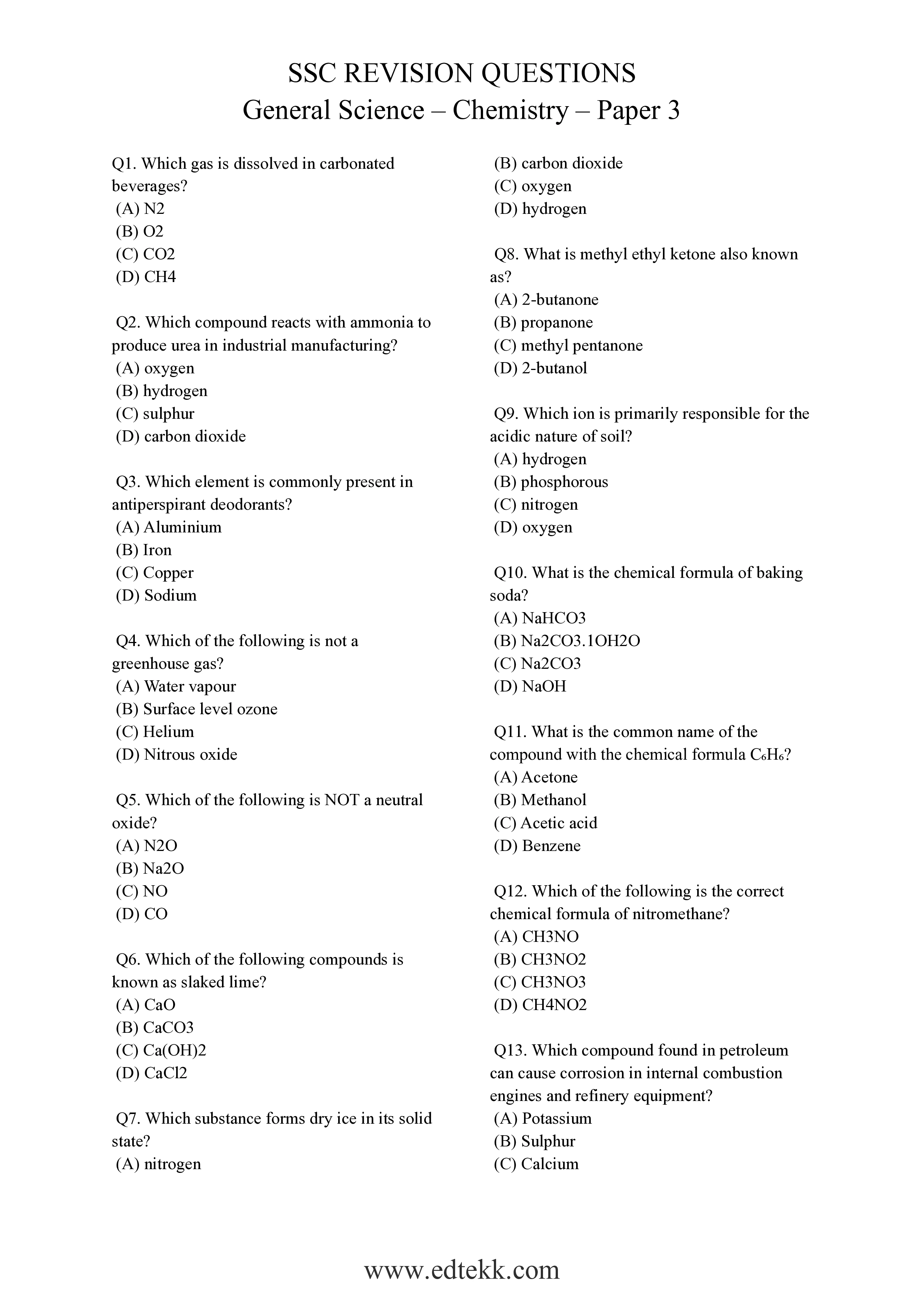
Q1. Which gas is dissolved in carbonated beverages?
(A) N2
(B) O2
(C) CO2
(D) CH4
Explanation: Carbonated beverages contain dissolved carbon dioxide (CO₂), which is introduced under pressure. A small amount reacts with water to form carbonic acid. When the pressure is released, carbon dioxide escapes as bubbles, producing the characteristic fizz.
Q2. Which compound reacts with ammonia to produce urea in industrial manufacturing?
(A) oxygen
(B) hydrogen
(C) sulphur
(D) carbon dioxide
Explanation: Urea, with the chemical formula CO(NH₂)₂, is manufactured industrially by reacting ammonia (NH₃) with carbon dioxide (CO₂) under elevated pressure and temperature. The process initially produces ammonium carbamate, which subsequently dehydrates to form urea and water. Urea is widely used as a nitrogen-rich fertiliser.
Q3. Which element is commonly present in antiperspirant deodorants?
(A) Aluminium
(B) Iron
(C) Copper
(D) Sodium
Explanation: Aluminium is commonly used in antiperspirants in the form of salts such as aluminium chlorohydrate. These compounds temporarily obstruct sweat ducts near the skin’s surface, reducing perspiration. Ordinary deodorants primarily control or mask unpleasant body odour rather than directly reducing sweat production.
Q4. Which of the following is not a greenhouse gas?
(A) Water vapour
(B) Surface level ozone
(C) Helium
(D) Nitrous oxide
Explanation: Helium is not a greenhouse gas because it does not significantly absorb outgoing infrared radiation. It is a chemically inert noble gas belonging to Group 18. In contrast, water vapour, surface-level ozone and nitrous oxide absorb infrared radiation and contribute to the greenhouse effect.
Q5. Which of the following is NOT a neutral oxide?
(A) N2O
(B) Na2O
(C) NO
(D) CO
Explanation: Sodium oxide (Na₂O) is a basic oxide because it reacts with water to form sodium hydroxide. Nitrous oxide (N₂O), nitric oxide (NO) and carbon monoxide (CO) are generally classified as neutral oxides in elementary chemistry.
Q6. Which of the following compounds is known as slaked lime?
(A) CaO
(B) CaCO3
(C) Ca(OH)2
(D) CaCl2
Explanation: Slaked lime is calcium hydroxide, Ca(OH)₂. It is produced by adding water to quicklime (calcium oxide, CaO), a process known as slaking. It is widely used in construction, water treatment and soil conditioning.
Q7. Which substance forms dry ice in its solid state?
(A) nitrogen
(B) carbon dioxide
(C) oxygen
(D) hydrogen
Explanation: Dry ice is the solid form of carbon dioxide (CO₂). Under ordinary atmospheric pressure, it changes directly from solid to gas through a process called sublimation, without passing through the liquid state.
Q8. What is methyl ethyl ketone also known as?
(A) 2-butanone
(B) propanone
(C) methyl pentanone
(D) 2-butanol
Explanation: Methyl ethyl ketone (MEK) is the common name for 2-butanone, an organic compound with the molecular formula C₄H₈O. It is a colourless, volatile liquid widely used as an industrial solvent in paints, coatings, adhesives and cleaning products.
Q9. Which ion is primarily responsible for the acidic nature of soil?
(A) hydrogen
(B) phosphorous
(C) nitrogen
(D) oxygen
Explanation: Acidic soil is characterised by a relatively high concentration of hydrogen ions (H⁺), resulting in a pH below 7. As hydrogen ion activity increases, soil pH decreases and acidity increases. Soil pH influences nutrient availability and plant growth.
Q10. What is the chemical formula of baking soda?
(A) NaHCO3
(B) Na2CO3.1OH2O
(C) Na2CO3
(D) NaOH
Explanation: Baking soda is sodium hydrogen carbonate, also known as sodium bicarbonate, with the chemical formula NaHCO₃. It acts as a leavening agent in baking by releasing carbon dioxide when it reacts with acids or decomposes on heating.
Q11. What is the common name of the compound with the chemical formula C₆H₆?
(A) Acetone
(B) Methanol
(C) Acetic acid
(D) Benzene
Explanation: Benzene is the common name of the compound with the molecular formula C₆H₆. It is an aromatic hydrocarbon consisting of a six-carbon ring with delocalised pi electrons. Benzene is an important industrial chemical used in the manufacture of plastics, synthetic fibres, detergents and other chemical products.
Q12. Which of the following is the correct chemical formula of nitromethane?
(A) CH3NO
(B) CH3NO2
(C) CH3NO3
(D) CH4NO2
Explanation: Nitromethane has the molecular formula CH₃NO₂. It consists of a methyl group (CH₃) attached to a nitro group (NO₂). It is the simplest organic nitro compound and is used as an industrial solvent and in specialised fuel applications.
Q13. Which compound found in petroleum can cause corrosion in internal combustion engines and refinery equipment?
(A) Potassium
(B) Sulphur
(C) Calcium
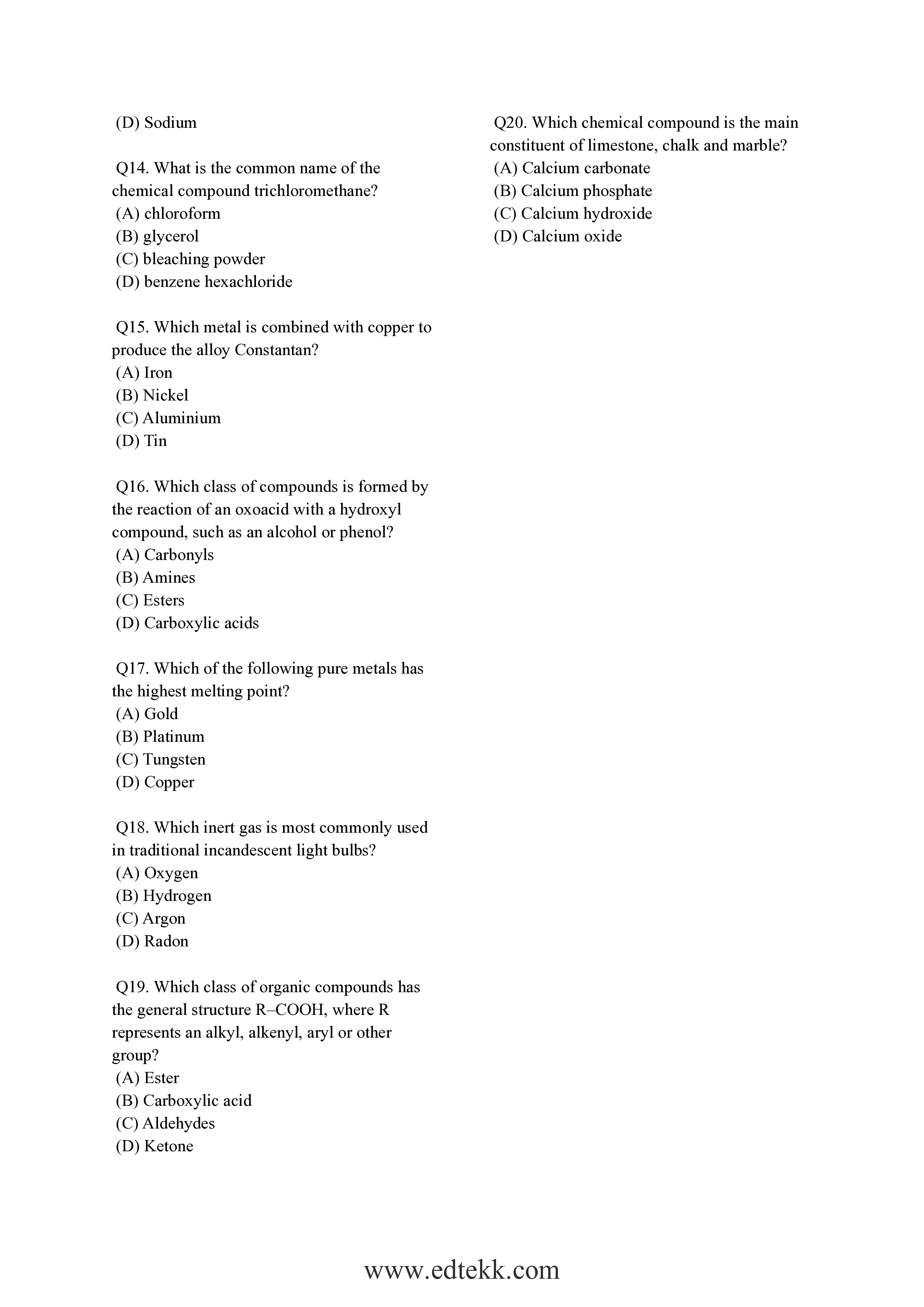
(D) Sodium
Explanation: Sulphur compounds present in petroleum can cause corrosion in internal combustion engines, pipelines and refinery equipment. During combustion, sulphur-containing compounds may produce sulphur oxides, which react with moisture to form corrosive acids. Petroleum refining therefore includes desulphurisation processes to reduce sulphur content and minimise corrosion and pollution.
Q14. What is the common name of the chemical compound trichloromethane?
(A) chloroform
(B) glycerol
(C) bleaching powder
(D) benzene hexachloride
Explanation: Trichloromethane (CHCl₃) is the IUPAC name of chloroform. It is a colourless, volatile liquid historically used as an anaesthetic and now mainly used as an industrial solvent and chemical intermediate. Its molecule contains one carbon atom, one hydrogen atom and three chlorine atoms.
Q15. Which metal is combined with copper to produce the alloy Constantan?
(A) Iron
(B) Nickel
(C) Aluminium
(D) Tin
Explanation: Constantan is an alloy primarily composed of copper and nickel, typically containing approximately 55% copper and 45% nickel. It has a low temperature coefficient of electrical resistance, making its resistance relatively stable across temperature changes. It is widely used in resistance wires and thermocouples.
Q16. Which class of compounds is formed by the reaction of an oxoacid with a hydroxyl compound, such as an alcohol or phenol?
(A) Carbonyls
(B) Amines
(C) Esters
(D) Carboxylic acids
Explanation: Esters are formed through esterification, a reaction between an oxoacid, commonly a carboxylic acid, and a hydroxyl-containing compound such as an alcohol or phenol. The reaction generally involves the elimination of water. Esters commonly have fruity odours and are widely used in perfumes, flavourings and solvents.
Q17. Which of the following pure metals has the highest melting point?
(A) Gold
(B) Platinum
(C) Tungsten
(D) Copper
Explanation: Tungsten has the highest melting point among the listed metals, approximately 3,422°C. Its exceptionally high melting point makes it suitable for applications involving extreme temperatures. It was historically used in incandescent light-bulb filaments because it can withstand very high temperatures without melting.
Q18. Which inert gas is most commonly used in traditional incandescent light bulbs?
(A) Oxygen
(B) Hydrogen
(C) Argon
(D) Radon
Explanation: Argon is the inert gas most commonly used in traditional incandescent light bulbs. As a noble gas, it is chemically unreactive and helps protect the hot tungsten filament from oxidation while reducing its evaporation rate. This increases the operating life of the bulb.
Q19. Which class of organic compounds has the general structure R–COOH, where R represents an alkyl, alkenyl, aryl or other group?
(A) Ester
(B) Carboxylic acid
(C) Aldehydes
(D) Ketone
Explanation: Carboxylic acids contain the functional group –COOH, in which a carbonyl group (C=O) and a hydroxyl group (–OH) are attached to the same carbon atom. Their general structural formula is R–COOH, where R can represent an alkyl, alkenyl, aryl or other organic group.
Q20. Which chemical compound is the main constituent of limestone, chalk and marble?
(A) Calcium carbonate
(B) Calcium phosphate
(C) Calcium hydroxide
(D) Calcium oxide
Explanation: Limestone, chalk and marble are rocks composed predominantly of calcium carbonate (CaCO₃). They differ in geological origin, texture and crystallinity. Limestone and chalk are sedimentary rocks, whereas marble is formed through the metamorphism of carbonate rocks.
Question Paper Images